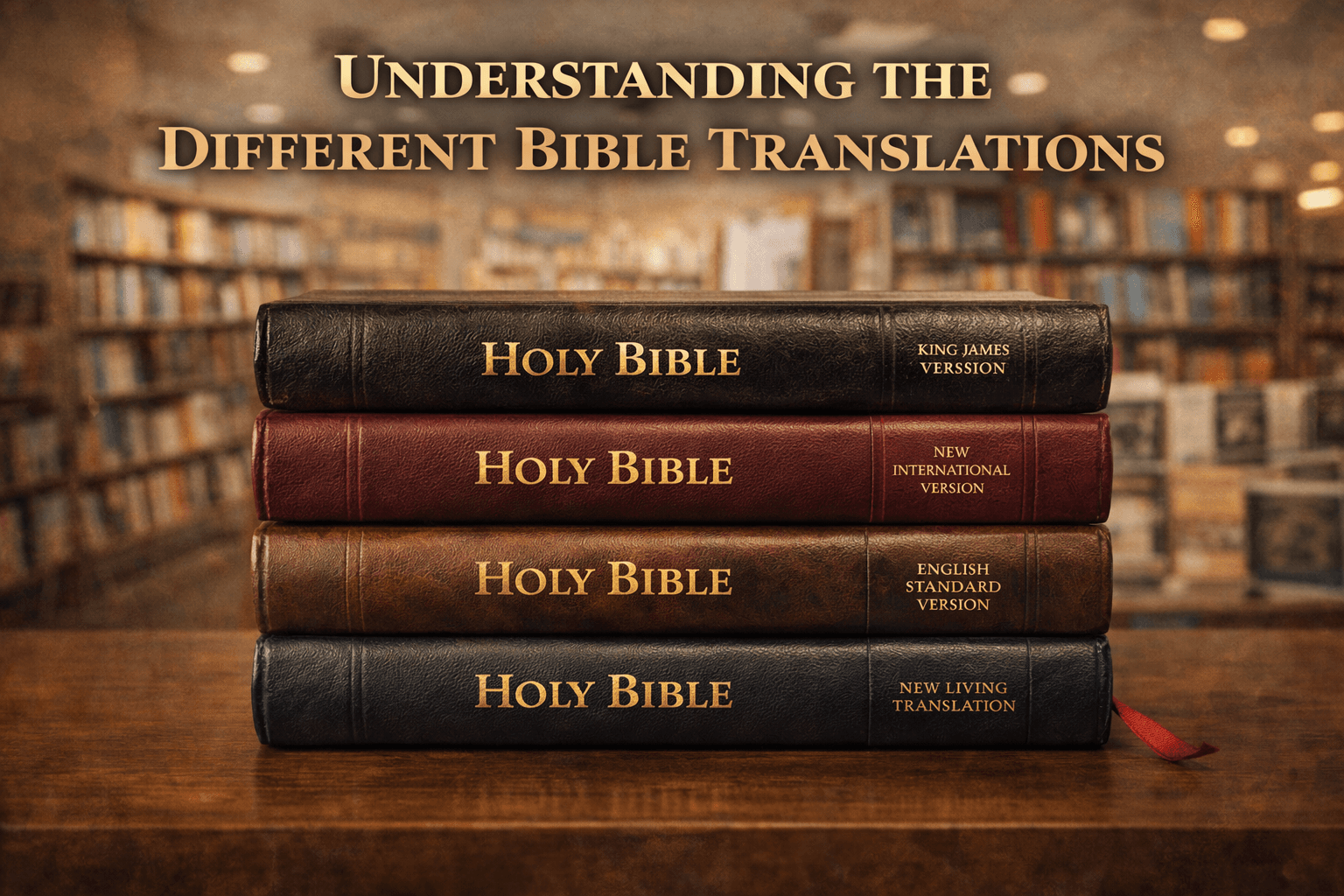
Why So Many Bible Translations?
Understanding Your Modern Bible Version
Have you ever wondered why there are so many different Bible translations?
Maybe you have opened a Bible app and felt overwhelmed.
ESV.
NIV.
KJV.
NKJV.
NLT.
NASB.
Which one is right?
Did someone change the Bible?
Did someone rewrite it?
Why does one version sound poetic and old while another sounds modern and simple?
If the Bible is God’s Word, why does it not look the same everywhere?
That is a real question.
And it deserves a real answer.
The reason there are many translations is not corruption.
It is clarity.
📜 The Bible Was Not Written in English
The Bible was not originally written in English.
The Old Testament was written primarily in Hebrew.
Parts of it were written in Aramaic.
The New Testament was written in Greek.
That means every English Bible you have ever held is a translation.
Not a remix.
Not an update to change theology.
Not a modern rewrite to fit culture.
A translation.
Scholars take ancient manuscripts and carefully translate them into the language people speak today so that the meaning is preserved and understood.
Languages change.
The English spoken in the year 1611 is not the English you speak today.
Even the English spoken one hundred years ago feels different.
If the Bible stayed locked in one era of language, many people would struggle to understand it.
Translation is not about changing the message.
It is about carrying the message forward.
📚 The Three Translation Approaches
Every major English Bible translation falls into one of three general approaches.
📝 Word for Word
This approach tries to stay as close as possible to the original wording and structure of Hebrew and Greek.
Examples include the King James Version, the New King James Version, the New American Standard Bible, and the English Standard Version.
📖 Thought for Thought
This approach focuses on translating the meaning of phrases clearly rather than matching every word structure exactly.
Examples include the New International Version and the Christian Standard Bible.
💬 Paraphrase
This approach restates Scripture in very modern language.
Examples include the New Living Translation and The Message.
None of these approaches are trying to change doctrine.
They are trying to communicate faithfully.
👑 The King James Version
In 1604 King James the First authorized a new English translation.
Forty seven scholars were appointed.
When it was published in 1611 it shaped the English language itself.
For centuries it was the dominant English Bible.
The New King James Version later updated its language while preserving its structure.
📘 The New American Standard Bible
First published in 1971.
It became known for precision and strict adherence to the original text.
It is often considered one of the most literal English translations available.
📖 The New International Version
Published in 1978.
Developed by over one hundred scholars.
Balanced readability and faithfulness to the original manuscripts.
📘 The English Standard Version
Published in 2001.
Designed to be word for word accurate while remaining readable.
📗 The New Living Translation
Published in 1996.
Focused on clarity and modern readability.
🔥 Why So Many?
Because English changes.
Because scholarship advances.
Because clarity matters.
More translations do not weaken Scripture.
They demonstrate its reach.
The message has not changed.
Only the language around it has.