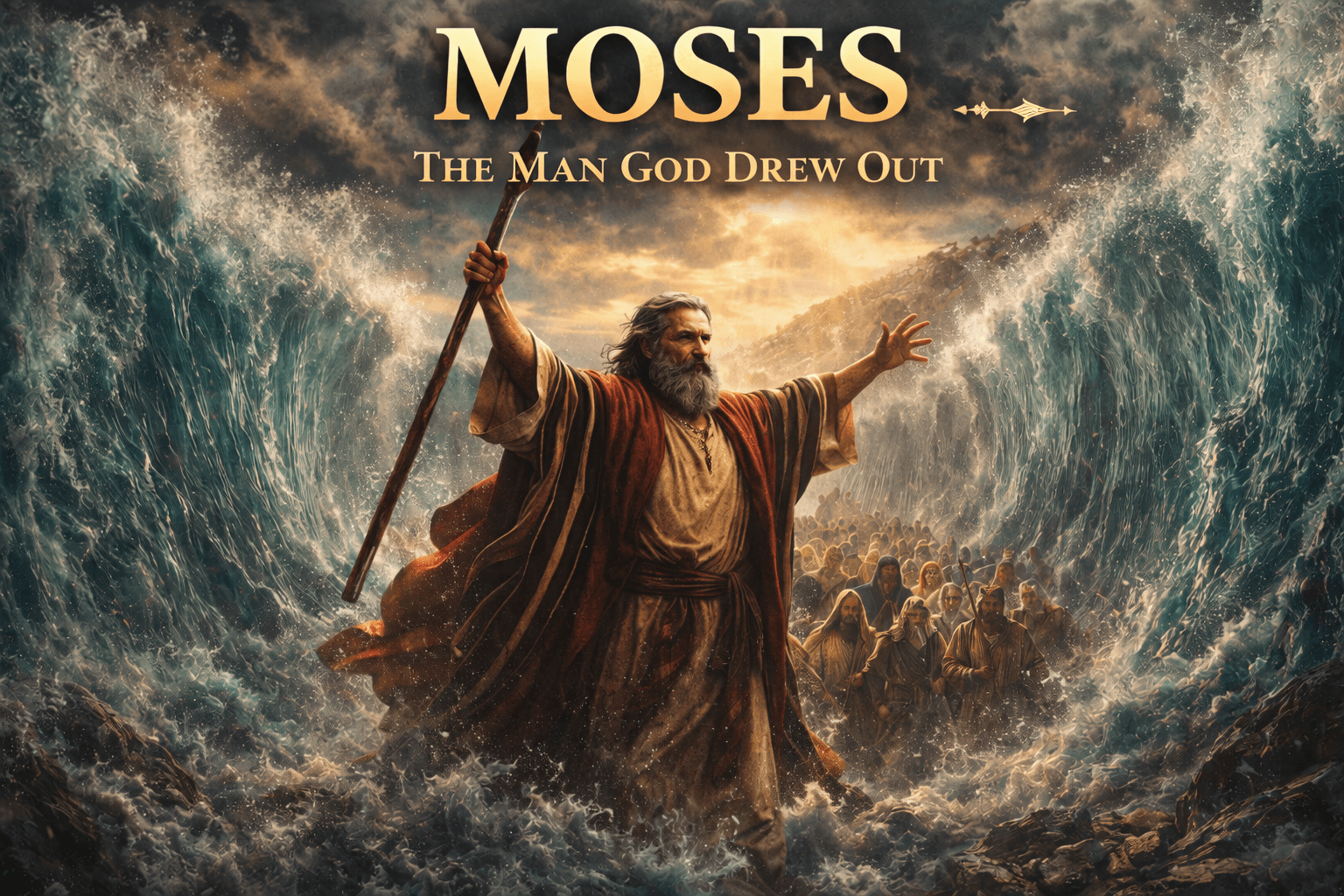
Moses
The Man God Drew Out
Moses enters Scripture in the middle of genocide.
Pharaoh has issued a decree:
📖 Exodus 1:22 — Every Hebrew baby boy must be thrown into the Nile.
Israel is multiplying.
Egypt feels threatened.
Fear turns into oppression.
Oppression turns into slaughter.
Mothers are hiding their newborns.
Fathers are praying for miracles.
The cries of the Hebrew people rise to heaven.
And in the middle of that darkness — one woman makes a desperate decision.
She builds a basket.
Coats it in pitch.
Places her three-month-old son inside.
Sets him among the reeds of the Nile.
She lets him go.
That baby is Moses.
The child who should have died.
The child God would use to confront empires.
👶 Moses — The Child Who Should Have Died
The Nile does not swallow him.
Instead, Pharaoh’s daughter finds him.
📖 Exodus 2:6 — “She saw that he was a fine child, and she had compassion on him.”
The irony is breathtaking.
The same river meant to kill Hebrew sons becomes the river that saves one.
Pharaoh orders death.
Pharaoh’s daughter delivers life.
Moses grows up in two worlds:
🔥 Hebrew by blood
🔥 Egyptian by upbringing
🔥 Raised in royalty
🔥 Trained in “all the wisdom of the Egyptians” (📖 Acts 7:22)
He is groomed for leadership in the most powerful empire on earth.
But he belongs to a people in chains.
From the beginning, Moses lives between identities.
Palace comfort.
Slave ancestry.
Privilege.
Oppression.
God is shaping a deliverer long before Moses knows he needs to be one.
⚔️ Moses the Impulsive Deliverer
Around the age of forty, something inside Moses breaks.
📖 Exodus 2:11–12
He sees an Egyptian beating a Hebrew slave.
He looks around.
No one sees.
He kills the Egyptian.
He hides the body.
This is not cowardice.
It is misdirected zeal.
📖 Acts 7:25 tells us Moses thought his people would understand that God was using him to rescue them.
They didn’t.
Instead, the next day, when Moses tries to intervene in a Hebrew dispute, he hears:
“Who made you ruler and judge over us?” (📖 Exodus 2:14)
Rejection cuts deeper than Pharaoh’s anger.
When Pharaoh learns what happened, Moses runs.
The prince becomes a fugitive.
🏜️ Forty Years of Silence
Moses disappears into Midian.
Not for weeks.
Not for months.
Forty years.
He who was raised in a palace now tends sheep in obscurity.
Forty years of:
🔥 Humility
🔥 Silence
🔥 Routine
🔥 Obscurity
The palace built his education.
The wilderness built his character.
Sometimes God removes you from influence before He entrusts you with impact.
Midian was not punishment.
It was preparation.
🔥 The God Who Burns but Does Not Consume
Then one ordinary day becomes history.
📖 Exodus 3
Moses sees a bush on fire.
But it is not burning up.
Curiosity draws him closer.
Then he hears his name.
“Moses… Moses.”
Remove your sandals.
The ground is holy.
God introduces Himself as:
“I AM WHO I AM.” (📖 Exodus 3:14)
Not a tribal god.
Not a regional deity.
The self-existent One.
God tells Moses:
“I have seen the misery of My people… I have heard them crying out… and I am concerned about their suffering.” (📖 Exodus 3:7)
He then says something shocking:
“I am sending you.”
Moses resists.
“I am not qualified.”
“I am not eloquent.”
“They won’t listen to me.”
God answers with one promise:
“I will be with you.”
That is the difference between human ambition and divine calling.
🌊 Moses the Deliverer
Moses returns to Egypt.
Not as a prince.
As a shepherd with a staff.
Ten plagues strike Egypt.
Each one dismantles a false god.
Each one exposes Pharaoh’s weakness.
Finally, the Passover comes.
📖 Exodus 12
The blood of a lamb marks the homes of Israel.
Judgment passes over them.
Deliverance begins.
Then the sea stands in the way.
📖 Exodus 14
Pharaoh’s army closes in.
Israel panics.
Moses stands firm.
“Stand firm and you will see the deliverance the Lord will bring you today.” (📖 Exodus 14:13)
He raises his staff.
The sea parts.
Walls of water rise.
Israel walks through on dry ground.
The slaves walk out free.
The empire collapses behind them.
Moses becomes the visible representative of the invisible God.
⛰️ Sinai and the Covenant
Deliverance is not the end.
It is the beginning.
At Mount Sinai, Moses ascends into thunder and cloud.
📖 Exodus 19–20
He receives the Law.
The Ten Commandments.
The covenant that will define Israel’s identity.
Moses becomes:
🔥 Lawgiver
🔥 Mediator
🔥 Intercessor
When Israel builds the golden calf (📖 Exodus 32), Moses pleads for them.
“Forgive their sin… but if not, blot me out of the book you have written.”
This is shepherd leadership.
Standing between judgment and the people.
🏕️ The Wilderness Leader
For forty more years, Moses leads a stubborn nation.
They complain.
They rebel.
They doubt.
He strikes the rock in frustration (📖 Numbers 20:11).
And because of that moment of disobedience, he is told he will not enter the Promised Land.
Even leaders face consequences.
Even the faithful are not flawless.
Yet Scripture says:
📖 Numbers 12:3 — “Now Moses was very humble, more than any man on the face of the earth.”
The former prince became the most humble man alive.
That is transformation.
📜 Moses the Writer
Moses authors:
🔥 Genesis
🔥 Exodus
🔥 Leviticus
🔥 Numbers
🔥 Deuteronomy
🔥 Psalm 90
He records creation.
The fall.
The flood.
The patriarchs.
The exodus.
The Law.
For fifteen hundred years, Israel stands on what Moses wrote.
He becomes the foundational historian and theologian of God’s people.
⛰️ His Final Climb
After forty years of leading Israel, Moses climbs Mount Nebo.
📖 Deuteronomy 34
God shows him the Promised Land.
He sees it.
But he does not enter it.
He dies there.
And Scripture says:
“The Lord buried him.” (📖 Deuteronomy 34:6)
No shrine.
No monument.
No grave to worship.
Just obedience.
✨ Final Reflection
Moses was not perfect.
He was impulsive.
He doubted.
He failed.
But he was faithful.
The child drawn out of the water.
The shepherd drawn out of obscurity.
The leader who drew a nation out of slavery.
Moses’ life proves something powerful:
God prepares in hidden places.
God calls the reluctant.
God uses the imperfect.
And sometimes, the man who never enters the Promise is still the man who leads everyone else to it.