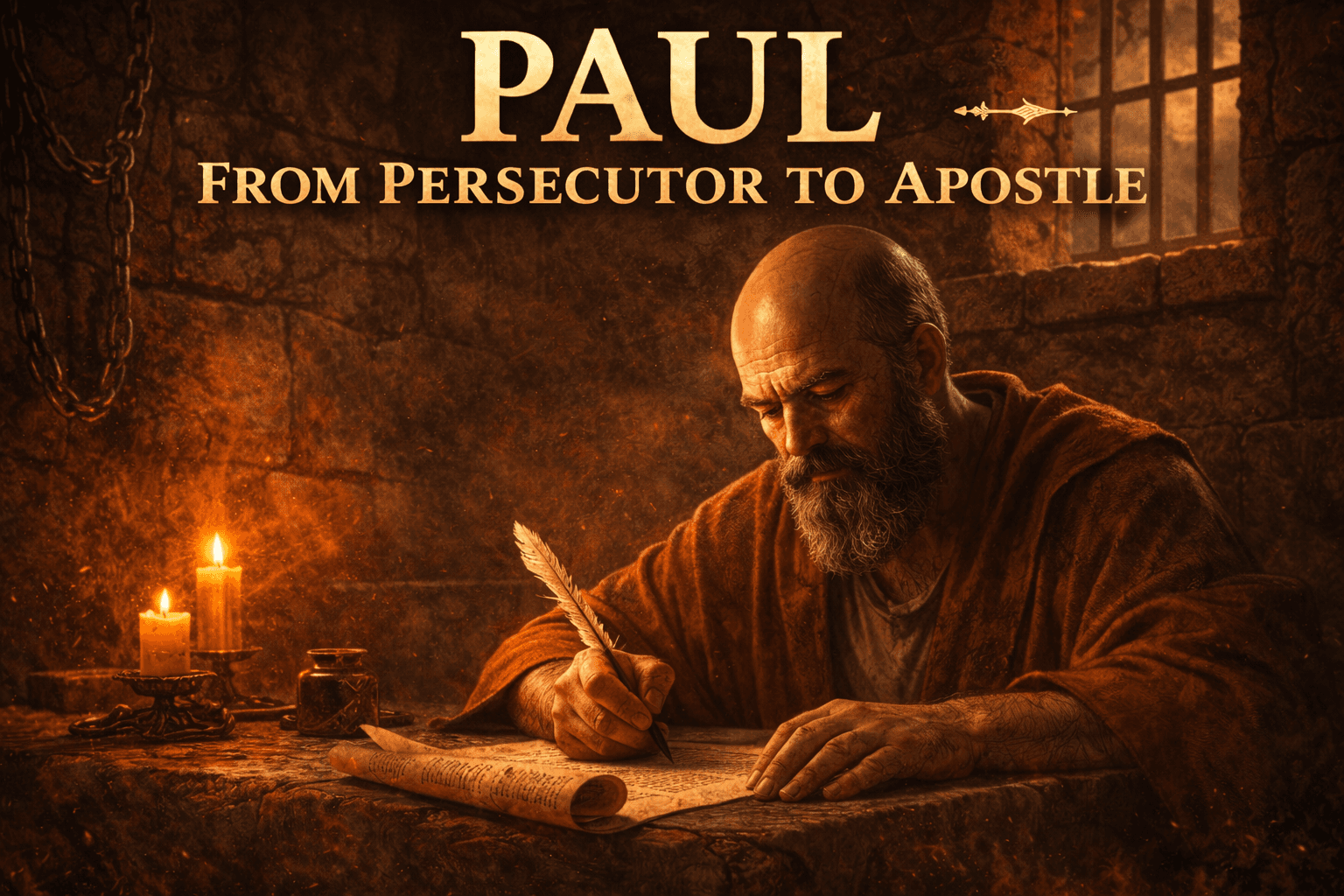
Paul
From Persecutor to Preacher
Before he became the Apostle Paul, he was known as Saul.
Not a seeker.
Not curious.
Not confused.
He was a violent enemy of the Church.
And yet one encounter with the risen Christ changed everything.
Paul Didn’t Become an Apostle the Traditional Way
He wasn’t one of the 12 disciples.
He didn’t walk with Jesus in Galilee.
He didn’t hear the Sermon on the Mount in person.
Instead — Jesus personally appeared to him after the resurrection.
📖 Acts 9:3–6
That’s what makes Paul unique.
His apostleship wasn’t secondhand.
It was commissioned directly by the risen Christ.
Paul Before Jesus: Saul of Tarsus 😡
Saul wasn’t spiritually lazy.
He was spiritually intense.
🔥 Born in Tarsus — a major intellectual city in the Roman Empire
🔥 Raised as a strict Pharisee (📖 Philippians 3:5–6)
🔥 Trained under Gamaliel — one of the most respected Jewish teachers (📖 Acts 22:3)
🔥 Fluent in Hebrew tradition and Greek culture
🔥 A Roman citizen by birth
He was educated.
Disciplined.
Devout.
And completely convinced Christians were dangerous heretics.
Saul viewed followers of Jesus as a threat to Judaism.
He hunted them.
He imprisoned them.
He approved of their executions.
📖 Acts 7:57–60 — Stephen’s stoning
📖 Acts 8:1–3 — Saul ravaged the church
Saul believed he was protecting God’s honor.
But in reality, he was opposing God’s Messiah.
The Damascus Road Encounter 🔥
Everything changed in Acts 9.
While traveling to Damascus to arrest more believers, a light from heaven stopped him.
📖 Acts 9:3–6
⚡ A bright light flashed.
⚡ Saul fell to the ground.
⚡ A voice spoke: “Saul, Saul, why are you persecuting Me?”
⚡ Saul asked, “Who are You, Lord?”
⚡ The answer: “I am Jesus, whom you are persecuting.”
Notice something important.
Jesus didn’t say,
“Why are you persecuting My people?”
He said,
“Why are you persecuting Me?”
To attack the Church is to attack Christ.
Saul was struck blind for three days.
He had to be led by hand into Damascus.
The proud Pharisee who once dragged Christians now had to be guided like a child.
This was not a dream.
Not a hallucination.
Not emotional guilt.
It was a direct appearance of the risen, glorified Christ.
That is why Paul could later defend his apostleship.
Jesus Himself called him.
After the Encounter: A Brand New Man 🕊️
God sent Ananias to him.
📖 Acts 9:10–18
Ananias laid hands on him.
Saul’s sight was restored.
And immediately:
🔥 He was baptized.
🔥 He began preaching that Jesus is the Son of God (📖 Acts 9:20–22).
The man who once destroyed the message now proclaimed it.
People were shocked.
Jewish leaders turned against him.
He had to escape Damascus by being lowered in a basket through a wall.
Grace had changed him — but it didn’t remove opposition.
The Hidden Years ⏳ (Galatians 1:17–18)
Most people skip this part.
But it matters.
After his conversion, Saul did not immediately launch into public ministry.
📖 Galatians 1:17–18
He spent three years in Arabia.
Alone.
Relearning Scripture.
Reprocessing the Law.
Seeing Christ in the Old Testament.
The man trained under Gamaliel now sat under the teaching of the Holy Spirit.
Those years were preparation.
God often prepares before He promotes.
Paul’s Apostolic Authority ✈️
Paul wasn’t self-appointed.
📖 Galatians 1:11–12
He makes it clear:
The Gospel he preached came by revelation of Jesus Christ.
In nearly every letter he writes:
“Paul, an apostle of Christ Jesus…”
📖 Romans 1:1
📖 Galatians 1:1
Critics questioned him.
But Paul stood firm.
Because he knew who called him.
Mission to the Nations 🌍
Paul became the apostle to the Gentiles.
His background made him uniquely equipped:
🔥 Jewish by heritage
🔥 Roman by citizenship
🔥 Educated in Greek culture
🔥 Trained in Scripture
He traveled across the Roman Empire:
📍 Antioch
📍 Corinth
📍 Philippi
📍 Thessalonica
📍 Ephesus
📍 Rome
He endured:
🔥 Beatings
🔥 Imprisonment
🔥 Shipwreck (📖 Acts 27)
🔥 Being stoned and left for dead (📖 Acts 14:19)
And yet he kept going.
Why?
📖 Philippians 1:21
“To live is Christ, to die is gain.”
His life had one purpose.
Christ.
Paul’s Letters: Half the New Testament 📬
Paul didn’t sit down to “write the Bible.”
He wrote letters to real churches dealing with real problems.
But those letters were Spirit-inspired.
📖 2 Timothy 3:16
📝 Romans — Salvation by faith alone
📝 1 & 2 Corinthians — Church correction and spiritual gifts
📝 Galatians — Grace versus the Law
📝 Ephesians — Identity in Christ
📝 Philippians — Joy in suffering
📝 Colossians — The supremacy of Christ
📝 1 & 2 Thessalonians — The return of Jesus
📝 1 & 2 Timothy, Titus — Church leadership
📝 Philemon — Forgiveness and reconciliation
By the 2nd century, his letters were circulating throughout the Christian world.
When the New Testament was compiled, 13 books bore his name.
The former persecutor became one of Christianity’s strongest theological voices.
Paul’s Weakness and Humility
Paul never forgot who he used to be.
📖 1 Corinthians 15:9 — “The least of the apostles.”
📖 1 Timothy 1:15 — “Chief of sinners.”
📖 2 Corinthians 12:9 — “My grace is sufficient for you.”
He understood grace because he knew what he had been saved from.
His theology was not academic theory.
It was personal transformation.
Paul’s Legacy 💥
From murderer to missionary.
From legalist to preacher of grace.
From enemy of Jesus to servant of Christ.
Paul’s life proves one undeniable truth:
No one is too far gone.
📖 2 Corinthians 5:17
“If anyone is in Christ, he is a new creation…”
Paul was not cleaned up.
He was made new.