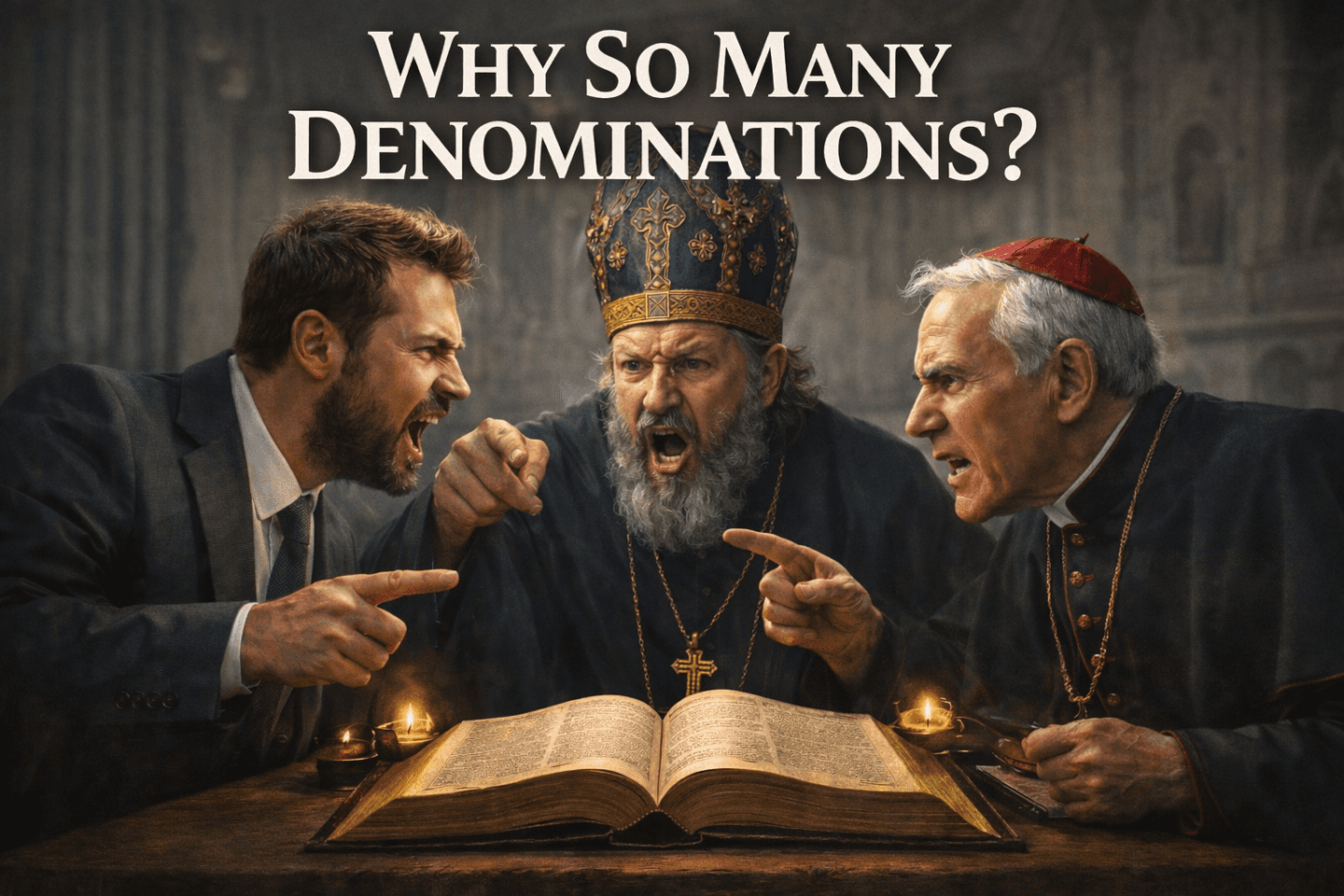
Why So Many Denominations
Understanding Christian Divisions
When people begin taking their faith seriously, they often run into something confusing.
Church labels.
Baptist.
Catholic.
Orthodox.
Pentecostal.
Methodist.
Non denominational.
And the question naturally comes up:
If we all follow Jesus, why are there so many different Christian groups?
Did Jesus intend this?
Did the apostles create this?
Or did something happen along the way?
To understand why denominations exist today, we have to start at the beginning.
✝️ It Started With Jesus, Not Religion
When Jesus gave the Great Commission in Matthew 28:19, He did not say:
Go and create separate religious systems.
He said:
“Go and make disciples of all nations.”
The earliest believers were not called Christians at first.
They were known as followers of The Way.
Acts 9:2 describes this movement.
It was not institutional.
It was not political.
It was a community built around:
- 🕊️ The resurrection of Jesus
- 📖 The apostles’ teaching
- 🤝 Shared life and prayer
- 🔥 Bold witness
The early Church met in homes.
They broke bread together.
They endured persecution.
They were unified around Christ.
But history did not stop there.
🏛️ The Early Church After Jesus
After Jesus ascended, leadership rested with the apostles.
Peter, James, John, Paul and others planted churches across the Roman Empire.
These churches were united by doctrine but spread across different cultures.
Greek speaking believers.
Latin speaking believers.
Jewish believers.
Gentile believers.
By the second and third centuries, regional bishops began overseeing churches in major cities.
Five major centers of Christianity emerged:
- 📍 Rome
- 📍 Constantinople
- 📍 Alexandria
- 📍 Antioch
- 📍 Jerusalem
This was still one Church.
But language, culture, and political tension slowly created distance.
The western Church spoke Latin.
The eastern Church spoke Greek.
Theology remained largely shared.
Culture did not.
👑 Constantine and Institutional Christianity
In 313 AD, Emperor Constantine legalized Christianity through the Edict of Milan.
Persecution ended.
Christianity moved from underground to imperial favor.
Church leaders gained political influence.
Buildings were constructed.
Structure became formalized.
By the late fourth century, Christianity became the official religion of the Roman Empire.
The bishop of Rome gained increasing authority in the West.
This development would shape what became Roman Catholicism.
Meanwhile, the eastern churches maintained a council based leadership model.
Tension slowly grew.
⚔️ The Great Schism of 1054
Over centuries, disagreements intensified between East and West.
Issues included:
- 🗣️ Language and cultural differences
- 👑 The authority of the Pope
- 📖 Theological wording about the Trinity
- 🏛️ Political rivalry between Rome and Constantinople
In 1054, the Church formally split.
This event is known as the Great Schism.
Christianity divided into:
- ➡️ The Roman Catholic Church in the West
- ➡️ The Eastern Orthodox Church in the East
Roman Catholicism centralized authority in the Pope.
Eastern Orthodoxy rejected papal supremacy and maintained shared episcopal leadership.
Both claimed apostolic roots.
But they were now separate communions.
This was the first major fracture.
📜 The Reformation
By the 1500s, concerns about corruption and doctrinal drift within the Roman Catholic Church grew.
Issues included:
- 💰 The selling of indulgences
- 📖 Limited access to Scripture in local languages
- ⚖️ Authority of church tradition over biblical authority
In 1517, Martin Luther published the Ninety Five Theses.
He called for reform based on Scripture.
The Protestant Reformation began.
Its central affirmations were:
- 📖 Scripture alone as final authority
- 🙏 Salvation by grace through faith
- ✝️ Christ alone as mediator
This created the second major division:
- ➡️ Roman Catholicism
- ➡️ Protestant Christianity
From there, Protestant branches formed.
🌳 The Growth of Protestant Denominations
Lutherans formed around Luther’s theology.
Reformed and Presbyterians emphasized covenant theology and God’s sovereignty.
Anglicans developed in England.
Baptists emphasized believer’s baptism and local church autonomy.
Methodists emphasized disciplined spiritual growth.
Later movements included:
- 🔥 Pentecostals emphasizing the gifts of the Spirit
- 📖 Evangelicals emphasizing biblical authority and conversion
- 🤝 Non denominational churches seeking independence from formal labels
Some divisions were theological.
Some were cultural.
Some were reactions to imbalance.
Some were unnecessary.
Human weakness always plays a role.
🧩 Why So Many Today
Denominations exist because of:
- 🧠 Differences in interpreting secondary doctrines
- 🌍 Cultural and language diversity
- ⚖️ Disagreements over authority
- 🏛️ Historical political influence
- 👥 Human pride and division
Despite visible separation, many denominations still affirm historic Christian essentials:
- ✔️ Jesus is Lord
- ✔️ He died and rose again
- ✔️ Salvation is by grace through faith
- ✔️ Scripture is authoritative
The visible Church is divided organizationally.
But unity in Christ still exists among those who hold to essential truth.
📖 What Jesus Desired
In John 17:21, Jesus prayed:
“That they may all be one.”
Unity was always the desire.
Not forced uniformity.
Not political control.
Unity rooted in truth and faith in Him.
Denominations reflect history.
They reflect theological development.
They reflect the global expansion of Christianity.
They also reflect human imperfection.
📌 Final Perspective
Jesus did not establish denominations.
History did.
Culture did.
Disagreement did.
Sometimes reform did.
The Church has experienced:
- 📜 Apostolic unity
- 🏛️ Institutional development
- ⚔️ East West division
- 📖 Reformation fracture
- 🔥 Modern expansion
Denominations can provide structure and community.
But they are not the foundation.
Christ is.
Labels explain history.
They do not define salvation.
Christianity is built on the life, death, and resurrection of Jesus.
Understanding the history removes confusion.
And it refocuses attention where it belongs.
On Christ Himself.