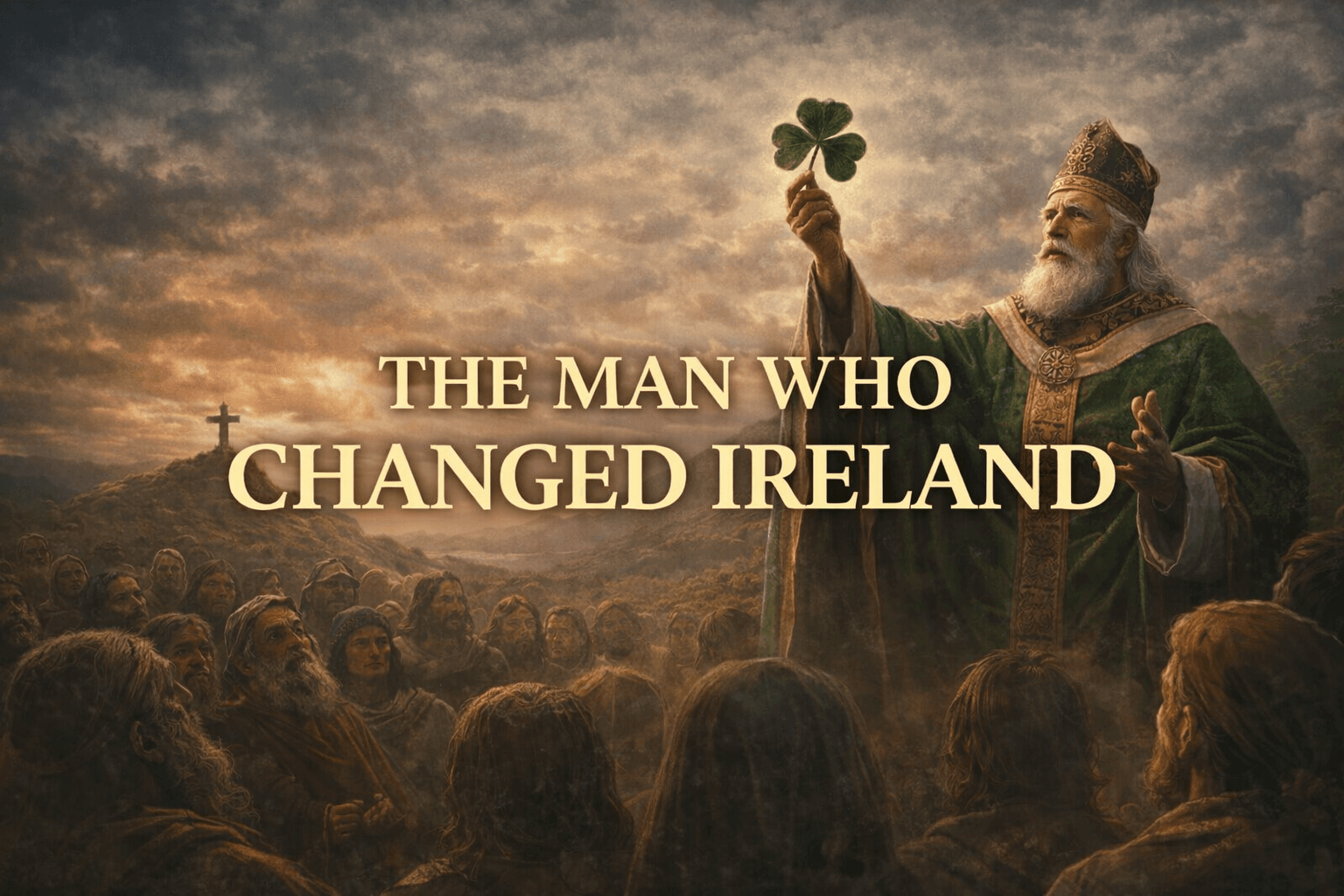
St. Patrick
He Who Brought Christianity to Ireland
For many people today, St. Patrick’s Day means one thing.
🍀 Wear green
🍺 Celebrate loudly
🎉 Call it Irish culture
But the day was never meant to begin as a party.
It began as a story of slavery, faith, obedience, and forgiveness.
And the man at the center of it was real.
👶 Who Was Patrick
St. Patrick was born in the late 300s AD in Roman Britain.
His birth name was likely Maewyn Succat.
Patricius was the Latin name he later adopted, which eventually became Patrick.
He was not born in Ireland.
He was not raised as a missionary.
He did not grow up dreaming of church leadership.
His father was a deacon and his grandfather a priest, but Patrick later admitted in his own writings that he did not take his faith seriously as a child.
That would change.
⛓️ Kidnapped and Enslaved
When Patrick was about sixteen years old, Irish raiders attacked his village.
He was captured.
Taken across the sea.
Sold into slavery in Ireland.
For six years he lived as a shepherd.
🌧️ Alone in harsh weather
🌙 Guarding animals at night
🌾 Working without freedom
This was not a short hardship.
This was his entire youth.
And during those years, something shifted.
Patrick later wrote in his Confessio that he began praying constantly.
Sometimes close to one hundred times a day.
Hardship stripped away comfort.
Isolation stripped away distraction.
And faith became real.
🏃 Escape and Return Home
After six years, Patrick claimed he heard a voice in a dream telling him to flee.
He escaped.
Traveled roughly two hundred miles.
Found passage on a ship.
Eventually returned home to Britain.
But this was not the end of the story.
It was the beginning of preparation.
📚 Years of Training
Patrick did not immediately return to Ireland.
He spent years studying Christianity deeply.
🧠 Learning theology
📖 Studying Scripture
⛪ Training under church leaders
Eventually, he was ordained as a bishop.
This process took decades.
Nearly forty years passed between his capture as a teenager and his return to Ireland as a missionary.
His mission was not impulsive.
It was prepared.
🔥 Returning to the Land of His Pain
Here is what defines Patrick’s story.
He chose to go back.
Back to Ireland.
Back to the land where he had been enslaved.
Not with soldiers.
Not with revenge.
But with the gospel.
Patrick returned to preach Christ to the very people who had once enslaved him.
That decision reflects something central to Christianity.
Forgiveness.
Obedience.
Mission.
🌍 Ireland Before Christianity
Ireland in the fifth century was not Roman.
It was tribal and pagan.
Druid priests held spiritual authority.
Worship centered around nature, multiple gods, and ritual practices.
Christianity was almost unknown.
Patrick entered a culture that did not share his beliefs.
He preached about:
✝️ Christ crucified and risen
🙏 Repentance
🕊️ New life through the Holy Spirit
And over time, communities began converting.
☘️ The Shamrock and the Trinity
Tradition says Patrick used the shamrock, a three leaf clover, to explain the Trinity.
☝️ One God
✝️ Three persons
Father, Son, and Holy Spirit
While historians cannot confirm exactly how he taught this, the shamrock became a lasting symbol of Irish Christianity.
It connected theology with something visible in the culture.
🐍 Did Patrick Drive Out the Snakes
Legend claims Patrick drove snakes out of Ireland.
There is no archaeological evidence that snakes ever lived in Ireland after the Ice Age.
Most historians believe the story is symbolic.
🐍 Snakes represented paganism
🔥 The spread of Christianity symbolized the removal of false worship
Whether literal or symbolic, the story reflects how deeply Patrick’s mission reshaped Ireland’s spiritual identity.
📖 What We Know From His Own Writings
Patrick left behind two authentic writings.
📜 Confessio
📜 Letter to the Soldiers of Coroticus
These documents reveal humility.
They show a man who did not view himself as powerful.
He described himself as weak and dependent on God.
He defended his mission not with pride but with conviction.
This gives historians confidence that his faith was sincere.
🕊️ The Spread of Christianity in Ireland
Patrick was not the first Christian in Ireland.
But he became the most influential.
Over time:
⛪ Monasteries formed
📖 Scripture was copied and preserved
🕊️ Ireland became a center of Christian learning
When much of Europe later fell into instability, Irish monks preserved biblical texts and theological works.
Patrick’s mission had generational impact.
🍀 How a Missionary Became a Holiday
Patrick likely died on March 17 in the mid fifth century.
Centuries later, the church designated that date as a feast day to honor his life.
Originally, St. Patrick’s Day was a religious observance.
🙏 Prayer
📖 Reflection
⛪ Church gatherings
The transformation into a cultural celebration happened much later.
📍 Irish immigrants in America began public celebrations
📍 Parades emphasized national identity
📍 Over time, religious focus faded
The story did not disappear.
It was overshadowed.
📌 Why His Story Still Matters
At its core, Patrick’s life is about:
❤️ Forgiving enemies
🔥 Obeying God’s call
🙏 Enduring suffering
🌍 Bringing the gospel to resistant places
St. Patrick’s Day was never meant to celebrate excess.
It was meant to remember obedience.
A kidnapped teenager became a missionary bishop.
A slave returned as a preacher.
A pagan nation encountered Christianity.
History remembers green.
But the foundation was faith.
Reflection Question
Keep studying with Bible Buddy
Understand the Bible one day at a time.
Listen through the Bible in one year, open study notes, test yourself with trivia, and join the discussion.