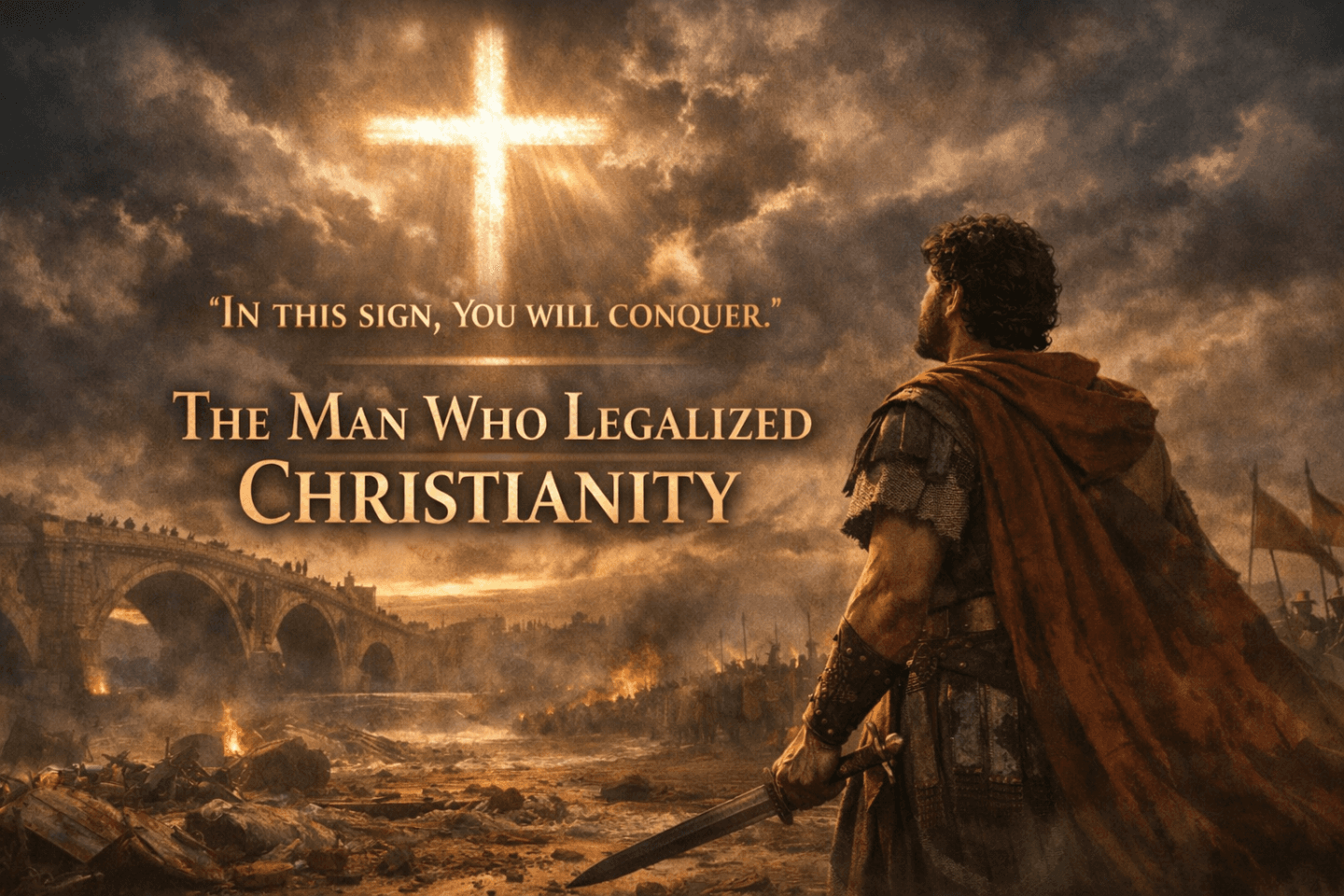
The Man Who Legalized Christianity
Constantine and the Turning Point of the Church
After the resurrection, Jesus gathered His disciples and gave them a command.
“Go therefore and make disciples of all nations… teaching them to observe all that I have commanded you.”
Matthew 28:19 to 20
No army.
No political power.
No royal backing.
Just obedience.
For nearly three hundred years, that obedience often came with persecution.
🔥 Christianity for the First Three Hundred Years
From 33 AD to 313 AD, Christianity was not safe.
Christians were not building cathedrals.
They were gathering quietly in homes.
- 🔥 Blamed for disasters
- 🦠 Used as scapegoats during plagues
- 🏛️ Accused of threatening Roman unity
Rome did not care what gods people worshipped.
Rome only required one thing.
- 👑 Acknowledgment that Caesar was divine.
Christians refused.
They would not worship the emperor.
So they were:
- ⛓️ Arrested
- 🧊 Executed
- 🐅 Fed to animals in arenas
- 🕯️ Forced into secrecy
Yet Christianity continued to spread.
Not because it had power.
Because it had conviction.
📄 The Major Waves of Persecution
- 🔥 64 AD
Under Emperor Nero, Christians were blamed for the Great Fire of Rome. Many were publicly tortured and killed. - 👑 81 to 96 AD
Domitian demanded to be called Lord and God. Christians refused and suffered. - 📄 98 to 117 AD
Under Trajan, Christianity was officially illegal. Accused believers who refused to recant were punished. - 🔥 161 to 180 AD
During the reign of Marcus Aurelius, plagues devastated Rome. Christians were blamed for angering the gods. - ⚔️ 303 AD
The Great Persecution under Diocletian and Galerius. Churches destroyed. Scriptures burned. Leaders imprisoned. Thousands executed.
This was the harshest persecution yet.
And then everything changed.
🏛️ Rome Was Fracturing
By the early fourth century, the Roman Empire was unstable.
- 🌍 Too large to manage
- ⚔️ Too many external threats
- 👑 Too many competing rulers
- 💥 Constant civil conflict
Power struggles erupted.
Multiple generals claimed the throne.
Armies marched against one another.
The empire was exhausted.
⚔️ Enter Constantine
Constantine was a Roman general.
Raised in military culture.
Formed in pagan religion.
Christianity was not his background.
In 312 AD, Constantine marched toward Rome to fight for control of the empire.
His army was outnumbered.
Then he claimed something extraordinary happened.
🌤️ The Vision Before Battle
Constantine later reported that he saw a sign in the sky.
- ✝️ A cross
With the words
“In this sign, you will conquer”
That night, he claimed Christ appeared to him in a dream and confirmed the message.
Constantine ordered the symbol of Christ placed on his soldiers’ shields.
Against expectations, he won the Battle of the Milvian Bridge.
From his perspective, Christ had granted victory.
🛡️ 313 AD The Edict of Milan
In 313 AD, Constantine and Licinius issued the Edict of Milan.
Its effects were dramatic.
- 🕊️ Christianity was legalized
- 🏛️ Churches could gather publicly
- 📜 Confiscated property was returned
- ⛓️ Persecution officially ended
For the first time in history, Christians could worship openly without fear of state execution.
This marked a turning point.
🏛️ What Happened After Legalization
Legalization did not simply mean freedom.
It reshaped the church.
- 🏠 House gatherings became basilicas
- 👑 Bishops gained influence
- 📜 Church leaders advised emperors
- 🌍 Christianity moved from margin to mainstream
In 325 AD, Constantine called the Council of Nicaea to resolve theological disputes, particularly regarding the nature of Christ.
This council produced the Nicene Creed, affirming that Jesus is fully divine.
For the first time, imperial authority and church doctrine intersected on a massive scale.
Christianity was no longer persecuted.
It was politically protected.
⚖️ Was Constantine Truly Converted
History does not give a simple answer.
- 👀 Some point to his support of church reform and doctrinal clarity.
- 🌞 Others note he continued using certain pagan imagery.
- ⏳ He delayed baptism until shortly before death.
- ⚔️ He remained a powerful and sometimes ruthless ruler.
Some historians see sincere faith.
Others see political strategy.
It may have been both.
🔄 The Long Term Impact
Constantine did not create Christianity.
It was already growing.
But he changed its trajectory.
Persecution stopped.
Public influence increased.
Imperial support strengthened church structure.
And over time, Christianity became the dominant religion of the Roman Empire.
Power, however, always reshapes movements.
Sometimes for protection.
Sometimes with unintended consequences.
📌 Why This Moment Matters
For three centuries, the church survived without power.
After Constantine, the church had influence.
That shift would eventually lead to:
- 🏛️ The formation of a unified imperial church
- ⚖️ The later division between East and West
- 📜 The shaping of what would become Roman Catholicism and Eastern Orthodoxy
But that is another chapter in history.
The legalization of Christianity marks one of the most significant turning points in church history.
A persecuted movement became a protected institution.
And the world would never be the same.
Reflection Question
Keep studying with Bible Buddy
Understand the Bible one day at a time.
Listen through the Bible in one year, open study notes, test yourself with trivia, and join the discussion.