📖 Exodus 14 Explained: The Red Sea and Pharaoh's Last Pursuit
Pharaoh only just let them go. Now his best chariots are closing in behind them, and the sea is closing in ahead.
Exodus 14 explained is the chapter where Israel's freedom gets tested before it has even had time to feel real. The same king who finally let them walk out of Egypt is already chasing them down, and God has led His own people straight into a place with no road out, on purpose, before Pharaoh ever moves a single chariot.
Maybe you have heard this chapter reduced to one special effect: a sea splitting in two. There is far more happening here than that.
- ❓ Why would God lead His own people into a dead end with no way out?
- ❓ Why does God harden Pharaoh's heart one more time, after everything that already happened?
- ❓ Did Moses really part a sea, or is there a natural explanation?
- ❓ And why does it take Israel until the very last verse of the chapter to actually believe?
📌 Exodus 14 is not a story about a sea splitting. It is the story of God closing off every other option until trusting Him was the only one left.
This walkthrough goes through the whole chapter in order: the trap God sets before Pharaoh ever moves, the terror that turns into blame the moment the chariots appear, the command to stand still and say nothing, the sea pulled back by a wind that blew all night long, and the drowning that finally convinces a nation that had already watched ten plagues and still was not fully sure.
Read slowly. This chapter does not actually end at the sea. It ends at belief, and that is the harder miracle of the two.
What Happened Just Before This Chapter
Exodus 13 ended with Israel only a few days out of Egypt, already carrying the weight of what had just happened: every firstborn claimed for God, a yearly feast built so a child would someday ask why they keep it, the bones of Joseph carried out after a promise made more than three hundred years earlier, and a pillar of cloud and fire going ahead of them day and night. God had also already chosen their route, steering them away from the short, busy road through Philistine territory and into the wilderness instead.
Exodus 14 opens only a short march further down that same wilderness road, camped by the edge of the sea. What looked like a detour for Israel's safety turns out to serve a second purpose nobody in the camp could have seen coming yet.
Exodus 14 Explained Verse by Verse
1. A Trap Set Before Pharaoh Ever Moves (verses 1 to 4)
Before Pharaoh makes a single decision in this chapter, God has already decided exactly where Israel will camp.
"And the LORD spake unto Moses, saying, Speak unto the children of Israel, that they turn and encamp before Pihahiroth, between Migdol and the sea, over against Baalzephon: before it shall ye encamp by the sea."
"For Pharaoh will say of the children of Israel, They are entangled in the land, the wilderness hath shut them in."
The exact modern location of Pihahiroth, Migdol, and Baalzephon is genuinely uncertain, but the point of naming them is not a map lesson. It is to show that God told Moses what Pharaoh would think before Pharaoh ever thought it. The camp site was bait, chosen on purpose, and God says so out loud ahead of time.
"And I will harden Pharaoh's heart, that he shall follow after them; and I will be honoured upon Pharaoh, and upon all his host; that the Egyptians may know that I am the LORD. And they did so."
📌 This is the final hardening, and it comes with a stated purpose attached to it. Not cruelty for its own sake. God names exactly what this chapter is for before it even starts: that Egypt will finally know, beyond argument, exactly who the LORD is.
2. Pharaoh's Chariots Close In (verses 5 to 9)
Word reaches the king of Egypt, and his tone about letting Israel go changes almost immediately.
"And it was told the king of Egypt that the people fled: and the heart of Pharaoh and of his servants was turned against the people, and they said, Why have we done this, that we have let Israel go from serving us?"
Notice the word Pharaoh's own report uses: fled, not released. Only a short time removed from the night of the tenth plague, Egypt is already rewriting what happened into something it can be angry about.
"And he made ready his chariot, and took his people with him: And he took six hundred chosen chariots, and all the chariots of Egypt, and captains over every one of them."
"But the Egyptians pursued after them, all the horses and chariots of Pharaoh, and his horsemen, and his army, and overtook them encamping by the sea, beside Pihahiroth, before Baalzephon."
⚠️ Six hundred chosen chariots were Egypt's elite strike force, and the text adds "all the chariots of Egypt" on top of them. This is not a halfhearted chase. It is the full weight of Egypt's military, arriving at exactly the spot God already named two verses earlier.
3. Fear, Blame, and a Command to Stand Still (verses 10 to 14)
Israel looks up and sees exactly what they feared most.
"And when Pharaoh drew nigh, the children of Israel lifted up their eyes, and, behold, the Egyptians marched after them; and they were sore afraid: and the children of Israel cried out unto the LORD."
That is the right instinct, crying out to the LORD. But the very next words out of their mouths go somewhere else entirely.
"And they said unto Moses, Because there were no graves in Egypt, hast thou taken us away to die in the wilderness? wherefore hast thou dealt thus with us, to carry us forth out of Egypt?"
"Is not this the word that we did tell thee in Egypt, saying, Let us alone, that we may serve the Egyptians? For it had been better for us to serve the Egyptians, than that we should die in the wilderness."
📌 It has been days since the Passover lamb, and already slavery sounds safer than freedom. Fear does that. It can make a person long for the very chains God just broke, the moment the next danger shows up.
Moses answers with three commands, and none of them is what fear usually demands.
"And Moses said unto the people, Fear ye not, stand still, and see the salvation of the LORD, which he will shew to you to day: for the Egyptians whom ye have seen to day, ye shall see them again no more for ever."
"The LORD shall fight for you, and ye shall hold your peace."
💡 Do not run. Do not fight. Do not even argue your case. Fear tells you to do something, anything, right now. Moses tells a trapped nation to do the one thing fear finds hardest: nothing at all, and watch.
4. The Sea Splits (verses 15 to 22)
God's answer to Moses is not more comfort. It is an order to move.
"And the LORD said unto Moses, Wherefore criest thou unto me? speak unto the children of Israel, that they go forward:"
"But lift thou up thy rod, and stretch out thine hand over the sea, and divide it: and the children of Israel shall go on dry ground through the midst of the sea."
Standing still in verse 13 was about Israel's panic, not Moses's task. Moses himself has work to do the moment God answers him.
"And the angel of God, which went before the camp of Israel, removed and went behind them; and the pillar of the cloud went from before their face, and stood behind them: And it came between the camp of the Egyptians and the camp of Israel; and it was a cloud and darkness to them, but it gave light by night to these: so that the one came not near the other all the night."
The same pillar that had only ever marched in front of Israel now moves to stand guard behind them, becoming a wall of darkness to one camp and a wall of light to the other at the exact same moment.
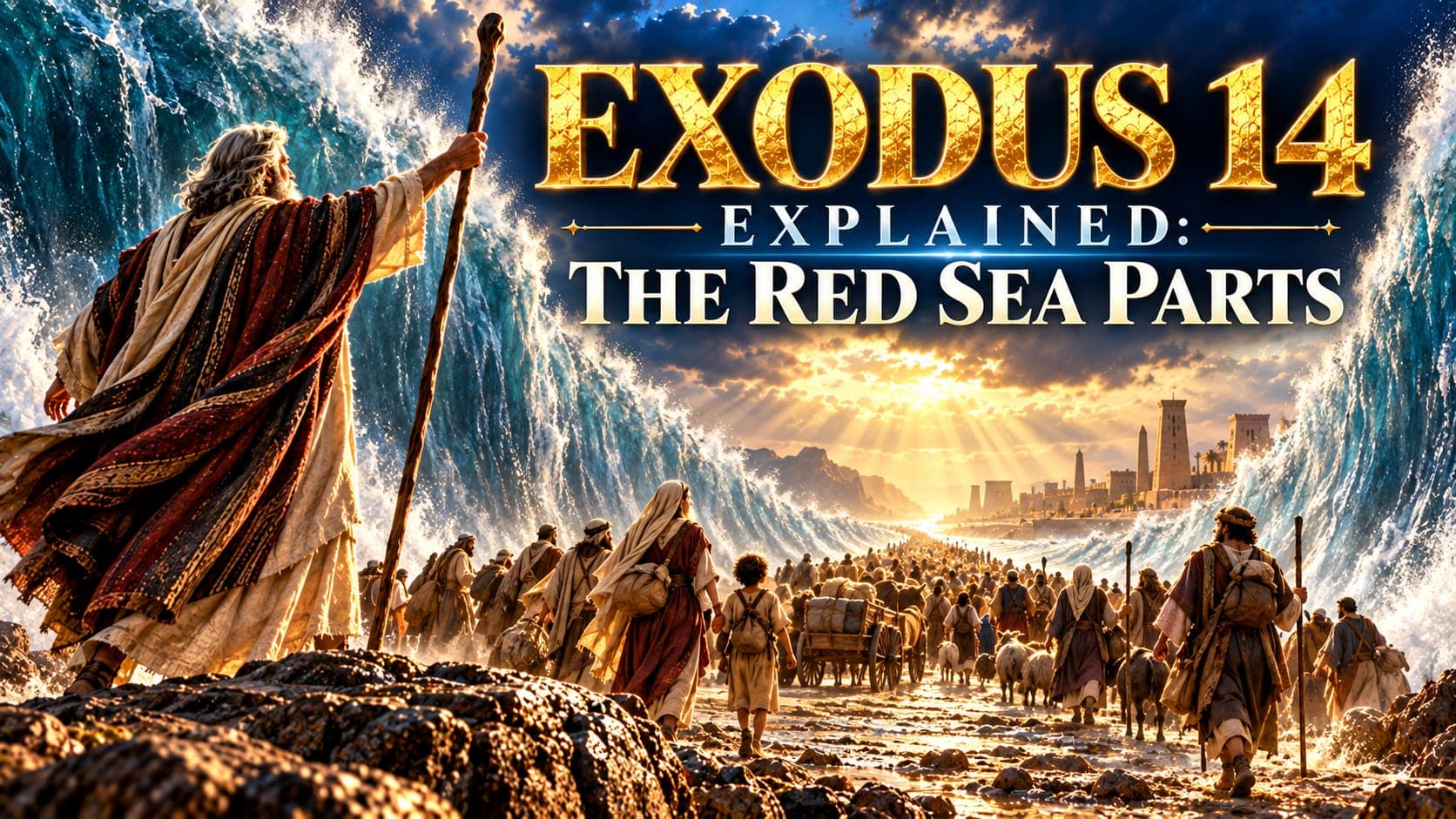
"And Moses stretched out his hand over the sea; and the LORD caused the sea to go back by a strong east wind all that night, and made the sea dry land, and the waters were divided."
"And the children of Israel went into the midst of the sea upon the dry ground: and the waters were a wall unto them on their right hand, and on their left."
⚠️ Notice the wind blows "all that night." This was not instant. Israel stood still, then watched something build for hours in the dark before there was any ground to walk on at all.
5. Egypt Walks Into Its Own End (verses 23 to 28)
Pharaoh's army does not hesitate at the edge of the sea. It drives straight in after them.
"And the Egyptians pursued, and went in after them to the midst of the sea, even all Pharaoh's horses, his chariots, and his horsemen."
"And it came to pass, that in the morning watch the LORD looked unto the host of the Egyptians through the pillar of fire and of the cloud, and troubled the host of the Egyptians, And took off their chariot wheels, that they drave them heavily: so that the Egyptians said, Let us flee from the face of Israel; for the LORD fighteth for them against the Egyptians."
📌 The confession comes from the enemy's own mouth. Not Moses saying it, not Israel saying it. Egyptian soldiers, mid chase, admitting the LORD is fighting against them, right before verse 28 ends the pursuit for good.
"And the LORD said unto Moses, Stretch out thine hand over the sea, that the waters may come again upon the Egyptians, upon their chariots, and upon their horsemen."
"And the waters returned, and covered the chariots, and the horsemen, and all the host of Pharaoh that came into the sea after them; there remained not so much as one of them."
6. What Israel Finally Believed (verses 29 to 31)
The chapter closes with the same ground Israel walked on, now seen from the other side.
"But the children of Israel walked upon dry land in the midst of the sea; and the waters were a wall unto them on their right hand, and on their left."
"Thus the LORD saved Israel that day out of the hand of the Egyptians; and Israel saw the Egyptians dead upon the sea shore. And Israel saw that great work which the LORD did upon the Egyptians: and the people feared the LORD, and believed the LORD, and his servant Moses."
📌 Belief shows up in the very last verse of the chapter, not the first. The people who begged to go back to Egypt in verse 12 are the same people believing the LORD in verse 31. Nothing changed about who God was between those two moments. What changed is what they had now watched Him do.
Hard Questions Exodus 14 Raises
Why does God harden Pharaoh's heart again, after everything that already happened? The text frames this hardening differently from the earlier plagues. Here it comes with a stated reason attached directly to it in verse 4: so that Egypt would know, without any remaining doubt, exactly who the LORD is. Pharaoh had already hardened his own heart repeatedly through the plague narrative. This final chapter shows God using that same settled stubbornness for one last, decisive purpose rather than softening it.
What does it mean that the Egyptians' chariot wheels "came off"? The text does not explain the mechanism. Some readers take this as a direct, instant miracle on the wheels themselves. Others point to the strong east wind already mentioned in verse 21, suggesting the sea bottom turned to heavy, churned mud under the weight of hundreds of chariots, which would also explain why they moved heavily. Scripture leaves the exact cause open; both readings agree the result was the same, an army suddenly unable to move.
Did every single Egyptian die that day? Verse 28 says "there remained not so much as one of them," but the "them" in context is the specific force that pursued into the sea itself, Pharaoh's horses, chariots, and horsemen named in verse 23. The text is not making a claim about the entire population or army of Egypt, only about the company that chased Israel into the water.
Is the "Red sea" in this chapter the same body of water people call the Red Sea today? This is genuinely disputed among scholars. The Hebrew name is Yam Suph, which some translate "Sea of Reeds," pointing to a shallower marshland further north than the modern Red Sea. Others hold to the traditional identification with the Red Sea itself. The text gives enough detail to describe a real crossing through real water, without settling the exact modern location.
Top Verses From Exodus 14
1. Exodus 14:13 and 14
"And Moses said unto the people, Fear ye not, stand still, and see the salvation of the LORD, which he will shew to you to day: for the Egyptians whom ye have seen to day, ye shall see them again no more for ever. The LORD shall fight for you, and ye shall hold your peace."
The clearest command in the whole chapter, and the hardest one to actually obey. Not fight, not flee, but stand still and watch God act first.
2. Exodus 14:22
"And the children of Israel went into the midst of the sea upon the dry ground: and the waters were a wall unto them on their right hand, and on their left."
The image that gives this chapter its name. Walls of water holding still on both sides while a whole nation walks through on ground that should not have been there.
3. Exodus 14:31
"And Israel saw that great work which the LORD did upon the Egyptians: and the people feared the LORD, and believed the LORD, and his servant Moses."
The real destination of the chapter. Not the far shore, but a people who finally believed the one who had been leading them the whole time.
4. Hebrews 11:29
"By faith they passed through the Red sea as by dry land: which the Egyptians assaying to do were drowned."
Centuries later, this exact crossing becomes a named example of faith, set right alongside Abraham, Moses, and the other names in the great roll call of Hebrews 11.
5. Isaiah 43:16
"Thus saith the LORD, which maketh a way in the sea, and a path in the mighty waters;"
Centuries after Exodus 14, Isaiah still reaches for this exact image, a way cut through the sea, to describe the kind of God Israel was dealing with.

Frequently Asked Questions About Exodus 14
What happens in Exodus 14?
God directs Israel to camp by the Red Sea, then hardens Pharaoh's heart one final time so Egypt's army pursues them there. Trapped between the sea and the chariots, Israel panics and blames Moses, but God tells them to stand still. Moses stretches his hand over the water, a strong east wind divides the sea, and Israel crosses on dry ground. When the Egyptian army follows, the waters return and destroy them, and the chapter ends with Israel finally believing the LORD.
Why did God harden Pharaoh's heart again in Exodus 14?
Exodus 14:4 states the reason directly: so that Egypt would know without doubt that the LORD is God. This final hardening used Pharaoh's own already settled stubbornness for one last, decisive demonstration rather than relenting.
Did Moses actually part the Red Sea, or is there a natural explanation?
Exodus 14:21 credits a strong east wind blowing all night as the means God used to divide the sea, while also calling it something the LORD caused. The text presents the wind and the miracle together rather than treating them as competing explanations.
Were any Egyptians left alive after the Red Sea closed?
Exodus 14:28 says none of the specific force that pursued Israel into the sea, Pharaoh's horses, chariots, and horsemen, survived. The verse is describing that pursuing company, not making a claim about every Egyptian in the nation.
What does it mean that the Egyptians' chariot wheels came off?
Exodus 14:25 says the LORD took off their chariot wheels so they drove heavily. Scripture does not explain the exact mechanism, and readers differ on whether this describes a direct miracle on the wheels or the effect of a churned, muddy sea floor.
Why did the pillar of cloud move behind Israel instead of staying in front?
Exodus 14:19 and 20 say the pillar relocated behind Israel to stand between the two camps, giving light to Israel while remaining darkness to the Egyptians. It served as a shield at exactly the moment Israel needed cover more than a guide.
Is the Red Sea in Exodus 14 the same Red Sea on a map today?
Scholars genuinely disagree. The Hebrew Yam Suph is sometimes translated "Sea of Reeds," suggesting a shallower body of water, while others hold to the traditional Red Sea identification. The exact modern location remains an open question.
What does "stand still" mean in Exodus 14:13?
Moses commands a trapped, terrified people to do nothing visible at all while God acts. It is not passivity as an end in itself, but trust that refuses to run or fight before seeing what God is about to do.
How does Exodus 14 point to Jesus?
The pattern of this chapter, a helpless people delivered through water while judgment falls on what pursued them, is one early Christians read as a picture of the deliverance Jesus provides, where the danger is defeated and the redeemed pass safely through to the other side.
Final Thoughts
Exodus 14 is not really about a sea. It is about what happens in the gap between crying out to God and actually believing Him.
📌 God sometimes leads you into what looks like a dead end on purpose. The camp by the sea was not a mistake in the plan. It was the plan, chosen before Pharaoh ever moved a single chariot.
📌 Crying out to God and doubting Him can happen in the same breath. Israel did both within two verses, and God still saved them. Panic is not disqualifying.
📌 Belief usually arrives after you watch God act, not before. The people who wanted to go back to slavery in verse 12 are the people believing the LORD in verse 31. The sea did not change. What they had seen Him do did.
So here is one thing to actually do with this chapter.
The next time you are cornered with no visible way out, do what Moses told a trapped nation to do. Stop moving long enough to watch for what God does, before you decide what you are going to do.