📖 Exodus 2 Explained: Baby Moses in the Basket and the Flight to Midian
A king orders every Hebrew baby boy thrown in a river. One mother answers by putting her own son in that same river on purpose.
Exodus 2 explained is the chapter that gets Moses from a basket in the reeds to a well in a foreign country, forty years apart, in only twenty five verses. A baby born under a death sentence grows up in the house of the very king who signed it, then throws it all away for a people who do not even recognize him as one of their own.
Maybe you have had to decide which side you actually belong to, even when it cost you everything comfortable.
- ❓ How does a death sentence turn into an adoption?
- ❓ Why does Moses kill a man, then run for his life?
- ❓ What happens to Moses during the forty silent years this chapter skips over?
- ❓ And why does the chapter end on Israel groaning instead of on Moses at all?
📌 Every major turn in this chapter happens because someone refused to leave a baby, a stranger, or a suffering people alone.
This walkthrough goes through Exodus 2 in order: the basket in the river, the princess who adopts a Hebrew son, the killing that sends Moses running, the well in Midian where he builds a new life, and the verse that quietly sets up everything Exodus 3 is about to do.
A chapter with no miracles in it still manages to be the hinge the whole book turns on.
What Happened Just Before This Chapter
Exodus 1 ended with Pharaoh giving up on secret killings through two midwives and going public instead, ordering every Hebrew son thrown into the river the moment he is born. The same family that once followed Joseph down into Egypt in safety is now hunted inside the very country that once saved them.
Exodus 2 opens with that decree still standing, and with one particular family about to test exactly how far they will go to disobey it.
Exodus 2 Explained Verse by Verse
1. A Mother's Desperate Plan (verses 1 to 4)
The chapter opens with a marriage, then almost immediately a crisis.
"And the woman conceived, and bare a son: and when she saw him that he was a goodly child, she hid him three months."
Neither parent is named yet in this chapter. Exodus will not give their names until later, when Moses's family line is recorded in full. For now the text keeps them as simply a man and a woman of the tribe of Levi, doing what any parent under that decree had to do: hide the child and buy time.
Three months of hiding only works for so long.
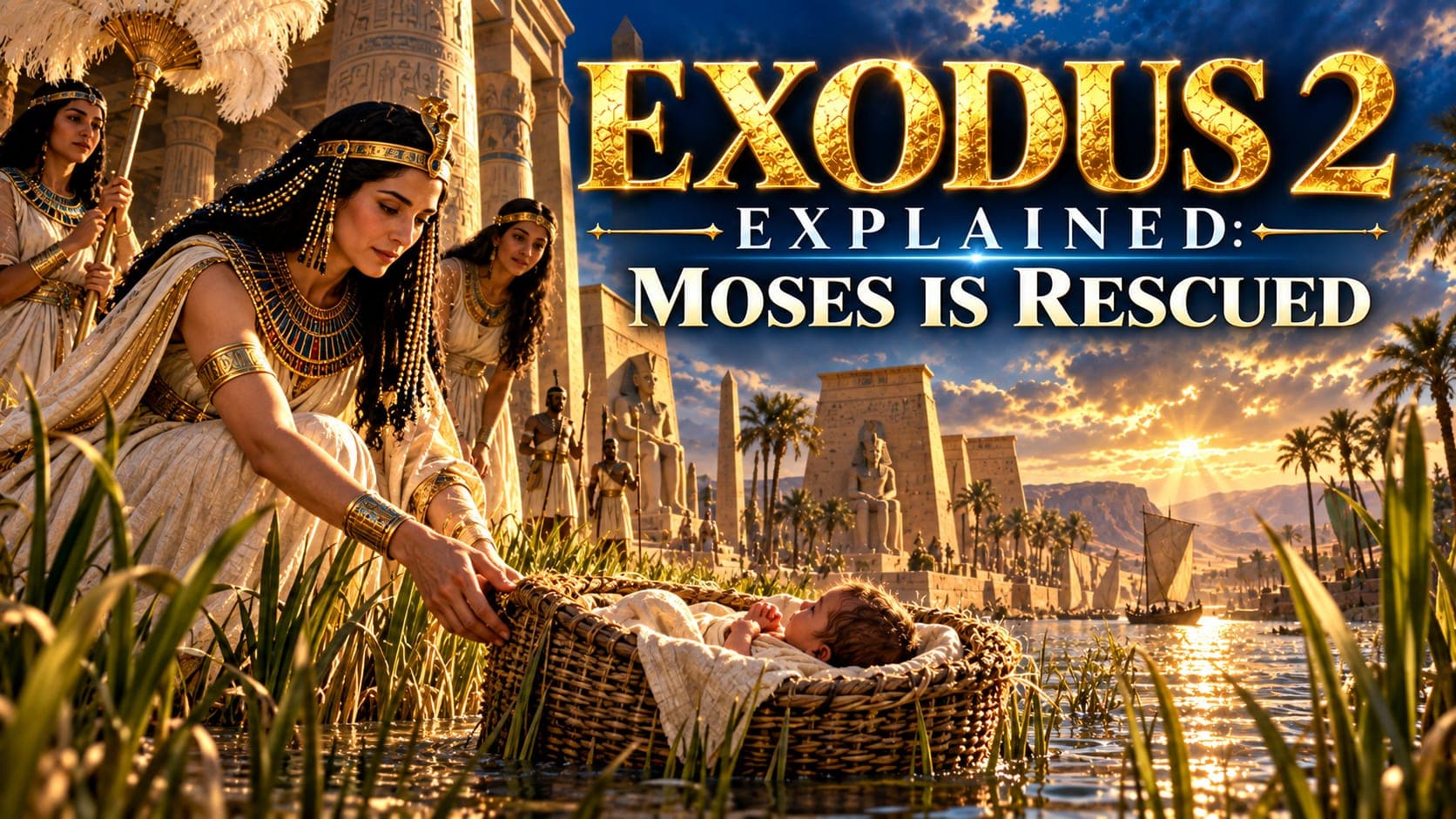
"And when she could not longer hide him, she took for him an ark of bulrushes, and daubed it with slime and with pitch, and put the child therein; and she laid it in the flags by the river's brink."
💡 The Hebrew word for this basket is the same word Genesis uses for Noah's ark. It is not the ordinary word for a boat. Scripture uses it exactly twice: once for the vessel that carried a family safely through a flood that destroyed the world, and once here, for the vessel that carries one baby safely through a decree meant to destroy him.
The New Testament later names what this mother was actually doing, long before she could see any of it work out.
"By faith Moses, when he was born, was hid three months of his parents, because they saw he was a proper child; and they were not afraid of the king's commandment."
📌 Hiding a baby for three months, then floating him down a crocodile filled river in a basket sealed with tar, gets called faith, not desperation. The decision was not blind. It was a calculated risk, taken by parents who refused to hand their son over to a decree without at least trying to put him somewhere God could still reach him.
2. A Princess Finds a Basket, and Names Him Moses (verses 5 to 10)
The basket does not drift unseen for long.
"And when she had opened it, she saw the child: and, behold, the babe wept. And she had compassion on him, and said, This is one of the Hebrews' children."
📌 Pharaoh's own daughter knows exactly what she is looking at, and saves him anyway. She does not mistake him for an Egyptian child by accident. She sees a Hebrew baby, the very thing her father ordered destroyed, and compassion wins before politics gets a vote.
Moses's sister, watching from a distance the whole time, steps in at exactly the right moment to offer a nurse, and the baby ends up back in his own mother's arms, paid by the one household in Egypt with the power to protect him.
"And the child grew, and she brought him unto Pharaoh's daughter, and he became her son. And she called his name Moses: and she said, Because I drew him out of the water."
💡 The name itself plays on the Hebrew word for drawing something out. A princess names a rescued baby after the very thing that almost killed him. Centuries later, that same man will draw an entire nation out of slavery through water, this time at the Red Sea instead of the Nile.
Nothing in this section is a miracle. No angel, no plague, no parted sea. Just a frightened mother, a watching sister, a compassionate stranger, and a river doing exactly what it was told not to do.
3. Forty Years Later: Moses Picks a Side (verses 11 to 15)
Exodus jumps straight from an infant to a grown man in one sentence.
"And it came to pass in those days, when Moses was grown, that he went out unto his brethren, and looked on their burdens: and he spied an Egyptian smiting an Hebrew, one of his brethren."
Stephen's speech in Acts fills in the one detail Exodus leaves out here.
"And when he was full forty years old, it came into his heart to visit his brethren the children of Israel."
📌 Moses is not a confused teenager here. He is a grown man, raised with every privilege Egypt could offer, making a deliberate choice about which family is actually his. Hebrews names that choice directly.
"Choosing rather to suffer affliction with the people of God, than to enjoy the pleasures of sin for a season; Esteeming the reproach of Christ greater riches than the treasures in Egypt: for he had respect unto the recompence of the reward."
What that choice looks like in the moment is not gentle.
"And he looked this way and that way, and when he saw that there was no man, he slew the Egyptian, and hid him in the sand."
⚠️ The text does not call this an act of faith or a model to copy. Looking around to check no one was watching before killing a man and burying the body describes someone hiding a crime, not a deliverer stepping into a calling with God's blessing. Whatever right instinct drove Moses toward his own people, he acted on it with violence and secrecy rather than waiting on God to send him properly, which is exactly what Exodus 3 eventually does instead.
The very next day proves the secret did not stay secret.
"And he said, Who made thee a prince and a judge over us? intendest thou to kill me, as thou killedst the Egyptian? And Moses feared, and said, Surely this thing is known."
💡 Moses stepped in to stop one Hebrew from wronging another, expecting gratitude, and got the exact question Cain's descendants had been asking for generations: who gave you the right. The people he just risked everything for are the ones who turn on him first.
4. A Well in Midian, and a Family of His Own (verses 15 to 22)
Word reaches Pharaoh, and Moses stops being safe in Egypt at all.
"Now when Pharaoh heard this thing, he sought to slay Moses. But Moses fled from the face of Pharaoh, and dwelt in the land of Midian: and he sat down by a well."
The man raised to one day possibly rule part of Egypt is now a fugitive sitting alone by a well in a country he does not belong to, with nothing. A well is also exactly where Isaac's servant found Rebekah and where Jacob first met Rachel. Moses's own turn at a well plays out the same way.
"And Moses was content to dwell with the man: and he gave Moses Zipporah his daughter."
"And she bare him a son, and he called his name Gershom: for he said, I have been a stranger in a strange land."
📌 Moses names his own son after exactly what he feels. Gershom sounds like the Hebrew for a stranger there. Raised Egyptian, born Hebrew, now married into a Midianite family, Moses does not belong fully anywhere, and he says so out loud through his son's name instead of pretending otherwise.
The priest who takes him in is named Reuel in this verse, though later chapters of Exodus call the same man Jethro. Scripture never explains the two names directly; what it does make clear is that Moses, the fugitive with nothing, is welcomed into this family and given a home.
The rest of Moses's story only really gets moving once this quiet stretch in Midian ends.
5. The King Dies, and God Remembers (verses 23 to 25)
The chapter closes by jumping forward again, this time skipping the rest of Moses's years in Midian in a single verse.
"And it came to pass in process of time, that the king of Egypt died: and the children of Israel sighed by reason of the bondage, and they cried, and their cry came up unto God by reason of the bondage."
Acts gives the length of that silent stretch a number Exodus itself never states here.
"And when forty years were expired, there appeared to him in the wilderness of mount Sina an angel of the Lord in a flame of fire in a bush."
⚠️ Forty years pass between one verse and the next, and the chapter spends more words on Israel's groaning than on anything Moses did during all of it. Whatever Moses was doing with sheep in Midian for four decades, Exodus treats it as not worth recording. What it does record, in full, is that the people kept crying out the entire time.
"And God heard their groaning, and God remembered his covenant with Abraham, with Isaac, and with Jacob. And God looked upon the children of Israel, and God had respect unto them."
📌 God is never named as doing anything active in this entire chapter until its very last two verses. No basket is guided by His hand on the page. No well meeting is called providence outright. Then, right at the end, four short clauses credit Him with hearing, remembering, looking, and respecting, as if the whole quiet chapter was Him working underneath everything the text actually described out loud.
The covenant named here is the same one God spelled out centuries earlier in Genesis 15, the promise that this exact bondage would end. Exodus 2 closes by quietly confirming that promise is still active, right before Exodus 3 shows what God does about it.

Hard Questions Exodus 2 Raises
Was Moses right to kill the Egyptian? The text itself never calls it righteous. Moses checks that no one is watching, kills the man, and hides the body, which reads as someone covering up a crime rather than carrying out justice openly. Hebrews 11 praises Moses's faith in choosing Israel over Egypt, but it never specifically praises this killing. Most careful readers separate the two: the choice to identify with his suffering people was right, the method he used that day was not, and the very next verses show the consequences catching up with him immediately.
Why does Exodus skip forty years between verse 15 and verse 23 without saying so? Exodus itself gives no number. Acts 7:30 is the verse that supplies it, saying forty years passed before the burning bush. Exodus was written to move the story toward the exodus itself, not to document Moses's private decades as a shepherd, so it compresses an entire adult lifetime into one short verse and spends far more space on what Israel was going through back in Egypt during that same stretch.
Why is the priest of Midian called Reuel here but Jethro later in Exodus? Exodus 2:18 names him Reuel. Exodus 3:1 and 18:1 call the same man Jethro. Bible teachers read this difference two main ways: some take Jethro as a title or honorific meaning something like his excellency, used alongside a personal name, Reuel. Others suggest Reuel was the grandfather and the family relationship got compressed in this early verse. Exodus never resolves which explanation is correct, and both readings keep the two names pointing at the same household.
Why does the same Hebrew word appear for Noah's ark and Moses's basket? Genesis 6 and Exodus 2 are the only two places in the Hebrew Bible that use this particular word for a vessel. Scripture does not explain the choice, but the pattern is hard to miss: both times, God preserves someone through water that should have destroyed them, inside a small sealed container that depended entirely on staying afloat and sealed.
Top 5 Bible Verses From Exodus 2
1. Exodus 2:3
"And when she could not longer hide him, she took for him an ark of bulrushes, and daubed it with slime and with pitch, and put the child therein; and she laid it in the flags by the river's brink."
A mother turns the very river meant to kill her son into the way she saves him, using the same kind of vessel God once used to save Noah's whole family.
2. Exodus 2:10
"And the child grew, and she brought him unto Pharaoh's daughter, and he became her son. And she called his name Moses: and she said, Because I drew him out of the water."
A name given in gratitude for a rescue from water becomes the name of the man who will later lead a whole nation through water to freedom.
3. Exodus 2:12
"And he looked this way and that way, and when he saw that there was no man, he slew the Egyptian, and hid him in the sand."
A right instinct carried out the wrong way, costing Moses the life he knew and sending him into forty years of exile before God sends him back properly.
4. Exodus 2:22
"And she bare him a son, and he called his name Gershom: for he said, I have been a stranger in a strange land."
Moses names his own grief out loud, belonging fully to neither the palace he grew up in nor the people he was born to.
5. Exodus 2:24 and 25
"And God heard their groaning, and God remembered his covenant with Abraham, with Isaac, and with Jacob. And God looked upon the children of Israel, and God had respect unto them."
After a whole chapter where God is never named as acting, four verbs in one breath reveal He was never absent, only quiet.

Frequently Asked Questions About Exodus 2
What happens in Exodus 2?
A Levite couple hides their newborn son from Pharaoh's decree, then sets him afloat in a basket on the Nile, where Pharaoh's own daughter finds him, names him Moses, and raises him. As a grown man, Moses kills an Egyptian he sees abusing a Hebrew, flees to Midian, marries, and has a son, while back in Egypt the people continue crying out to God under their bondage.
Who were Moses's real parents?
Exodus 2 does not name them, describing them only as a man and woman of the tribe of Levi. Exodus 6:20 later identifies them by name as part of the family record, after this chapter has already told their part of the story.
Why did Pharaoh's daughter adopt a Hebrew baby?
Exodus 2:6 says simply that she had compassion on him once she saw he was a Hebrew child. The text gives no political motive and no sign she was trying to undermine her father's decree. It presents her choice as an ordinary human response to a crying baby, nothing more calculated than that.
What does the name Moses mean?
Exodus 2:10 ties it to the Hebrew idea of drawing something out, explained in the verse itself as the reason Pharaoh's daughter gave him that name. The connection becomes sharper later, once the man named for being drawn out of water becomes the one who draws a whole nation out through water at the Red Sea.
Why did Moses flee to Midian?
Exodus 2:15 says Pharaoh heard about the Egyptian Moses killed and sought to kill him in return. Midian, east of Egypt, was far enough away to be safe and was already home to relatives of Abraham through his son Midian, giving Moses somewhere to land that was not entirely foreign ground.
Who was Zipporah?
Zipporah was the daughter of the priest of Midian, given to Moses as his wife in Exodus 2:21 after he helped her and her sisters at a well. Her name is connected to the Hebrew word for a bird. She becomes the mother of Moses's son Gershom in this chapter and appears again later in Exodus.
Did Moses know he was Hebrew while growing up in the palace?
Exodus 2:11 describes him going out to his brethren as an adult, language that assumes he already knew exactly who his own people were. His birth mother nursed him as a baby according to Exodus 2:9, which likely gave him real contact with his Hebrew identity before he ever moved fully into Pharaoh's household.
How many years does Exodus 2 actually cover?
The chapter spans roughly eighty years in twenty five verses. Acts 7:23 and 7:30 supply the two numbers Exodus itself leaves out: Moses was forty when he fled Egypt, and another forty years passed in Midian before the events of Exodus 3.
Why does the chapter end with Israel groaning instead of with Moses?
Exodus 2:23 to 25 shifts the camera away from Moses entirely, back to the people still suffering in Egypt. The ending makes clear this story was never only about one man building a new life in Midian. It was always about a whole people God had not forgotten, whether or not Moses was anywhere near them yet.
Final Thoughts
Exodus 2 has no plague, no parted sea, and no burning bush, and it still shapes everything that follows.
📌 God works through ordinary courage long before He works through miracles. A basket, a watching sister, a compassionate princess, and a well in a foreign country all move this story forward before a single supernatural sign appears.
📌 Choosing your people can cost you everything you were given by the people you did not choose. Moses walked away from an Egyptian palace the moment he decided which family was actually his, and the cost was immediate and real.
📌 God's silence is not the same as God's absence. Forty years pass with nothing recorded, and the chapter still ends by naming exactly what God was doing underneath all of it: hearing, remembering, looking, and caring.
You may be in a season that feels as quiet and unrecorded as Moses's years with sheep in Midian.
So here is your one next step.
Keep crying out, the way Israel did in the very last verses of this chapter, even without any sign yet that it is being heard. Exodus 2 ends by promising it already was.