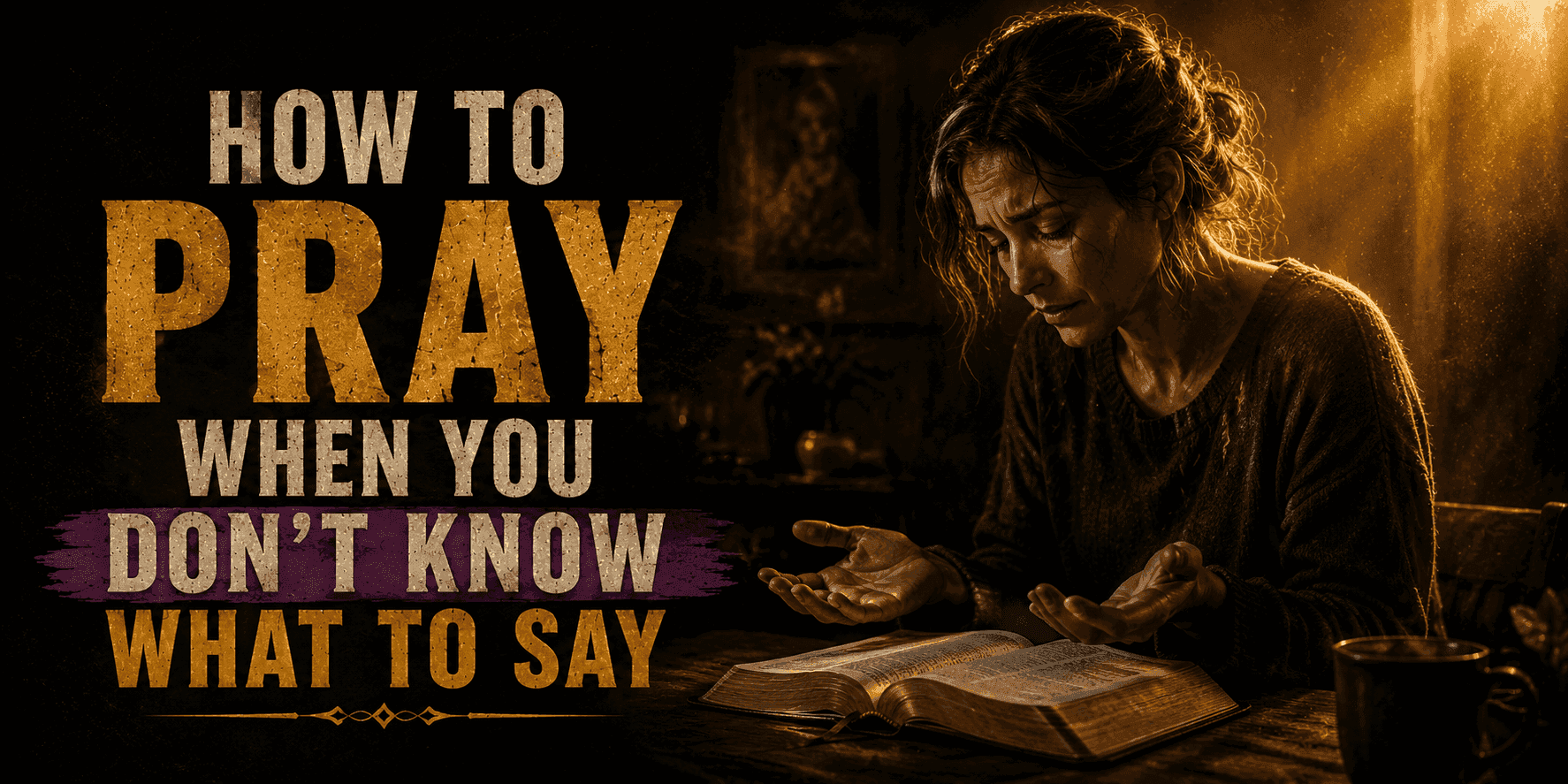
📖 How to Pray When You Don't Know What to Say
You kneel down to pray and nothing comes out.
You open your mouth and the words just will not form.
Maybe you have sat in a small group and listened to someone else pray out loud, warm and fluent, and felt your stomach drop because your own prayers sound nothing like that.
📌 Hear this before anything else. Prayer was never a performance you can fail.
And if you have ever typed "how to pray" into your phone because you honestly do not know where to start, you are exactly who this guide is for.
Maybe church taught you a certain shape. Maybe you grew up hearing long, polished prayers and quietly decided you were not good at this.
- 🔲 Say the right words.
- 🔲 Sound sincere enough.
- 🔲 Do not repeat yourself or go blank.
None of that is actually in the Bible.
Jesus warns against exactly that kind of praying.
Here is what might surprise you.
The men and women God used most in Scripture prayed short, messy, even angry prayers. And He never once turned one of them away for it.
📖 God is not grading your sentences. He is listening to you.
So this guide will walk you through:
- ✅ What Jesus actually taught about prayer
- ✅ What the Psalms give you permission to say
- ✅ What happens in your prayer when you truly have no words
- ✅ A simple pattern you could use tonight, no script required
No performance. No memorized script. No scoreboard.
Just you, honest, talking to a Father who already knows what you need before you say a word of it.
Take a breath. Let's walk through what God's Word actually says about prayer.
Why This Matters for Your Faith
You can find a hundred apps and courses that promise to improve your prayer life.
Breathing techniques. Guided meditations. Manifesting your best life.
Some of that can quiet a busy mind for a minute. None of it can do what prayer does.
Because prayer is not a technique. Prayer is a relationship.
A meditation app wants to calm you down and send you back to your day. God wants you to talk to Him like a Father, because that is exactly what He is.
That is why how you pray matters for your faith specifically.
If prayer stays a performance in your head, something you have to get right, you will quietly stop doing it. Nobody keeps showing up to a test they are failing.
And once you stop praying, you stop bringing God your actual life. You start carrying decisions, fears, and regrets alone, because you decided somewhere along the way that your prayers were not good enough to bother Him with.
That lie has cost a lot of believers their closeness with God. It does not have to cost you yours.
- ❓ Does God actually want to hear from you, or just correct your grammar?
- ❓ Is the silence in prayer a sign something is wrong with you?
- ❓ Can you really bring Him the thought you are most ashamed of?
Learning what to do with an anxious mind or a fearful one starts right here, because prayer is where every other struggle in your walk with God actually gets carried.
The stakes are not whether you sound spiritual.
📌 The stakes are whether you keep talking to God at all, or quietly give up.
This guide is about making sure you never have to give up again.

What God's Word Says About Prayer
1. Prayer Is Not a Performance You Can Fail
Jesus had something specific to say about impressive sounding prayers.
He was not a fan of them.
"But when ye pray, use not vain repetitions, as the heathen do: for they think that they shall be heard for their much speaking."
"Vain repetitions" means stacking up words to sound sincere, the way people outside the faith tried to talk their gods into listening.
Jesus says that is not what gets your Father's attention.
Then He tells you exactly why you do not need any of that:
"Be not ye therefore like unto them: for your Father knoweth what things ye have need of, before ye ask him."
Read that again.
📌 He already knows what you need before you open your mouth.
So your prayer is not the thing informing God. It is the thing connecting you to Him.
That changes everything about the pressure you feel. You are not auditioning for a part. You are not convincing a stranger. You are talking to the one Person in the universe who already understands exactly what is going on in you.
💡 A clumsy, honest sentence to your Father beats a flawless speech to a stranger.
It also changes how you handle the times the answer does not come the way you hoped. A prayer was never a performance you failed just because the outcome was not what you asked for.
2. The Lord's Prayer Is a Frame, Not a Script
Right after warning against empty words, Jesus gives His disciples a model prayer. Not a spell to repeat word for word, a frame to build your own prayers on.
"After this manner therefore pray ye: Our Father which art in heaven, Hallowed be thy name. Thy kingdom come. Thy will be done in earth, as it is in heaven. Give us this day our daily bread. And forgive us our debts, as we forgive our debtors. And lead us not into temptation, but deliver us from evil: For thine is the kingdom, and the power, and the glory, for ever. Amen."
Notice what Jesus says "after this manner." In this shape. Not these exact syllables every time.
Look at the actual order of it, because the order teaches you something.
- 🟢 Start with who He is. "Our Father. Hallowed be thy name."
- 🟢 Then His kingdom and His will, ahead of your own.
- 🟢 Then your actual needs. Daily bread. Forgiveness. Protection from temptation.
Five simple moves. You can hold this in your head without ever memorizing a word of the original.
Who God is. What He wants. What you need today. Where you fail. What you are afraid of.
That is not a script to recite. That is a map you can walk through in your own words, tonight, about your actual day.
3. The Psalms Give You Permission to Be Honest
Here is something a lot of Christians were never taught.
A huge share of the Psalms are not calm. They are not tidy. Some of them are close to furious.
"How long wilt thou forget me, O LORD? for ever? how long wilt thou hide thy face from me? How long shall I take counsel in my soul, having sorrow in my heart daily? how long shall mine enemy be exalted over me?"
Four questions in a row. No answer from God yet. Real sorrow, said out loud.
And this is Scripture. God put it in the Bible on purpose, as a prayer for you to pray.
Hannah prayed the same honest way, years of grief behind her words.
"And Hannah answered and said, No, my lord, I am a woman of a sorrowful spirit: I have drunk neither wine nor strong drink, but have poured out my soul before the LORD."
📌 Poured out her soul. Not a clean paragraph. Not three points and an application. A pouring out.
The psalmist does the same thing when he has nowhere else to turn:
"I cried unto the LORD with my voice; with my voice unto the LORD did I make my supplication. I poured out my complaint before him; I shewed before him my trouble."
A complaint. A trouble. Shown to God plainly, no editing for tone.
If you have ever felt guilty for being angry, confused, or flat out exhausted in prayer, the Psalms are telling you that feeling is allowed in the room.
Working through honest doubt or naming a fear you have been hiding both start the same way. You say the true thing to God instead of the polished thing.
⚠️ A prayer that hides your real heart is not more spiritual. It is just further from Him.
Job argued with God for chapters and God never once told him to tone it down. Elijah asked God to let him die. Neither one got rebuked for honesty. Both got met.
4. When You Have No Words, the Spirit Prays for You
Now here is the verse for the exact moment you cannot find a single word.
Paul admits something you have probably felt and never heard a pastor admit:
"Likewise the Spirit also helpeth our infirmities: for we know not what we should pray for as we ought: but the Spirit itself maketh intercession for us with groanings which cannot be uttered."
📌 We know not what we should pray for as we ought. Even Paul, the man who wrote most of the New Testament, says that about himself.
So when you kneel down and nothing comes out but a groan, you have not failed at prayer. You have landed exactly where this verse was written for.
The next verse finishes the thought:
"And he that searcheth the hearts knoweth what is the mind of the Spirit, because he maketh intercession for the saints according to the will of God."
God is not waiting on you to translate your pain into perfect sentences before He will act on it.
💡 When the words will not come, the Spirit is already praying the parts you cannot put into language.
You showing up, even wordless, even in tears, is already prayer.
5. You Do Not Need to Earn an Appointment
Some people picture prayer like approaching a king who might be too busy for them today. Scripture pictures it completely differently.
"Let us therefore come boldly unto the throne of grace, that we may obtain mercy, and find grace to help in time of need."
Boldly. Not nervously. Not after you have cleaned yourself up first.
You walk straight up to the throne, because the One sitting on it already calls you His.
And He is not a distant deity waiting for the right incantation. Jeremiah heard this directly from God for a nation that had failed badly:
"Then shall ye call upon me, and ye shall go and pray unto me, and I will hearken unto you. And ye shall seek me, and find me, when ye shall search for me with all your heart."
Not a hard bar to clear. Not a perfect record required.
Call. Seek with your whole heart. That is the entry requirement. It was always the only one.
6. Pour Out Your Heart, Not Just a List of Requests
Most of us treat prayer like a request form. Ask, move on, ask again tomorrow.
David modeled something fuller than that.
"Trust in him at all times; ye people, pour out your heart before him: God is a refuge for us. Selah."
Pour out your heart. Not just a line item. The whole cup, tipped over, everything that is actually in there.
That includes the parts you edit out in church. The resentment. The exhaustion. The question you are scared to say out loud, like why this happened at all.
Notice the reason David gives right after. God is a refuge. A refuge is not a place you visit once you have cleaned up. It is where you run while you are still a mess.
📌 At all times means this is not reserved for crisis moments. The ordinary Tuesday counts too.
7. A Simple Pattern You Can Use Tonight
You do not need a new vocabulary. You need a shape simple enough to use when your mind is tired and your heart is loud.
Here is one built straight from the Lord's Prayer, in plain words:
- 🙏 Father. Say who you are talking to. You are not shouting into space.
- 🙏 Thank you. Name one true thing you are grateful for right now, even a small one.
- 🙏 Here is what is actually going on. Say the real thing. The fear, the need, the person you are angry at.
- 🙏 Help me. Ask plainly for what you need. God is not impressed by vague requests.
- 🙏 I trust you with it. Hand it over, even if you have to say that part through gritted teeth.
Five short moves. Thirty seconds if that is all you have tonight.
Say it out loud, or just in your head. Say it kneeling, or lying flat on your back unable to sleep.
📌 God is not grading the delivery. He is listening for you.

Practical Tips: Praying When Words Are Hard
Prayer grows the same way anything else does. Small, repeated, honest.
Here are seven things you can start tonight.
- Pray the moment you notice you have not. Do not wait for the right mood or the perfect quiet room. The thought "I should pray" is already the start of one.
- Borrow a Psalm when you have nothing of your own. Read one out loud and mean it as your own words. The psalmist already said what you cannot find language for.
- Say one true sentence instead of a long speech. "Father, I am scared about tomorrow" is a complete prayer. You do not need a closing argument.
- Keep the five word pattern close. Father. Thank you. Here is what is going on. Help me. I trust you. Write it on a card if that helps.
- Pray out loud sometimes, even alone. Speaking a prayer instead of just thinking it tends to pull your mind out of the spiral and into the room with God.
- Do not fill the silence that follows. After you have said it, sit for a minute before you move on. Learning what real time with God looks like includes learning to stop talking sometimes.
- Expect it to feel ordinary most days. Dramatic breakthroughs in prayer are rare for most believers. Ordinary, honest, daily conversation is the actual target.
- Do not fight your mind for staying perfectly still. It will wander. When you notice, just bring it back gently and keep going. That small return is part of the prayer, not a failure of it.
None of these require eloquence.
Pick one tonight. Not all eight.
Top 5 Bible Verses About Prayer
If you want a short list to come back to, start with these five.
1. Jeremiah 29:12 and 13
"Then shall ye call upon me, and ye shall go and pray unto me, and I will hearken unto you. And ye shall seek me, and find me, when ye shall search for me with all your heart."
God speaks this to a people who had wandered far and failed badly, exiled in a foreign land.
And His answer is not a list of conditions. Call. He will hear. Seek Him fully and He will be found.
If you feel too far gone to pray, this verse was written exactly for that feeling.
2. Romans 8:26
"Likewise the Spirit also helpeth our infirmities: for we know not what we should pray for as we ought: but the Spirit itself maketh intercession for us with groanings which cannot be uttered."
The verse for the moment you have no words at all.
It names your weakness plainly and then tells you the Spirit fills the exact gap you feel. Keep this one close for the nights nothing will come out.
3. Hebrews 4:16
"Let us therefore come boldly unto the throne of grace, that we may obtain mercy, and find grace to help in time of need."
One word carries this whole verse. Boldly.
Not timidly. Not after a long apology for showing up. You are invited to walk right up, because grace, not your record, is what gets you in.
4. 1 Thessalonians 5:17
"Pray without ceasing."
Three words. The shortest command in the whole Bible about prayer.
It does not mean kneeling all day. It means keeping an open line running underneath everything else you do, so a short honest sentence to God never feels out of place.
5. James 5:16
"Confess your faults one to another, and pray one for another, that ye may be healed. The effectual fervent prayer of a righteous man availeth much."
Notice this is not a solo verse. Confess to one another. Pray for one another.
Prayer was never meant to be a project you carry alone in your head. Bringing someone else into it is not weakness. It is exactly what this verse asks for.

Frequently Asked Questions About How to Pray
Is it okay to pray with no real words?
Yes. Romans 8:26 says the Spirit prays through groanings that cannot even be put into words. A tear, a sigh, or a single whispered name is still prayer. God is reading your heart, not scoring your vocabulary.
Do I have to pray the Lord's Prayer exactly?
No. Jesus said pray "after this manner," meaning in this shape, not word for word every time. Use its order, who God is, His will, your needs, your failures, as a frame for your own words.
Can I tell God I am angry or confused?
Yes, and the Psalms prove it over and over. David asked God "how long" with real frustration. Honest anger brought to God is not rebellion. Hidden anger that never gets brought to Him is far more dangerous to your faith.
What does "pray without ceasing" actually mean?
It does not mean nonstop kneeling. It means staying in ongoing conversation with God through your day, bringing Him the small things as they happen instead of saving everything for one formal prayer time.
Why do my prayers feel repetitive?
Because your real needs are probably repetitive too. Bringing the same worry back tomorrow is not a failed prayer. It is what Jesus meant by daily bread, asking again because you need it again.
Is it a sin if I forget to pray for a while?
Forgetting is not the same as refusing. If you have drifted, the fix is simple. Come boldly to the throne of grace today, per Hebrews 4:16, and start again. There is no waiting period and no penalty box.
Does prayer have to be out loud?
No. Scripture records whispered prayers, silent ones, and prayers that are just a groaning the Spirit interprets. Say it however it actually comes out of you.
What if I do not feel anything when I pray?
Keep praying anyway. Feeling is not the measure of whether a prayer worked. Obedience and honesty are. Some of the most faithful prayers in Scripture were prayed in flat, dry, exhausted seasons.
How long should a prayer be?
As long as it needs to be and no longer. Jesus warned against piling up words to sound sincere. A ten second honest prayer is not inferior to a ten minute one.
What if I pray and nothing seems to change?
Keep going, and keep bringing it back to Him. Prayer is first about staying connected to your Father, not a transaction that owes you an instant visible result. The answer is sometimes patience, sometimes a changed heart, sometimes a door you could not see yet.
Why does my mind keep wandering when I try to pray?
Because your mind wanders in general, not just in prayer. That is a human limit, not a spiritual failure. When you catch yourself drifting, simply bring your attention back to God and keep talking. The returning is part of the practice, every single time.
Should I pray for myself first, or for others?
There is no required order. The Lord's Prayer puts God's name and His kingdom first, then moves to daily needs, so following that shape is a fine habit. But if your own need is loud and urgent, bring that first. God is not offended by where you start.
Is it a sin to not know how to pray?
No. Not knowing how is not a sin, it is just being human. Romans 8:26 exists precisely because every believer hits this wall at some point. Asking God to teach you, the way the disciples asked Jesus in Luke 11:1, is itself a real prayer.
Final Thoughts
If you remember nothing else from this guide, remember these three things.
📌 Prayer is not a performance you can fail. Your Father already knows what you need before you ask. You are not informing Him. You are connecting to Him.
📌 The Psalms give you permission to be honest. Confused, angry, exhausted prayers are still in the Bible for a reason. Bring the real thing, not the polished thing.
📌 When you have no words, the Spirit prays for you. A groan you cannot put into language still counts. It is not a failed prayer. It is Romans 8:26 happening in real time.
You will probably not wake up tomorrow suddenly fluent in prayer.
That is okay. Nobody is.
This was never about sounding like someone else. It is about a Father who has been waiting to hear from you, exactly as you actually talk.
David and Hannah and Elijah and Paul all prayed exactly as themselves, in their own words, in their own mess. That is the whole pattern Scripture hands you. Not a better vocabulary. Just you, showing up, again and again.
So here is your one next step.
Tonight, before you sleep, say one honest sentence to God. Just one. Out loud or in your head.
Not eloquently. Just honestly.
That single honest sentence is a real prayer.
He is not waiting for better words from you.
He is just waiting for you.