🖍️ A Simple Bible Highlighting System That Actually Works
You picked up a highlighter before you ever asked why.
Everyone does.
You open your Bible, a verse catches your eye, and you color it in.
It feels like study. It feels like progress.
📌 Here is the problem. A Bible highlighting system without a plan does not create understanding. It creates color.
Flip back through your Bible right now. Look at the pages you already marked up.
- 🔲 Why is this verse yellow?
- 🔲 What did blue mean again?
- 🔲 Why does half the chapter glow and the other half does not?
If you cannot answer those questions, you are not alone.
Most Christians highlight the Bible the same way they highlighted a textbook in school. Whatever looks important in the moment gets the color. There is no rule behind it, so there is nothing to come back to later.
That changes today.
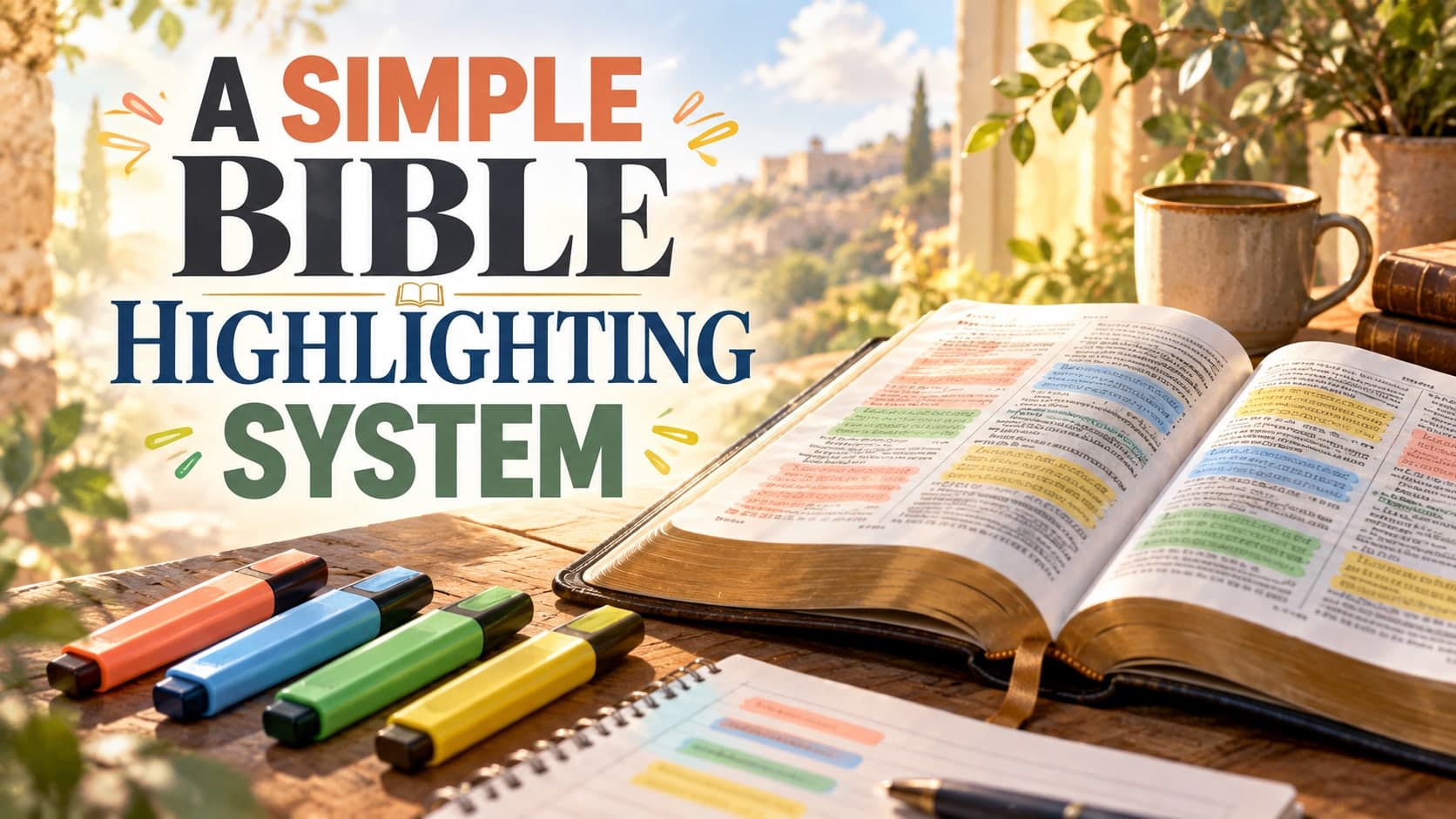
This guide walks you through a simple Bible highlighting system built on four colors. Each color answers one clear question about the text, every single time. You will see exactly how it works, including a real walkthrough of John 3:16 and Psalm 23 so you can watch the colors do their job on verses you already know.
By the end, your Bible will not just be colorful.
✅ It will be a record of what you have actually learned.
Why This Matters for Your Faith
A highlighter is a small thing.
What you do with Scripture is not.
Paul told a young pastor named Timothy exactly what Scripture is for:
"All scripture is given by inspiration of God, and is profitable for doctrine, for reproof, for correction, for instruction in righteousness: That the man of God may be perfect, throughly furnished unto all good works."
Read that list again. Doctrine. Reproof. Correction. Instruction in righteousness.
Scripture does not just inform you.
It is meant to change you, in four distinct ways.
⚠️ If you highlight without a plan, you flatten all four of those into one undifferentiated blur.
Everything looks equally important, so nothing gets prioritized. You cannot tell doctrine from conviction from something you still do not understand.
That is not a small loss.
📌 The stakes are whether your Bible study actually builds your faith, or just makes you feel like it did.
God did not hand you His Word so you could admire it. He handed it to you so you would actually read it and let it change how you live.
A highlighting system that actually works is not a decoration project. It is a tool for taking Scripture seriously enough to remember what it said.
How to Build a Bible Highlighting System That Actually Works
1. Why Highlight at All
Before you pick a single color, ask the real question.
Why highlight in the first place?
Not because everyone else does.
Not because a colorful Bible looks impressive on a shelf.
Highlighting only earns its place if it serves a purpose.
A good Bible highlighting system should let you flip open your Bible months from now and instantly see:
- 📌 What confused you
- 📌 What revealed something about God
- 📌 What connected to another part of Scripture
- 📌 What personally convicted or encouraged you
That is it. Four questions. Four answers.
💡 Highlighting is not decoration. It is communication with your future self.
Your future self is going to open this same page during a hard season, or while teaching a friend, or while wrestling with a passage that will not make sense right away. Give that person something worth finding.
2. Why More Colors Is Not the Answer
When four colors feel like too much, the instinct is to add more.
- 🔵 Blue
- 🟢 Green
- 🟡 Yellow
- 🔴 Red
- 🟣 Purple
- 🟠 Orange
Six colors feel serious. Organized. Spiritual, even.
But without a clear rule behind every color, six colors become just as random as one.
Months later, the page looks vibrant and means nothing.
❓ Blue for what? Purple for why?
⚠️ Color without a rule is not a system. It is decoration wearing a system's clothes.
The Bible itself is not one kind of writing. It holds history, poetry, prophecy, wisdom, letters, and narrative, all in one book. A system with ten fussy rules works fine in Psalms and falls apart the moment it hits Leviticus.
A good system has to be simple enough to survive contact with the whole Bible.
That means fewer colors, not more.
3. The Four Colors, and the One Question Each Answers
Here is the whole system. Four colors. Four questions. Nothing else to memorize.
- 🍑 Peach: What don't I understand yet?
- 🔵 Blue: What does this reveal about God?
- 🟢 Green: What does this connect to?
- 🟡 Yellow: What is this saying to me personally?
The colors themselves do not matter. There is nothing spiritual about the color blue. Swap them for whatever four colors you already own.
What matters is that each color answers exactly one question, the same question, every single time you pick it up.
Let's walk through each one.
4. Peach: What You Don't Understand Yet
Anything unclear gets peach.
A confusing word. A hard phrase. A command that seems to sit next to another one in tension. A name you cannot place.
Peach says three things at once.
- 📌 This needs deeper study
- 📌 Do not skip this
- 📌 Confusion lives here, and that is fine
Solomon told his son to pursue understanding the way you would pursue silver:
"My son, if thou wilt receive my words, and hide my commandments with thee; So that thou incline thine ear unto wisdom, and apply thine heart to understanding; Yea, if thou criest after knowledge, and liftest up thy voice for understanding; If thou seekest her as silver, and searchest for her as for hid treasures; Then shalt thou understand the fear of the LORD, and find the knowledge of God."
Notice the verbs. Receive. Incline. Cry after. Search. None of those describe someone who already understands everything.
Confusion is not evidence that your faith is weak.
It is the starting point Scripture assumes.
Peach keeps your study honest. It marks the gap between what you have read and what you actually understand, so you know exactly where to go back.
5. Blue: What Reveals Who God Is
Blue marks anything directly about God or Jesus. His character. His commands. His promises. Any description of who He is.
This color answers one question every time. Who is God in this passage?
Take the most familiar verse in the whole Bible.
"For God so loved the world, that he gave his only begotten Son, that whosoever believeth in him should not perish, but have everlasting life."
Read it again slowly, and watch where the colors would go.
- 🔵 "For God so loved the world" is blue. That is a statement about who God is.
- 🔵 "that he gave his only begotten Son" is blue too. That is what God did, because of who He is.
- 🟡 "that whosoever believeth in him should not perish, but have everlasting life" is yellow. That is the offer landing directly on you.
One verse. Two colors. Two different jobs.
💡 Blue keeps your eyes on God even in a verse everyone already thinks they know by heart.
When you flip through a Bible full of blue months later, patterns show up. Attributes repeat. Themes strengthen. The character of God gets clearer, verse by verse, without you ever forcing it.
6. Green: What Connects Across Scripture
The Bible was not written by one author in one afternoon. It was written across sixteen centuries, and it still holds together as one story.
Green marks the seams.
- 🔗 An Old Testament promise fulfilled in the New
- 🔗 A theme that repeats across different books
- 🔗 A picture that shows up again somewhere else in Scripture
Look at David's opening line in one of the most familiar psalms ever written.
"The LORD is my shepherd; I shall not want. He maketh me to lie down in green pastures: he leadeth me beside the still waters. He restoreth my soul: he leadeth me in the paths of righteousness for his name’s sake."
🟢 Green belongs on "The LORD is my shepherd." That single image threads through the whole Bible. Centuries later, Jesus picks up the exact same picture and applies it directly to Himself, calling Himself the good shepherd who lays down His life for the sheep.
David did not know he was previewing Jesus.
God did.
Green is the color that proves the Bible is not a pile of unrelated stories. It is one book, with one author standing behind every human hand that wrote it.
7. Yellow: What God Is Saying to You Personally
Yellow is the only color that is entirely about you.
It marks conviction. Encouragement. Comfort. Correction. Whatever presses on your heart the moment you read it.
❓ What is God pressing on your heart right now, in this verse, today?
Yellow will not look the same in your Bible as it looks in anyone else's. The same verse can convict you on a Tuesday and comfort you on a Friday.
Over months, your yellow highlights start telling a story. Seasons of struggle. Seasons of encouragement. Moments where a verse suddenly made sense because of exactly what you were walking through.
✅ That is not a coincidence. That is the Holy Spirit using the same words to meet you exactly where you are, every time you open the page.

Practical Tips for Using Your Bible Highlighting System
A system only works if you actually use it.
Here are eight ways to make it stick.
- Read the whole passage before you highlight anything. Marking as you go turns your Bible into a highlighter fight with your own eyes. Read it through once first. Then go back and mark it with your four colors on the second pass.
- Start with just two colors. If four feels like too much on day one, begin with blue and yellow only. Add peach and green once the habit is set.
- Write the reason in the margin. A single word next to a highlight, like "promise" or "confusing," does more for your future self than the color alone ever will.
- Let peach mean unfinished, not failed. Come back to your peach highlights on purpose every so often. That is where your next season of real study is already waiting for you.
- Protect a few honest minutes before you even pick up the highlighter. A rushed skim will not give you anything worth marking. This is where self control matters more than which color you choose.
- Choose one color when a verse fits two categories. Do not stall out trying to be perfectly precise. Pick whichever color fits best and keep moving.
- Let the system flex across every genre. A law in Leviticus and a psalm in the Psalms will not use your four colors the same way, and that is exactly how it should work.
- Pair your highlighter with real time in the Word, not a shortcut around it. Highlighting supports study. It does not replace sitting down for a real, unhurried hour with God. One works because of the other.
Top 5 Bible Verses About Studying God's Word
You could highlight for years and never run out of verses about studying Scripture itself. But these five are the best place to start.
1. 2 Timothy 2:15
"Study to shew thyself approved unto God, a workman that needeth not to be ashamed, rightly dividing the word of truth."
Paul wrote this to a young pastor named Timothy, and the word "study" here does not mean cramming for a test.
It means work diligently, the way a craftsman works to get every detail right.
📌 "Rightly dividing" means handling Scripture with care, not cutting a verse loose from everything around it.
A highlighting system is one small way to obey this verse. It forces you to slow down and actually look at what a passage says instead of skimming past it.
If your Bible study ever starts feeling careless, come back to this verse and let it reset your pace.
2. Psalm 119:105
"Thy word is a lamp unto my feet, and a light unto my path."
This is the verse that gives Bible highlighting its whole reason for existing.
A lamp does not light up the whole horizon. It lights up the next few steps.
💡 That is exactly what a marked up Bible does. It shows you where you have already found light, so you do not stumble over the same confusion twice.
Every highlight in your Bible is a small lamp you lit for your future self.
Next time you feel lost inside a passage, remember the light was never meant to show you the whole path at once. Just the next step.
3. Joshua 1:8
"This book of the law shall not depart out of thy mouth; but thou shalt meditate therein day and night, that thou mayest observe to do according to all that is written therein: for then thou shalt make thy way prosperous, and then thou shalt have good success."
God gave this command to Joshua the same week Joshua took over leading an entire nation into war.
Not "read this once." Meditate on it day and night.
✅ The promise attached is enormous. Prosperity and good success, tied directly to staying in the Word.
A Bible highlighting system supports exactly this kind of meditation. It gives your eyes a place to land again and again on the same truths, instead of reading a chapter once and never returning to it.
Joshua needed courage for a battlefield. You need it for whatever you are carrying this week. The method God gave him still works.
4. Acts 17:11
"These were more noble than those in Thessalonica, in that they received the word with all readiness of mind, and searched the scriptures daily, whether those things were so."
Luke calls the believers in Berea "more noble" than the ones in the city before them, and here is exactly why.
They did not just listen to Paul preach. They went home and checked what he said against Scripture, every single day.
❓ Would your own Bible study earn that description?
Highlighting with a system is one way to search the scriptures the way the Bereans did. Blue verses become the truths you have confirmed about God. Peach verses become the ones you are still checking.
Nobility, in this verse, just means taking the Word seriously enough to actually look.
5. Psalm 1:2 and 3
"But his delight is in the law of the LORD; and in his law doth he meditate day and night. And he shall be like a tree planted by the rivers of water, that bringeth forth his fruit in his season; his leaf also shall not wither; and whatsoever he doeth shall prosper."
This is the picture the whole highlighting system is really pointing toward.
Not a colorful Bible. A tree planted by water, bearing fruit in its season, leaves that never wither.
📌 That is what delighting in God's Word and meditating on it day and night actually produces.
Your highlights are not the goal. They are roots reaching toward water, one small habit at a time.
Keep this picture in mind every time you open your Bible and pick up a highlighter.

Frequently Asked Questions About Bible Highlighting
What is the best color coding system for highlighting the Bible?
There is no single official system, and that is good news. Some systems use seven or ten colors and collapse under their own complexity within a few weeks. A simple four color system, one color each for confusion, God's character, cross references, and personal application, covers almost everything you will ever need to mark, and it is simple enough to actually keep using.
Should I highlight directly in my Bible or use a separate notebook?
Either one works, so pick whichever you will actually stick with. Highlighting straight in your Bible keeps everything in one place and lets you see patterns as you flip through it. A separate notebook keeps your Bible's pages clean if that matters to you. Neither choice is more spiritual than the other.
Is it wrong to write or highlight in my Bible?
No. Your Bible is a tool for study, not a museum piece. Plenty of faithful Christians fill their margins with notes and their pages with color, and it has never once made Scripture less true or less holy. What matters is your heart toward the Word, not whether the pages stay pristine.
What if a verse fits more than one color?
That happens all the time, and it is normal. Pick whichever color fits the verse best, or add a small secondary mark in the margin if you want to note the second category too. The system exists to serve your understanding of the text. The text does not exist to serve the system.
What highlighters or pens are safe to use in a thin Bible so they do not bleed through?
Look for highlighters or gel pens made specifically for Bible paper, since regular highlighters often bleed or smear on the thin pages. Test any new pen on the very last blank page of your Bible before you use it anywhere that matters. A little patience here saves you from ruining a page you cannot get back.
How do I start highlighting the Bible as a beginner?
Start small. Pick one book, like John or Philippians, and use only two colors for your first few weeks. Read a passage all the way through first, then go back and mark it. Once the habit feels natural, add the other two colors and expand to the rest of your Bible.
Does highlighting actually help you understand the Bible better?
Highlighting helps when it is paired with real reading, not when it replaces it. A system with a clear rule behind every color forces you to ask what a verse actually means before you mark it, which is a form of the careful study Paul told Timothy to pursue. Highlighting alone, with no thought behind the color, adds decoration but not understanding.
Does it matter which Bible translation I highlight in?
Use whichever translation you actually read consistently. This guide quotes from the King James Version, but the four color system works in any translation you own. If you have ever wondered why there are so many Bible translations in the first place, the short answer is that they all aim at the same goal from slightly different angles. Consistency matters far more than which translation you choose.
How often should I go back over my highlighted Bible?
Every few months is a good rhythm, and definitely before any big decision or hard season. Flip back through your peach highlights first and see how many of them finally make sense now. Then read through your yellow highlights and watch the story of your own growth appear on the page.
What if I already highlighted my Bible randomly for years with no system?
You do not need to start over or feel discouraged about the pages you already marked. Simply begin applying the four questions going forward, and add a small margin note next to any old highlight once you remember why you made it. Your Bible can hold both an old, random season of marking and a new, intentional one. Neither one erases the other.
Final Thoughts
If you remember nothing else from this guide, remember these three things.
📌 Highlighting without a plan creates color, not understanding. A Bible covered in random color still leaves you asking why, months later.
📌 Four colors, four questions. What confuses you. What reveals God. What connects to the rest of Scripture. What lands on your heart personally. Nothing else to memorize.
📌 The goal was never a colorful Bible. It was a Bible you understand a little more every time you open it.
You do not need six colors or a complicated key taped inside your cover.
You need four questions, asked the same way, every single time you read.
So here is your one next step.
Open your Bible to wherever you left off. Read the passage all the way through once.
Then go back with a single color, just one, and mark whatever answers that color's question.
Thy word is a lamp unto thy feet, and a light unto thy path. Let your highlighter be part of how you keep that lamp lit.