📖 How to Read the Bible: A Simple Way to Study Scripture So It Actually Sticks
You open your Bible with good intentions.
You read a chapter.
You close it twenty minutes later and cannot remember a single verse.
Not because you were not paying attention. Because nobody ever showed you how to actually read the Bible, only that you should.
📌 If that is you, hear this first. The problem is not your faith. It is your method.
Maybe you have tried the usual advice.
- 🔲 Read a chapter a day.
- 🔲 Start in Genesis and push through.
- 🔲 Just have more discipline.
And maybe you stalled out in Leviticus, the same place almost everyone stalls out, and quietly decided the Bible just is not for people like you.
It is not that you lack discipline.
Reading and studying are two different skills, and nobody separated them for you.
📖 The Bible was never meant to be skimmed like a news feed. It was written to be read slowly, out loud, in community, over a lifetime.
This guide gives you a real, workable way to study Scripture so it starts to stick:
- ✅ The difference between reading and studying
- ✅ A simple set of questions to ask of any passage
- ✅ How to see the whole Bible as one story instead of scattered verses
- ✅ A practical routine you can start tonight, no seminary required
This is not a productivity hack for finishing more chapters. It is a way of coming to God's Word so that it actually changes something.
Get your Bible. Let's open it together, the right way this time.
Why This Matters for Your Faith
You could read a hundred devotionals about God without ever hearing directly from Him.
Devotionals, sermons, and podcasts all have their place.
None of them replace hearing God speak in His own words.
Every other source is someone else's summary. Scripture is the primary source.
📌 How you read the Bible shapes what you believe about God, and what you believe about God shapes everything else.
A Christian who never learns to study Scripture ends up living on borrowed convictions, repeating what a pastor or an influencer said without ever checking it for themselves.
- ❓ Do you actually know what God said, or only what someone told you He said?
- ❓ Could you open Scripture tonight and find comfort for what you are facing?
Learning to study well is not academic. It is part of understanding what the Bible actually is and trusting it enough to build your life on it.
📌 The stakes are not just Bible knowledge. The stakes are whether your faith stands on your own convictions or someone else's.
This guide is about making sure it is your own.
A Simple Way to Actually Study the Bible
1. Separate Reading From Studying
Most people think reading the Bible and studying the Bible are the same activity.
They are not.
Reading gathers information. Studying pursues meaning.
Paul told Timothy exactly what to aim for:
"Study to shew thyself approved unto God, a workman that needeth not to be ashamed, rightly dividing the word of truth."
📌 Notice the word Paul uses. Study. Not skim. Not glance. Study, the way a workman studies a craft.
A workman who never studies his materials makes mistakes he cannot see coming. A Christian who never studies the Word ends up building on guesses.
You do not have to give up reading through Scripture. You just have to add a second gear underneath it, one that slows down long enough to ask what a passage actually means.
2. See the Bible as One Story, Not a List of Verses
The Bible is not a random collection of inspirational quotes.
It is one unified story, told across sixty six books, tying together the accounts of creation, a chosen people, a promised Rescuer, and the church He built after He came.
Each book stands on its own. But every one of them connects.
Themes repeat. Promises made in one book get kept books later.
When you pull a verse out with no sense of where it sits in that larger story, you can make it say almost anything.
💡 Before you ask what a verse means, ask where it sits. Old Testament or New? Before the cross or after? Law, history, poetry, prophecy, gospel, or letter?
That single question saves you from more bad interpretations than any commentary ever will.
3. Ask What It Meant Before You Ask What It Means to You
Most misreadings of Scripture happen because someone skipped straight to "what does this mean for me" without first asking "what did this mean to the people who first heard it."
Look at how the Levites handled Scripture in Nehemiah's day:
"So they read in the book in the law of God distinctly, and gave the sense, and caused them to understand the reading."
They did not just read the words out loud. They gave the sense. They explained it so the people actually understood.
The believers in Berea did the same thing when Paul preached to them:
"These were more noble than those in Thessalonica, in that they received the word with all readiness of mind, and searched the scriptures daily, whether those things were so."
📌 The Bereans are called noble for one reason: they checked everything against Scripture itself, even when an apostle was the one teaching.
Ask these questions of any passage before you move on:
- 👤 Who wrote this, and who were they writing to?
- 📍 What was happening at the time?
- 🧩 What comes right before and right after this passage?
- ➡️ What did the original audience need to hear?
Only after answering those does "what does this mean for me" become a safe question to ask.
4. Meditate, Do Not Just Read
God gave Joshua one instruction as he took over leading Israel, and it was not military strategy.
"This book of the law shall not depart out of thy mouth; but thou shalt meditate therein day and night, that thou mayest observe to do according to all that is written therein: for then thou shalt make thy way prosperous, and then thou shalt have good success."
Meditate does not mean empty your mind. In Scripture it means the opposite: fill your mind with one thing and turn it over slowly, the way a cow chews the same mouthful again and again.
The psalmist describes the same habit in the very first psalm:
"But his delight is in the law of the LORD; and in his law doth he meditate day and night."
"And he shall be like a tree planted by the rivers of water, that bringeth forth his fruit in his season; his leaf also shall not wither; and whatsoever he doeth shall prosper."
💡 A tree planted by a river does not grow overnight. It grows because its roots sit in the water day after day, season after season.
One rushed chapter a day will not grow deep roots. One verse chewed on slowly, for five minutes longer than feels necessary, will.
5. Let the Word Study You Back
Most study methods treat Scripture like a puzzle to solve. That is only half the picture.
"For the word of God is quick, and powerful, and sharper than any twoedged sword, piercing even to the dividing asunder of soul and spirit, and of the joints and marrow, and is a discerner of the thoughts and intents of the heart."
⚠️ A sword this sharp is not only for you to hold. It is meant to cut into you.
You are not just examining the text. The text is examining you. So while you study, ask a second set of questions alongside the historical ones:
- ❓ What does this reveal about who God is?
- ❓ What does this expose about my own heart?
- ❓ Is there a promise here to believe, a command to obey, or a sin to confess?
📌 Bible study that never changes anything about how you live was never finished. It just stopped early.
6. Feed on It Daily, Like Food
Peter compares Scripture to something every believer already understands: appetite.
"As newborn babes, desire the sincere milk of the word, that ye may grow thereby:"
Nobody eats one enormous meal on New Year's Day and calls it nutrition for the year.
Growth comes from a daily habit, not an occasional binge.
Moses told Israel to weave God's words into the ordinary rhythm of a day:
"And these words, which I command thee this day, shall be in thine heart: And thou shalt teach them diligently unto thy children, and shalt talk of them when thou sittest in thine house, and when thou walkest by the way, and when thou liest down, and when thou risest up."
Sitting in the house. Walking down the road. Lying down. Waking up. Ordinary moments, not a special hour reserved for religious people.
If a single quiet hour feels impossible to find, start with a simpler way to spend focused time with God and let it grow from there.
7. Write Down What You Find
Thoughts you do not write down tend to evaporate by lunchtime.
Keep a simple notebook. When a verse stops you, write the reference, one sentence about what it means, and one sentence about what you are going to do about it.
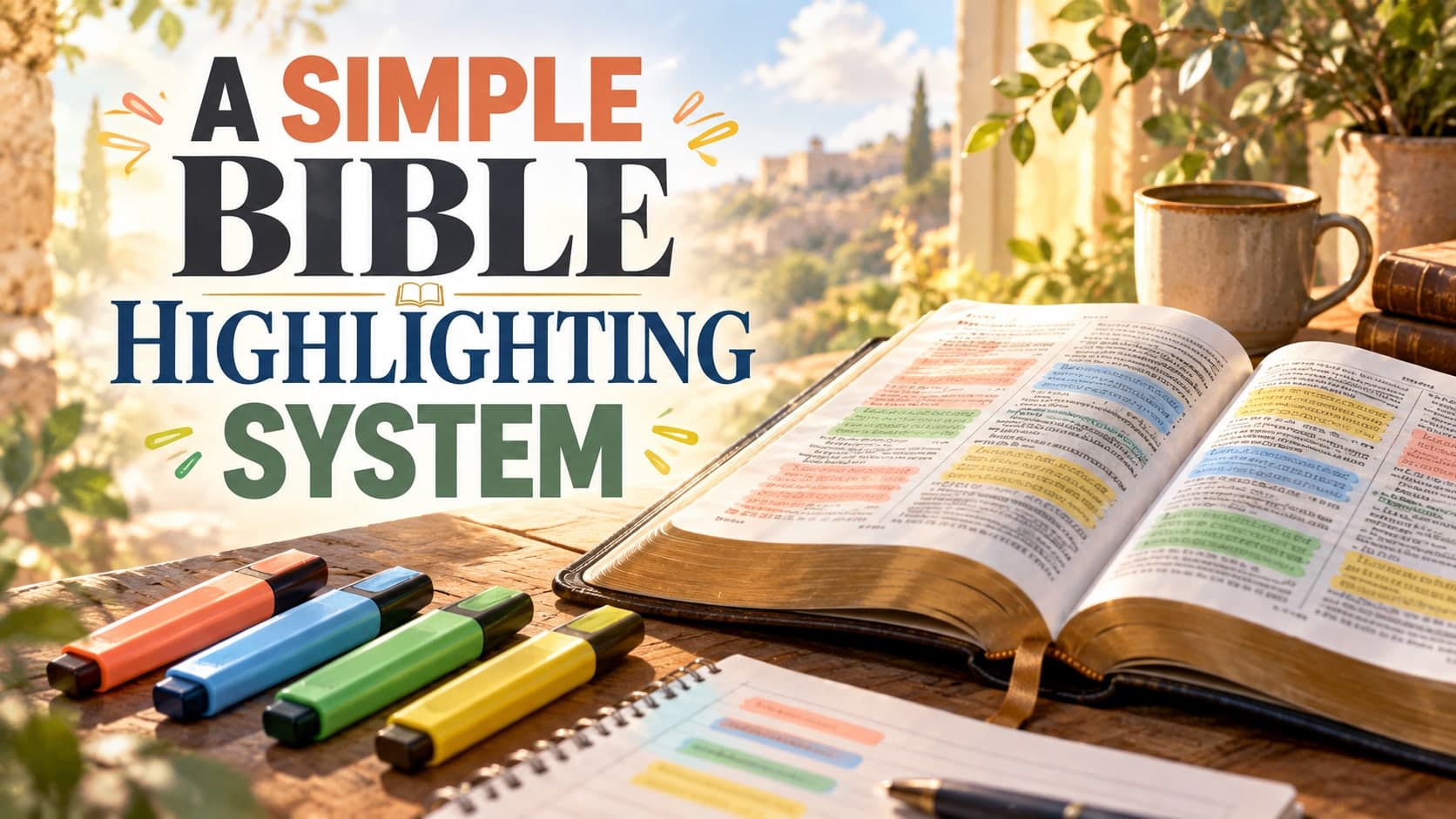
A simple highlighting system in your actual Bible does the same job for verses you want to find again fast.
Six months of that habit becomes a written record of exactly how God has been speaking to you, which is worth more than a shelf of other people's notes.
Practical Tips: A Simple Study Routine to Start Tonight
You do not need forty five minutes and a stack of commentaries to begin.
Here are eight habits that build real understanding over time.
- Pick one short passage, not a whole chapter. Ten verses studied slowly teach you more than three chapters skimmed fast.
- Read it out loud. Your ear catches things your eye skips over. Scripture was heard long before it was silently read.
- Ask who, what, where, and why before what it means for you. Context first, application second, every single time.
- Write one sentence in your own words. If you cannot restate it simply, you have not understood it yet.
- Look for one thing to believe and one thing to do. A promise to trust, or a command to obey. Every passage offers at least one.
- Pray the passage back to God. Turn what you just read into an actual prayer instead of closing the book and moving on.
- Read with someone else. A spouse, a friend, a small group. Understanding grows faster in conversation than in isolation.
- Return to hard passages instead of skipping them. A verse that confuses you today may open up completely in six months, once you understand more of the story around it.
Do not try all eight tomorrow morning.
Pick two. Build the habit. Add another once it feels natural.
Top 5 Bible Verses About Reading and Studying Scripture
1. 2 Timothy 2:15
"Study to shew thyself approved unto God, a workman that needeth not to be ashamed, rightly dividing the word of truth."
This is the clearest command in the New Testament to actually study, not merely possess, God's Word.
"Rightly dividing" is a craftsman's phrase, cutting a straight, accurate line rather than a careless one.
Handling Scripture carelessly is possible even with good intentions. Paul warns against it here.
2. 2 Timothy 3:16 and 17
"All scripture is given by inspiration of God, and is profitable for doctrine, for reproof, for correction, for instruction in righteousness: That the man of God may be perfect, throughly furnished unto all good works."
This is Scripture's own claim about itself. Not a human opinion about the Bible, but the Bible's testimony about its own source.
Four uses listed here: teaching what is true, reproof for what is wrong, correction toward what is right, and training in righteous living.
The goal named at the end is not information. It is a person made complete and equipped.
3. Joshua 1:8
"This book of the law shall not depart out of thy mouth; but thou shalt meditate therein day and night, that thou mayest observe to do according to all that is written therein: for then thou shalt make thy way prosperous, and then thou shalt have good success."
Joshua was about to lead a nation into war. God's strategy was not a battle plan. It was a book, meditated on constantly.
The prosperity promised here is not primarily material. It is the success of a life actually lined up with God's word.
4. Psalm 119:105
"Thy word is a lamp unto my feet, and a light unto my path."
A lamp in that world did not floodlight the horizon. It lit the next few steps.
📌 Scripture rarely reveals your entire future at once. It gives enough light for the step you are on right now.
That is reason enough to keep opening it, even when you cannot see very far ahead.
5. Hebrews 4:12
"For the word of God is quick, and powerful, and sharper than any twoedged sword, piercing even to the dividing asunder of soul and spirit, and of the joints and marrow, and is a discerner of the thoughts and intents of the heart."
"Quick" here means alive, not fast. God's Word is not a dead ancient document. It is living and active.
It reaches places surgery cannot reach, dividing soul from spirit, exposing what you actually think and want underneath what you say you think and want.
That is uncomfortable. It is also exactly what real change requires.
Frequently Asked Questions About Reading the Bible
Where should a beginner start reading the Bible?
Not Genesis straight through to Leviticus, where most attempts die. Start with the Gospel of John to meet Jesus directly, then Genesis for the beginning of the story, then a psalm a day for the language of prayer. Save Leviticus, Numbers, and the detailed law codes for later, once you have more context to make sense of them.
How long should Bible study take each day?
However long you can actually sustain, honestly. Ten focused minutes daily beats one exhausted hour on Sunday that never repeats. Start smaller than feels impressive and let the habit grow on its own once it is established.
Do I need to know Hebrew or Greek to study the Bible?
No. Useful, not required. A good translation, a concordance, and patience will take you remarkably far. The Bereans studied the Scriptures daily without a seminary degree between them, and Scripture calls that noble.
Why is the Bible so hard to understand sometimes?
Some of it is genuinely difficult, written across three languages and roughly fifteen hundred years, in cultures very different from your own. Some of what feels hard, though, is simply unfamiliar, not actually complicated, and clears up with more exposure to the wider story. If you want a deeper look at why some passages feel confusing on purpose, see why Bible study is hard.
Is it wrong to use a study Bible or commentary?
No. Study tools are not a shortcut around Scripture, they are other believers who did careful work handed to you. Use them to check your understanding, never to replace reading the text itself firsthand.
What if I read a passage and get nothing out of it?
That happens to every serious reader of Scripture at some point. Do not force an artificial insight. Note the passage, move forward, and come back to it later. Some seed takes longer to sprout than other seed, and that is not a spiritual failure.
Should I read the Bible in order or jump around?
For your first full pass, a reading plan that moves through books in a sensible order beats jumping randomly, since context builds as you go. Once you know the overall story, topical study and jumping to a specific passage for a specific need both become far more fruitful.
How do I know if I am interpreting a verse correctly?
Check it against its immediate context, against the rest of Scripture, and against what faithful believers have historically understood it to mean. If your reading contradicts a plain teaching found elsewhere in the Bible, the problem is almost always with the new interpretation, not with the rest of Scripture.
What is the best Bible translation for studying?
The one you will actually read consistently, in a version careful enough to trust for study. Comparing translations side by side on a difficult verse can also open up shades of meaning a single version might miss. For more on why different translations exist at all, see why there are so many Bible translations.
How do I stay consistent when I keep falling off?
Attach it to something you already do every day, like coffee or brushing your teeth, so it rides on an existing habit instead of needing its own willpower. And when you miss a day, or a week, simply restart the next day rather than waiting for a fresh new year or a clean slate that never actually arrives.
Final Thoughts
If you remember nothing else from this guide, remember these three things.
📌 Reading and studying are different skills. Reading gathers words. Studying pursues meaning. You need both, in that order.
📌 Context comes before application. Ask what a passage meant to its first readers before you ask what it means for you today.
📌 The Word is meant to study you back. If nothing about how you live ever changes, the study was never finished.
None of this requires a seminary degree. It requires slowing down, asking better questions, and coming back tomorrow.
So here is your one next step.
Open your Bible tonight. Pick ten verses, not a whole chapter.
Read them slowly, out loud, and ask what they meant before you ask what they mean for you.
That is how real Bible study begins. One short, unhurried passage at a time.