📖 Biblical Numbers and Their Meanings: What Scripture Actually Teaches
You have probably seen the graphic.
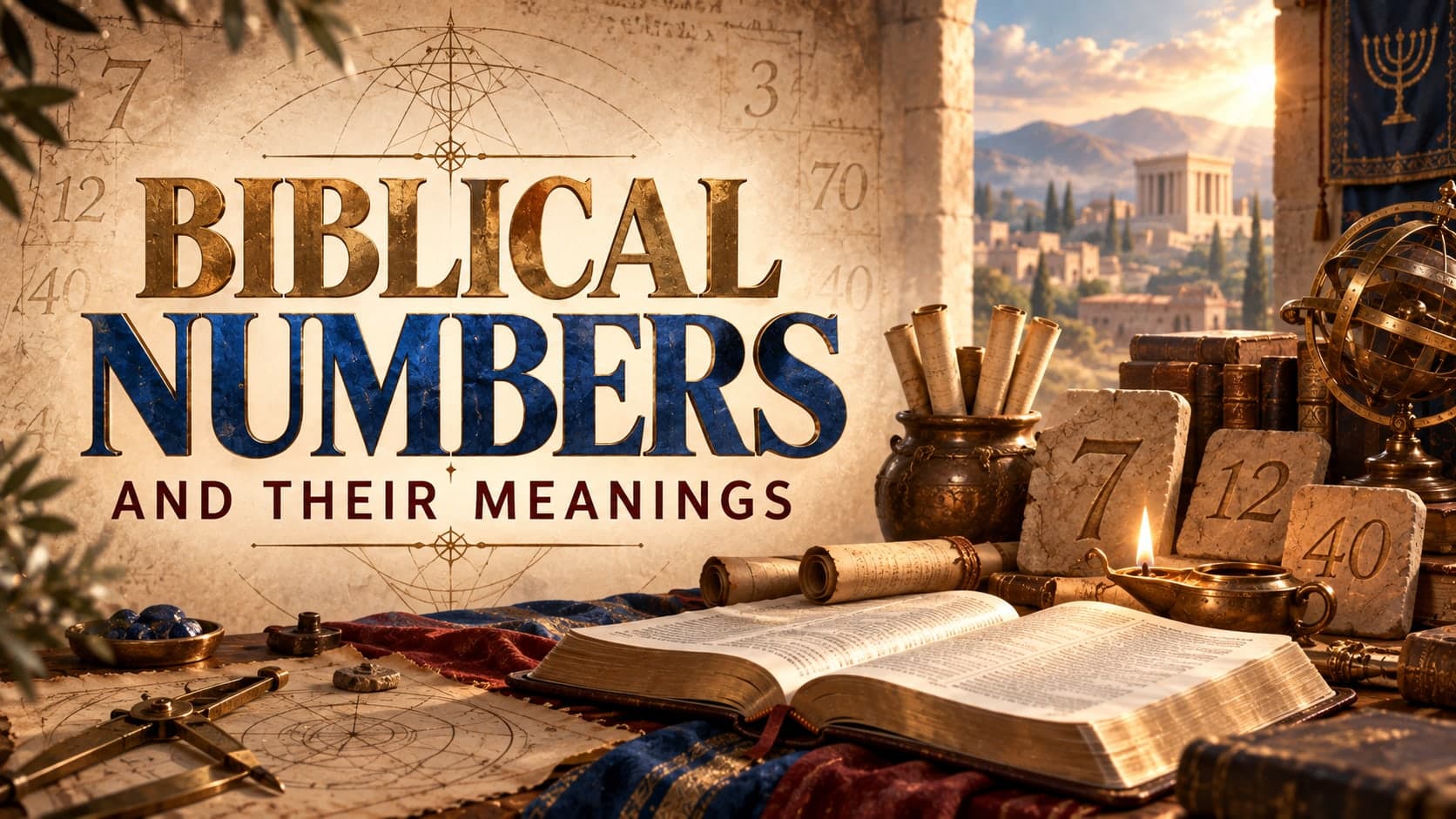
Seven means completion. Forty means testing. Twelve means God's people. A neat little chart of biblical numbers and their meanings, saved from Pinterest, promising that Scripture is hiding a secret code just under the surface.
Some of that chart is true. Some of it is folk tradition dressed up as Bible fact.
And you deserve to know which is which before you build your faith on it.
📌 Scripture really does use numbers with intention. Some patterns show up again and again, in different books, written by different people, hundreds of years apart. That is not superstition. That is design.
But other numbers get meanings pinned on them with no real verse behind the claim. That is not Bible study. That is guessing, and it can quietly slide into the same kind of thinking Scripture actually warns against.
This guide walks through the numbers that matter most in the Bible: one, three, six, seven, ten, twelve, forty, fifty, and the famous six hundred sixty six. For each one, you will get a real verse, not a recycled meme.
Let's separate the pattern from the guesswork.
Why This Matters for Your Faith
This might seem like a fun trivia topic. It is not, entirely.
How you handle numbers in the Bible says something about how you handle the whole book.
⚠️ Treating every number as a secret code is a habit, not a harmless one.
It trains you to look past what a passage plainly says and go hunting for a hidden meaning instead. That is close cousin to the fascination with zodiac signs and horoscopes that Scripture warns believers away from. Both promise a shortcut to hidden knowledge. Neither is how God actually speaks.
On the other hand, ignoring the real patterns is its own mistake.
📌 When the same number keeps showing up on purpose, God is teaching you something.
Seven days of creation. Forty years of wilderness. Twelve tribes, twelve apostles. Those are not coincidences. They are threads God wove through centuries of history to make one point stick.
So this guide draws a clear line. A real pattern gets a real verse. A popular claim without one gets named as exactly that, a guess.
The Numbers Scripture Actually Uses on Purpose
Seven: The Number of Completion
Seven has the strongest support of any number in the Bible.
It starts on day one of Scripture, with the very shape of the week.
"And on the seventh day God ended his work which he had made; and he rested on the seventh day from all his work which he had made. And God blessed the seventh day, and sanctified it: because that in it he had rested from all his work which God created and made."
Six days of work. One day set apart because the work was finished.
📌 Seven marks something whole, not something magic.
That same pattern keeps returning. Seven feasts on Israel's calendar. Seven times Naaman washed in the Jordan. Seven churches, seven seals, and seven trumpets in Revelation. Seven is not a one time detail. It is a pattern that runs the length of the whole Bible.
Twelve: The Number of God's People
Twelve shows up wherever God is gathering a people for Himself.
"All these are the twelve tribes of Israel: and this is it that their father spake unto them, and blessed them; every one according to his blessing he blessed them."
Twelve sons of Jacob became twelve tribes.
Centuries later, Jesus chose twelve apostles, echoing that same number on purpose.
And when John describes the New Jerusalem, the number is still there, gate after gate, foundation after foundation, tribe names and apostle names carved side by side. If you want the full picture Scripture paints of what heaven is actually like, Revelation 21 is the place to start.
📌 Twelve is God's number for a complete, gathered people. Old covenant and new, the number stayed the same.
Forty: The Number of Testing and Transition
No number is tied to hard seasons more consistently than forty.
"And thou shalt remember all the way which the LORD thy God led thee these forty years in the wilderness, to humble thee, and to prove thee, to know what was in thine heart, whether thou wouldest keep his commandments, or no."
Forty days and nights of rain in Noah's flood.
Forty years wandering behind Moses before Israel entered the promised land.
Forty days Jesus fasted in the wilderness before His public ministry began.
📌 Every forty in Scripture marks a season of proving, not punishment for its own sake. Something ends on the other side of it. A flood gives way to dry ground. A wandering people finally cross the Jordan. A tempted Savior begins to teach.
Three: The Number Tied to the Resurrection
Jesus himself pointed back to an Old Testament sign to explain His own death.
"For as Jonas was three days and three nights in the whale's belly; so shall the Son of man be three days and three nights in the heart of the earth."
Paul later summed up the whole gospel the same way, that Christ died, was buried, and rose again on the third day, exactly according to what Scripture had already promised.
📌 Three is the number stamped on the resurrection itself. That gives it real weight, even though the Bible never turns three into a symbol for everything, the way some charts try to.
One, Ten, and Fifty: Numbers of Order
Three more numbers earn their place, each for a specific, textual reason.
One is the number of God Himself.
"Hear, O Israel: The LORD our God is one LORD:"
That single line, called the Shema, is the foundation of Israel's whole faith. One God, not many. Paul echoes it again for the church, one body, one Spirit, one Lord.
Ten is the number of the law God carved into stone.
"And he was there with the LORD forty days and forty nights; he did neither eat bread, nor drink water. And he wrote upon the tables the words of the covenant, the ten commandments."
Ten commandments, a complete moral law in one short set.
Fifty is the number of freedom and new beginnings.
"And ye shall hallow the fiftieth year, and proclaim liberty throughout all the land unto all the inhabitants thereof: it shall be a jubile unto you; and ye shall return every man unto his possession, and ye shall return every man unto his family."
Every fifty years, debts were cancelled and land returned. That same fifty day count also marks Pentecost, the day the church was born, an event Luke records in the book of Acts.
666: What Revelation Actually Says
No number gets more fear and more speculation attached to it than six hundred sixty six.
Here is exactly what the text says, no more and no less.
"Here is wisdom. Let him that hath understanding count the number of the beast: for it is the number of a man; and his number is Six hundred threescore and six."
John calls it the number of a man, tied to a specific figure in his own prophecy. That part is stated plainly in the text.
⚠️ What is not stated plainly is which man, in your own time, that number points to. Christians have guessed at that answer for two thousand years, and nearly all of those guesses have been wrong. Be very careful with anyone confidently naming a living person as the fulfillment of this verse. The verse itself calls for wisdom, not a headline.
Where Popular Numerology Runs Ahead of Scripture
Now the honest part. Not every number on a Pinterest chart has this kind of backing.
Five is often labeled the number of grace. There is no verse that says this. It gets repeated because it sounds spiritual and it rhymes with a few coincidences, like the five wounds of Christ or the five loaves that fed the crowd. That is pattern spotting, not Bible teaching.
Six is often called the number of man, and this one has a thin real basis, since man was created on the sixth day of the creation week.
"And God saw every thing that he had made, and, behold, it was very good. And the evening and the morning were the sixth day."
That single connection is real. But the bigger claim, that six always means humanity or imperfection everywhere it appears, goes well past what that one verse can carry.
Sixty six gets treated as meaningful because the Protestant Bible has sixty six books. That is simply a fact about how the books were later collected, not a teaching Scripture makes about the number itself. No verse assigns sixty six any spiritual meaning. If you want the fuller story of how those books came together as one Bible, that history is worth reading, but the count itself is not a code.
📌 A pattern that repeats across many passages, in different eras, is worth noticing. A single coincidence stretched into a rule is not the same thing.
How to Read Numbers in the Bible Wisely
You do not need a chart memorized to read numbers well. You need a few honest habits.
- Ask what the passage itself says the number means. Genesis 2 tells you why the seventh day is holy. Revelation 13 tells you why six hundred sixty six matters. Let the text explain itself before you reach for a chart.
- Look for repetition across different books. Seven and forty earn their weight because they show up again and again, written centuries apart. One appearance is not a pattern.
- Say "this is a popular tradition" out loud when that is what it is.There is nothing wrong with noticing a coincidence. There is something wrong with teaching it as if God said it.
- Stay away from number based fortune telling. Counting letters or dates to predict the future is not Bible study, no matter how many verses get quoted around it.
Three Verses Worth Remembering
If you only carry three of these forward, make it these.
Genesis 2:2 and 3
The very first pattern in the Bible. Rest was built into creation before sin ever entered the story. Seven is not a trick number. It is the shape of a finished, blessed work.
Deuteronomy 8:2
Whenever your own life feels like it is stuck in a forty, a season with no clear end, this verse names exactly what God is doing. Not abandoning you. Proving what is actually in your heart.
Revelation 13:18
The verse that starts a thousand guesses actually asks for wisdom, not speculation. Read it slowly next time someone hands you a confident theory about who the number points to.
Verses like these read very differently once you slow down and study them line by line. That is exactly what Bible Buddy is built for, and it is free to start any time you want to go deeper than an overview.

Frequently Asked Questions About Biblical Numbers
What does the number seven mean in the Bible?
Seven marks completion and rest, starting with God resting on the seventh day of creation in Genesis 2. The pattern continues through Israel's feasts and into Revelation, where seven churches, seals, and trumpets appear. It is the most consistently supported number in Scripture.
Why does the number forty show up so often in Scripture?
Forty marks a season of testing that ends in something new. Forty days of flood, forty years in the wilderness, forty days of Jesus fasting in the desert. Each time, forty leads somewhere, not nowhere.
What does 666 actually mean in Revelation?
Revelation 13:18 calls it the number of a man, tied to a specific figure John describes in his vision. The text does not name a modern person, and Christians have wrongly guessed at that identity for centuries. Treat confident modern claims with real caution.
Does the number five really mean grace in the Bible?
No verse says this. It is a popular tradition built on a few coincidences rather than a pattern the text points to itself. It is fine to notice it, just not fine to teach it as settled Bible fact.
Do the sixty six books of the Bible have a hidden meaning?
No. That number describes how the Protestant Bible was later compiled, not a spiritual teaching Scripture makes about the number itself. It is a fact about the book's history, not a code inside it.
Final Thoughts
God does use numbers with intention. That part of the Pinterest chart is not wrong.
📌 Seven, twelve, forty, and three carry real, repeated weight across Scripture. One, ten, and fifty each rest on a specific, real passage too.
📌 Five, an extended reading of six, and sixty six do not have that same support. Notice them if you want. Just do not preach them as settled truth.
The safest way to hold all of this is simple. Let a real, repeated pattern teach you something about God's character. Let a coincidence stay a coincidence.
The best next step is not memorizing a number chart. It is opening the actual passages these numbers come from and reading them slowly, in context, the way they were written.