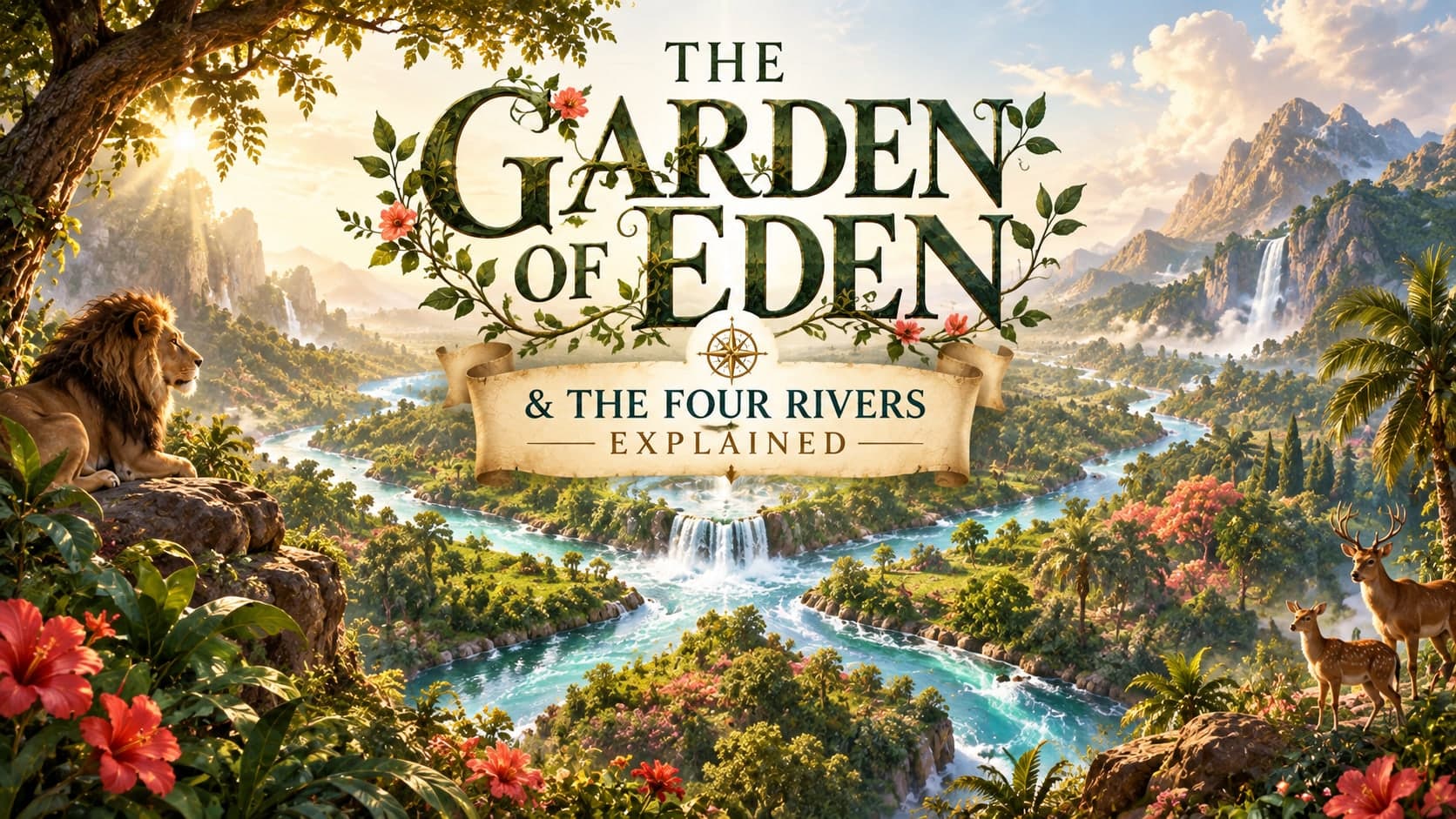
📖 The Garden of Eden & the Four Rivers Explained
You have probably seen the graphic.
A garden. One river flowing out of it. Then splitting into four.
Maybe it even had a little map, confidently marking where the garden of Eden and its four rivers supposedly sat.
📌 Here is the good news. This is not just a meme. It is real Bible geography, straight out of Genesis 2.
But here is the catch.
A lot of what circulates online quietly adds details Genesis never gives, and skips past details it actually does.
Most graphics stop right after the four rivers. They never show you what happened next. The cherubim. The flaming sword. The tree of life, guarded and out of reach.
Maybe you landed here because a sermon mentioned Eden and you wanted the real verses, not just the summary. Or maybe you just want to know if any of this is still true today, in an actual place, on an actual map.
This guide walks through what Scripture actually says about Eden, the two trees, Adam's job there, all four rivers by name, and what happened to the garden after Adam and Eve were sent out.
And it will be honest with you about where the text stops talking and where guesswork begins.
Let's open Genesis and look for ourselves.
Why Eden Is Worth Getting Right
It would be easy to treat Eden like a fairy tale setting. A once upon a time garden.
Genesis, the book traditionally credited to Moses, does not write it that way.
It names a real river system. Real regions. Real minerals in the ground. That is not how you open a fable.
📌 Eden is presented as an actual place, at the start of actual history.
That matters, because Eden is where the Bible first shows you what life with God was meant to look like. Work without frustration. A clear command instead of confusion. Close, unhidden fellowship with God.
Everything that goes wrong later in Scripture is measured against what was true here first.
⚠️ And Eden is not just where the story starts. It is where the Bible tells you what was lost, and what will one day be given back.
That is why this passage deserves a slow, careful read instead of a five second glance at a graphic.
What Genesis Actually Says About Eden
1. The Garden God Planted
Genesis is specific about where this starts.
"And the LORD God planted a garden eastward in Eden; and there he put the man whom he had formed."
Notice the small but important detail. Eden is the wider region. The garden is the specific plot God planted inside it, eastward within that land.
Inside that garden, two trees get named on purpose.
"And out of the ground made the LORD God to grow every tree that is pleasant to the sight, and good for food; the tree of life also in the midst of the garden, and the tree of knowledge of good and evil."
- 🌲 The tree of life, standing in the middle of the garden.
- 🌲 The tree of knowledge of good and evil, a separate tree, also named.
Two different trees, two different roles in the story. Popular retellings sometimes blur them into one tree. Genesis keeps them distinct.
💡 Keep that tree of life in mind. It shows up one more time before this guide is done, and not in Genesis.
2. Adam's Job and the One Command
Eden was not a place to sit idle. Adam had work to do there, before sin ever entered.
"And the LORD God took the man, and put him into the garden of Eden to dress it and to keep it."
💡 Work is not a punishment from the fall. It came first. Adam was given responsibility over the garden while everything was still very good.
Right after that, God gave one clear boundary.
"And the LORD God commanded the man, saying, Of every tree of the garden thou mayest freely eat: But of the tree of the knowledge of good and evil, thou shalt not eat of it: for in the day that thou eatest thereof thou shalt surely die."
⚠️ Here is one place a lot of graphics get ahead of the text. This command was spoken to the man alone. Eve had not been formed yet. That happens later in the same chapter. Genesis never records God repeating the command to her directly, only that she knew it, whichever way it reached her.
One tree, freely available, minus one. That was the whole boundary. Not a maze of rules. A single line, clearly drawn, in a garden of abundance.
3. One River, Four Heads
Now the part your pin was actually about.
Genesis describes a single river flowing out of Eden to water the garden, then splitting into four.
"And a river went out of Eden to water the garden; and from thence it was parted, and became into four heads. The name of the first is Pison: that is it which compasseth the whole land of Havilah, where there is gold; And the gold of that land is good: there is bdellium and the onyx stone. And the name of the second river is Gihon: the same is it that compasseth the whole land of Ethiopia. And the name of the third river is Hiddekel: that is it which goeth toward the east of Assyria. And the fourth river is Euphrates."
One small correction worth making here. The King James Bible spells the first river Pison, not the more common modern spelling "Pishon." Different Bible translations spell some names differently. Same river, same Hebrew word underneath.
Here is what Genesis tells you about each one:
- 🟢 Pison flows around the land of Havilah, described as having gold, bdellium, and onyx stone.
- 🟢 Gihon flows around the land the King James Version calls "Ethiopia," translating the Hebrew word Cush.
- 🟢 Hiddekel is named plainly as flowing east of Assyria. Bible scholars widely agree this is the river known today as the Tigris.
- 🟢 Euphrates is named directly, no explanation needed, because it was already a well known river to the original readers.
✅ Two of the four you can find on a modern map right now. The Tigris and Euphrates still run through the Middle East today, roughly through modern Iraq, Syria, and Turkey.
📌 The other two are the honest mystery. Havilah and the region Genesis calls Ethiopia are not confidently located by scholars today. The Hebrew word Cush shows up elsewhere in Scripture connected to regions near Mesopotamia, not only to Africa, so even that identification is genuinely debated. No river flowing today has been proven to be the Pison or the Gihon of Genesis 2.
4. What We Know, and What We Do Not
This is the part any honest guide has to say plainly. Genesis does not give a modern address for Eden.
Because two of the four rivers point toward Mesopotamia, most careful readers place Eden somewhere in that general region, likely near where the Tigris and Euphrates once began. That is a reasonable, text based guess.
⚠️ It is still a guess. Any map that pins an exact spot with total confidence is going further than Genesis does. Geography can shift dramatically over thousands of years, and Scripture simply does not tell us what became of the garden itself.
What Genesis does tell us is what happened after Adam and Eve sinned.
"Therefore the LORD God sent him forth from the garden of Eden, to till the ground from whence he was taken. So he drove out the man; and he placed at the east of the garden of Eden Cherubims, and a flaming sword which turned every way, to keep the way of the tree of life."
The way back to the tree of life was guarded, not left standing open. That single detail is why this passage rewards slow, careful reading rather than a quick glance at a graphic. Studying it verse by verse, the way you can free inside Bible Buddy, brings out details like this that a summary always flattens.
5. The Cherubim, the Sword, and the Tree of Life's Return
Look again at what got left behind at the door of Eden.
Not a locked gate. Not a wall.
Cherubims, and a flaming sword that turned every way.
Cherubim show up again and again in Scripture as guardians of God's holy presence. You find them woven into the curtains of the tabernacle. You find them stationed over the mercy seat in the holy of holies. Here, at the very start, they are already doing the same job. Standing where sinful people cannot casually walk back into unguarded access to God.
📌 The flaming sword was not cruelty. It was mercy in disguise. Eating from the tree of life while carrying sin would have locked humanity into an endless fallen state. God closed the door to protect a future, not just to punish a mistake.
⚠️ This is the thread most graphics leave out completely. They show you four rivers and call it done. They never follow the tree of life to see where it goes next.
Because it does go somewhere. All the way to the last chapter of the Bible.
"Blessed are they that do his commandments, that they may have right to the tree of life, and may enter in through the gates into the city."
💡 Read that against Genesis 3:24. There, the way to the tree was guarded and shut. Here, there is a right to enter, through open gates, into a city.
No cherubim blocking the road this time. No flaming sword turning every way. The gates stand open to anyone whose sin has been dealt with.
If you want to walk through the whole chapter that sets this thread in motion, in order, verse by verse, Genesis 2 explained covers it start to finish.
📌 What sin closed in a garden, Christ reopens in a city. That is not a coincidence Genesis and Revelation share. It is the whole Bible telling one story.

How to Read This Passage Well
Genesis 2 rewards slow readers, not skimmers.
Here are seven ways to actually dig into it this week.
- Read Genesis 2 itself, not just a summary of it. Learning how to read the Bible slowly pays off here. Five minutes with the actual text beats scrolling ten graphics about it.
- Hold the location question loosely. Enjoy the puzzle of the Tigris and Euphrates without needing the other two rivers pinned down to feel settled.
- Notice that work came before sin. Adam tended a garden in a perfect world before sin ever entered the picture. Reading who Adam was in Scripture shows he was a caretaker and a namer first, not just the man who fell.
- Mark the passage for yourself. A simple highlighting system makes it easy to come back to Genesis 2 later and see the whole picture at a glance.
- Trace the four rivers on a modern map. Open a map and find the Tigris and Euphrates for yourself. Then notice how much harder Havilah and Cush are to pin down. Seeing the real geography makes the honest mystery feel less abstract.
- Look up Havilah and Cush in a Bible dictionary. A good Bible dictionary will show you every other place those names appear in Scripture. That wider view is more useful than any single map graphic, because it shows you the debate instead of hiding it.
- Read Genesis 2 alongside Revelation 22, then journal it. Put the two chapters side by side. Write down what "very good" meant before the fall, and what gets restored in Revelation. Seeing the beginning and the end together is one of the clearest ways to see the whole Bible as one story.
None of these take more than a few minutes.
Pick two to start this week. Not all seven.
Key Verses on the Garden of Eden
You could study this chapter for weeks. Start with these four.
Genesis 2:9
"And out of the ground made the LORD God to grow every tree that is pleasant to the sight, and good for food; the tree of life also in the midst of the garden, and the tree of knowledge of good and evil."
The center of the garden held a choice, not just beauty. Everything pleasant to look at surrounded one tree that would define the rest of human history.
Two trees, side by side, both named on purpose.
📌 God did not hide the tree of knowledge in a corner. He put it right where Adam and Eve would see it every day. The boundary was never about distance. It was about trust.
Genesis 2:15
"And the LORD God took the man, and put him into the garden of Eden to dress it and to keep it."
Two verbs, dress and keep, describe purposeful, meaningful labor. God placed Adam there on purpose, with a job, not just a view.
💡 Your work is not a side effect of the fall. It is part of how God designed people from the very beginning, before anything went wrong.
That should change how you see your own Monday morning.
Genesis 3:24
"So he drove out the man; and he placed at the east of the garden of Eden Cherubims, and a flaming sword which turned every way, to keep the way of the tree of life."
This is the verse the graphics skip.
The tree of life did not disappear. It stayed exactly where it was. What changed was access.
⚠️ Cherubim and a flaming sword are not decoration. They mark a real, guarded boundary between sinful people and unrestricted access to life with God.
Read this verse before you read Revelation 22. It makes the ending land much harder.
Revelation 22:1 and 2
"And he shewed me a pure river of water of life, clear as crystal, proceeding out of the throne of God and of the Lamb. In the midst of the street of it, and on either side of the river, was there the tree of life, which bare twelve manner of fruits, and yielded her fruit every month: and the leaves of the tree were for the healing of the nations."
💡 The Bible ends where it began. A river. A tree of life. Access restored. What sin closed off in Genesis 3, Revelation shows opened again for good.
No cherubim guarding this river. No flaming sword. Just water flowing straight from the throne of God, and a tree bearing fruit every single month.
✅ That is not a different garden. It is the same promise, finished.
Frequently Asked Questions About the Garden of Eden
Where was the Garden of Eden located?
Genesis does not give exact coordinates. Because two of the four rivers, the Hiddekel and the Euphrates, are identified with the Tigris and Euphrates, most careful readers place Eden broadly in the ancient Mesopotamia region. That is an educated guess drawn from the text, not a stated location, so it is worth holding without excessive certainty.
Was the Garden of Eden a real place?
Genesis describes it with the same kind of real world detail used for actual geography elsewhere in Scripture, naming rivers, regions, and minerals. It is written and treated as a real place, even though its exact site is not known to us today. The text simply does not read like a fable, and that detail matters when you weigh how seriously to take it.
Are the Pishon and Gihon rivers still around today?
No river today has been confidently matched to the Pison or Gihon of Genesis 2. Some scholars have proposed candidates over the centuries, but none is settled. Only the Hiddekel and Euphrates are widely agreed to correspond to rivers that still flow today.
What happened to the Garden of Eden?
Genesis says Adam and Eve were sent out after they sinned, and that cherubim with a flaming sword were placed to guard the way to the tree of life. Scripture does not say what became of the garden's physical location after that, so anything beyond that point is speculation rather than a biblical claim.
Could the Garden of Eden still exist today?
Scripture never says the garden was destroyed, but it also never says where it stands now. Thousands of years of floods, war, and shifting rivers make any modern claim to have found it unreliable. The honest answer is that we simply do not know, and Genesis does not ask you to know. What it does promise is that the tree of life was not lost forever.
What do the cherubim and flaming sword mean?
They mark a guarded boundary, not a random obstacle. Cherubim appear elsewhere in Scripture guarding the presence of God, including over the mercy seat in the tabernacle. The flaming sword that "turned every way" made the tree of life impossible to sneak past. It was God protecting people from an endless fallen state, not simply punishing them.
Were the tree of life and the tree of knowledge the same tree?
No. Genesis 2:9 names them as two separate trees growing in the same garden. The tree of life stood in the middle of the garden, and the tree of knowledge of good and evil is named right alongside it as a distinct tree with its own role in the story.
Is Havilah a real place?
Havilah is named as a real region in Genesis, tied to gold, bdellium, and onyx stone, and the name shows up again later in the Old Testament. But its exact location has not been confidently identified by modern scholars. It is treated in Scripture as a genuine place, just one whose location has been lost to time rather than one that was ever fictional.
Does the tree of life appear again anywhere in the Bible?
Yes, in the very last chapter of Revelation. It stands beside a river flowing from the throne of God, bearing fruit every month, and its leaves are for the healing of the nations. What cherubim and a flaming sword guarded in Genesis 3, Revelation shows made freely available again, this time through gates that stand open.
Final Thoughts
Strip away the graphics and the guesswork, and here is what actually stands in Genesis 2 and 3.
📌 A real garden, planted by God, with two named trees and one clear command.
📌 Four real rivers. Two you can trace on a map today, the Hiddekel and the Euphrates. Two that remain an honest mystery, the Pison and the Gihon.
📌 Work and responsibility, given to Adam before sin ever entered the picture.
📌 A guarded door, and a promise it would not stay guarded forever. Cherubim and a flaming sword closed the way to the tree of life. Revelation shows that same tree standing again, with gates thrown open.
The location is worth understanding. The relationship it pictures is worth wanting back.
That is exactly what Revelation promises, a garden opened again, a tree of life within reach, for anyone who trusts God's Son.
Read Genesis 2 and Revelation 22 for yourself this week. Slowly. Verse by verse.
You will notice details a graphic never had room for.