📖 Exodus 19 Explained: The Covenant Offer at Mount Sinai
Three months of walking, and the camp finally stops in front of the mountain for good.
Exodus 19 explained is the chapter where Israel reaches the exact place this whole journey has been aimed at since before the first plague ever fell on Egypt. God does not open with commands here. He opens with an offer, and waits for an answer before a single rule gets spoken out loud.
Maybe you have wondered what it would actually feel like to stand that close to God.
- ❓ What does it mean that Israel would be a "peculiar treasure"?
- ❓ Why does touching the mountain carry a death sentence?
- ❓ Why does Moses keep climbing up and down the same slope?
- ❓ And why does God want an answer from the people before He gives them a single law?
📌 Exodus 19 is a proposal before it is a law code. God asks Israel to agree to a relationship, and only then starts explaining what it will look like.
This walkthrough goes through the whole chapter in order: the arrival at Sinai, the offer of a covenant, Israel's answer, the washing and the boundary lines, the fire and smoke on the mountain, and the warning Moses carries up and down the slope one more time before the Ten Commandments are ever spoken.
Read slowly. This chapter sets the terms for everything that follows it in the Bible.
What Happened Just Before This Chapter
Exodus 18 closed on a quiet note. Jethro visited, watched Moses collapse under the weight of judging every dispute alone, and talked him into appointing able, God fearing men to carry the smaller cases. Water was solved. Food fell every morning. Amalek had been beaten back. For the first time in several chapters, the camp had room to breathe.
Exodus 19 opens with Israel moving on from Rephidim into the wilderness of Sinai, the same stretch of desert where Moses first met God at the burning bush on Horeb, another name for this same mountain. Everything since that bush, the plagues, the sea, the bread, the water, the war, has been leading Israel back to the exact place where Moses was first called.

Exodus 19 Explained Verse by Verse
1. Arrival at Sinai, Third Month (verses 1 and 2)
The chapter opens with a date, the same way several chapters before it have.
"In the third month, when the children of Israel were gone forth out of the land of Egypt, the same day came they into the wilderness of Sinai."
"For they were departed from Rephidim, and were come to the desert of Sinai, and had pitched in the wilderness; and there Israel camped before the mount."
Jewish tradition remembers this arrival as the sixth day of that third month, the same point on the calendar later marked every year at the Feast of Weeks. Whatever the exact date, Scripture is careful to tie the whole nation's arrival to a specific, countable moment after Egypt, not a vague "sometime later."
📌 Israel camps "before the mount." Every chapter until now has moved Israel somewhere else. This one stops. The mountain is the destination the whole journey out of Egypt has been building toward.
2. The Covenant Offer: Eagles' Wings and a Kingdom of Priests (verses 3 to 6)
Moses goes up the mountain before anything is announced to the camp.
"And Moses went up unto God, and the LORD called unto him out of the mountain, saying, Thus shalt thou say to the house of Jacob, and tell the children of Israel;"
"Ye have seen what I did unto the Egyptians, and how I bare you on eagles' wings, and brought you unto myself."
💡 God starts by reminding Israel of what they have already seen, not what they are about to owe Him. The eagle picture is not decoration. An eagle is said to carry its young on its own wings, bearing the weight itself rather than making the young one fly alone. That is the picture God chooses for the exodus He just finished.
"Now therefore, if ye will obey my voice indeed, and keep my covenant, then ye shall be a peculiar treasure unto me above all people: for all the earth is mine:"
"And ye shall be unto me a kingdom of priests, and an holy nation. These are the words which thou shalt speak unto the children of Israel."
💡 Peculiar in 1611 English did not mean strange. It meant one's own, set apart, a treasure kept for a particular owner. The Hebrew word behind it describes a treasured possession set apart from everything else a person owns. Israel is not being called odd. Israel is being called claimed.
📌 Notice the order: rescue first, relationship second, instructions third. God does not open with a list of demands. He opens with what He has already done, then offers a relationship, and only after that starts explaining what obedience will look like.
3. Israel's Answer, and Moses the Go-Between (verses 7 to 9)
Moses comes down and puts the offer to the people exactly as it was given to him.
"And Moses came and called for the elders of the people, and laid before their faces all these words which the LORD commanded him."
"And all the people answered together, and said, All that the LORD hath spoken we will do. And Moses returned the words of the people unto the LORD."
⚠️ Israel says yes before hearing a single commandment. No Ten Commandments have been given yet. No law code exists. The people agree to the relationship first, in full, and the details come after the agreement, not before it. That order matters for reading everything from Exodus 20 onward correctly: the law is not the price of being chosen, it is the shape of a relationship Israel already said yes to.
Moses carries that answer back up, and God explains why the next step will look the way it does.
"And the LORD said unto Moses, Lo, I come unto thee in a thick cloud, that the people may hear when I speak with thee, and believe thee for ever. And Moses told the words of the people unto the LORD."
📌 The whole public spectacle that follows has one stated purpose: so Israel will trust Moses for the rest of his life. Every future law Moses brings down from this mountain rests on something the whole nation heard with their own ears this one time, not on Moses' word alone. The same cloud that guided the camp as a pillar of cloud and fire now becomes the cloud God speaks out of.
4. Getting Ready to Meet a Holy God (verses 10 to 15)
God gives Moses two days to prepare the entire nation for the third.
"And the LORD said unto Moses, Go unto the people, and sanctify them to day and to morrow, and let them wash their clothes,"
"And be ready against the third day: for the third day the LORD will come down in the sight of all the people upon mount Sinai."
Washing clothes is an outward act, something every single person in the camp could actually do with their own hands. It does not clean a heart. It is a visible way of saying this day is not an ordinary day, acted out in the body before anything is asked of the soul.
Then comes a boundary line nobody may cross.
"And thou shalt set bounds unto the people round about, saying, Take heed to yourselves, that ye go not up into the mount, or touch the border of it: whosoever toucheth the mount shall be surely put to death:"
"There shall not an hand touch it, but he shall surely be stoned, or shot through; whether it be beast or man, it shall not live: when the trumpet soundeth long, they shall come up to the mount."
⚠️ Even an animal that wanders onto the mountain by accident does not survive it. The penalty is not about intent. It is about proximity to something holy enough that nearness without preparation is simply fatal, the same way a hand does not need to mean harm to get burned by fire.
Moses goes back down to put all of this into motion.
"And Moses went down from the mount unto the people, and sanctified the people; and they washed their clothes."
"And he said unto the people, Be ready against the third day: come not at your wives."
💡 This instruction is temporary and total, not a verdict on marriage itself. Israel is being asked to set aside every ordinary comfort and routine, including the most intimate one, so that nothing about these three days feels like business as usual.
5. The Mountain on Fire (verses 16 to 19)
The third morning arrives, and nothing about it looks ordinary.
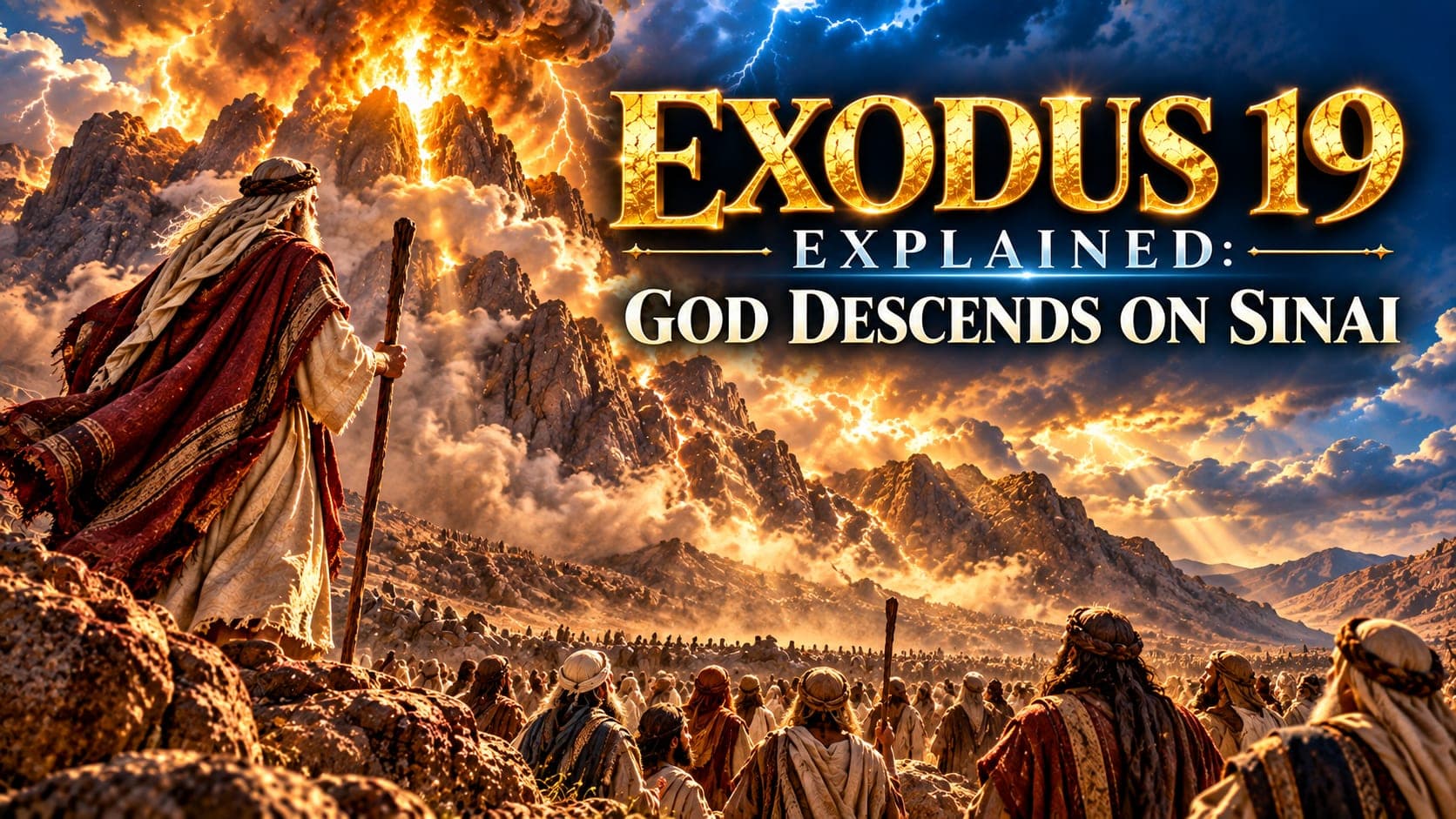
"And it came to pass on the third day in the morning, that there were thunders and lightnings, and a thick cloud upon the mount, and the voice of the trumpet exceeding loud; so that all the people that was in the camp trembled."
"And Moses brought forth the people out of the camp to meet with God; and they stood at the nether part of the mount."
📌 Moses leads the people toward the terror, not away from it. Every instinct would say to keep the camp as far from thunder and fire as possible. Moses brings them out to meet it, because the point of the whole chapter was never to avoid God, it was to be ready for Him.
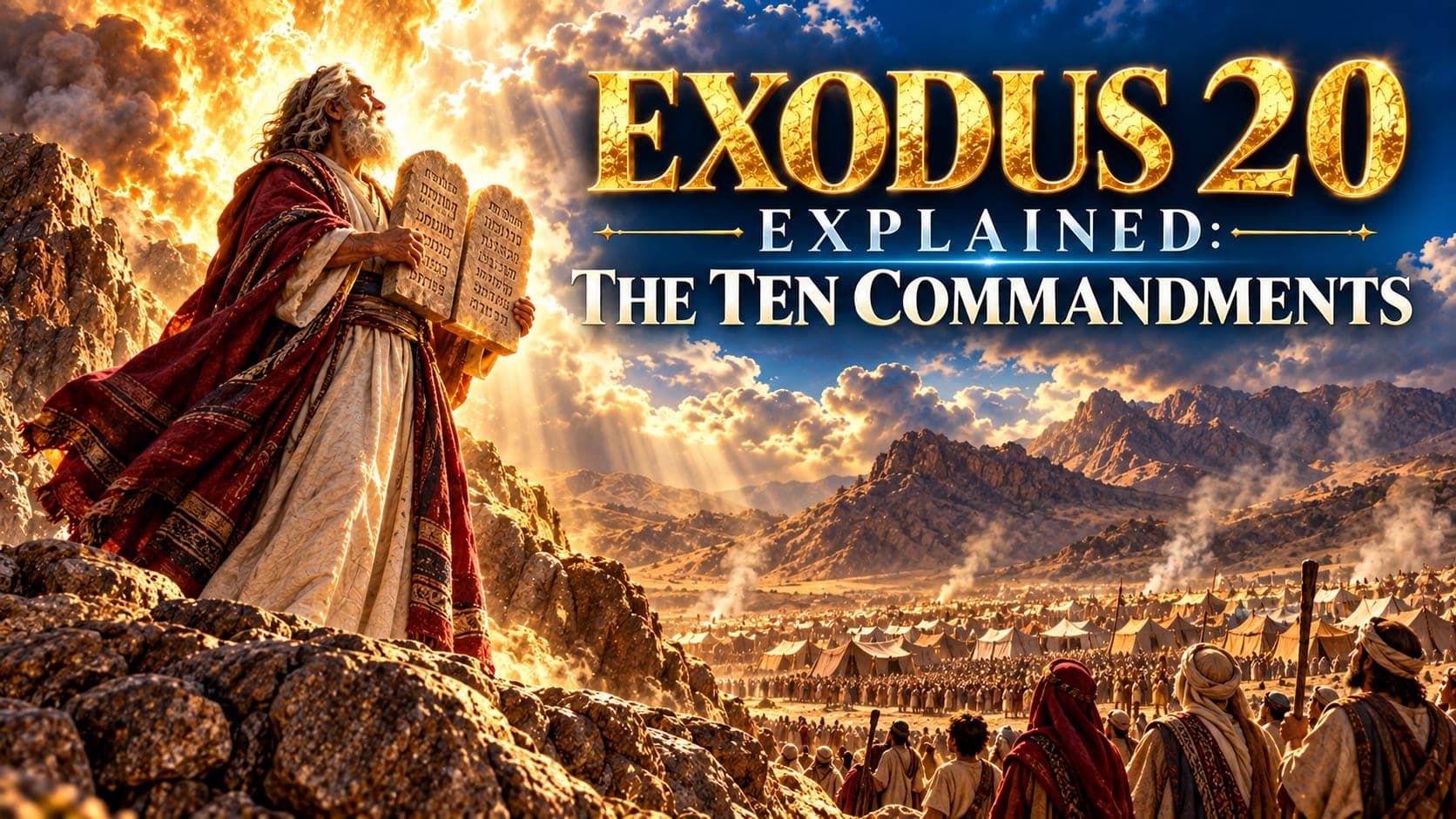
"And mount Sinai was altogether on a smoke, because the LORD descended upon it in fire: and the smoke thereof ascended as the smoke of a furnace, and the whole mount quaked greatly."
"And when the voice of the trumpet sounded long, and waxed louder and louder, Moses spake, and God answered him by a voice."
A mountain that quakes, smokes like a furnace, and burns with fire is not a metaphor here. It is the visible, physical shape of what it costs a holy God to come close enough for an entire camp to hear Him speak.
6. One More Warning Before the Words Are Spoken (verses 20 to 25)
Before a single commandment is given, God calls Moses up one more time with one more caution.
"And the LORD came down upon mount Sinai, on the top of the mount: and the LORD called Moses up to the top of the mount; and Moses went up."
"And the LORD said unto Moses, Go down, charge the people, lest they break through unto the LORD to gaze, and many of them perish."
📌 By this point in the chapter, Moses has already climbed this slope several times. Up in verse 3, down to speak to the elders, back up with their answer, down again to sanctify the camp, and now up once more for a final warning. The whole chapter is built on Moses physically carrying words back and forth between two parties who cannot yet stand in the same place.
"And let the priests also, which come near to the LORD, sanctify themselves, lest the LORD break forth upon them."
"And Moses said unto the LORD, The people cannot come up to mount Sinai: for thou chargedst us, saying, Set bounds about the mount, and sanctify it."
Moses actually pushes back here, pointing out that the boundary God commanded already makes this new warning unnecessary. It is a small, easy to miss detail: Moses feels free to question God's instruction out loud, and gets an answer rather than a rebuke.
"And the LORD said unto him, Away, get thee down, and thou shalt come up, thou, and Aaron with thee: but let not the priests and the people break through to come up unto the LORD, lest he break forth upon them."
"So Moses went down unto the people, and spake unto them."
⚠️ Only Moses and Aaron are named exceptions, and even that comes with a repeated warning attached. The chapter ends exactly where the Ten Commandments are about to begin, with Moses standing between a trembling camp and a mountain on fire, having gone up and down it one final time.

Hard Questions Exodus 19 Raises
Why does simply touching the mountain carry a death sentence? The text does not explain the mechanism, only the fact: whosoever touches the mount, man or beast, dies. The point the chapter keeps making is that holiness is not a feeling. It has a real boundary, and ignoring that boundary carries a real cost, whether or not the one crossing it meant any disrespect.
What does "a kingdom of priests, and an holy nation" actually mean? In the Old Testament, priests stood between God and everyone else, carrying people's need for God and God's word back to the people. Calling the whole nation a kingdom of priests means every single Israelite, not one priestly family alone, was meant to live that same in between role toward the surrounding nations. 1 Peter 2:9 later applies this exact language to the church, which is why many Christians read Exodus 19:6 as a pattern that gets picked up again, not retired.
Is the covenant offered here the same kind of promise God made to Abraham? God's promise to Abraham in Genesis came with no "if" attached to it. The offer in Exodus 19:5 opens with "if ye will obey my voice indeed." Many Bible teachers distinguish the two for exactly this reason: Abraham's covenant rests on God's own word alone, while the covenant at Sinai is explicitly conditioned on Israel's obedience. Both are real and both come from the same God, but they are not the same shape of promise.
Does telling married couples "come not at your wives" mean sex is sinful or unclean? The instruction is given for three specific days, not as a permanent rule, and nothing elsewhere in Scripture treats marriage itself as something to be ashamed of. The point was total, temporary consecration, setting aside every normal routine, not a verdict on marriage.
Where exactly is Mount Sinai? Scripture gives no modern coordinates. Long tradition and most maps place it at Jebel Musa in the southern Sinai Peninsula. A smaller number of researchers have argued for a site across the Gulf of Aqaba in what is now Saudi Arabia instead. Scholars disagree, and the exact modern location does not change anything the chapter actually says happened there.
Top Verses From Exodus 19
1. Exodus 19:4 and 5
"Ye have seen what I did unto the Egyptians, and how I bare you on eagles' wings, and brought you unto myself. Now therefore, if ye will obey my voice indeed, and keep my covenant, then ye shall be a peculiar treasure unto me above all people: for all the earth is mine:"
Rescue first, offer second. God grounds the whole covenant proposal in what He has already done, not in what Israel still owes Him.
2. Exodus 19:6
"And ye shall be unto me a kingdom of priests, and an holy nation. These are the words which thou shalt speak unto the children of Israel."
One of the most far reaching identity statements in the Old Testament, picked up again centuries later for an entirely new covenant people.
3. Exodus 19:8
"And all the people answered together, and said, All that the LORD hath spoken we will do. And Moses returned the words of the people unto the LORD."
A full yes, spoken together, before a single law had been given. The promises come after the agreement, not the other way around.
4. Exodus 19:18
"And mount Sinai was altogether on a smoke, because the LORD descended upon it in fire: and the smoke thereof ascended as the smoke of a furnace, and the whole mount quaked greatly."
The clearest physical picture in the chapter of what it costs a holy God to come close enough to be heard.
5. 1 Peter 2:9
"But ye are a chosen generation, a royal priesthood, an holy nation, a peculiar people; that ye should shew forth the praises of him who hath called you out of darkness into his marvellous light;"
Centuries later, Peter hands Exodus 19:6's exact language, "holy nation" and "peculiar," to a church made up of people who were never physically present at Sinai.

Frequently Asked Questions About Exodus 19
What happens in Exodus 19?
Israel arrives at Mount Sinai three months after leaving Egypt. God offers Moses a covenant for the nation, promising they will be His treasured possession and a kingdom of priests if they obey Him, and the people agree to everything before any law is given. Moses then prepares the camp for three days, setting boundaries around the mountain and having the people wash their clothes and abstain from marital relations, and on the third day God descends on the mountain in fire, thunder, and smoke while the people tremble below.
What does "peculiar treasure" mean in Exodus 19:5?
In the King James English of 1611, "peculiar" meant one's own special possession, not strange or odd. The phrase describes Israel as a treasure set apart and claimed by God, the same sense carried by the Hebrew word behind it.
What does "kingdom of priests, and an holy nation" mean?
A priest represented people before God and carried God's word back to people. Calling the entire nation a kingdom of priests meant every Israelite, not one tribe or family alone, was meant to live out that in between role toward the nations around them. 1 Peter 2:9 applies the same language to the church centuries later.
Why did the Israelites have to wash their clothes before meeting God?
Exodus 19:10 and 14 describe washing clothes as part of sanctifying the people for the third day. It was an outward, physical act every person could actually do, marking the day as set apart from ordinary life before anything deeper was asked of them.
Why was touching Mount Sinai punishable by death?
Exodus 19:12 and 13 state the penalty plainly without explaining the mechanism behind it. The boundary treats nearness to an unprepared encounter with God's holiness as dangerous in itself, the same way getting too close to fire burns a hand regardless of intent.
Does Exodus 19:15 mean sex is sinful or unclean?
No. The instruction covers three specific days, not a permanent rule, and nothing elsewhere in Scripture treats marriage as shameful. It asked couples to set aside every normal comfort for a short, total consecration ahead of meeting God.
Where is Mount Sinai located?
The Bible gives no modern coordinates. Long tradition points to Jebel Musa in the southern Sinai Peninsula, while a minority of researchers argue for a site in modern Saudi Arabia. Scholars disagree, and the chapter's meaning does not depend on settling the exact modern location.
Did Moses go up and down the mountain more than once in this chapter?
Yes. Exodus 19 shows Moses climbing Sinai and returning to the camp several times, carrying God's words down and the people's answer back up, a pattern that pictures the role he plays as mediator between the two.
Is the covenant in Exodus 19 the same as God's promise to Abraham?
No. God's promise to Abraham in Genesis carried no condition attached to it. The covenant offered in Exodus 19:5 opens with "if ye will obey my voice indeed," making Israel's side of the agreement explicitly conditional in a way Abraham's was not.
How does Exodus 19 connect to the New Testament?
1 Peter 2:9 hands the exact phrases "holy nation" and "peculiar people" from Exodus 19:6 to the church, applying language first spoken to Israel at Sinai to a people made up of Jews and Gentiles alike who never stood at the base of that mountain.
Final Thoughts
Exodus 19 never gets to the Ten Commandments. It spends the whole chapter on what comes before them, and that order is the point.
📌 Rescue comes before rules. God reminds Israel what He already did for them before He ever asks anything of them. Obedience in this chapter is a response to grace already given, not a transaction to earn it.
📌 Israel said yes before hearing the details. "All that the LORD hath spoken we will do" was spoken about words not yet given. That kind of trust, agreeing to the relationship before seeing every term of it, is tested hard in the chapters right after this one.
📌 Nearness to a holy God was never casual. Washed clothes, marked boundaries, a mountain on fire: this chapter refuses to let meeting God feel ordinary.
So here is one thing to actually do with this chapter.
Read Exodus 19:4 and 5 again, slowly, and notice which word comes first: what God already did, or what God is asking. Let your own obedience this week start from the same place Israel's was asked to.