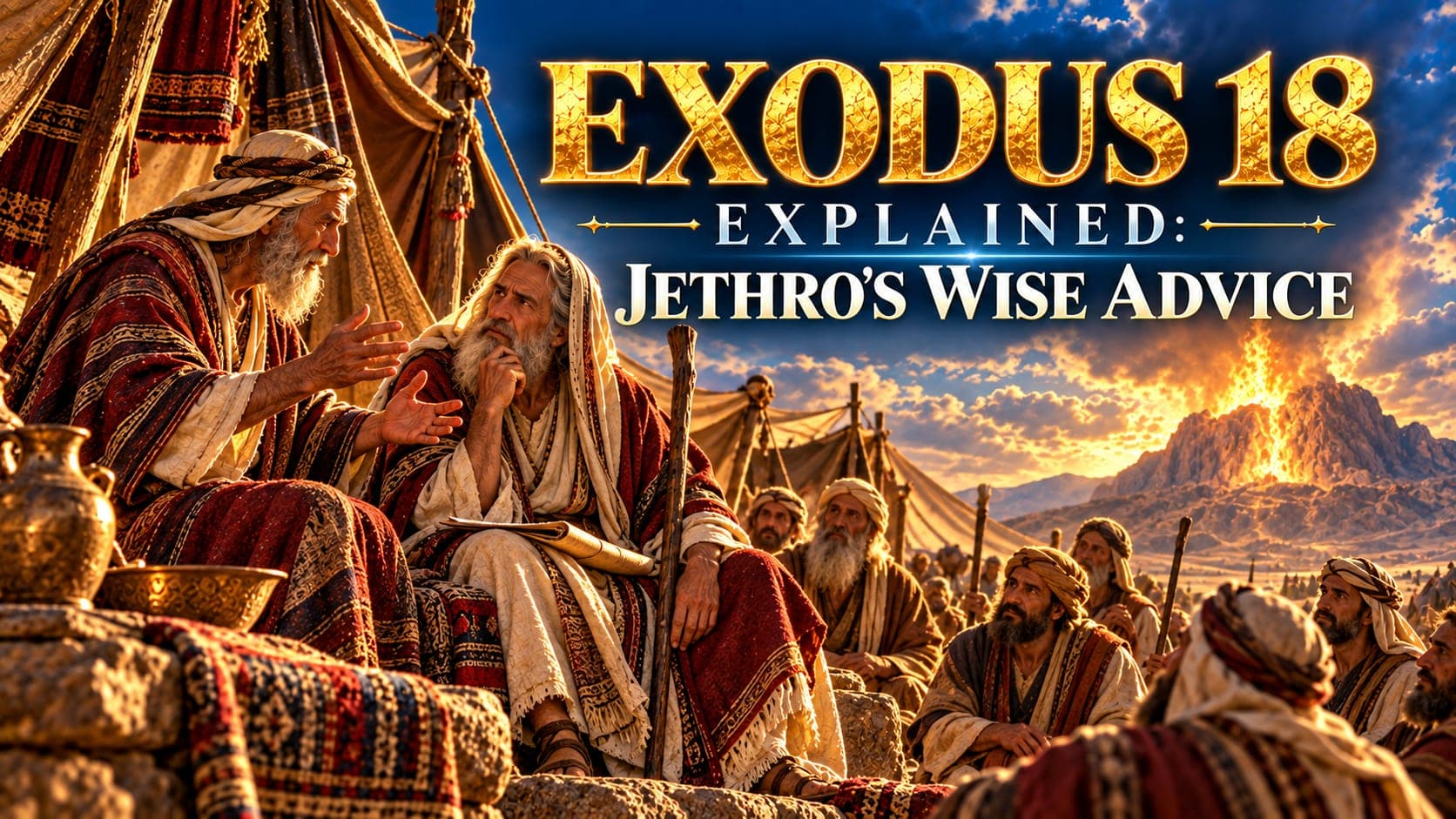
📖 Exodus 18 Explained: Jethro's Visit and Israel's First Judges
No plague in this chapter. No enemy. No miracle at all, really. Just a father in law showing up with news that travels faster than armies do.
Exodus 18 explained is the chapter where the fighting finally pauses long enough for a family to reunite. Jethro arrives at the camp with Zipporah and her two sons, hears the whole story of what God did at the sea, and ends up giving Moses the single most practical piece of advice he receives in the entire book. Then Moses does something that will shape Israel for centuries: he actually takes the advice.
Maybe you have never thought of a father in law as part of God's plan for a nation.
- ❓ Why was Zipporah not even with Moses when this chapter opens?
- ❓ Is Jethro the same man Exodus 2 calls Reuel?
- ❓ Did Jethro become a believer in the LORD here, or was he already one?
- ❓ And why does one tired man sitting in a chair all day become a whole chapter of Scripture?
📌 Exodus 18 is the Bible's case study in a leader who is willing to hear correction from someone outside his own authority, and change because of it.
This walkthrough goes through the whole chapter in order: the family Jethro brings back, the names of Moses' two sons, the sacrifice and meal at the mountain of God, the line forming in front of Moses from morning to night, Jethro's blunt diagnosis, and the system of judges that comes out of one honest conversation.
Read slowly. This chapter has more to say about doing everything yourself than you might expect.
What Happened Just Before This Chapter
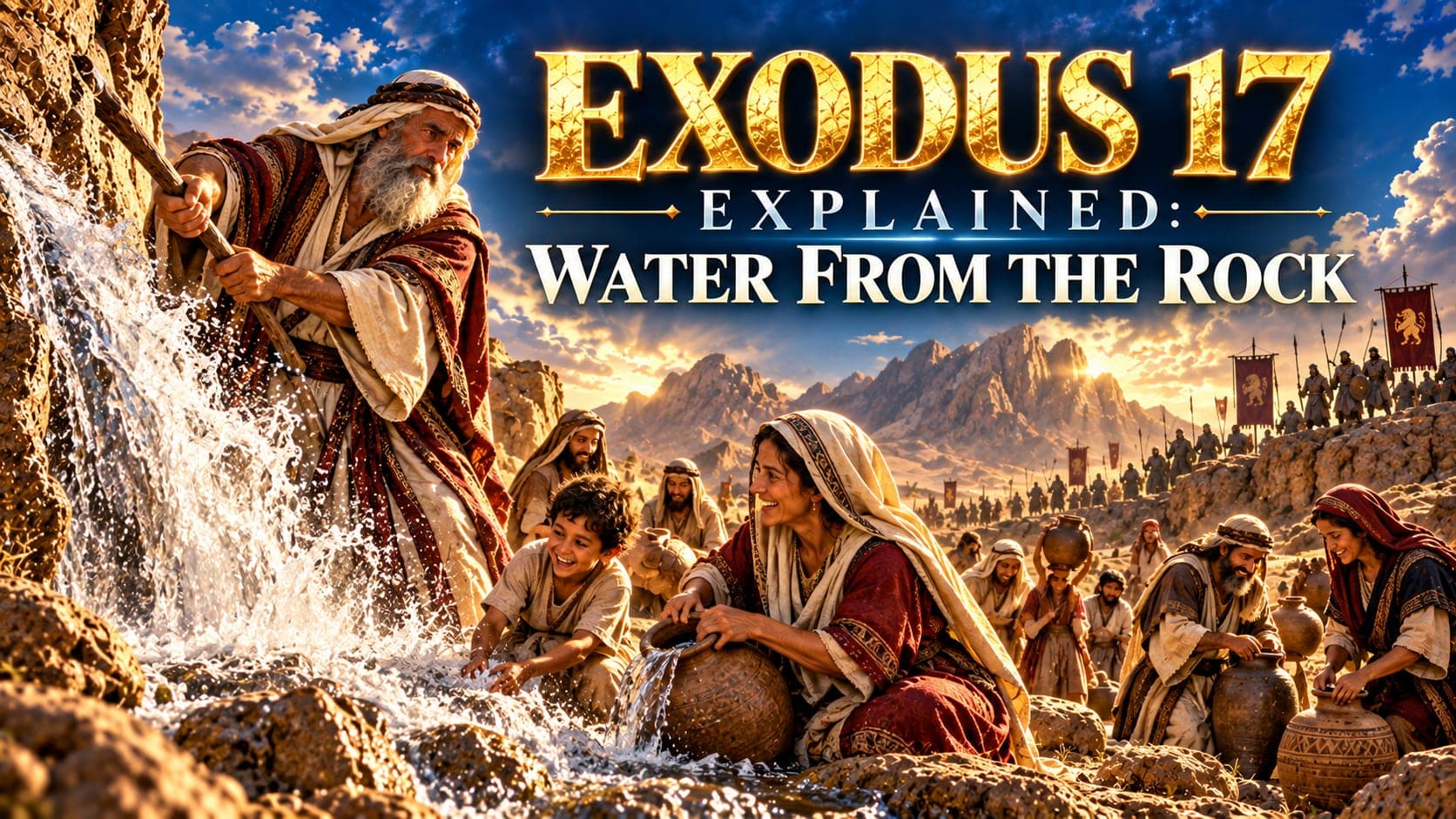
Exodus 17 ended with Israel's first war since leaving Egypt. Amalek attacked at Rephidim, Joshua led the fight on the ground, and the battle turned on Moses holding up his hands on a hill, with Aaron and Hur steadying his tired arms until sundown. Moses built an altar afterward and called it Jehovahnissi, "the LORD is my banner," and wrote down what happened as a memorial.
Exodus 18 opens still at that same camp, Rephidim, now called the wilderness near "the mount of God." Water is solved. Food falls every morning. Amalek has been beaten back. For the first time in several chapters, nothing in the camp is actively on fire. Into that quiet, a visitor arrives from outside the camp entirely.

Exodus 18 Explained Verse by Verse
1. Jethro Hears What God Did (verses 1 and 2)
The chapter opens with news reaching a man who was nowhere near the sea when it happened.
"When Jethro, the priest of Midian, Moses' father in law, heard of all that God had done for Moses, and for Israel his people, and that the LORD had brought Israel out of Egypt;"
Jethro, the priest of Midian, is already a familiar figure to Moses. Midian traces back to Abraham's son by Keturah in Genesis 25, which makes Jethro a distant relative of the very people Moses is now leading. He is not a stranger showing up out of nowhere. He is family, and the news of the Red Sea has reached him before Moses ever sent for him.
"Then Jethro, Moses' father in law, took Zipporah, Moses' wife, after he had sent her back,"
That last clause, "after he had sent her back," is the only place the text mentions this. Nowhere earlier does Exodus narrate Moses sending Zipporah and the boys away. We know from Exodus 4 that she traveled with Moses toward Egypt in the first place. Somewhere between then and the Red Sea, she went back to her father's household, and the Bible simply never tells us when or why.
2. Two Sons, Named After Exile and Rescue (verses 3 and 4)
The chapter pauses to explain the two names Moses gave his sons, and both names are small confessions.
"And her two sons; of which the name of the one was Gershom; for he said, I have been an alien in a strange land: And the name of the other was Eliezer; for the God of my father, said he, was mine help, and delivered me from the sword of Pharaoh:"
💡 Gershom sounds like the Hebrew for "a stranger there," and Moses names his own son after the years he spent as a foreigner in Midian, running from Pharaoh. Eliezer means "my God is help," naming a rescue that, at the time the boy was born, had not happened yet in full. Moses was still a shepherd in exile when he picked that name, trusting a help he had not yet fully seen.
📌 Both names describe Moses' own story before they describe anything his sons would do. A father naming a child after what he has survived, and after what he is still waiting on God to do, is not a strange thing. It is one of the oldest things in Scripture.
3. A Reunion at the Mountain of God (verses 5 to 9)
Jethro does not send word ahead and wait. He travels the whole way himself.
"And Jethro, Moses' father in law, came with his sons and his wife unto Moses into the wilderness, where he encamped at the mount of God:"
"And Moses went out to meet his father in law, and did obeisance, and kissed him; and they asked each other of their welfare; and they came into the tent."
⚠️ The most powerful man in Israel walks out to greet his father in law and bows to him first. Moses leads a camp that has just crossed a sea and fought a war, and none of that changes how he treats his own family. The reunion happens before any business does.
"And Moses told his father in law all that the LORD had done unto Pharaoh and to the Egyptians for Israel's sake, and all the travail that had come upon them by the way, and how the LORD delivered them."
"And Jethro rejoiced for all the goodness which the LORD had done to Israel, whom he had delivered out of the hand of the Egyptians."
Moses does not lead with the thirst, the hunger, or the complaints that filled the last three chapters. He tells the deliverance, and only then the hardship along the way. Jethro's reaction is not polite interest. The text names it plainly: he rejoiced.
4. "Now I Know": Jethro's Confession and Sacrifice (verses 10 to 12)
Hearing the story out loud moves Jethro from rejoicing to a direct statement about who God is.
"And Jethro said, Blessed be the LORD, who hath delivered you out of the hand of the Egyptians, and out of the hand of Pharaoh, who hath delivered the people from under the hand of the Egyptians."
"Now I know that the LORD is greater than all gods: for in the thing wherein they dealt proudly he was above them."
📌 "Now I know" is the language of a conclusion being reached, not a fact being repeated. As a priest of Midian, Jethro already worshipped some version of God before this day. What the Exodus story does is settle the comparison for him, the same way it settled the comparison for Israel in the song of Exodus 15: no other claim to power held up against what Egypt's own pride had just run into.
Jethro does not stop at words. He brings an offering.
"And Jethro, Moses' father in law, took a burnt offering and sacrifices for God: and Aaron came, and all the elders of Israel, to eat bread with Moses' father in law before God."
Aaron and the elders of Israel sit down to eat with a Midianite priest, in front of God, at the very mountain where the law will soon be given. Before Israel becomes a nation set apart, it shares a meal with an outsider who just recognized the same LORD they serve.
5. One Man, One Chair, All Day Long (verses 13 to 16)
The warmth of the reunion gives way, the very next morning, to something Jethro cannot ignore.
"And it came to pass on the morrow, that Moses sat to judge the people: and the people stood by Moses from the morning unto the evening."
"And when Moses' father in law saw all that he did to the people, he said, What is this thing that thou doest to the people? why sittest thou thyself alone, and all the people stand by thee from morning unto even?"
💡 Jethro's question is not an accusation. It is an outsider's eyes catching something everyone inside the system had stopped noticing. A line that stretches from morning to evening had probably looked normal to Israel by now. It took someone who had just arrived to ask why.
"And Moses said unto his father in law, Because the people come unto me to enquire of God: When they have a matter, they come unto me; and I judge between one and another, and I do make them know the statutes of God, and his laws."
Moses' answer is not laziness or control. It is a man who genuinely believes every dispute in the camp needs to pass through him personally, because every dispute is really a question about God's own statutes and laws. The motive is good. The method is about to break him.
6. Jethro's Advice: Find Men, Share the Weight (verses 17 to 23)
Jethro names the problem without softening it.
"And Moses' father in law said unto him, The thing that thou doest is not good."
"Thou wilt surely wear away, both thou, and this people that is with thee: for this thing is too heavy for thee; thou art not able to perform it thyself alone."
📌 Jethro says the cost falls on two parties, not one. Moses will wear away, and so will the people, still standing in line while their leader burns out in front of them. A bottleneck at the top does not only hurt the person stuck at the top.
Then comes the plan, not just the diagnosis.
"Hearken now unto my voice, I will give thee counsel, and God shall be with thee: Be thou for the people to God-ward, that thou mayest bring the causes unto God: And thou shalt teach them ordinances and laws, and shalt shew them the way wherein they must walk, and the work that they must do."
"Moreover thou shalt provide out of all the people able men, such as fear God, men of truth, hating covetousness; and place such over them, to be rulers of thousands, and rulers of hundreds, rulers of fifties, and rulers of tens:"
Notice what the list actually asks for: able men comes first, but the next three qualities are all about character, not skill: fearing God, truthful, hating covetousness. Capability opens the list. Integrity fills the rest of it.
"And let them judge the people at all seasons: and it shall be, that every great matter they shall bring unto thee, but every small matter they shall judge: so shall it be easier for thyself, and they shall bear the burden with thee."
"If thou shalt do this thing, and God command thee so, then thou shalt be able to endure, and all this people shall also go to their place in peace."
⚠️ Jethro himself does not treat his own advice as final. "If thou shalt do this thing, and God command thee so" leaves room for Moses to take this back to God rather than simply obey a father in law because he said so. Good counsel from outside still submits to confirmation from above.
7. Moses Listens, and a Nation Gets Its First Court System (verses 24 to 27)
What happens next is the part of this chapter easiest to read past too quickly.
"So Moses hearkened to the voice of his father in law, and did all that he had said."
📌 Moses does not defend his old method, and he does not do half of what Jethro suggested. He hearkened, and did all that he had said. The man who argued with God at his own calling and who has led a whole nation through a sea takes correction from his father in law without a recorded word of pushback.
"And Moses chose able men out of all Israel, and made them heads over the people, rulers of thousands, rulers of hundreds, rulers of fifties, and rulers of tens."
"And they judged the people at all seasons: the hard causes they brought unto Moses, but every small matter they judged themselves."
The line that stood from morning to evening in verse 13 simply stops existing. Small matters get decided on the spot by men already proven able and God fearing. Only the hard causes, the ones that genuinely need Moses, still reach him.
"And Moses let his father in law depart; and he went his way into his own land."
Jethro does not stay to run anything or claim credit for the system now in place. He gives the counsel, watches Moses act on it, and goes home. The chapter closes as quietly as it began, with a family visit that reshaped how an entire nation would be governed.

Hard Questions Exodus 18 Raises
Is Jethro the same man Exodus 2 calls Reuel? Exodus 2:18 names Zipporah's father Reuel, while this chapter and several others call him Jethro. The text never explains the two names side by side. The two common explanations among careful readers are that Jethro was a priestly title attached to a personal name, Reuel, or that Reuel was the head of the wider family and Jethro his son and Zipporah's actual father. Scripture itself does not settle which explanation is correct.
Was Jethro a believer in the LORD before this chapter, or did he convert here? The text calls him "the priest of Midian" in verse 1, already a man with some religious standing before he ever hears Israel's story. His words in verse 11, "now I know," describe a comparison being settled rather than a god being discovered for the first time. Most careful readers take this as Jethro moving from a broader respect for God toward a specific conviction that the LORD stands above every rival claim to power, not as his very first encounter with the idea of God at all.
Does this chapter happen before or after the events at Sinai in Exodus 19? Exodus 18:5 already places Jethro's visit "at the mount of God," yet Exodus 19:1 and 2 describes Israel arriving at Sinai as though for the first time. Deuteronomy 1:9 to 15 also recounts Moses appointing capable leaders, but places that account after the law had already been given at Sinai. Many conservative scholars read Exodus 18 as placed here for thematic reasons, grouped with the other wilderness testing chapters before the giving of the law rather than strictly by the order events occurred. Others read it as happening exactly where it sits, with Deuteronomy 1 referring to a related, later stage of the same ongoing arrangement. The text itself does not resolve the exact timeline.
Is Jethro's advice merely good human wisdom, or was it from God? Jethro frames his own counsel carefully in verse 23: "if thou shalt do this thing, and God command thee so." The text does not record God speaking this plan to Moses directly before Moses acts on it. What it does show is Moses, a man who regularly hears from God directly, recognizing sound counsel when he hears it and acting on it without waiting for a separate, private revelation to confirm what was already plainly wise.
Top Verses From Exodus 18
1. Exodus 18:11
"Now I know that the LORD is greater than all gods: for in the thing wherein they dealt proudly he was above them."
A priest from outside Israel reaches the same conclusion Pharaoh's whole empire was forced to learn the hard way, simply by hearing the story told honestly.
2. Exodus 18:14
"What is this thing that thou doest to the people? why sittest thou thyself alone, and all the people stand by thee from morning unto even?"
One honest question from a visitor exposes a problem the whole camp had quietly accepted as normal.
3. Exodus 18:18
"Thou wilt surely wear away, both thou, and this people that is with thee: for this thing is too heavy for thee; thou art not able to perform it thyself alone."
A warning that doing everything alone does not just cost the leader. It costs everyone waiting on him.
4. Exodus 18:21
"Moreover thou shalt provide out of all the people able men, such as fear God, men of truth, hating covetousness; and place such over them, to be rulers of thousands, and rulers of hundreds, rulers of fifties, and rulers of tens:"
Capable opens the list, but three of the four qualities named are about character: God fearing, truthful, and free of greed.
5. Acts 6:3
"Wherefore, brethren, look ye out among you seven men of honest report, full of the Holy Ghost and wisdom, whom we may appoint over this business."
Centuries later, the apostles face the same overload Moses faced and reach for the same answer: find able, trustworthy people and actually hand them real responsibility.

Frequently Asked Questions About Exodus 18
What happens in Exodus 18?
Jethro, Moses' father in law, hears about the Exodus and brings Zipporah and her two sons, Gershom and Eliezer, to Moses at the mountain of God. After hearing the full story, Jethro offers sacrifice and declares that the LORD is greater than all gods. He then watches Moses judge the people alone from morning to evening, tells him this cannot continue, and advises him to appoint able, God fearing men as judges over smaller matters. Moses follows the advice, and Jethro returns home.
Who was Jethro in the Bible?
Exodus 18:1 names Jethro as the priest of Midian and Moses' father in law. He is also called Reuel in Exodus 2:18, a difference Scripture never directly explains, and he appears as a man already holding some religious standing of his own before this chapter's events.
Why was Zipporah not with Moses before this chapter?
Exodus 18:2 simply says Jethro brought her back "after he had sent her back," without explaining when or why Moses sent her and their sons away. Exodus 4:20 shows her traveling toward Egypt with Moses at the start of the journey, so the separation happened sometime between then and this reunion, a detail the text does not fill in.
What do the names Gershom and Eliezer mean?
Exodus 18:3 and 4 explain both names directly. Gershom reflects Moses calling himself "an alien in a strange land," and Eliezer means "my God is help," naming the rescue Moses was still waiting to see in full when the boy was born.
Did Jethro become a believer in Exodus 18?
Exodus 18:11 records Jethro saying "now I know that the LORD is greater than all gods," language that fits someone reaching a firm conclusion rather than meeting the idea of God for the very first time. He is already called a priest in verse 1, before he ever hears Israel's story told.
Why couldn't Moses keep judging every case by himself?
Exodus 18:13 and 18 describe the people standing in line from morning to evening and Jethro warning that the load would wear Moses away. One man hearing every dispute in a growing nation could not scale, no matter how capable or well intentioned that one man was.
What qualifications did Jethro say the new judges needed?
Exodus 18:21 lists them in order: able men, who fear God, who are truthful, and who hate covetousness. Capability is named first, and character fills out the rest of the list.
Does Exodus 18 happen before or after Mount Sinai?
Exodus 18:5 already places this visit at the mountain of God, yet Exodus 19 describes Israel's arrival at Sinai right afterward, and Deuteronomy 1 recounts a similar leader-appointing scene after the law was given. Scholars read the placement differently, and the text itself does not spell out the exact order of events.
How does Exodus 18 connect to the rest of the Bible?
Acts 6:1 to 4 shows the apostles facing a nearly identical overload centuries later and reaching for the same solution Jethro gave Moses: find trustworthy people and actually delegate real responsibility to them, rather than trying to carry every need personally.
Final Thoughts
Exodus 18 has no plague, no sea, and no enemy. It is still one of the most practical chapters in the whole book.
📌 Good intentions do not make an overloaded system healthy. Moses was not lazy or power hungry sitting in that chair all day. He was simply trying to carry more than one person was built to carry.
📌 Correction from outside your own authority is still worth hearing. Jethro had no official standing over Moses, and Moses listened to him anyway, fully, the first time he said it.
📌 Capability alone was never the whole qualification. Jethro's list for the new judges opened with able men, then spent the rest of the sentence on character: fearing God, truthful, free of greed.
So here is one thing to actually do with this chapter.
Name the one thing in your life right now that you are still carrying entirely alone, the way Moses carried every dispute in Israel, and ask who the able, trustworthy person is that you have not yet asked to share it.