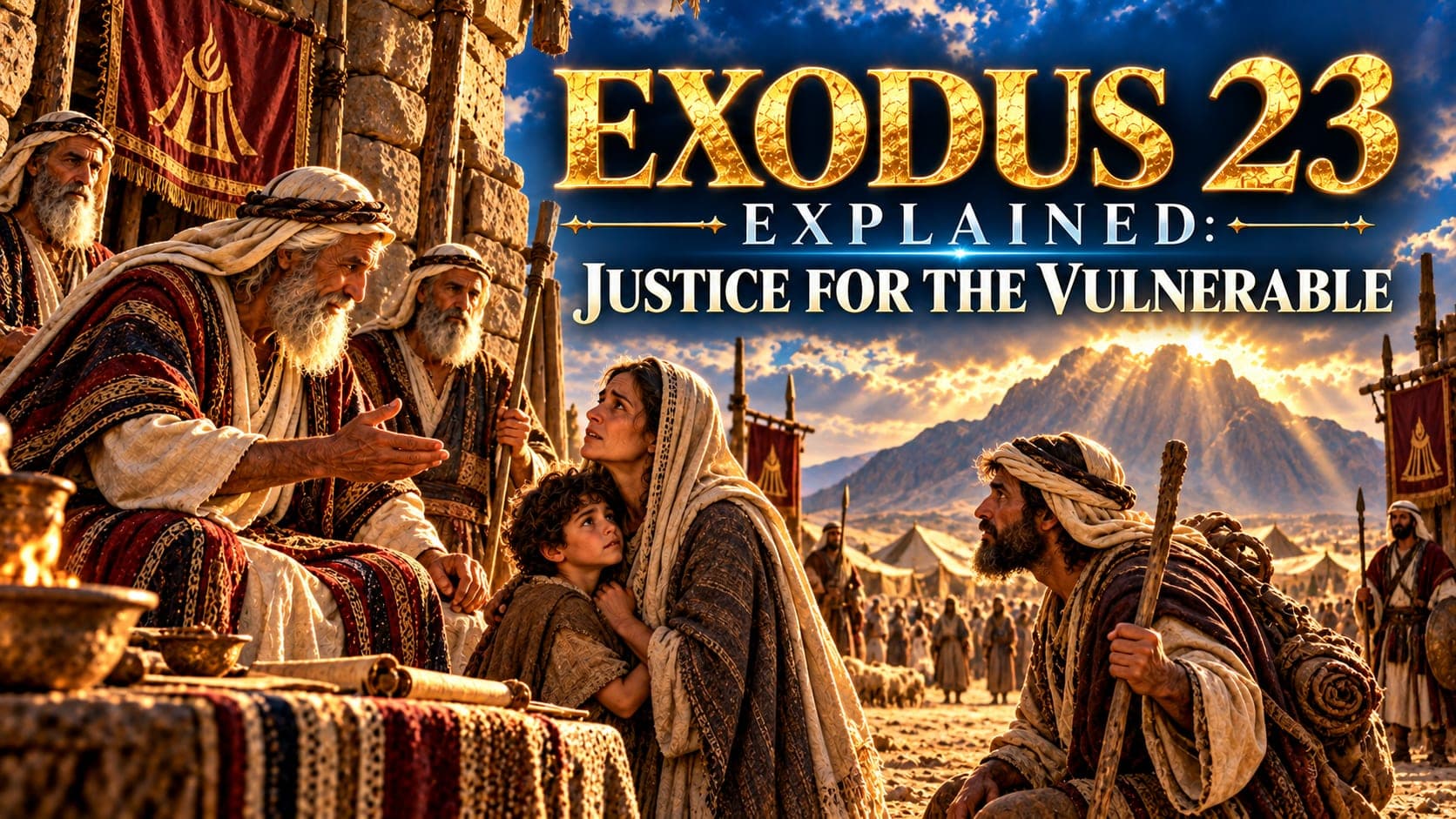
📖 Exodus 23 Explained: Justice, Rest, and the Three Feasts
Stolen oxen and gored servants are done. This chapter asks a quieter question instead.
Exodus 23 explained is the chapter where the case law softens into something closer to a way of life: how to testify honestly, how to treat an enemy's struggling animal, when to let the land itself rest, and which three feasts mark the whole year. Then, in its last third, the subject shifts entirely to the land Israel has not even reached yet.
Maybe you have never noticed how much of this chapter is about people you do not like.
- ❓ Why does God command kindness to your enemy's ox, centuries before Jesus says love your enemies?
- ❓ Why does the law warn against favoring a poor man in court, right next to warning against crushing him?
- ❓ Who is the "Angel" God says He is sending ahead of Israel, with His own name in him?
- ❓ And why does one line about a young goat and its mother's milk still shape kosher kitchens today?
📌 Exodus 23 keeps circling back to one test: does your life actually look different toward the people and the land you have no obligation to be kind to?
This walkthrough goes through the whole chapter in order: honesty in court, mercy toward an enemy's animal, the sabbath given to both land and people, the three annual feasts, the rules around sacrifice, and the long closing promise about the Angel who leads Israel into a land still full of nations that do not yet know they are leaving.
This chapter asks more of your ordinary Tuesday than it does of your Sunday.
What Happened Just Before This Chapter
Exodus 22 closed Israel's case law on property and people with its most personal turn yet: God naming Himself the one who hears the cry of the stranger, the widow, and the poor when no human court will. The chapter ended on firstfruits, firstborn animals, and a people told plainly to be holy, down to what they put on their plates.
Exodus 23 keeps the same voice speaking to Moses on the same mountain, but the subject moves from settling disputes after the fact to shaping honesty and rest before any dispute starts. By the chapter's second half, the camera pulls back even further, from Israel's own camp to the land of Canaan itself, a land none of them have set foot in yet.

Exodus 23 Explained Verse by Verse
1. Honesty in Court, From Both Directions (verses 1 to 3)
The chapter opens back in the courtroom, picking up exactly where the case law in Exodus 21 and 22 assumed judges would be listening.
"Thou shalt not raise a false report: put not thine hand with the wicked to be an unrighteous witness."
"Thou shalt not follow a multitude to do evil; neither shalt thou speak in a cause to decline after many to wrest judgment:"
"Neither shalt thou countenance a poor man in his cause."
💡 Verse 2 names a specific kind of lying: going along with a crowd. A false report does not need a single liar behind it. It only needs enough people agreeing on the wrong version of events, and one more witness willing to decline after the many rather than say what actually happened.
📌 Verse 3 sounds almost backward at first read. Why would the law warn against favoring a poor man? Because justice this chapter describes is not supposed to bend toward wealth or toward poverty. A judge who pities a poor man into a verdict he did not earn has broken the same rule as a judge who bows to a rich man's pressure. The law wants the facts of the case weighed, not the social standing of whoever is standing in front of the judge.
2. Your Enemy's Ox (verses 4 and 5)
From the courtroom, the law turns to a situation no court would ever hear about, because nobody is forcing the choice.
"If thou meet thine enemy’s ox or his ass going astray, thou shalt surely bring it back to him again."
"If thou see the ass of him that hateth thee lying under his burden, and wouldest forbear to help him, thou shalt surely help with him."
⚠️ Nobody is watching either of these moments happen. A stray animal could simply be ignored. A struggling animal under a heavy load could be walked past without a word said to anyone. The law names the exact temptation, "wouldest forbear to help him," and commands the opposite anyway.
📌 This is centuries before Jesus tells His listeners to love their enemies. Exodus 23 already assumes an Israelite will have people who hate him, and already requires concrete, physical kindness toward their property anyway. The command is not about feelings. It is about what your hands do with an enemy's struggling animal when no one is around to make you.
3. No Bribes, No Oppressing the Stranger (verses 6 to 9)
The law returns to the courtroom, now from the opposite angle of verse 3.
"Thou shalt not wrest the judgment of thy poor in his cause."
"Keep thee far from a false matter; and the innocent and righteous slay thou not: for I will not justify the wicked."
"And thou shalt take no gift: for the gift blindeth the wise, and perverteth the words of the righteous."
📌 Verses 3 and 6 are the same warning aimed at two different failures. A judge can tilt toward a poor man out of sympathy, or tilt against him because he has no money or standing to push back. Either way the verdict stopped being about what actually happened. Verse 8 names the more familiar version of that same failure: a gift, a bribe, dulling even a wise judge's ability to see clearly.
Then the warning widens to someone with even less standing in court than a poor Israelite.
"Also thou shalt not oppress a stranger: for ye know the heart of a stranger, seeing ye were strangers in the land of Egypt."
💡 This is the same reasoning Exodus 22 already used for the stranger: Israel knows exactly what that treatment feels like, so the law will not let the memory of Egypt fade into indifference toward the next foreigner standing in their own courts.
4. A Sabbath for the Land, and a Sabbath for Everyone in the House (verses 10 to 12)
From courtroom honesty, the law moves to a rhythm built into the calendar itself.
"And six years thou shalt sow thy land, and shalt gather in the fruits thereof:"
"But the seventh year thou shalt let it rest and lie still; that the poor of thy people may eat: and what they leave the beasts of the field shall eat. In like manner thou shalt deal with thy vineyard, and with thy oliveyard."
📌 The land itself gets a sabbath, and the point of that rest is named plainly: so the poor can eat. Whatever grows on its own in the seventh year is not the landowner's harvest to collect. It belongs first to the poor, then to whatever animals are left to graze it. Rest here is not only about the soil recovering. It is a built in year of provision for people who own no land of their own.
The same rhythm then drops from years down to a single week.
"Six days thou shalt do thy work, and on the seventh day thou shalt rest: that thine ox and thine ass may rest, and the son of thy handmaid, and the stranger, may be refreshed."
This is the same weekly sabbath Exodus 20 already commanded, stated again here with its reason spelled out even more plainly: rest for the ox, rest for the donkey, rest for a slave's own son, rest for the stranger living among them. The person with the least power in the household gets named by the same word, "refreshed," as the animals doing the household's heaviest labor.
5. No Other Gods Named, Three Feasts a Year (verses 13 to 17)
One short warning bridges the sabbath laws into the calendar of worship that follows.
"And in all things that I have said unto you be circumspect: and make no mention of the name of other gods, neither let it be heard out of thy mouth."
💡 Not even casual reference to another god's name is allowed, let alone worship of one. That warning sets up everything that follows: three feasts, all aimed at the LORD, and no one else.
"Three times thou shalt keep a feast unto me in the year."
"Thou shalt keep the feast of unleavened bread: (thou shalt eat unleavened bread seven days, as I commanded thee, in the time appointed of the month Abib; for in it thou camest out from Egypt: and none shall appear before me empty:)"
"And the feast of harvest, the firstfruits of thy labours, which thou hast sown in the field: and the feast of ingathering, which is in the end of the year, when thou hast gathered in thy labours out of the field."
"Three times in the year all thy males shall appear before the LORD God."
📌 Each of the three feasts marks a different point in the farming year, and each one points back to something God already did. The feast of unleavened bread falls in early spring and remembers the rushed, leaven free exit from Egypt on the night of the Passover. The feast of harvest comes at the end of the spring grain harvest, later called the feast of weeks. The feast of ingathering falls in autumn, at the end of the whole growing year, later called the feast of tabernacles. None of the three is invented for its own sake. Every one of them ties worship to a season Israel was already living through.
6. Sacrifice Rules, and the Kid in Its Mother's Milk (verses 18 and 19)
Two short, specific rules close out the section on worship.
"Thou shalt not offer the blood of my sacrifice with leavened bread; neither shall the fat of my sacrifice remain until the morning."
"The first of the firstfruits of thy land thou shalt bring into the house of the LORD thy God. Thou shalt not seethe a kid in his mother’s milk."
💡 Verse 18 protects the Passover sacrifice specifically, the same meal Exodus 12 already instructed Israel to eat with unleavened bread and nothing left over until morning. Leaven and delay both had no place in that one meal.
📌 The last line of verse 19 is one sentence, and an entire branch of later Jewish dietary law grows out of it. "Thou shalt not seethe a kid in his mother's milk" forbids cooking a young goat in the milk of its own mother. Jewish tradition later widened this single command into the broader practice of keeping meat and dairy separate at every meal, not just this one dish.
7. The Angel Who Goes Before Them, and the Nations Still in the Land (verses 20 to 33)
The chapter's final third turns forward, past Sinai entirely, to the land Israel has not yet walked into.
"Behold, I send an Angel before thee, to keep thee in the way, and to bring thee into the place which I have prepared."
"Beware of him, and obey his voice, provoke him not; for he will not pardon your transgressions: for my name is in him."
⚠️ "My name is in him" is a striking thing to say about a created messenger. This Angel is not told to pardon on his own authority, and he is not treated as an ordinary envoy either. Because of that language, many Bible teachers read this Angel as carrying God's own authority in a direct, personal way, the same kind of appearance Scripture elsewhere calls the Angel of the LORD.
"But if thou shalt indeed obey his voice, and do all that I speak; then I will be an enemy unto thine enemies, and an adversary unto thine adversaries."
"For mine Angel shall go before thee, and bring thee in unto the Amorites, and the Hittites, and the Perizzites, and the Canaanites, the Hivites, and the Jebusites: and I will cut them off."
"Thou shalt not bow down to their gods, nor serve them, nor do after their works: but thou shalt utterly overthrow them, and quite break down their images."
📌 Six nations are named by name, long before Israel has fought a single battle against any of them. The warning against their gods is not abstract. Israel is about to live surrounded by people whose worship looked nothing like what this chapter just spent nineteen verses describing.
"And ye shall serve the LORD your God, and he shall bless thy bread, and thy water; and I will take sickness away from the midst of thee."
"There shall nothing cast their young, nor be barren, in thy land: the number of thy days I will fulfil."
"I will send my fear before thee, and will destroy all the people to whom thou shalt come, and I will make all thine enemies turn their backs unto thee."
"And I will send hornets before thee, which shall drive out the Hivite, the Canaanite, and the Hittite, from before thee."
💡 The hornets in verse 28 have been read two different ways. Some take the word plainly, an actual plague of stinging insects sent ahead of Israel's advance. Others read it as a picture of terror and panic spreading through these nations before Israel ever arrives. The text itself does not settle which, only that something real and frightening clears the way before them.
"I will not drive them out from before thee in one year; lest the land become desolate, and the beast of the field multiply against thee."
"By little and little I will drive them out from before thee, until thou be increased, and inherit the land."
📌 God tells Israel plainly that this will not happen all at once. A land emptied in a single year, before Israel had enough people to farm it or enough flocks to graze it, would turn back into wilderness. The slow pace is not a sign the promise is failing. It is built into the promise on purpose.
"And I will set thy bounds from the Red sea even unto the sea of the Philistines, and from the desert unto the river: for I will deliver the inhabitants of the land into your hand; and thou shalt drive them out before thee."
"Thou shalt make no covenant with them, nor with their gods."
"They shall not dwell in thy land, lest they make thee sin against me: for if thou serve their gods, it will surely be a snare unto thee."
⚠️ The chapter ends with a warning about a danger that never comes from the outside at all. Israel is not warned that the Canaanites might defeat them in battle. They are warned that sharing the land with Canaanite worship will become a snare, something that traps quietly rather than attacks openly. That is exactly the failure Israel's later history in Judges keeps running into.

Hard Questions Exodus 23 Raises
Who is the Angel God sends before Israel in verses 20 and 21? The text says God's own name is in him, and that he can refuse to pardon rebellion, language stronger than what Scripture uses for an ordinary created angel elsewhere. Many Bible teachers connect this figure to other appearances of the Angel of the LORD, who speaks and acts with God's own authority. Others read him simply as a uniquely empowered messenger carrying delegated divine authority. The chapter itself does not resolve the question further than what these two verses already say.
Do verses 3 and 6 contradict each other? No. Verse 3 warns against favoring a poor man out of pity, and verse 6 warns against crushing a poor man's case because he has no standing to push back. Both verses protect the same thing: a verdict decided by the facts of the case, not by how much sympathy or how little power the person in front of the judge happens to have.
Why does the law single out an enemy's animal instead of just saying love your enemy? Because a command aimed at an action can actually be checked, while a command aimed only at a feeling cannot. Verses 4 and 5 do not ask Israel to feel differently about someone who hates them. They ask for a specific action, returning a stray animal or helping a struggling one, which still shapes the heart even before the feelings catch up.
Are the hornets in verse 28 literal insects? Scripture does not settle this. Some take it at face value, an actual plague of stinging insects sent ahead of Israel. Others read it as a figure for the dread and panic that spread through these nations before Israel's arrival. Either reading keeps the main point intact: the clearing of the land was God's doing, not Israel's military strength.
Why does God say He will not drive out the nations all in one year? Verse 29 gives the reason directly: an empty land would turn back to wilderness and fill with wild animals faster than a small, newly arrived nation could manage it. The slow timeline in verse 30 protects the very inheritance God is giving, rather than handing it over faster than Israel could actually keep it.
Top Verses From Exodus 23
1. Exodus 23:9
"Also thou shalt not oppress a stranger: for ye know the heart of a stranger, seeing ye were strangers in the land of Egypt."
Israel's own memory of Egypt becomes the reason to treat the next foreigner fairly, the same argument Exodus 22 already made, repeated because it still needed saying.
2. Exodus 23:4 and 5
"If thou meet thine enemy’s ox or his ass going astray, thou shalt surely bring it back to him again. If thou see the ass of him that hateth thee lying under his burden, and wouldest forbear to help him, thou shalt surely help with him."
A command to help an enemy's struggling animal, centuries before Jesus ever says the words love your enemies.
3. Exodus 23:12
"Six days thou shalt do thy work, and on the seventh day thou shalt rest: that thine ox and thine ass may rest, and the son of thy handmaid, and the stranger, may be refreshed."
The same word, refreshed, covers the household's animals and its least powerful people alike, naming exactly who the sabbath was always meant to protect.
4. Exodus 23:21
"Beware of him, and obey his voice, provoke him not; for he will not pardon your transgressions: for my name is in him."
One of the most debated lines in the chapter, describing a messenger who carries God's own name and authority ahead of Israel into the land.
5. Exodus 23:30
"By little and little I will drive them out from before thee, until thou be increased, and inherit the land."
A promise that comes with its own pace built in, slow enough that the inheritance it describes could actually be kept once it arrived.
Frequently Asked Questions About Exodus 23
What happens in Exodus 23?
Exodus 23 covers honesty in court, kindness toward an enemy's animal, protection for the stranger, a sabbath for both the land and the household, the three annual feasts, rules around sacrifice, and a long closing promise about the Angel who leads Israel into Canaan, with a warning not to worship the gods of the nations already living there.
What does Exodus 23 say about helping your enemy?
Verses 4 and 5 command returning a stray animal belonging to an enemy and helping an animal struggling under its load, even when it belongs to someone who hates you. The command targets the action, not the feeling behind it.
What are the three feasts in Exodus 23?
The feast of unleavened bread in early spring, remembering the exodus from Egypt. The feast of harvest, later called the feast of weeks, at the end of the grain harvest. The feast of ingathering, later called the feast of tabernacles, at the end of the farming year.
Who is the Angel in Exodus 23:20 and 21?
A messenger God sends ahead of Israel into Canaan, described as carrying God's own name and the authority to refuse pardon for rebellion. Many Bible teachers connect this figure to other appearances of the Angel of the LORD elsewhere in Scripture, though the chapter itself does not say more than these two verses state.
Why does the Bible say not to boil a young goat in its mother's milk?
Exodus 23:19 states the command without explaining its reasoning. Jewish tradition later built the broader practice of separating meat and dairy at every meal out of this one specific instruction.
What is the sabbatical year in Exodus 23?
Verses 10 and 11 command letting farmland rest every seventh year, with whatever grows on its own during that year set aside first for the poor to eat and then for wild animals, rather than harvested by the landowner.
Why does Exodus 23 name six specific nations?
Verse 23 names the Amorites, Hittites, Perizzites, Canaanites, Hivites, and Jebusites as the peoples already living in the land God is giving Israel, making the warning against worshipping their gods a concrete one rather than a vague caution about idolatry in general.
Why didn't God clear the land for Israel all at once?
Verse 29 gives the reason: a land emptied too quickly would turn to wilderness and fill with wild animals faster than a small, newly settled nation could manage. Verse 30 promises the process instead of matching Israel's own growth over time.
What does Exodus 23 say about bribery?
Verse 8 forbids taking any gift connected to a legal case, stating plainly that a bribe blinds even a wise judge and twists the words of someone in the right.
How does Exodus 23 connect to the rest of the Bible?
Its command to help an enemy's animal anticipates Jesus teaching His followers to love their enemies, and its warning against covenants with Canaan's gods sets up the exact failure Israel's later history in Judges keeps repeating.
Final Thoughts
Exodus 23 spends most of its length on people nobody is forcing you to be fair to.
📌 Kindness toward an enemy shows up here as an action, not a feeling. Verses 4 and 5 do not wait for Israel to stop hating anyone. They just command the hand to move toward a struggling animal anyway, enemy or not.
📌 Rest in this chapter was never only personal. The land gets a sabbath year so the poor can eat from it. The weekly sabbath names the household's servants and even its animals by the same word as everyone else: refreshed.
📌 The real danger waiting in Canaan was never the nations themselves. The chapter's closing verses warn that sharing the land with Canaanite worship, not losing a battle, is the snare that would actually catch Israel.
You probably will not meet a straying ox this week. You will almost certainly cross paths with someone who has done nothing to earn your help.
That is the test Exodus 23:4 and 5 actually sets. Not whether you can be kind to people who deserve it. Whether you will still be kind when they do not.