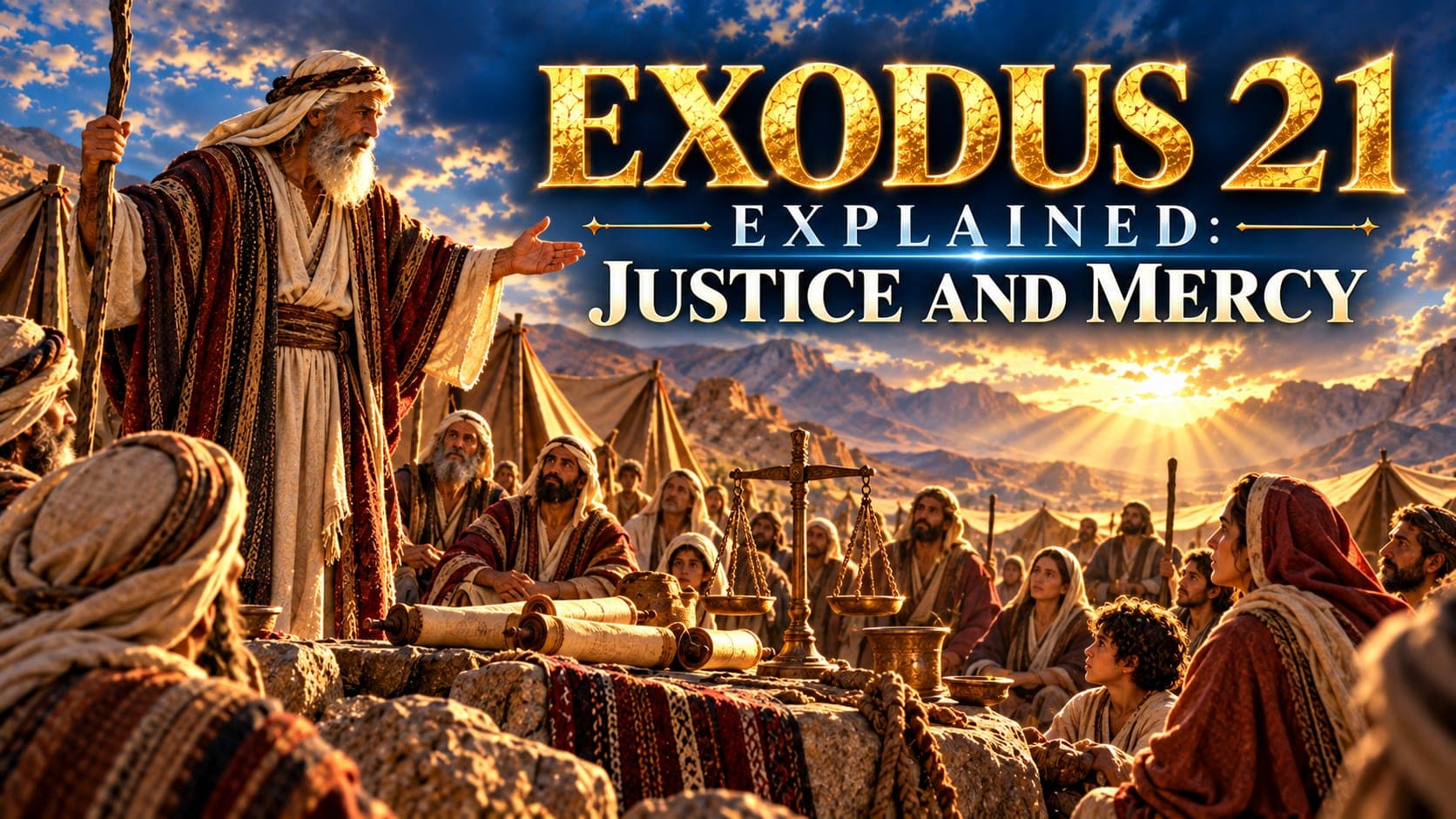
📖 Exodus 21 Explained: Servants, Justice, and Eye for Eye
No mountain on fire this time. No trumpet, no thunder. Just thirty six verses of ordinary disputes God expects Israel's judges to actually settle with fairness.
Exodus 21 explained is the first full chapter of what Exodus 24:7 later calls "the book of the covenant," the case law that fills in exactly how the Ten Commandments apply once two neighbors disagree, a fight breaks out, or someone's animal does damage it was never supposed to do.
Maybe you have skimmed past this chapter because it reads more like a law code than a story.
- ❓ Why does the Bible regulate servitude instead of simply ending it on the spot?
- ❓ What does "eye for eye, tooth for tooth" actually mean?
- ❓ Why do a son's and a daughter's situations get such different rules?
- ❓ And why does one verse about a struck servant sound so hard to read?
📌 Exodus 21 is not a chapter celebrating servitude or revenge. It is a chapter putting hard limits on both, inside a world that already practiced both long before Israel existed.
This walkthrough goes through the whole chapter in order: the release built into Hebrew servitude, the different protection given to a daughter, the laws on taking a life, the fight that goes wrong, the hardest verse in the chapter, the famous eye for eye principle, and the laws about an ox that gores or falls into somebody's pit.
Read slowly. This chapter asks harder questions of a modern reader than almost any other in Exodus.
What Happened Just Before This Chapter
Exodus 20 ended with God speaking the Ten Commandments directly to the whole trembling nation, then giving Moses simple instructions for building a plain altar of earth or unworked stone. The people had just asked for a go between rather than hear God's voice again, and Moses walked toward the thick darkness on their behalf.
Exodus 21 opens right where that leaves off, with God still speaking to Moses, but the subject shifts from broad commands to specific disputes. This is also the chapter where the system Jethro talked Moses into setting up, judges handling the people's cases, finally gets something concrete to work from. The Ten Commandments said what mattered. Exodus 21 starts telling judges how to rule when real people bring real disputes before them.

Exodus 21 Explained Verse by Verse
1. From Ten Words to Case Law (verse 1)
One short sentence changes the whole shape of the book.
"Now these are the judgments which thou shalt set before them."
💡 Judgments here means specific rulings for specific situations, not broad principles like "thou shalt not steal." The Ten Commandments told Israel what kind of people to be. What follows tells Israel's judges exactly what to do when two of those people end up in conflict anyway.
📌 "Before them" is not a vague audience. It means the able, God fearing men Moses had just appointed as judges in Exodus 18. The commandments came from the mountain. The case law that applies them comes to sit on the desks of ordinary men settling ordinary arguments.
2. Six Years a Servant, the Seventh Year Free (verses 2 to 6)
The very first case law in Israel's legal code is a built in expiration date on servitude.
"If thou buy an Hebrew servant, six years he shall serve: and in the seventh he shall go out free for nothing."
The servant this law has in mind is almost always a fellow Israelite who fell into deep debt or extreme poverty and sold his own labor to survive, not a prisoner captured in war or a person bought as permanent property. Whatever the arrangement cost to begin with, the seventh year cancels it completely, free, for nothing.
Family complicates the release, and the text addresses that directly.
"If he came in by himself, he shall go out by himself: if he were married, then his wife shall go out with him."
"If his master have given him a wife, and she have born him sons or daughters; the wife and her children shall be her master's, and he shall go out by himself."
A man can walk into servitude married and walk out married. A man given a wife by his master inside that household leaves that arrangement alone when his own six years end, unless he chooses otherwise.
"And if the servant shall plainly say, I love my master, my wife, and my children; I will not go out free:"
"Then his master shall bring him unto the judges; he shall also bring him to the door, or unto the door post; and his master shall bore his ear through with an aul; and he shall serve him for ever."
⚠️ This decision has to be made publicly, in front of judges, not quietly agreed to behind closed doors. Staying is allowed only when the servant himself states it plainly, and the mark that follows, a hole bored through the ear at the doorpost, is permanent and visible. Many Christian readers later connect this image to Psalm 40:6, "mine ears hast thou opened," and to Hebrews 10's picture of Christ taking on a body to do the Father's will, a willing, lifelong service chosen rather than forced.
3. A Daughter Sold as a Servant (verses 7 to 11)
The next case law covers a situation the six year rule does not: a daughter sold into a household expecting her to eventually marry into it.
"And if a man sell his daughter to be a maidservant, she shall not go out as the menservants do."
"If she please not her master, who hath betrothed her to himself, then shall he let her be redeemed: to sell her unto a strange nation he shall have no power, seeing he hath dealt deceitfully with her."
"And if he have betrothed her unto his son, he shall deal with her after the manner of daughters."
This arrangement functions closer to a marriage contract than ordinary labor. The six year release does not apply because the expectation was never a temporary job, it was a future place in the family. What the law refuses to allow is just as telling: she can never be resold to outsiders, and if the man who received her loses interest, she must be let go through redemption rather than traded away like property with no say in the matter.
"If he take him another wife; her food, her raiment, and her duty of marriage, shall he not diminish."
"And if he do not these three unto her, then shall she go out free without money."
📌 Neglect has a built in penalty, and it favors her. Food, clothing, and marital care are named specifically, and failing even one of the three cancels the whole arrangement and sets her free with no payment required from her side at all.
4. When a Life Is Taken (verses 12 to 17)
The next group of case laws all protect a life or a family bond, and the penalty for breaking them is the most severe the chapter names.
"He that smiteth a man, so that he die, shall be surely put to death."
This single sentence rests on the same ground Genesis 9:6 already laid down after the flood: human life carries a weight nothing else does, because every person bears God's image. The very next two verses, though, show the law refusing to treat every death the same way.
"And if a man lie not in wait, but God deliver him into his hand; then I will appoint thee a place whither he shall flee."
"But if a man come presumptuously upon his neighbour, to slay him with guile; thou shalt take him from mine altar, that he may die."
📌 An accident gets a place to run to. A planned killing gets dragged away from the altar itself. Verse 13 is the first seed of what later Scripture develops into full cities of refuge, places built specifically so someone who kills without intent to kill has somewhere safe to go while the facts get sorted out. Verse 14 closes the one loophole a murderer might try: grabbing the horns of an altar could not turn premeditated murder into something God's own holy ground would shield.
"And he that smiteth his father, or his mother, shall be surely put to death."
"And he that stealeth a man, and selleth him, or if he be found in his hand, he shall surely be put to death."
"And he that curseth his father, or his mother, shall surely be put to death."
Three more capital cases sit alongside murder: striking a parent, cursing a parent, and kidnapping a free person to sell them. The law that just spent six verses regulating how a person enters servitude honestly now names stealing someone into servitude by force a crime worth a life.
5. A Fight That Doesn't Kill, and a Servant Who Is Struck (verses 18 to 21)
From capital cases, the law drops down to the kind of dispute that probably happened in the camp every week.
"And if men strive together, and one smite another with a stone, or with his fist, and he die not, but keepeth his bed:"
"If he rise again, and walk abroad upon his staff, then shall he that smote him be quit: only he shall pay for the loss of his time, and shall cause him to be thoroughly healed."
Recovery changes everything here. Once the injured man can walk again, the one who struck him is not charged with assault going forward, but he still owes real money for the lost wages and the full cost of healing. The law treats an ordinary fist fight seriously without treating it like murder.
Then the chapter turns to the hardest two verses in it.
"And if a man smite his servant, or his maid, with a rod, and he die under his hand; he shall be surely punished."
"Notwithstanding, if he continue a day or two, he shall not be punished: for he is his money."
⚠️ Read honestly, this is uncomfortable, and it should be. Verse 20 is easy to skip past, but it is doing real work: killing a servant outright carries real punishment, in a world where plenty of surrounding cultures gave an owner unlimited power over a servant's life. Verse 21 is the part that sits hardest, treating a servant's recovery after a beating as grounds for no punishment, reasoning in purely economic terms that would never be acceptable applied to any other relationship in this chapter. The section below on hard questions takes this verse seriously rather than explaining it away.
6. Eye for Eye: The Unborn Child and the Limits on Revenge (verses 22 to 27)
The most famous line in the whole chapter grows out of a very specific accident.
"If men strive, and hurt a woman with child, so that her fruit depart from her, and yet no mischief follow: he shall be surely punished, according as the woman's husband will lay upon him; and he shall pay as the judges determine."
"And if any mischief follow, then thou shalt give life for life,"
"Eye for eye, tooth for tooth, hand for hand, foot for foot,"
"Burning for burning, wound for wound, stripe for stripe."
💡 "Eye for eye" is a ceiling, not a floor. The phrase gets quoted today as a byword for brutal revenge, but inside this law it caps the punishment at matching the harm, no more. A wrong done to one eye cannot be answered with two, and verse 22 already models how that plays out in practice: real harm, real payment, set by judges, not by the angriest party in the dispute.
"And if a man smite the eye of his servant, or the eye of his maid, that it perish; he shall let him go free for his eye's sake."
"And if he smite out his manservant's tooth, or his maidservant's tooth; he shall let him go free for his tooth's sake."
📌 The same eye for eye principle that just capped revenge between free men now protects a servant's own body. A master who damages a servant's eye or tooth does not pay a fine, he loses the servant entirely, free, no term left to serve. Whatever a servant owed before that injury is erased the moment the injury happens.
7. When an Ox Gores or Falls Into a Pit (verses 28 to 36)
The chapter closes on property and livestock, and the question running underneath every verse is the same one: did the owner know, and did he do anything about it.
"If an ox gore a man or a woman, that they die: then the ox shall be surely stoned, and his flesh shall not be eaten; but the owner of the ox shall be quit."
"But if the ox were wont to push with his horn in time past, and it hath been testified to his owner, and he hath not kept him in, but that he hath killed a man or a woman; the ox shall be stoned, and his owner also shall be put to death."
An ox that had never shown violence before carries no blame back to its owner. The same ox, once its owner has already been warned and done nothing, turns his own negligence into something close to killing by his own hand. Verse 30 even allows his life to be ransomed with payment instead, a mercy the law did not have to include.
"If the ox shall push a manservant or a maidservant; he shall give unto their master thirty shekels of silver, and the ox shall be stoned."
Thirty shekels, a specific, fixed price, is the same number the Gospels record being counted out for betraying Jesus centuries later in Matthew 26:15, the price of a servant's life turning up again at the cost someone was willing to pay to hand Him over.
"And if a man shall open a pit, or if a man shall dig a pit, and not cover it, and an ox or an ass fall therein;"
"The owner of the pit shall make it good, and give money unto the owner of them; and the dead beast shall be his."
⚠️ Nobody has to be struck by lightning or an enemy army for this law to matter. An uncovered hole in the ground is a hazard whether or not anyone ever falls in it, and the law assigns responsibility for it before disaster happens, not only after. The final two verses apply the same logic when one man's ox injures another's, splitting the loss when the danger was unknown and placing it fully on the negligent owner when it was not.

Hard Questions Exodus 21 Raises
Does Exodus 21 mean the Bible endorses slavery? The servitude it regulates is almost entirely debt servitude, paying off what you owed through labor, with a guaranteed release after six years. That is a different institution from the lifelong, inherited chattel slavery practiced later in history, which this same chapter criminalizes in verse 16 by making it a capital crime to kidnap a free person and sell them.
Why does a daughter sold as a maidservant get different rules than a son? A son's servitude in verses 2 to 6 is temporary labor with a fixed end date. A daughter's arrangement in verses 7 to 11 is a path toward marriage into the household, closer to a betrothal contract than a job, which is why it comes with its own protections, guaranteed food, clothing, and marital care, that her brother's arrangement never needed.
What does "eye for eye, tooth for tooth" actually mean? It states a ceiling on punishment, not a license for personal revenge. The injury in verse 22 that triggers the whole principle is settled by judges assigning a payment, not by the husband taking matters into his own hands. Centuries later, Jesus directly addresses this same phrase in His teaching on the Sermon on the Mount, pushing His listeners past the legal limit on retaliation toward not retaliating at all.
What does "her fruit depart from her" mean in verses 22 and 23? Careful readers genuinely disagree on this one. Some understand it as a miscarriage, with verse 22's fine covering the loss of the unborn child when no further harm comes to the mother, and verse 23's life for life applying only if the mother herself dies. Others read it as an early, survivable birth, with verse 22 covering that outcome and verse 23's harsher penalty reserved for a case where the child dies as a result. Both readings take the passage seriously as describing real harm to an unborn child; they differ on exactly which harm triggers which penalty, and the Hebrew text itself does not settle the question for us.
Why does verse 21 say a servant beaten and still alive after a day or two goes unpunished, "for he is his money"? This is the hardest verse in the chapter to defend, and it should not be softened into something more comfortable than it is. The reasoning given is frankly economic, the master's own financial loss standing in for further punishment. What the law does do, in the verse right before it, is criminalize outright killing a servant, a real limit on an owner's power, even while verse 21 falls short of the full dignity the gospel ultimately extends to every person.
Why does an accidental killer still need somewhere to flee, if it genuinely was not murder? Grief and anger do not wait for a trial to decide whether a death was intentional. A dead man's family could seek revenge on the spot before anyone sorts out what happened. The place to flee in verse 13 protects an innocent killer from exactly that, giving the facts time to be weighed by judges instead of settled by whoever grieves loudest.
Top Verses From Exodus 21
1. Exodus 21:2
"If thou buy an Hebrew servant, six years he shall serve: and in the seventh he shall go out free for nothing."
The very first case law in Israel's legal code is a built in release date, a limit on servitude that was never meant to last a lifetime.
2. Exodus 21:13 and 14
"And if a man lie not in wait, but God deliver him into his hand; then I will appoint thee a place whither he shall flee. But if a man come presumptuously upon his neighbour, to slay him with guile; thou shalt take him from mine altar, that he may die."
The earliest seed of the cities of refuge, and proof the law already distinguished an accident from a plan long before the rest of Scripture builds that system out fully.
3. Exodus 21:23 to 25
"Then thou shalt give life for life, Eye for eye, tooth for tooth, hand for hand, foot for foot, Burning for burning, wound for wound, stripe for stripe."
The most quoted line in the chapter, a ceiling on punishment rather than a command to seek it, decided by judges rather than by the injured party.
4. Exodus 21:32
"If the ox shall push a manservant or a maidservant; he shall give unto their master thirty shekels of silver, and the ox shall be stoned."
A fixed price for a servant's life that resurfaces centuries later as the exact sum paid to betray the Son of God.
5. Matthew 5:38 and 39
"Ye have heard that it hath been said, An eye for an eye, and a tooth for a tooth: But I say unto you, That ye resist not evil: but whosoever shall smite thee on thy right cheek, turn to him the other also."
Jesus takes the exact legal ceiling set in Exodus 21 and calls His own followers to something that goes even further past it.

Frequently Asked Questions About Exodus 21
What happens in Exodus 21?
Exodus 21 opens the case law given to Israel's judges after the Ten Commandments. It covers the terms of Hebrew servitude and its release in the seventh year, the different rules for a daughter sold as a maidservant, the penalties for murder, manslaughter, striking or cursing a parent, and kidnapping, injuries from fights and from a servant being struck, the eye for eye principle after an injury to a pregnant woman, and the liability of an owner whose ox gores someone or falls into an uncovered pit.
Does Exodus 21 support slavery?
It regulates debt servitude, a temporary arrangement with a guaranteed release after six years, while making it a capital crime in verse 16 to kidnap a free person and sell them. The chapter restricts one practice severely and bans the other outright rather than endorsing either without limit.
What does "eye for eye, tooth for tooth" mean?
It sets a maximum penalty equal to the harm done, decided by judges, not a command to pursue personal revenge. Matthew 5:38 and 39 shows Jesus referencing this exact phrase centuries later while calling His followers toward something beyond even that legal limit.
What was a Hebrew servant in Exodus 21?
Almost always a fellow Israelite working off a debt or extreme poverty, not a prisoner of war or lifelong property. Exodus 21:2 guarantees the arrangement ends after six years, with release owed for nothing in the seventh.
Why would a servant choose to stay forever instead of going free?
Exodus 21:5 and 6 describe a servant who has come to genuinely love his master, wife, and children formed during his service, and who says so plainly before judges rather than being pressured into staying. The ear boring that follows marks the choice publicly and permanently.
What does "her fruit depart from her" mean in Exodus 21:22?
Careful readers disagree. Some take it as a miscarriage caused during a fight between men, with the harsher life for life penalty in verse 23 reserved for the mother's own death. Others take it as a premature but survivable birth, with the stricter penalty applying if the child later dies. The Hebrew wording itself does not resolve which reading is correct.
Why does Exodus 21:21 say nothing happens to a master if his servant survives a beating?
The text gives an economic reason, the servant being the master's own financial loss, and it is genuinely one of the hardest verses in the chapter to read. The verse immediately before it does criminalize killing a servant outright, a real restriction, even though verse 21 still falls short of treating a servant's body with the full protection the rest of this same chapter gives to a free man.
Why does an ox that gores someone get stoned?
Exodus 21:28 treats the animal as no longer fit to remain among the living and forbids eating its meat afterward, marking the death as a serious matter rather than an ordinary loss of livestock, while the owner himself goes free when the ox had never shown violence before.
What is a city of refuge, and where does Exodus 21 connect to it?
Exodus 21:13 is the earliest reference to an appointed place where someone who kills without intent to kill can flee for safety. Numbers 35 and Joshua 20 later establish specific cities that serve this purpose.
How does Exodus 21 connect to the rest of the Bible?
Matthew 5:38 and 39 takes this chapter's eye for eye ceiling and pushes past it. Matthew 26:15 echoes the thirty shekel price this chapter sets in verse 32, paid again centuries later to betray Jesus.
Final Thoughts
Exodus 21 will not let a reader stay comfortable, and it was probably never meant to.
📌 Every law here limits power that had no limit before it. A servant gets a release date, a daughter gets protection written into her contract, an ox owner gets held responsible for what he already knew, and even revenge gets capped at matching the wrong done.
📌 Not every limit reaches as far as it should. Verse 21 is in this chapter too, and pretending it reads easily would be dishonest. Scripture's own trajectory, from this case law all the way to Christ, keeps pushing further toward the full dignity every person was created with.
📌 Eye for eye was always meant to restrain revenge, not demand it. Jesus takes that same legal ceiling in Matthew 5 and calls His people to go past it, toward mercy that the law never required but never forbade either.
This chapter rewards a second, slower read more than a first one. Go back through the hard verses again, the ones you want to explain away fastest, and let them stay as uncomfortable as they actually are before you move on to Exodus 22.