📖 Exodus 4 Explained: Moses's Excuses and the Return to Egypt
God has already answered two objections. Moses is still not done arguing.
Exodus 4 explained is the chapter where a man who just heard the voice of God from a bush that would not burn out keeps finding new reasons to say no. A shepherd's staff turns into a snake, a hand turns leprous and back again, and Moses still answers with his own weakness instead of simply going.
Maybe you have kept arguing with God long after He already answered you.
- ❓ Why does God give Moses three separate signs instead of just one?
- ❓ Why does God get angry at Moses, then hand the job to Aaron anyway?
- ❓ What actually happens at the inn with Zipporah and the knife?
- ❓ And why does God say He will harden Pharaoh's own heart?
📌 Every excuse Moses raises gets answered, and he keeps raising another one anyway, until God stops answering objections and simply gives him a brother to lean on instead.
This walkthrough goes through Exodus 4 in order: the sign of the serpent, the sign of the leprous hand, the sign of the water, Moses's complaint about his own speech, God's anger and the gift of Aaron, the journey back into Egypt, the strange night at the inn, and the moment the people of Israel finally believe.
A chapter full of excuses ends with a whole nation bowing its head in worship.
What Happened Just Before This Chapter
Exodus 3 ended with God laying out the whole plan at the burning bush: Moses would go to the elders of Israel first, then to Pharaoh, and God had already told him in advance that Pharaoh would refuse. God even gave Moses His own name, I AM THAT I AM, as the answer to the question "who am I."
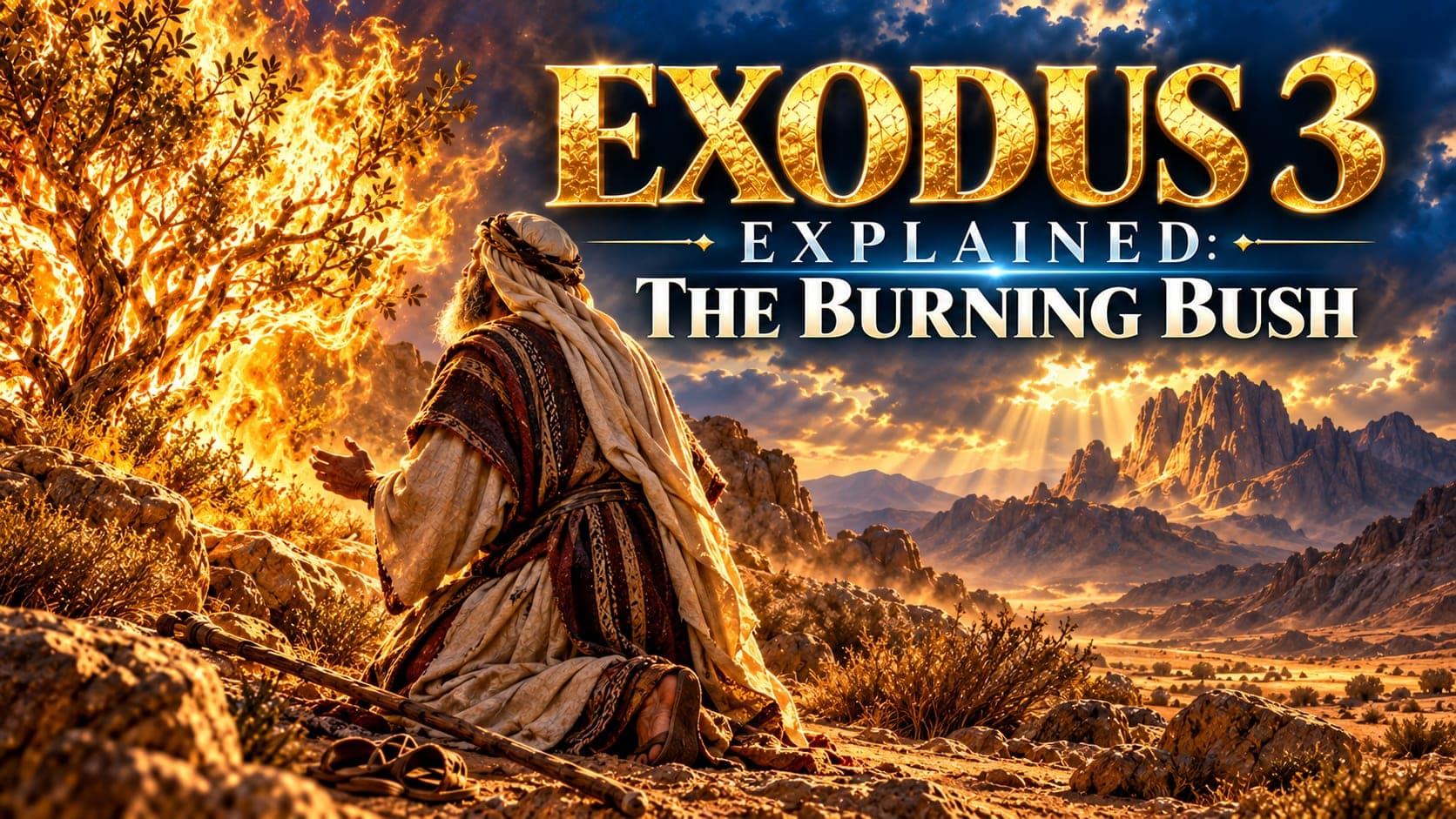
Exodus 4 opens in the same conversation, at the same mountain, with Moses still standing in front of the bush. God has answered "who am I" and "what is your name." Moses is not finished objecting.
Exodus 4 Explained Verse by Verse
1. "They Will Not Believe Me": The Sign of the Serpent (verses 1 to 5)
Moses raises a third objection before God has even finished speaking from the bush.
"And Moses answered and said, But, behold, they will not believe me, nor hearken unto my voice: for they will say, The LORD hath not appeared unto thee."
📌 Notice what Moses is actually afraid of here. Not Pharaoh. His own people. He is less worried about the most powerful man in Egypt than he is about the Israelites simply not taking his word for it. God does not argue the point. He gives Moses something to hold in his hand instead of an argument to win.
"And the LORD said unto him, What is that in thine hand? And he said, A rod. And he said, Cast it on the ground. And he cast it on the ground, and it became a serpent; and Moses fled from before it."
That rod is the same plain shepherd's staff Moses has carried through forty years of tending Jethro's flock. It is the most ordinary object he owns, and it is the first thing God turns into a sign. Moses, who just watched it happen, still runs from what his own staff became.
"And the LORD said unto Moses, Put forth thine hand, and take it by the tail. And he put forth his hand, and caught it, and it became a rod in his hand: That they may believe that the LORD God of their fathers, the God of Abraham, the God of Isaac, and the God of Jacob, hath appeared unto thee."
💡 God tells Moses to grab the snake by the tail, the one way a person is never supposed to pick up a snake. Obeying this sign cost Moses something: real, reasonable fear, overridden by a direct command. The staff turns back into a rod the moment he obeys instead of flees.
2. Two More Signs Before Anyone Else Ever Sees One (verses 6 to 9)
God does not stop at one sign. He gives Moses a second, more personal one.
"And the LORD said furthermore unto him, Put now thine hand into thy bosom. And he put his hand into his bosom: and when he took it out, behold, his hand was leprous as snow."
Leprosy in the Old Testament was not just a disease. It was a visible picture of uncleanness, the one condition that got a person shut out of the camp entirely. For a few seconds, Moses carries that exact condition in his own body, with no warning and no explanation given before it happens.
"And he said, Put thine hand into thy bosom again. And he put his hand into his bosom again; and plucked it out of his bosom, and, behold, it was turned again as his other flesh."
📌 The God who can make a hand leprous in an instant can heal it in the same instant. The sign is not only about sickness. It is about which direction the power runs, and who controls it on both ends.
Then God names a third sign in advance, one Moses has not performed yet when the chapter ends.
"And it shall come to pass, if they will not believe thee, neither hearken to the voice of the first sign, that they will believe the voice of the latter sign. And it shall come to pass, if they will not believe also these two signs, neither hearken unto thy voice, that thou shalt take of the water of the river, and pour it upon the dry land: and the water which thou takest out of the river shall become blood upon the dry land."
⚠️ Three separate signs, stacked in advance, in case the first two are not enough. This third one, water turning to blood, is a small preview of the very first plague Egypt is about to suffer in full force. God is not improvising here. The signs He hands Moses at this ordinary mountain already match the scale of what is coming to an entire nation.
3. "I Am Not Eloquent" (verses 10 to 12)
Three signs in hand, Moses moves to a fourth objection, and this one is personal.
"And Moses said unto the LORD, O my LORD, I am not eloquent, neither heretofore, nor since thou hast spoken unto thy servant: but I am slow of speech, and of a slow tongue."
Exodus never says exactly what Moses means. It could be a genuine speech difficulty, or simply a man who spent forty years talking to sheep instead of addressing crowds and kings. Whichever it is, Moses treats it as a hard limit on what God is asking him to do.
"And the LORD said unto him, Who hath made man's mouth? or who maketh the dumb, or deaf, or the seeing, or the blind? have not I the LORD? Now therefore go, and I will be with thy mouth, and teach thee what thou shalt say."
📌 God does not deny the weakness. He claims to have made it. The same God who forms mouths, ears, and eyes is the one standing in front of Moses offering to work through exactly the limitation Moses just named, not around it.
4. God's Anger, and the Gift of Aaron (verses 13 to 17)
Moses has one more card to play, and it is the plainest no of the whole conversation.
"And he said, O my LORD, send, I pray thee, by the hand of him whom thou wilt send."
Every earlier objection asked a question. This one just asks God to pick someone else. It is the moment the conversation finally turns.
"And the anger of the LORD was kindled against Moses, and he said, Is not Aaron the Levite thy brother? I know that he can speak well. And also, behold, he cometh forth to meet thee: and when he seeth thee, he will be glad in his heart."
⚠️ This is the only place in the whole bush conversation where God's anger is named outright. It is not aimed at Moses's fear or his weak speech. Those God already answered gently. It follows the request to simply hand the job to someone else after every real objection has already been met.
And yet the anger does not cancel the call. God answers it by giving Moses exactly what he asked for, a second voice, without taking away what he was actually sent to do.
"And thou shalt speak unto him, and put words in his mouth: and I will be with thy mouth, and with his mouth, and will teach you what ye shall do. And he shall be thy spokesman unto the people: and he shall be, even he shall be to thee instead of a mouth, and thou shalt be to him instead of God."
Aaron is Moses's own brother, a fellow Levite, already on his way to meet him before Moses has even started walking. God built the solution to this objection into the plan before Moses ever raised it.
"And thou shalt take this rod in thine hand, wherewith thou shalt do signs."
5. Leaving Midian for Egypt (verses 18 to 20)
The arguing is over. Moses finally moves.
"And Moses went and returned to Jethro his father in law, and said unto him, Let me go, I pray thee, and return unto my brethren which are in Egypt, and see whether they be yet alive. And Jethro said to Moses, Go in peace."
📌 Moses tells his father in law he wants to check on his brethren, not that he has just spoken with God at a burning bush. He takes the smallest honest reason for leaving rather than the whole story, and Jethro sends him off without asking for more.
"And the LORD said unto Moses in Midian, Go, return into Egypt: for all the men are dead which sought thy life."
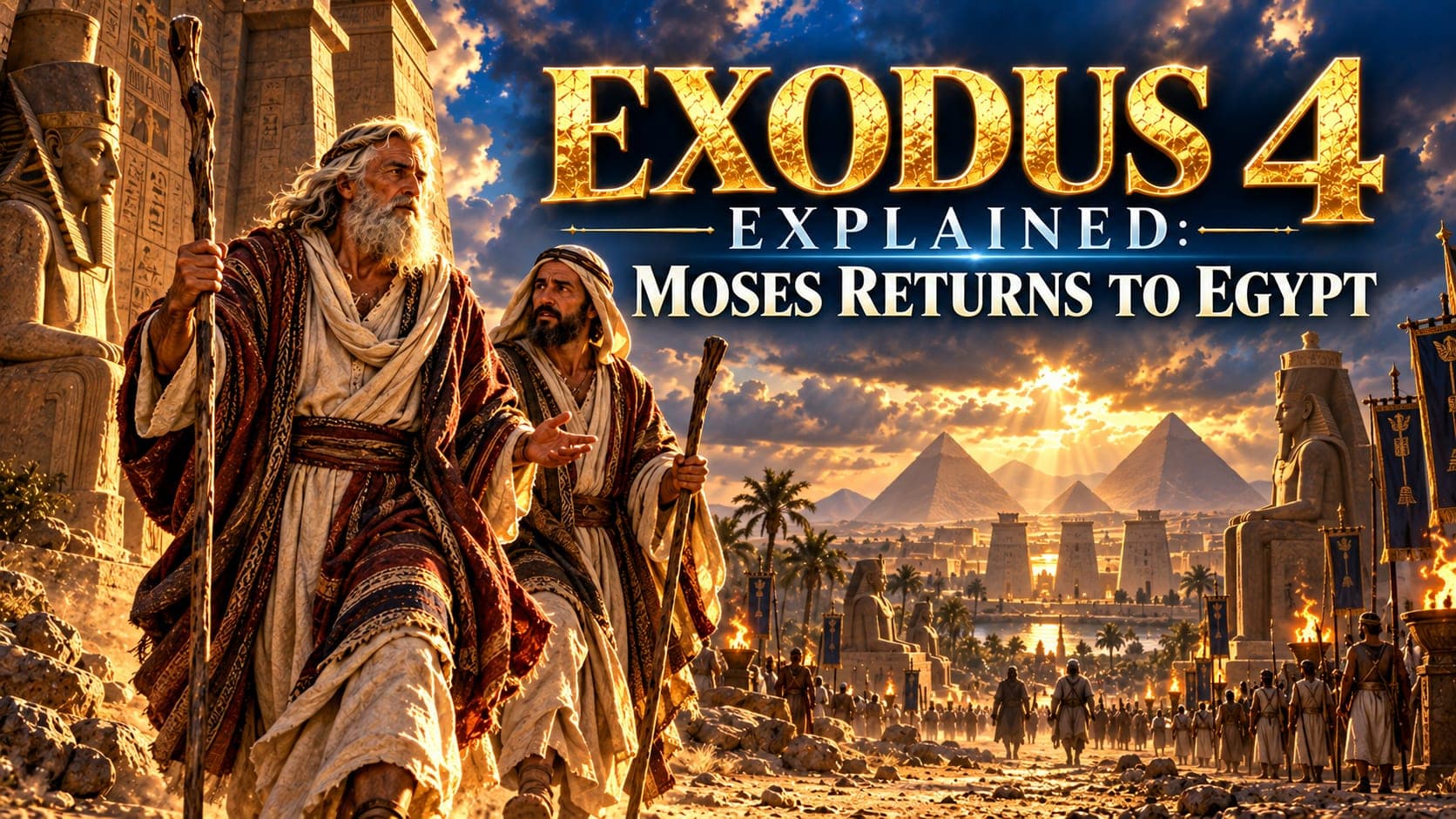
"And Moses took his wife and his sons, and set them upon an ass, and he returned to the land of Egypt: and Moses took the rod of God in his hand."
The ordinary shepherd's rod from verse two has a new title by verse twenty: the rod of God. Nothing about the wood changed. What it had been used for did.
6. "Israel Is My Son" and a Pharaoh Already Hardened (verses 21 to 23)
Before Moses reaches Egypt, God tells him plainly how the confrontation will go.
"And the LORD said unto Moses, When thou goest to return into Egypt, see that thou do all those wonders before Pharaoh, which I have put in thine hand: but I will harden his heart, that he shall not let the people go."
💡 Later chapters of Exodus describe Pharaoh hardening his own heart just as often as they describe God hardening it. Both things are true across the book, and Exodus never treats them as a contradiction that needs explaining away.
"And thou shalt say unto Pharaoh, Thus saith the LORD, Israel is my son, even my firstborn: And I say unto thee, Let my son go, that he may serve me: and if thou refuse to let him go, behold, I will slay thy son, even thy firstborn."
📌 God names the last plague before Moses has even delivered the first warning. The death of Egypt's firstborn sons, the event that finally breaks Pharaoh in the book's final chapters, is already on the table in this one sentence, long before any plague has struck.
7. The Hardest Verses in the Chapter: the Inn and the Bloody Husband (verses 24 to 26)
Three verses, almost no explanation, and more debate among Bible teachers than anything else in this chapter.
"And it came to pass by the way in the inn, that the LORD met him, and sought to kill him. Then Zipporah took a sharp stone, and cut off the foreskin of her son, and cast it at his feet, and said, Surely a bloody husband art thou to me. So he let him go: then she said, A bloody husband thou art, because of the circumcision."
The pronouns in this passage are not labeled by name past the first clause, which is exactly why it is debated. Most careful readers take God to be seeking the life of the uncircumcised son, not Moses, since circumcising that son is what ends the threat. Covenant membership, marked by circumcision ever since God's promise to Abraham, was not something the man carrying God's own staff back into Egypt could leave undone in his own house.
⚠️ Whatever else is uncertain here, the text is clear that Zipporah is the one who acts, with a sharp stone rather than a proper knife, and that her action is what stops the danger immediately.
8. Aaron Meets Moses, and Israel Believes (verses 27 to 31)
The chapter that opened with Moses arguing alone closes with two brothers working together.
"And the LORD said to Aaron, Go into the wilderness to meet Moses. And he went, and met him in the mount of God, and kissed him."
"And Moses told Aaron all the words of the LORD who had sent him, and all the signs which he had commanded him."
Aaron, promised back in verse fourteen, is already walking toward Moses by the time this section opens. Together they go first to the elders of Israel, exactly as Exodus 3 laid out, not straight to Pharaoh.
"And Aaron spake all the words which the LORD had spoken unto Moses, and did the signs in the sight of the people."
"And the people believed: and when they heard that the LORD had visited the children of Israel, and that he had looked upon their affliction, then they bowed their heads and worshipped."
📌 The exact fear Moses raised in verse one, that his own people would not believe him, turns out to be the one objection that never actually happens.Every objection in this chapter belonged to Moses. Not one of them belonged to Israel.

Hard Questions Exodus 4 Raises
Why three signs instead of one? The text does not explain the number directly, but it does explain the order: each sign is offered specifically for the case that the one before it is not believed. God builds in redundancy before Moses has even spoken to a single Israelite, planning for doubt rather than assuming it away.
Did God really harden Pharaoh's heart, or did Pharaoh harden his own? Exodus 4:21 says God will do it. Later chapters repeatedly say Pharaoh hardened his own heart just as plainly. Most conservative readers hold both together rather than picking one: Pharaoh's own stubborn refusal is real and his own, and God's sovereignty over that refusal is also real, confirming a direction Pharaoh had already chosen for himself rather than forcing a change of heart against his will.
Who was God seeking to kill at the inn, Moses or his son? Exodus 4:24 never names the target directly. The circumcision of the son is what resolves the danger, which is the main reason most readers conclude the uncircumcised son was the one in danger, with Moses carrying responsibility for a covenant obligation left undone in his own household. Some older readings take Moses himself as the target, as God's judgment on a leader about to represent Him publicly while neglecting the sign of the covenant privately. Exodus leaves the question open rather than settling it outright.
Was Moses's objection about his own weakness a sin? Scripture does not condemn his claim of slow speech the way it later condemns his flat request to send someone else instead. God's anger in verse fourteen responds to the second kind of resistance, asking out of the mission entirely, not to Moses being honest about a real limitation.
Top 5 Bible Verses From Exodus 4
1. Exodus 4:11 and 12
"And the LORD said unto him, Who hath made man's mouth? or who maketh the dumb, or deaf, or the seeing, or the blind? have not I the LORD? Now therefore go, and I will be with thy mouth, and teach thee what thou shalt say."
God does not remove Moses's weakness. He claims to have made it, and offers to work through it rather than around it.
2. Exodus 4:14
"And the anger of the LORD was kindled against Moses, and he said, Is not Aaron the Levite thy brother?"
The only moment God's anger shows up in this entire conversation, and it still ends with God giving Moses exactly what he asked for.
3. Exodus 4:2 and 3
"And the LORD said unto him, What is that in thine hand? And he said, A rod. And he said, Cast it on the ground. And he cast it on the ground, and it became a serpent."
The most ordinary object Moses owns becomes the first proof God hands him, and later the very staff he carries back into Egypt.
4. Exodus 4:22 and 23
"And thou shalt say unto Pharaoh, Thus saith the LORD, Israel is my son, even my firstborn: And I say unto thee, Let my son go, that he may serve me."
The final plague is named before the first one ever strikes, a warning Pharaoh had the whole book of Exodus to heed.
5. Exodus 4:31
"And the people believed: and when they heard that the LORD had visited the children of Israel, and that he had looked upon their affliction, then they bowed their heads and worshipped."
The exact fear Moses raised in verse one, that nobody would believe him, never comes true.
Frequently Asked Questions About Exodus 4
What happens in Exodus 4?
God gives Moses three signs to prove his calling, answers his complaint about slow speech, and responds to his request to send someone else by appointing his brother Aaron as a spokesman. Moses then leaves Midian for Egypt, survives a dangerous night at an inn once his wife Zipporah circumcises their son, reunites with Aaron, and watches the elders of Israel believe and worship.
Why did Moses's rod turn into a serpent?
Exodus 4:3 gives no explanation beyond the sign itself: proof that the voice from the bush had real power over the ordinary world, starting with the plainest object in Moses's own hand.
Why did God make Moses's hand leprous?
Exodus 4:6 and 7 do not state a reason beyond serving as the second sign. Leprosy marked the most visibly unclean condition in the Old Testament, which made its instant appearance and instant healing an unmistakable display of God's control over both sickness and its cure.
Was Moses's speech problem real, or an excuse?
Exodus 4:10 does not clarify whether Moses had an actual speech difficulty or simply felt unpracticed after decades away from public life. God's answer in verse eleven treats the limitation as real either way, and offers to work through it rather than dismiss it.
Why did God get angry at Moses in this chapter?
Exodus 4:14 places God's anger specifically after Moses asks Him to send someone else entirely, not after his earlier, more honest objections about being believed or about his own speech.
Who was Aaron, and why was he chosen?
Exodus 4:14 identifies Aaron as Moses's own brother and a fellow Levite, already described as a capable speaker. He becomes Moses's spokesman to Pharaoh and later Israel's first high priest.
What actually happened with Zipporah at the inn?
Exodus 4:24 to 26 describes God meeting Moses on the road and seeking to kill someone, resolved only when Zipporah circumcises their son. Most readers conclude the uncircumcised son was the one in danger, since circumcising him is exactly what ends the threat, though the passage never names the target outright.
Does God hardening Pharaoh's heart mean Pharaoh had no choice?
Exodus 4:21 says God will harden Pharaoh's heart, while later chapters repeatedly describe Pharaoh hardening his own heart. Scripture holds both together rather than resolving the tension, presenting God's sovereignty and Pharaoh's own stubborn choice as both genuinely true.
Why does God call Israel His firstborn son in this chapter?
Exodus 4:22 and 23 frame the coming conflict as a father demanding his son back from Pharaoh, with the death of Egypt's own firstborn named as the consequence if Pharaoh refuses, months before that final plague actually strikes in later chapters.
How many times does Moses object to God in Exodus 3 and 4?
Counting from "who am I" in Exodus 3:11 through "send someone else" in Exodus 4:13, Moses raises five separate objections across the two chapters, and God answers every one of them before Moses finally leaves for Egypt.
Final Thoughts
Exodus 4 is a long argument that God wins without ever raising His voice, except once.
📌 God answers every honest objection patiently, and only grows angry at the request to be excused entirely. Fear, weak speech, and self doubt all get a direct, gentle answer. Asking out of the mission does not.
📌 The fear Moses carried the whole chapter never came true. He was certain Israel would not believe him. Israel believed immediately, the very first time they heard it.
📌 God does not wait for Moses to feel ready. He gives him exactly what he needs to go anyway: signs for his hands, a brother for his mouth, and a promise for his fear.
You may still be arguing with God about something He has already answered more than once.
So here is your one next step.
Stop waiting to run out of objections before you obey. Moses never ran out of them. He just finally went anyway.