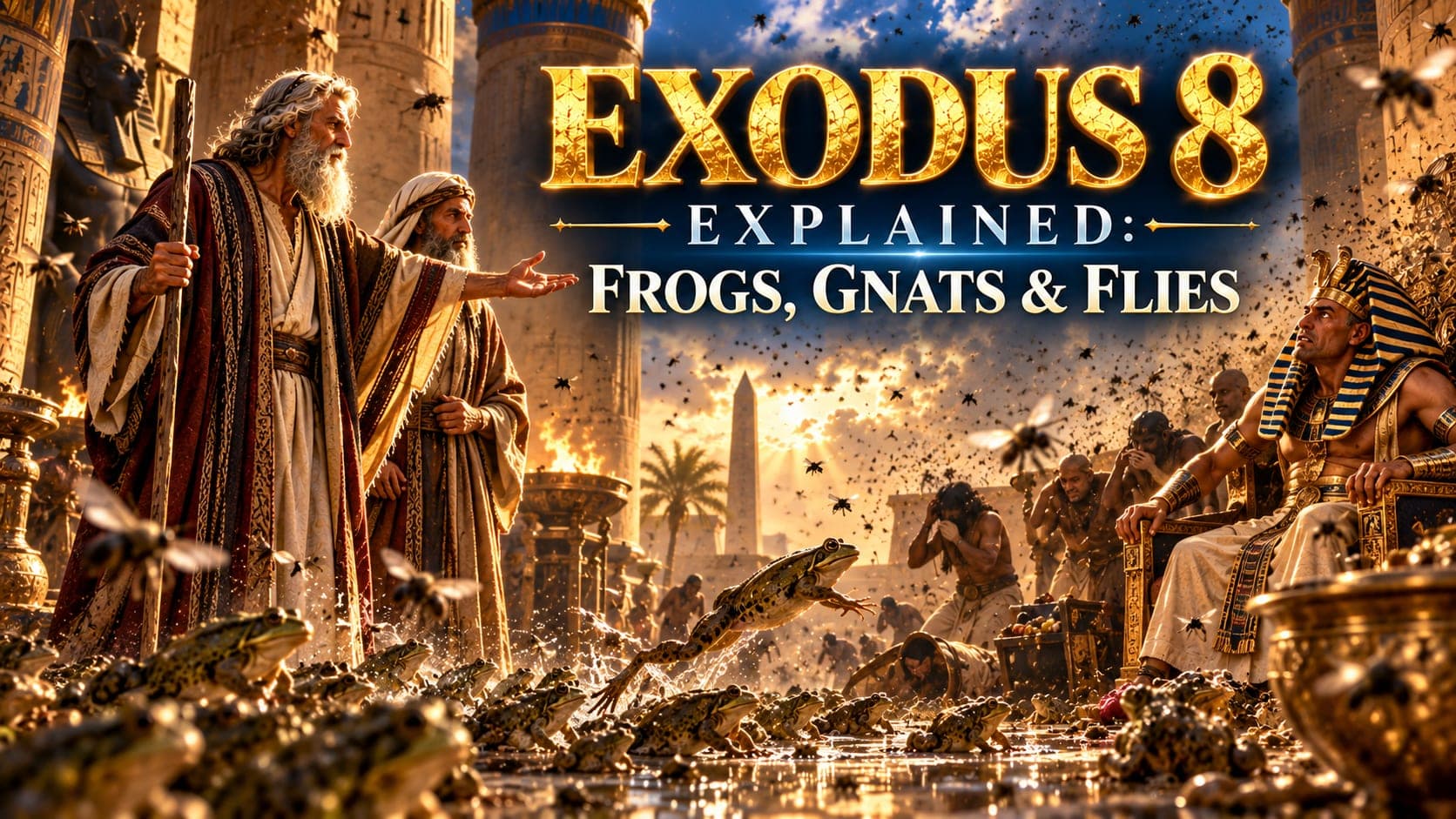
📖 Exodus 8 Explained: Frogs, Lice, and the Finger of God
Frogs in the bed. Lice in the dust. Flies in every house but one.
Exodus 8 explained is the chapter where three plagues land back to back, Pharaoh begs for relief three separate times, and his own magicians finally say out loud what Pharaoh himself will not admit. Egypt is now watching something it cannot copy.
Maybe you have made a promise under pressure that you quietly dropped once the pressure lifted.
- ❓ Why can the magicians fake frogs but not lice?
- ❓ What does it mean that this plague is "the finger of God"?
- ❓ Why does God suddenly spare one piece of land and not the rest?
- ❓ And was Pharaoh's begging ever real repentance at all?
📌 Every time the pain stops in this chapter, so does Pharaoh's promise. Relief and repentance turn out to be two very different things.
This walkthrough works through Exodus 8 from the first frog to the last hardened heart: the plague Pharaoh begs to have removed, the plague his own experts cannot reproduce, the plague that finally draws a visible line between Egypt and Israel, and the bargaining that follows once Pharaoh realizes he cannot simply wait this one out.
Watch how many times relief gets confused for repentance in this one chapter alone.
What Happened Just Before This Chapter
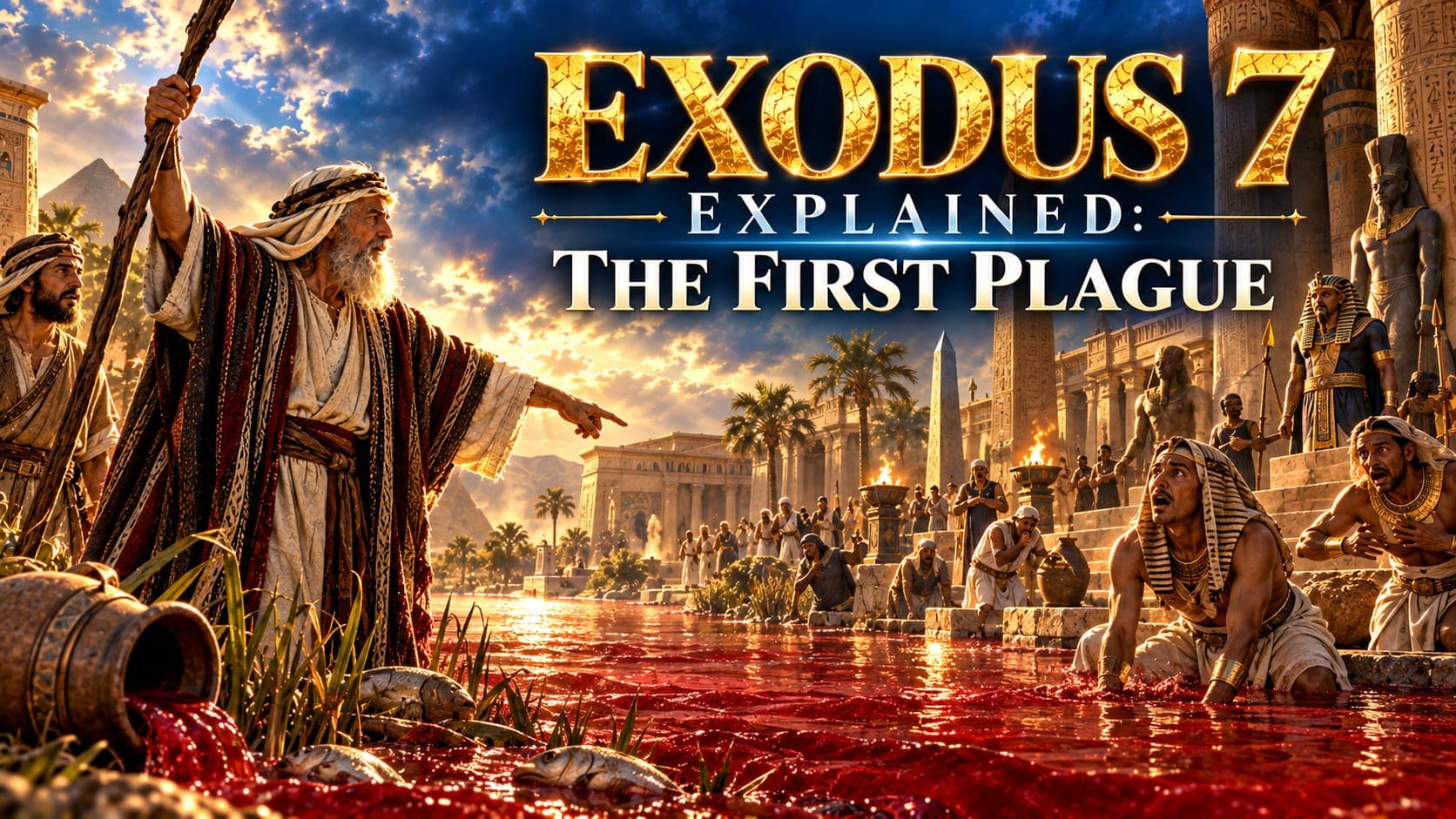
Exodus 7 ended with the first plague still hanging over Egypt. Aaron's rod had already swallowed the magicians' rods in a public contest, Pharaoh had watched his own experts lose it, and then the Nile itself turned to blood. The magicians copied that too, Pharaoh turned and walked calmly back into his house, and the whole nation spent seven days digging into the ground for water it could no longer drink from the river.
Exodus 8 opens the moment those seven days end. No apology has come from the palace. Nothing has softened. God simply sends Moses back in, the way He said He would in Exodus 7, to multiply the signs Pharaoh refused to take seriously the first time.
Exodus 8 Explained Verse by Verse
1. The Plague of Frogs: A Warning First (verses 1 to 6)
Unlike the blood in the river, this plague comes with a warning attached.
"And the LORD spake unto Moses, Go unto Pharaoh, and say unto him, Thus saith the LORD, Let my people go, that they may serve me."
"And if thou refuse to let them go, behold, I will smite all thy borders with frogs: And the river shall bring forth frogs abundantly, which shall go up and come into thine house, and into thy bedchamber, and upon thy bed, and into the house of thy servants, and upon thy people, and into thine ovens, and into thy kneadingtroughs."
📌 Notice exactly where God says the frogs will go. Not just the riverbank or the fields. The bedroom, the bed itself, the ovens, the bowls used to knead bread. Nowhere in an Egyptian home is left untouched, named one room at a time before a single frog appears.
"And the LORD spake unto Moses, Say unto Aaron, Stretch forth thine hand with thy rod over the streams, over the rivers, and over the ponds, and cause frogs to come up upon the land of Egypt."
"And Aaron stretched out his hand over the waters of Egypt; and the frogs came up, and covered the land of Egypt."
Aaron's rod does the same work it did in Exodus 7, only this time the target is not the one river Egypt depends on. It is every stream, every pond, every source of water in the land, all at once.
2. Pharaoh Begs for Relief, on His Own Terms (verses 7 to 15)
Egypt's own wise men answer the frogs the same way they answered the blood.
"And the magicians did so with their enchantments, and brought up frogs upon the land of Egypt."
⚠️ Adding more frogs to a land already covered in them is not a solution. It is proof the magicians can multiply a disaster without being able to touch it. For the first time, Pharaoh does something he did not do after the blood.
"Then Pharaoh called for Moses and Aaron, and said, Intreat the LORD, that he may take away the frogs from me, and from my people; and I will let the people go, that they may do sacrifice unto the LORD."
📌 This is Pharaoh's first promise in the whole book, and it comes out of him only once the frogs are in his own bed. He asks Moses to pray, not to a god he respects, but to the one power in the room that can actually stop what is happening to him.
Moses answers with an unusual offer. He lets Pharaoh set the timing himself.
"And Moses said unto Pharaoh, Glory over me: when shall I intreat for thee, and for thy servants, and for thy people, to destroy the frogs from thee and thy houses, that they may remain in the river only?"
"And he said, To morrow. And he said, Be it according to thy word: that thou mayest know that there is none like unto the LORD our God."
💡 Moses does not strike the frogs away immediately. He has Pharaoh name the hour, then God answers at precisely that hour and no sooner. The delay itself is the proof. Nothing about the timing can be written off as a coincidence of nature, because Pharaoh chose the moment out loud and God kept it.
"And Moses and Aaron went out from Pharaoh: and Moses cried unto the LORD because of the frogs which he had brought against Pharaoh."
"And the LORD did according to the word of Moses; and the frogs died out of the houses, out of the villages, and out of the fields."
"And they gathered them together upon heaps: and the land stank."
The relief itself is not clean. Dead frogs piled in heaps across the whole country left behind a smell that outlasted the plague by days. Even the end of a judgment in Exodus carries a cost that lingers.
"But when Pharaoh saw that there was respite, he hardened his heart, and hearkened not unto them; as the LORD had said."
⚠️ The word respite is doing all the work in this verse. The moment the pressure lifted, so did the promise. Pharaoh never said he believed in the LORD. He said he wanted the frogs gone, and once they were, the vow that bought their removal went with them.
3. The Plague of Lice: the Magicians' First Failure (verses 16 to 19)
No warning this time. The dust itself simply turns against Egypt.
"And the LORD said unto Moses, Say unto Aaron, Stretch out thy rod, and smite the dust of the land, that it may become lice throughout all the land of Egypt."
"And they did so; for Aaron stretched out his hand with his rod, and smote the dust of the earth, and it became lice in man, and in beast; all the dust of the land became lice throughout all the land of Egypt."
Blood came from the river. Frogs came from the river. This plague comes from the ground itself, the one surface no Egyptian can avoid standing on.
"And the magicians did so with their enchantments to bring forth lice, but they could not: so there were lice upon man, and upon beast."
📌 Twice already the magicians matched God's sign. Here, for the first time, they simply cannot. Whatever power or trick let them copy a serpent and copy blood and copy frogs runs out completely against the dust turning to lice.
"Then the magicians said unto Pharaoh, This is the finger of God: and Pharaoh's heart was hardened, and he hearkened not unto them; as the LORD had said."
💡 Egypt's own occult experts say out loud what Pharaoh will not. They do not call it luck or a trick of nature. They name it the finger of God, an admission from the one group in Egypt with the most reason to explain it away if they possibly could. Even that confession changes nothing in Pharaoh himself.
4. The Plague of Flies, and the Line Drawn at Goshen (verses 20 to 24)
God sends Moses back with the same message, early, before Pharaoh leaves his house.
"And the LORD said unto Moses, Rise up early in the morning, and stand before Pharaoh; lo, he cometh forth to the water; and say unto him, Thus saith the LORD, Let my people go, that they may serve me."
"Else, if thou wilt not let my people go, behold, I will send swarms of flies upon thee, and upon thy servants, and upon thy people, and into thy houses: and the houses of the Egyptians shall be full of swarms of flies, and also the ground whereon they are."
Then comes a detail that has not appeared in any plague so far.
"And I will sever in that day the land of Goshen, in which my people dwell, that no swarms of flies shall be there; to the end thou mayest know that I am the LORD in the midst of the earth."
"And I will put a division between my people and thy people: to morrow shall this sign be."
📌 Blood, frogs, and lice fell on every Egyptian without exception. This is the first plague God names a place His own people will not share. Goshen, where Israel settled back in Genesis 47, becomes a visible boundary line that Egypt can watch from the outside and never cross.
"And the LORD did so; and there came a grievous swarm of flies into the house of Pharaoh, and into his servants' houses, and into all the land of Egypt: the land was corrupted by reason of the swarm of flies."
Pharaoh's own house is named specifically. The flies reach the throne room itself, while a few miles away an entire Hebrew settlement sees none of it.
5. Pharaoh's Compromise, and Moses's Refusal (verses 25 to 29)
For the first time, Pharaoh does not simply refuse. He offers a version of yes that is not really a yes at all.
"And Pharaoh called for Moses and for Aaron, and said, Go ye, sacrifice to your God in the land."
⚠️ Pharaoh offers worship without departure. Stay in Egypt, sacrifice right here, and nothing about Israel's actual bondage has to change. Moses does not accept it.
"And Moses said, It is not meet so to do; for we shall sacrifice the abomination of the Egyptians to the LORD our God: lo, shall we sacrifice the abomination of the Egyptians before their eyes, and will they not stone us?"
"We will go three days' journey into the wilderness, and sacrifice to the LORD our God, as he shall command us."
💡 Several of the animals Israel would sacrifice, sheep and cattle among them, were sacred to the Egyptians rather than merely ordinary livestock. Killing them in full view of Egyptian worshippers was not a small cultural mismatch. Moses calls it exactly what it would look like to Egypt: an abomination, dangerous enough to get them stoned where they stood.
"And Pharaoh said, I will let you go, that ye may sacrifice to the LORD your God in the wilderness; only ye shall not go very far away: intreat for me."
📌 Pharaoh moves the goalposts instead of letting them go. First it was sacrifice inside Egypt. Now it is sacrifice outside Egypt, but not very far outside. Every concession stops just short of the full request God actually sent Moses to make.
"And Moses said, Behold, I go out from thee, and I will intreat the LORD that the swarms of flies may depart from Pharaoh, from his servants, and from his people, to morrow: but let not Pharaoh deal deceitfully any more in not letting the people go to sacrifice to the LORD."
Moses agrees to pray again, but he says the word deceitfully to Pharaoh's face before he does it. After two broken promises already, Moses names exactly what he expects to happen next.
6. Relief Again, and the Same Hardened Heart (verses 30 to 32)
Moses keeps his word. The question left standing is whether Pharaoh will keep his.
"And Moses went out from Pharaoh, and intreated the LORD."
"And the LORD did according to the word of Moses; and he removed the swarms of flies from Pharaoh, from his servants, and from his people; there remained not one."
"And Pharaoh hardened his heart at this time also, neither would he let the people go."
⚠️ Not one fly left behind, and still not one Israelite let go. Moses named the pattern out loud two verses earlier, and the chapter closes with Pharaoh proving him right a third time in three plagues.

Hard Questions Exodus 8 Raises
Why could the magicians copy frogs but not lice? Exodus 8 states the fact plainly in verse 18 without explaining the mechanism behind either success or failure. The text is confident about the limit, not the method: whatever power or skill let the magicians multiply frogs ran out completely once the sign came from the dust itself rather than the water.
What does "the finger of God" mean? It is a way of naming direct, personal action by God, used again much later when Jesus describes casting out demons by the same phrase. Coming from Pharaoh's own magicians in verse 19, it is the strongest admission in the chapter that something beyond their craft is at work, and it still does not soften Pharaoh's own heart even one verse later.
Were the lice and flies of Exodus 8 literally lice and flies? Bible translators genuinely disagree here. Some render the Hebrew word in verses 16 to 18 as lice, others as gnats or mosquitoes, and the swarms of verse 21 are rendered by some translations as flies and by others as beetles. The text itself does not resolve which insect is meant. What every reading agrees on is the scale: something small, numerous, and inescapable covering all of Egypt at once.
Why did God spare Goshen starting with this plague and not the earlier ones? Exodus 8 does not explain the timing. It simply states, in verse 23, that this is the plague where God chooses to put a division between the two peoples. The chapters before this one struck all of Egypt without distinction; from here forward, where someone lives starts to matter.
Was Pharaoh's begging in this chapter real repentance? Nothing in the text calls it that. Pharaoh asks for relief three times and breaks his word three times, always the moment the suffering stops rather than once he has actually agreed with what God said. Exodus draws a clear line between wanting pain to end and actually turning from the choice causing it, and lets Pharaoh's own pattern make the distinction rather than stating it directly.
Top Verses From Exodus 8
1. Exodus 8:19
"Then the magicians said unto Pharaoh, This is the finger of God: and Pharaoh's heart was hardened, and he hearkened not unto them; as the LORD had said."
The clearest confession in the chapter, spoken by the people with the least reason to give God credit for anything, and it still changes nothing in Pharaoh.
2. Exodus 8:23
"And I will put a division between my people and thy people: to morrow shall this sign be."
The first visible line drawn between Israel and Egypt in the plagues, a boundary that becomes sharper with every plague that follows this one.
3. Exodus 8:15
"But when Pharaoh saw that there was respite, he hardened his heart, and hearkened not unto them; as the LORD had said."
Relief and repentance are not the same thing, and this verse is the clearest proof of the difference anywhere in the chapter.
4. Exodus 8:10
"And he said, To morrow. And he said, Be it according to thy word: that thou mayest know that there is none like unto the LORD our God."
Moses lets Pharaoh name the hour himself, so that whatever happens next cannot be explained away as coincidence.
5. Luke 11:20
"But if I with the finger of God cast out devils, no doubt the kingdom of God is come upon you."
Centuries later, Jesus reaches for the exact same phrase Pharaoh's own magicians used, pointing His listeners to the same conclusion they could not escape in Egypt.
Frequently Asked Questions About Exodus 8
What happens in Exodus 8?
Three plagues strike Egypt in order: frogs, lice, and flies. Pharaoh begs for relief after the frogs and promises to let Israel go, then hardens his heart the moment they are gone. His magicians copy the frogs but fail to produce lice, calling it the finger of God. God then spares the land of Goshen from the flies, and Pharaoh offers to let Israel sacrifice without fully letting them leave, before hardening his heart a third time.
What is the plague of frogs in Exodus 8?
The second plague on Egypt, where frogs come up out of the Nile and every other water source and fill Egyptian homes, including bedrooms, ovens, and kneading bowls, exactly as verses 2 and 3 describe before it happens.
Why couldn't Pharaoh's magicians produce lice?
Exodus 8:18 simply states that they tried with their enchantments and could not. It is the first plague in the book their power cannot reproduce, after successfully copying both the earlier blood and the frogs.
What does "this is the finger of God" mean?
It is the magicians themselves admitting, in Exodus 8:19, that this plague comes from God directly rather than from any power they can imitate. The same phrase appears later on Jesus's own lips in Luke 11:20, describing His authority over evil spirits.
Why did God spare the land of Goshen from the flies?
Exodus 8:22 and 23 say God put a division between His people and Egypt starting with this plague, so Pharaoh would know the LORD was active in the middle of the earth, not acting on Egypt and Israel equally.
Were the lice in Exodus 8 actually lice?
Scholars genuinely disagree. Some translations render the Hebrew as lice, others as gnats or mosquitoes, and the text does not settle the question. Every reading agrees the insect was small, numerous, and covered all of Egypt at once.
Why wouldn't Moses let Israel sacrifice inside Egypt?
Exodus 8:26 has Moses call it an abomination to the Egyptians, since the animals Israel would sacrifice were sacred to Egyptian religion. Doing it in plain view risked being stoned by the very people watching.
Did Pharaoh ever really intend to keep his promises in this chapter?
The pattern across all three plagues says no. He promises relief after the frogs and breaks it in verse 15, offers a limited compromise after the flies, and still hardens his heart again in verse 32 once the flies are gone.
How does Exodus 8 connect to the rest of the plagues?
It introduces two patterns the rest of the book will keep: Pharaoh negotiating partial obedience instead of full obedience, and God drawing a visible line between Israel and Egypt that grows sharper with each plague still to come.
Final Thoughts
Exodus 8 is the chapter where wanting relief and actually changing finally split apart.
📌 Relief is not repentance. Pharaoh asked for the frogs, the lice, and the flies to stop. He never once asked to become a different kind of man, and the moment each plague lifted proved it.
📌 Even undeniable proof does not force a closed heart open. Pharaoh's own magicians called the lice the finger of God. He heard them say it, and hardened his heart in the very next phrase.
📌 A compromise is not the same as obedience. Sacrifice in the land, then sacrifice nearby, were both offers to keep most of the old arrangement while looking like he had given something up.
You may be offering God a modified yes right now, the same way Pharaoh offered Moses worship without departure.
So here is your one next step.
Name the place where you are negotiating with God instead of obeying Him, the way Pharaoh kept moving the line instead of crossing it.