📖 Exodus 9 Explained: Boils, Hail, and a Name Declared to Egypt
The cattle in the field start dying. Then the sores appear on skin. Then fire falls out of the sky.
Exodus 9 explained is the chapter where the plagues stop being an inconvenience Pharaoh can wait out and start taking lives and bodies directly. Three plagues land in these verses, and for the first time, Pharaoh's own magicians are not just outperformed. They are personally struck down by the very disease they used to study from a safe distance.
Maybe you have said the right words under pressure without actually meaning to change anything.
- ❓ What is a murrain, and why does it target cattle specifically?
- ❓ Why can the magicians not even stand up in this chapter?
- ❓ Why does God say He raised Pharaoh up for this exact purpose?
- ❓ And why does the hail skip some Egyptians but not others?
📌 Exodus 9 is the chapter where God states, out loud, exactly why this is happening, and Pharaoh still cannot get past saying the right words.
This walkthrough goes through Exodus 9 in order: the cattle disease that kills what Egypt cannot replace, the boils that reach the magicians themselves, the long speech where God names His own purpose in full, the Egyptians who get a choice the earlier plagues never offered, the worst hailstorm Egypt had ever seen, and Pharaoh's fastest return to a hardened heart yet.
Watch how close Pharaoh gets to the truth in this chapter, and how little it changes him.
What Happened Just Before This Chapter
Exodus 8 ended with Pharaoh offering Moses a worship arrangement that kept Israel inside Egypt, then a worship arrangement that kept them close by, and rejecting the real request both times. The flies lifted the moment Moses prayed, and Pharaoh hardened his heart a third time in that one chapter alone, breaking the pattern down to its bare mechanics: pressure, promise, relief, nothing.
Exodus 9 opens with God sending Moses back in again, and this time the plagues stop touching only Egypt's water and its dust. They start touching Egypt's food supply, its own people's bodies, and finally its crops.
Exodus 9 Explained Verse by Verse
1. The Fifth Plague: Death Comes to the Cattle (verses 1 to 7)
God sends the same demand He has sent three times already, with a new kind of warning attached.
"Then the LORD said unto Moses, Go in unto Pharaoh, and tell him, Thus saith the LORD God of the Hebrews, Let my people go, that they may serve me."
"For if thou refuse to let them go, and wilt hold them still, Behold, the hand of the LORD is upon thy cattle which is in the field, upon the horses, upon the asses, upon the camels, upon the oxen, and upon the sheep: there shall be a very grievous murrain."
Murrain is an old English word for a disease that kills livestock. Every working animal Egypt owns is named one at a time: horses, donkeys, camels, oxen, sheep. This is not a plague on an inconvenience. It is a plague on the animals that plow the fields, carry the loads, and feed the people.
Then comes a line that had not appeared this plainly before.
"And the LORD shall sever between the cattle of Israel and the cattle of Egypt: and there shall nothing die of all that is the children's of Israel."
"And the LORD appointed a set time, saying, To morrow the LORD shall do this thing in the land."
📌 God names the day before it happens, and names which animals will live before a single one dies. Nothing here is left for Pharaoh to explain away later as an unlucky coincidence of weather or disease moving through the region on its own.
"And the LORD did that thing on the morrow, and all the cattle of Egypt died: but of the cattle of the children of Israel died not one."
"And Pharaoh sent, and, behold, there was not one of the cattle of the Israelites dead. And the heart of Pharaoh was hardened, and he did not let the people go."
⚠️ Pharaoh does not take anyone else's word for this. He sends his own people to check Israel's herds with his own eyes. The report comes back exactly as God said it would, and it changes nothing. Notice too what is missing from this plague that was present in every earlier one: no magician steps forward to copy it. Dead animals cannot be faked, and for the first time nobody even tries.
2. Boils That Strike the Magicians Themselves (verses 8 to 12)
The sixth plague comes without a warning sent to Pharaoh first.
"And the LORD said unto Moses and unto Aaron, Take to you handfuls of ashes of the furnace, and let Moses sprinkle it toward the heaven in the sight of Pharaoh."
"And it shall become small dust in all the land of Egypt, and shall be a boil breaking forth with blains upon man, and upon beast, throughout all the land of Egypt."
Blains is an old word for swellings or sores, paired here with boils to describe something painful breaking out across skin. This time the plague comes from ash thrown into the air rather than from the river or the ground, striking the Egyptians' own bodies directly for the first time in the book.
"And they took ashes of the furnace, and stood before Pharaoh; and Moses sprinkled it up toward heaven; and it became a boil breaking forth with blains upon man, and upon beast."
"And the magicians could not stand before Moses because of the boils; for the boil was upon the magicians, and upon all the Egyptians."
📌 In every earlier contest, the magicians lost by failing to copy a sign. Here, they lose by becoming part of the plague they once tried to reproduce. They cannot even stand in Pharaoh's court, let alone perform. The men Pharaoh once called in to answer Aaron's rod are now too sick to appear at all.
"And the LORD hardened the heart of Pharaoh, and he hearkened not unto them; as the LORD had spoken unto Moses."
This is the first time in Exodus that the text says plainly the LORD hardened Pharaoh's heart, rather than saying Pharaoh's heart simply was hardened. The wording shifts from verse to verse across this chapter, and it is worth watching closely as the chapter goes on.
3. Why God Says He Raised Pharaoh Up (verses 13 to 17)
Before the seventh plague falls, God gives Moses the longest speech of the confrontation so far.
"And the LORD said unto Moses, Rise up early in the morning, and stand before Pharaoh, and say unto him, Thus saith the LORD God of the Hebrews, Let my people go, that they may serve me."
"For I will at this time send all my plagues upon thine heart, and upon thy servants, and upon thy people; that thou mayest know that there is none like me in all the earth."
"For now I will stretch out my hand, that I may smite thee and thy people with pestilence; and thou shalt be cut off from the earth."
💡 God tells Pharaoh plainly that He could have ended this already. The plagues so far have been restraint, not the full weight of what could fall on Egypt. Then comes the verse that explains the whole confrontation from God's side.
"And in very deed for this cause have I raised thee up, for to shew in thee my power; and that my name may be declared throughout all the earth."
"As yet exaltest thou thyself against my people, that thou wilt not let them go?"
📌 God names His own purpose out loud, in the middle of the story, instead of leaving it for the reader to guess. Pharaoh was not raised up by accident into a position to defy God. His resistance itself becomes the stage on which God's power and name get shown to the whole earth, not only to Egypt.
Centuries later, Paul draws this same declaration straight into Romans 9:17 while writing about how God works out His purposes even through a hardened king. It is one of the clearest straight lines in Scripture between an Old Testament event and a New Testament argument about God's sovereignty.
4. A Warning the Egyptians Could Actually Act On (verses 18 to 21)
For the first time, God tells Egypt exactly what to do to avoid the coming disaster.
"Behold, to morrow about this time I will cause it to rain a very grievous hail, such as hath not been in Egypt since the foundation thereof even until now."
"Send therefore now, and gather thy cattle, and all that thou hast in the field; for upon every man and beast which shall be found in the field, and shall not be brought home, the hail shall come down upon them, and they shall die."
Egypt splits into two groups, and the line between them has nothing to do with being Egyptian or Hebrew.
"He that feared the word of the LORD among the servants of Pharaoh made his servants and his cattle flee into the houses:"
"And he that regarded not the word of the LORD left his servants and his cattle in the field."
📌 Every earlier plague drew the line at the border of Goshen. This one draws the line at whoever actually believed the warning. Some of Pharaoh's own servants feared the word of the LORD enough to act on it, and the text says plainly that those servants, and their animals, were spared. Being Egyptian did not decide the outcome here. What a person did with the warning did.
5. The Worst Hail Egypt Had Ever Seen (verses 22 to 26)
Moses raises his rod, and the storm God described arrives exactly as promised.
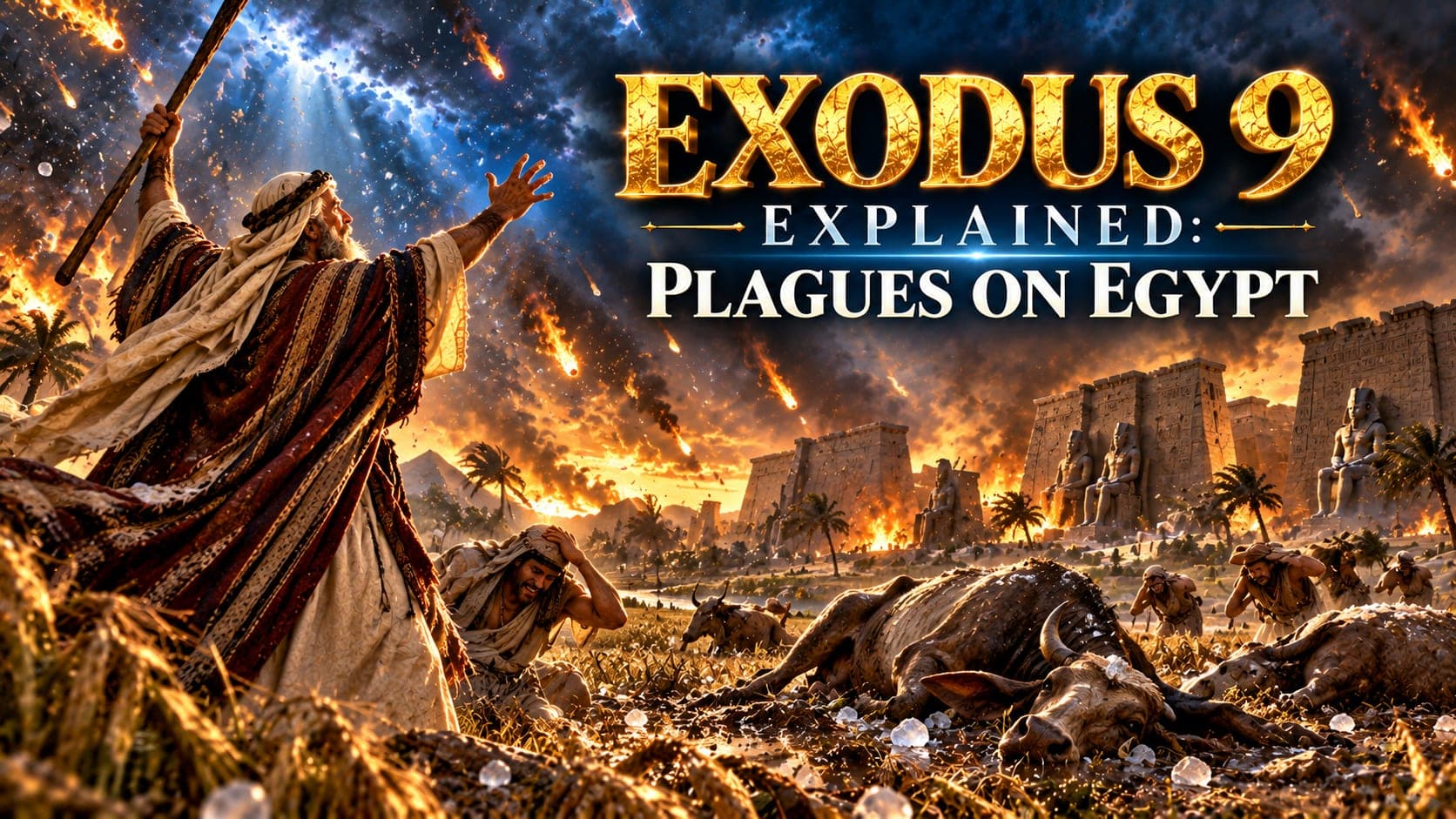
"And Moses stretched forth his rod toward heaven: and the LORD sent thunder and hail, and the fire ran along upon the ground; and the LORD rained hail upon the land of Egypt."
"So there was hail, and fire mingled with the hail, very grievous, such as there was none like it in all the land of Egypt since it became a nation."
"And the hail smote throughout all the land of Egypt all that was in the field, both man and beast; and the hail smote every herb of the field, and brake every tree of the field."
Fire mixed inside falling ice is not ordinary weather, and the text does not pretend otherwise, calling it something Egypt had never once seen since it became a nation. Crops, trees, and anyone caught outside all suffer the same damage.
"Only in the land of Goshen, where the children of Israel were, was there no hail."
The national line reappears here even after verses 20 and 21 already showed a line drawn by belief rather than birth. Moses is watching both kinds of mercy work at the same time: the fearful Egyptian servant spared in his own house, and the whole territory of Goshen spared outright.
6. Pharaoh's Clearest Confession, and the Fastest Hardening Yet (verses 27 to 35)
For the first time in the book, Pharaoh says something that sounds like an admission of guilt.
"And Pharaoh sent, and called for Moses and Aaron, and said unto them, I have sinned this time: the LORD is righteous, and I and my people are wicked."
📌 No earlier plague produced words this direct. Pharaoh does not just ask for relief this time. He says the LORD is righteous and names his own people wicked, closer to real confession than anything he has said through the six plagues before this one.
"Intreat the LORD (for it is enough) that there be no more mighty thunderings and hail; and I will let you go, and ye shall stay no longer."
"And Moses said unto him, As soon as I am gone out of the city, I will spread abroad my hands unto the LORD; and the thunder shall cease, neither shall there be any more hail; that thou mayest know how that the earth is the LORD's."
"But as for thee and thy servants, I know that ye will not yet fear the LORD God."
⚠️ Moses says yes to the request and tells Pharaoh to his face that the words will not hold. He has watched this exact pattern three plagues running and names it again before it happens a fourth time.
"And the flax and the barley was smitten: for the barley was in the ear, and the flax was bolled."
"But the wheat and the rie were not smitten: for they were not grown up."
💡 Barley ripens earlier in the Egyptian growing season than wheat, which is exactly why one crop stood tall enough to be destroyed while the other was still low to the ground. A small farming detail like this is easy to skip past, but it fits the real agricultural calendar of Egypt rather than a vague, generic disaster.
"And Moses went out of the city from Pharaoh, and spread abroad his hands unto the LORD: and the thunders and hail ceased, and the rain was not poured upon the earth."
"And when Pharaoh saw that the rain and the hail and the thunders were ceased, he sinned yet more, and hardened his heart, he and his servants."
"And the heart of Pharaoh was hardened, neither would he let the children of Israel go; as the LORD had spoken by Moses."
⚠️ Verse 34 does not just say Pharaoh hardened again. It says he sinned yet more. The man who said two verses earlier that he and his people were wicked turns around and adds to that same guilt the moment the sky clears. Watch the grammar across this one chapter: the LORD hardened him in verse 12, Pharaoh hardened himself in verse 34, and his heart simply was hardened in verses 7 and 35. Scripture holds all three without flattening any of them into the others.

Hard Questions Exodus 9 Raises
Did God harden Pharaoh's heart, or did Pharaoh harden his own? Exodus 9 uses both kinds of language inside the same chapter. Verse 12 says the LORD hardened Pharaoh's heart. Verse 34 says Pharaoh himself hardened his heart and sinned yet more. Verses 7 and 35 simply state that his heart was hardened, without naming who did it. The text never resolves the two into one simple mechanism. It presents God's active role and Pharaoh's own choice as both real at once.
What does it mean that God raised Pharaoh up for this purpose? Exodus 9:16 states that God placed Pharaoh in this exact position to show His power and declare His name throughout the earth. Paul quotes this verse directly in Romans 9:17 while defending God's right to work His purposes through whoever He chooses, including a king who refuses Him. Christians have long debated how far this extends to questions of free will and divine sovereignty in general, and the honest answer is that serious, Bible believing thinkers land in different places on that larger question. What Exodus 9 itself states plainly is narrower: Pharaoh's specific resistance served God's specific purpose of making His name known.
Was Pharaoh's confession in verse 27 real repentance? He says the LORD is righteous and calls his own people wicked, words no earlier plague produced from him. But Moses answers him in verse 30 by predicting he still will not fear the LORD, and verse 34 confirms it within the same chapter. Exodus draws a distinction between saying true words under pressure and actually being changed by them, and lets Pharaoh's own next move make the distinction rather than stating it as a rule.
Why were some Egyptians spared from the hail and others were not? Verses 20 and 21 say plainly that it came down to who feared the word of the LORD enough to bring themselves and their animals indoors. This sits inside the same chapter as the land of Goshen being spared entirely in verse 26, so the chapter shows mercy working along two different lines at once: one drawn by where Israel lived, and one drawn by who believed the warning regardless of where they lived.
Top Verses From Exodus 9
1. Exodus 9:16
"And in very deed for this cause have I raised thee up, for to shew in thee my power; and that my name may be declared throughout all the earth."
God states His own purpose in the middle of the story rather than leaving it hidden, and Paul draws this same declaration into his own argument centuries later in Romans 9:17.
2. Exodus 9:27
"And Pharaoh sent, and called for Moses and Aaron, and said unto them, I have sinned this time: the LORD is righteous, and I and my people are wicked."
The most direct words Pharaoh has spoken yet, and still not enough to outlast the storm clearing.
3. Exodus 9:11
"And the magicians could not stand before Moses because of the boils; for the boil was upon the magicians, and upon all the Egyptians."
The men who once matched Aaron's signs become part of the next plague instead of its audience.
4. Exodus 9:20
"He that feared the word of the LORD among the servants of Pharaoh made his servants and his cattle flee into the houses:"
A line drawn by belief rather than birth, inside the household of the very king refusing to listen.
5. Romans 9:17
"For the scripture saith unto Pharaoh, Even for this same purpose have I raised thee up, that I might shew my power in thee, and that my name might be declared throughout all the earth."
Paul reaches back to this same declaration from Exodus 9:16, treating Pharaoh's own story as proof inside his own argument about God.
Frequently Asked Questions About Exodus 9
What happens in Exodus 9?
Three plagues strike Egypt in order: a disease that kills Egypt's livestock while Israel's survives, boils that strike every Egyptian including Pharaoh's own magicians, and the worst hailstorm Egypt had ever known. God also tells Pharaoh plainly why He raised him up, and Pharaoh confesses he has sinned before hardening his heart again once the hail stops.
What is murrain in the Bible?
Murrain is an old English word used in Exodus 9:3 for a disease that kills livestock. The fifth plague struck every kind of Egyptian animal named in that verse while leaving Israel's herds untouched.
Why couldn't the magicians copy the plague of boils?
Exodus 9:11 says they could not even stand before Moses, because the boils were on the magicians themselves. This plague did not just defeat their power. It made them part of the disaster rather than observers of it.
What does "I have raised thee up" mean in Exodus 9:16?
It means God placed Pharaoh in his position specifically so that God's power and name would be made known through the confrontation. Paul quotes this verse directly in Romans 9:17 to make the same point centuries later.
Does Exodus 9 say God hardened Pharaoh's heart or Pharaoh hardened his own?
Both appear in this single chapter. Verse 12 says the LORD hardened it. Verse 34 says Pharaoh hardened his own heart and sinned yet more. Scripture states both as true without resolving them into one simple cause.
Why were some Egyptians spared from the hail?
Exodus 9:20 says it came down to who feared the word of the LORD enough to bring themselves and their animals indoors before the storm. That line ran through Pharaoh's own household, not only along Egypt's border with Goshen.
Why did the hail destroy the barley and flax but not the wheat?
Exodus 9:31 and 32 explain it directly: the barley and flax were already grown and exposed, while the wheat and rie had not grown up enough yet to be struck the same way.
Was Pharaoh's confession in Exodus 9:27 genuine repentance?
Moses did not think so. He tells Pharaoh in verse 30 that he and his servants still will not fear the LORD, and verse 34 shows Pharaoh hardening his heart again the moment the hail clears.
How does Exodus 9 connect to the New Testament?
Romans 9:17 draws directly on Exodus 9:16, using God's stated purpose for Pharaoh as part of Paul's argument about God's sovereignty over who He raises up and who He hardens.
Final Thoughts
Exodus 9 is the chapter where Pharaoh finally says almost everything right, and it still is not enough.
📌 Saying the truth about God is not the same as fearing Him. Pharaoh called the LORD righteous and his own people wicked, closer to a real confession than anything he had said before, and hardened his heart again within the same chapter.
📌 God never hid His purpose in this confrontation. Exodus 9:16 states plainly why Pharaoh was raised up, and Paul leans on that exact verse generations later to make his own case about God's sovereignty.
📌 Mercy in this chapter did not only follow a border. Some of Pharaoh's own servants feared the word of the LORD and were spared inside Egypt itself, proof that the line was never only about which side of Goshen someone lived on.
You may have said the right words to God under pressure before, the way Pharaoh did, without letting them cost you anything once the pressure lifted.
So here is your one next step.
Ask whether a recent confession of yours was Pharaoh's kind, true words with no follow through, or the kind that actually feared God enough to act before the storm hit.