📖 Genesis 41 Explained: Pharaoh's Dreams and Joseph's Rise to Power
Two years of silence. Then one morning, everything changes in a single afternoon.
Genesis 41 explained is the chapter where a forgotten prisoner is pulled out of a dungeon and, before the sun sets, is running the most powerful nation on earth. Pharaoh dreams twice. No one in Egypt can tell him what it means. And the only man who can is the Hebrew slave his own butler forgot two chapters ago.
Maybe you have waited so long for a door to open that you stopped expecting it to.
- ❓ Why does Pharaoh dream the same thing twice in one night?
- ❓ Why can every magician in Egypt not explain it, when Joseph explains it instantly?
- ❓ Why does Pharaoh hand the entire country to a prisoner he has never met?
- ❓ What do the names Joseph gives his two sons actually mean?
📌 Thirteen years after his brothers sold him, Joseph steps out of a prison cell and into the second highest seat in Egypt in the space of one conversation.
This walkthrough goes through Genesis 41 in order: the cattle and the grain in Pharaoh's two dreams, the butler who finally remembers, Joseph's interpretation and his plan to survive it, the promotion itself, and the famine that starts spreading the moment the seven good years end.
This chapter is where waiting finally pays off, and it does not explain why it took this long.
What Happened Just Before This Chapter
Genesis 40 ended on one of the bluntest sentences in the whole Joseph story: the chief butler, restored to his old job exactly as Joseph predicted, "did not remember Joseph, but forgat him." Joseph had asked for one small favor, to be mentioned to Pharaoh, and the chapter closed with that favor simply not happening.
Genesis 41 opens two full years later. Nothing in the text tells you what those two years looked like for Joseph, only that they happened, silently, between one chapter and the next.
Genesis 41 Explained Verse by Verse
1. Pharaoh Dreams Twice in One Night (verses 1 to 7)
The chapter opens with the king of Egypt himself, standing in a dream by the Nile.
"And it came to pass at the end of two full years, that Pharaoh dreamed: and, behold, he stood by the river."
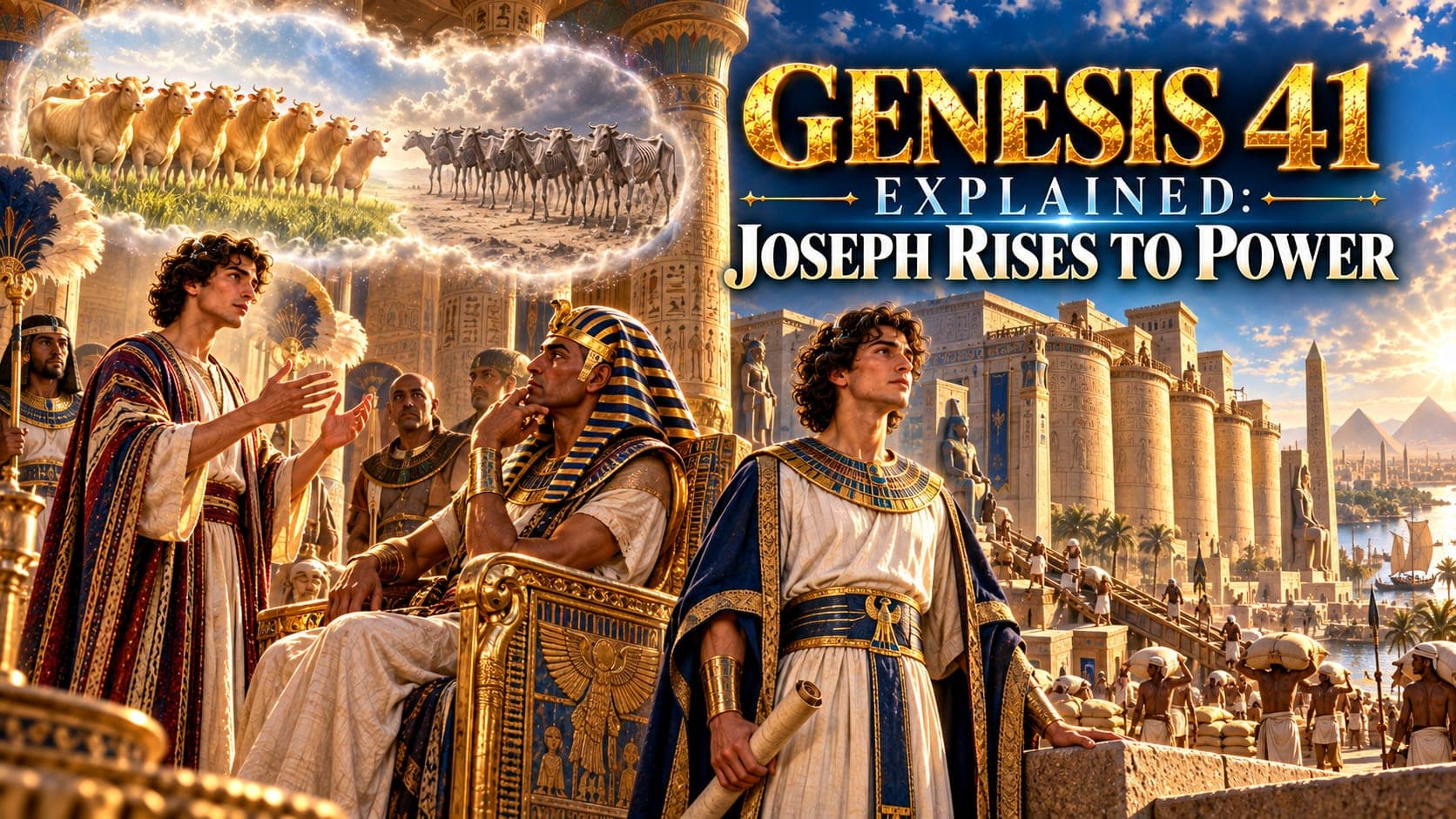
"And, behold, there came up out of the river seven well favoured kine and fatfleshed; and they fed in a meadow. And, behold, seven other kine came up after them out of the river, ill favoured and leanfleshed; and stood by the other kine upon the brink of the river. And the ill favoured and leanfleshed kine did eat up the seven well favoured and fat kine. So Pharaoh awoke."
Kine is simply the old word for cattle. "Fatfleshed" and "leanfleshed" are exactly what they sound like: well fed cows and starving ones. Seven healthy cows come up from the Nile, then seven sickly ones follow them out of the same river and swallow them whole.
Pharaoh wakes, falls back asleep, and dreams again, in a different picture with the same shape.
"And he slept and dreamed the second time: and, behold, seven ears of corn came up upon one stalk, rank and good. And, behold, seven thin ears and blasted with the east wind sprung up after them. And the seven thin ears devoured the seven rank and full ears. And Pharaoh awoke, and, behold, it was a dream."
📌 Two different dreams, the same exact pattern. Seven strong things, seven weak things, and the weak things swallow the strong ones without gaining any visible size from it. Whatever this means, Pharaoh's own mind has already told him twice in one night.
2. Egypt's Wise Men Fail, and the Butler Finally Remembers (verses 8 to 13)
Morning comes, and Pharaoh does what any king with the nation's best resources would do.
"And it came to pass in the morning that his spirit was troubled; and he sent and called for all the magicians of Egypt, and all the wise men thereof: and Pharaoh told them his dream; but there was none that could interpret them unto Pharaoh."
Egypt's magicians were not entertainers doing tricks. They were trained priests and scholars, the official interpreters of omens and dreams for the royal court, the best Egypt had. Every one of them stands in front of the king and comes up empty.
That failure is what finally jogs a memory two years overdue.
"Then spake the chief butler unto Pharaoh, saying, I do remember my faults this day: Pharaoh was wroth with his servants, and put me in ward in the captain of the guard's house, both me and the chief baker: And we dreamed a dream in one night, I and he; we dreamed each man according to the interpretation of his dream. And there was there with us a young man, an Hebrew, servant to the captain of the guard; and we told him, and he interpreted to us our dreams; to each man according to his dream he did interpret. And it came to pass, as he interpreted to us, so it was; me he restored unto mine office, and him he hanged."
📌 The butler calls it "my faults," not a generous memory lapse. He knows exactly what he failed to do. It takes watching every expert in Egypt strike out before he is willing to admit it out loud, in front of the king, that the man who could actually help has been sitting forgotten in a cell this whole time.
3. A Prisoner Is Shaved, Dressed, and Brought Before the King (verses 14 to 16)
Pharaoh does not wait.
"Then Pharaoh sent and called Joseph, and they brought him hastily out of the dungeon: and he shaved himself, and changed his raiment, and came in unto Pharaoh."
Egyptians shaved their heads and faces as a matter of custom, unlike the Hebrews around Joseph. In one verse, Joseph is pulled out of a cell he has likely sat in for years and made to look the part before he ever opens his mouth in front of the most powerful man in the region.
"And Pharaoh said unto Joseph, I have dreamed a dream, and there is none that can interpret it: and I have heard say of thee, that thou canst understand a dream to interpret it."
"And Joseph answered Pharaoh, saying, It is not in me: God shall give Pharaoh an answer of peace."
💡 Before Joseph has heard a single detail, he tells Pharaoh the one thing the butler never thought to mention two years earlier: the answer is not Joseph's own gift to sell. It belongs to God. That single sentence is the same reflex Joseph already showed interpreting the butler and baker's dreams, now spoken to the most important audience of his life.
4. Pharaoh Tells the Dream Again, in Full (verses 17 to 24)
Pharaoh repeats both dreams to Joseph word for word, adding one detail Genesis did not mention the first time:
"And the lean and the ill favoured kine did eat up the first seven fat kine: And when they had eaten them up, it could not be known that they had eaten them; but they were still ill favoured, as at the beginning. So I awoke."
📌 The thin cows swallow the fat ones and stay thin. Nothing about them improves. Whatever is coming does not balance out or average itself away. It simply consumes what came before it and leaves no trace that the good years ever happened.
Pharaoh finishes with the same stark admission the magicians already reached, and failed at:
"And I told this unto the magicians; but there was none that could declare it to me."
5. One Dream, Not Two, and a Warning Doubled for Certainty (verses 25 to 32)
Joseph's answer starts by collapsing two dreams into one single message.
"And Joseph said unto Pharaoh, The dream of Pharaoh is one: God hath shewed Pharaoh what he is about to do."
"The seven good kine are seven years; and the seven good ears are seven years: the dream is one. And the seven thin and ill favoured kine that came up after them are seven years; and the seven empty ears blasted with the east wind shall be seven years of famine."
Cows and grain are two different pictures of the exact same seven years, once of plenty and once of famine. Then Joseph explains why Pharaoh saw it twice at all:
"And for that the dream was doubled unto Pharaoh twice; it is because the thing is established by God, and God will shortly bring it to pass."
📌 The repetition was never random. It was confirmation. Joseph reads the doubling itself as part of the message, a second witness built into a single night, telling Pharaoh this is settled, not a maybe.
Joseph does not stop at explaining the dream. He adds the warning no one asked him for:
"And there shall arise after them seven years of famine; and all the plenty shall be forgotten in the land of Egypt; and the famine shall consume the land."
💡 A slave brought in only to name a meaning volunteers a forecast of exactly how bad it will get. He was asked to interpret. He goes further and tells Pharaoh what the interpretation means for the next fourteen years of his kingdom.
6. Joseph's Plan, and a Stunning Promotion (verses 33 to 45)
Interpretation becomes a proposal.
"Now therefore let Pharaoh look out a man discreet and wise, and set him over the land of Egypt. Let Pharaoh do this, and let him appoint officers over the land, and take up the fifth part of the land of Egypt in the seven plenteous years."
Discreet here means sharp minded and able to judge well, not quiet. Joseph is describing the kind of leader the moment requires, and he never once names himself as a candidate for the job. Pharaoh reaches that verdict entirely on his own:
"And Pharaoh said unto his servants, Can we find such a one as this is, a man in whom the Spirit of God is? And Pharaoh said unto Joseph, Forasmuch as God hath shewed thee all this, there is none so discreet and wise as thou art: Thou shalt be over my house, and according unto thy word shall all my people be ruled: only in the throne will I be greater than thou."
📌 Pharaoh does not interview Joseph's record. He has none, as far as Egypt is concerned. He bases the single biggest promotion in the chapter entirely on the way Joseph just spoke about God. Nothing about Joseph's past as a slave or a prisoner comes up at all.
"And Pharaoh took off his ring from his hand, and put it upon Joseph's hand, and arrayed him in vestures of fine linen, and put a gold chain about his neck; And he made him to ride in the second chariot which he had; and they cried before him, Bow the knee: and he made him ruler over all the land of Egypt."
The ring carried Pharaoh's own authority to seal documents in his name. The second chariot was the highest seat in Egypt short of the throne itself. In the span of a few verses, Joseph goes from a shaved prisoner standing before the king to the man every official in Egypt is told to bow to.
Pharaoh also gives Joseph a new name and a wife, the daughter of an Egyptian priest:
"And Pharaoh called Joseph's name Zaphnathpaaneah; and he gave him to wife Asenath the daughter of Potipherah priest of On."
Genesis never explains what the Egyptian name means, so any specific translation of it is a guess the text does not back up. What the verse does make plain is how completely Joseph has been absorbed into Egypt: a new name, a new wife from a priestly family, a new life, all handed to him in the same afternoon as his promotion.
7. Two Sons, Seven Good Years, and a Famine That Reaches the Whole Earth (verses 46 to 57)
Genesis marks exactly how old Joseph is the day this all happens.
"And Joseph was thirty years old when he stood before Pharaoh king of Egypt."
Genesis 37 said Joseph was seventeen when his brothers sold him. Thirteen years pass between that pit and this throne room, years that included slavery in Potiphar's house, a false accusation, and a prison sentence with no release date attached.
Joseph spends the seven good years exactly as he proposed, storing grain without even finishing the count:
"And Joseph gathered corn as the sand of the sea, very much, until he left numbering; for it was without number."
During those same years, two sons are born, and their names are not random:
"And Joseph called the name of the firstborn Manasseh: For God, said he, hath made me forget all my toil, and all my father's house."
"And the name of the second called he Ephraim: For God hath caused me to be fruitful in the land of my affliction."
📌 Genesis explains both names directly, in Joseph's own words. Manasseh ties to forgetting the toil behind him. Ephraim ties to being fruitful inside the very land where he suffered. Joseph names his sons after what God did with his pain, not after what Egypt gave him.
Then the seven good years end exactly on schedule, and the chapter closes on the famine spreading far past Egypt's own borders:
"And the famine was over all the face of the earth: And Joseph opened all the storehouses, and sold unto the Egyptians; and the famine waxed sore in the land of Egypt."
"And all countries came into Egypt to Joseph for to buy corn; because that the famine was so sore in all lands."
⚠️ The chapter ends with the whole world walking toward Joseph for bread. A famine that started as a dream only he could read has turned into the reason entire nations now depend on him. The next chapter opens with his own family among them, though none of them yet know it.

Hard Questions Genesis 41 Raises
Why could Egypt's own magicians not interpret the dream, when Joseph could instantly? Genesis does not describe their methods, only their result: every one of them failed. The text credits Joseph's answer directly to God revealing the meaning, not to Joseph having a sharper technique than Egypt's trained interpreters. The contrast is the point. Egypt's best resources could not do what one imprisoned foreigner did the moment God gave him the answer.
Is this the same thing as fortune telling? Joseph performs no ritual and claims no private power to see the future on his own. He states plainly, twice in this chapter, that the answer belongs to God, before he has heard any detail and again after he gives it. Scripture frames this as God revealing something true through a dream, the same pattern already seen when Joseph read the butler and baker's dreams, not as Joseph practicing a forbidden art.
Was it really plausible for a foreign prisoner to become second in command of Egypt in one day? The chapter does not soften how extraordinary this is, and it does not pretend to explain Pharaoh's reasoning beyond what the text gives: a king convinced that the Spirit of God was on the man standing in front of him. Egypt did place real power in appointed officials under Pharaoh, so the position itself was not impossible. What the text leaves remarkable is the speed, not the structure.
Should Joseph have married a pagan priest's daughter? Genesis states the marriage as a fact handed to Joseph by Pharaoh, without commenting on it one way or the other. On, where Asenath's father served as priest, was a center of Egyptian sun worship, and the text does not pretend Joseph's new household was untouched by that world. Genesis simply does not moralize this marriage the way it does some others earlier in the book. What it does show clearly is that God still works through Joseph, and later through his sons Manasseh and Ephraim, inside that same household.
Why does the famine reach the whole earth, not just Egypt? Genesis states it as fact in verse fifty seven without explaining the geography. What the chapter does make clear is the effect: a famine that could have simply destroyed Egypt instead becomes the reason surrounding nations, Joseph's own family included, end up walking straight toward the one man who planned for it.
Practical Tips From Genesis 41
Joseph's rise in this chapter did not start the morning Pharaoh dreamed. It started with how he had already been living.
- Keep crediting God even when no one is watching for it. Joseph said "it is not in me" to Pharaoh the same way he said it to two prisoners two chapters earlier. Consistency in private is what makes the public version believable.
- Say the hard part, not just the technical answer. Joseph was asked to interpret a dream. He also volunteered a warning and a plan nobody requested. Do not stop at the minimum when you can see further than that.
- Let your actual competence speak instead of your resume. Pharaoh never asks about Joseph's past as a slave or a prisoner. He responds to how Joseph handles the moment in front of him right then.
- Name what God did with your hard years, instead of hiding them. Joseph named his own sons after his toil and his affliction, not after his new status. He did not pretend the hard years never happened.
- Plan for the lean years during the good ones. Joseph's entire strategy was preparing for a famine while everyone else was enjoying plenty. The time to prepare for hardship is before it arrives, not during it.
Top 5 Bible Verses From Genesis 41
1. Genesis 41:16
"And Joseph answered Pharaoh, saying, It is not in me: God shall give Pharaoh an answer of peace."
Joseph's very first words to the most powerful man in Egypt point away from himself, before he has even heard what the dream contains.
2. Genesis 41:32
"And for that the dream was doubled unto Pharaoh twice; it is because the thing is established by God, and God will shortly bring it to pass."
Joseph reads the repetition itself as part of the message: two dreams with one meaning, given as confirmation that this is certain, not a possibility.
3. Genesis 41:40
"Thou shalt be over my house, and according unto thy word shall all my people be ruled: only in the throne will I be greater than thou."
A prisoner with no standing in Egypt becomes the second most powerful man in the nation in the same breath Pharaoh speaks this sentence.
4. Genesis 41:52
"And the name of the second called he Ephraim: For God hath caused me to be fruitful in the land of my affliction."
Joseph names his own son after being fruitful inside the very hardship he once suffered, not after the honor he now holds.
5. Genesis 41:57
"And all countries came into Egypt to Joseph for to buy corn; because that the famine was so sore in all lands."
The chapter's last line sets up everything that follows: a famine so wide that even Joseph's own estranged family will soon have no choice but to come looking for him.

Frequently Asked Questions About Genesis 41
What happens in Genesis 41?
Pharaoh dreams twice about seven good things and seven bad things each destroying the good. No Egyptian wise man can explain it, so the chief butler finally remembers Joseph. Joseph interprets both dreams as seven years of plenty followed by seven years of famine, proposes a storage plan, and Pharaoh makes him ruler over all of Egypt the same day.
What do Pharaoh's two dreams in Genesis 41 mean?
Both dreams carry the same message in different pictures. Seven fat cows and seven full ears of grain represent seven years of plenty in Egypt. Seven thin cows and seven withered ears, which swallow the healthy ones without gaining anything, represent seven years of famine right behind them.
Why did Pharaoh have the same dream twice?
Joseph explains it directly in Genesis 41:32: the doubling was not two separate messages but one confirmed twice, a sign to Pharaoh that the thing was certain and already settled by God.
Why couldn't Egypt's magicians interpret Pharaoh's dream?
Genesis 41:8 states the fact without explaining their methods: none of Egypt's trained wise men could interpret it. The chapter credits Joseph's correct answer to God revealing it, not to a technique Egypt's own experts lacked.
How old was Joseph when he became ruler of Egypt?
Genesis 41:46 says he was thirty. Genesis 37:2 says he was seventeen when his brothers sold him, meaning thirteen years passed between the pit and the throne room.
What does the name Zaphnathpaaneah mean?
Genesis never explains it. Pharaoh gives Joseph this Egyptian name in Genesis 41:45 without the text offering a translation, so any specific meaning assigned to it goes beyond what Scripture actually states.
Why did Joseph name his sons Manasseh and Ephraim?
Joseph explains both names himself. Manasseh ties to God making him forget his toil and his father's house. Ephraim ties to God making him fruitful in the very land where he had suffered.
Who was Asenath in the Bible?
Genesis 41:45 names her as the daughter of Potipherah, a priest of On, whom Pharaoh gave to Joseph as a wife the same day he was promoted. She becomes the mother of Manasseh and Ephraim.
How does Genesis 41 connect to Genesis 42?
The famine that begins at the end of Genesis 41 spreads far enough that Joseph's own family in Canaan runs out of food. Genesis 42 opens with Jacob sending his sons down to Egypt to buy grain, straight into the hands of the brother they sold years earlier.
Is interpreting Pharaoh's dream the same as practicing divination?
Joseph performs no ritual and claims no power of his own to foresee the future. He states plainly, before and after interpreting, that the answer belongs to God. Scripture treats this as God revealing truth through a dream rather than Joseph practicing a forbidden art.
Final Thoughts
Genesis 41 moves faster than almost any chapter before it, and that speed is the point.
📌 Thirteen years of waiting ended in one conversation. Nothing about the years in between explains or excuses how long it took. The chapter simply shows what happened once the moment finally came.
📌 God confirmed the dream by doubling it, not by making it easier to miss. Certainty in Scripture often arrives as repetition, not as something louder or more dramatic.
📌 Joseph named his own sons after his pain, not his promotion. Manasseh and Ephraim kept the toil and the affliction in the family's memory even after Egypt had given Joseph everything else.
You may be sitting in a long stretch right now that looks nothing like an answer. Joseph's thirteen years did not look like one either, right up until the morning they suddenly did.
So here is your one next step.
Keep living faithfully in the waiting part, the way Joseph did in a cell nobody thought to check on, so you are ready the day the door actually opens.