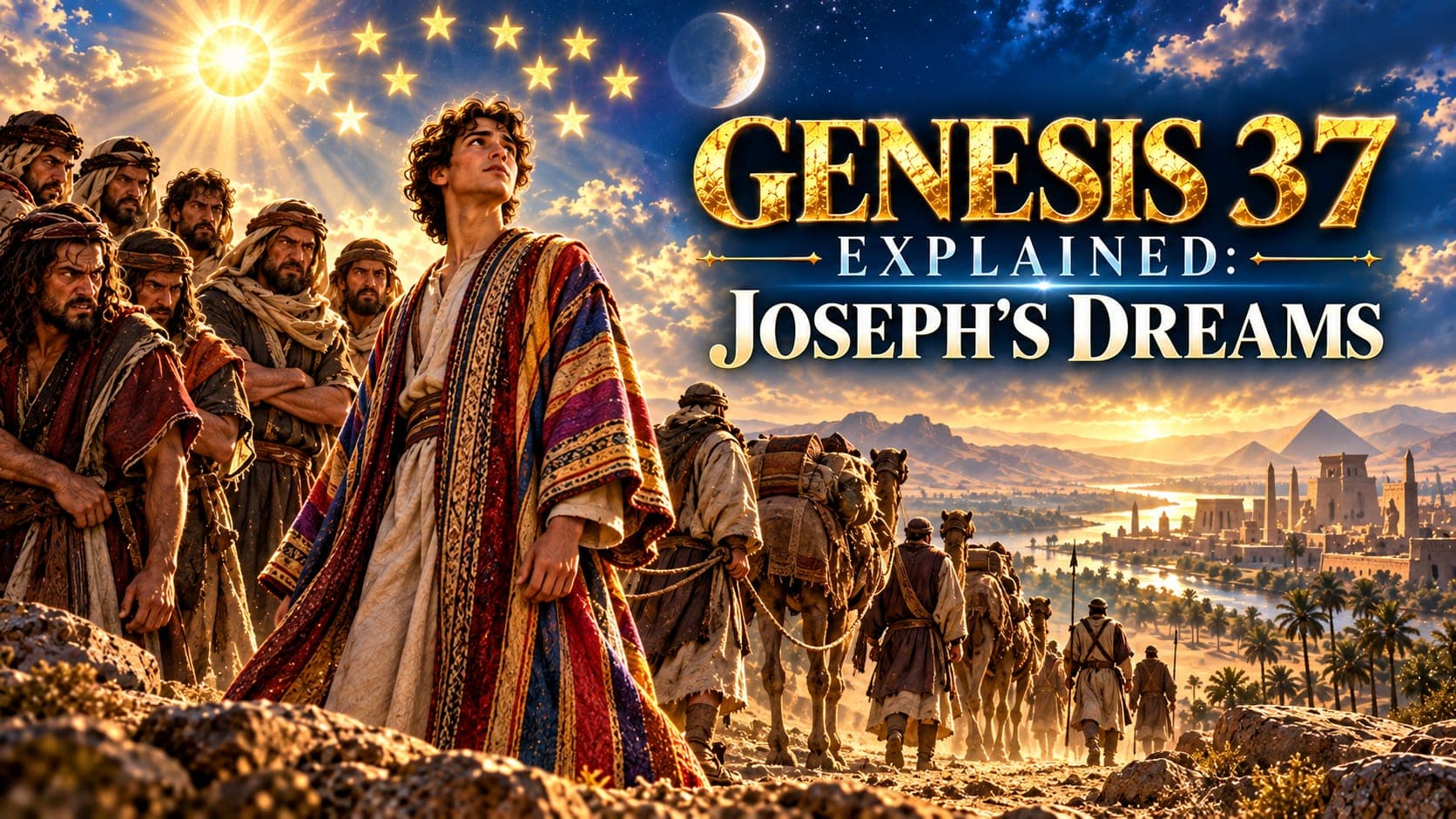
📖 Genesis 37 Explained: Joseph's Dreams and the Brothers Who Sold Him
One coat. Two dreams. Ten brothers who cannot say a kind word to him.
That is all it takes for Joseph's own family to sell him for the price of a slave.
Genesis 37 explained is where the second half of Genesis turns a corner. After chapters of genealogies and family history, the story narrows down to one seventeen year old boy, a father who cannot hide his favorite son, and brothers whose hatred grows from cold silence into a plan to kill him. By the end of the chapter Joseph is gone, sold into Egypt, and his father is left holding a bloodstained coat, convinced his son is dead.
Maybe you know what it is like to be the one your own family cannot stand to be around.
- ❓ Did Joseph's brothers actually sell him, or did someone else take him first?
- ❓ Why does Jacob send his favorite son alone into the middle of his brothers' hatred?
- ❓ Was Reuben really trying to save Joseph, or protect himself?
- ❓ Why does a coat matter enough to nearly get a man killed?
📌 Every major turn in this chapter, the coat, the dreams, the pit, the sale, comes back to one root problem: a father who loved one son out loud and let the rest of his sons feel it every day.
This walkthrough goes through Genesis 37 in order: the coat that marks Joseph out, the two dreams that seal his brothers' hatred, the errand that walks him straight into danger, the plot to kill him, Reuben's quiet attempt to save him, Judah's bargain, and the coat that comes home without him.
Watch how many people in this chapter choose the story that is easiest to tell over the one that is true.
What Happened Just Before This Chapter
Genesis 36 spent forty three verses recording every branch of Esau's family, the dukes, the kings, the territory of Edom, before Genesis turned its attention away from that side of the family for good. Before that, Genesis 35 closed out Jacob's own line: Rachel died giving birth to Benjamin, Jacob's twelve sons were listed complete for the first time, and Jacob's father Isaac died at Hebron.
📌 Genesis 37 opens by narrowing the whole book down to one family line and, within a few verses, to one son inside it. Joseph was born to Rachel, the wife Jacob loved most, late in Jacob's years of working for Laban. Rachel is gone now, and Joseph is seventeen, the older of her two sons, living in a household of half brothers who never forgot how their father counted the years before Rachel finally had a son of her own.
Genesis 37 Explained Verse by Verse
1. The Favored Son and His Coat (verses 1 to 4)
The chapter wastes no time naming the problem at the center of everything that follows.
"These are the generations of Jacob. Joseph, being seventeen years old, was feeding the flock with his brethren; and the lad was with the sons of Bilhah, and with the sons of Zilpah, his father's wives: and Joseph brought unto his father their evil report."
⚠️ Joseph is introduced as a tale bearer before he is introduced as a dreamer. Whatever the "evil report" actually was, Genesis never explains it, only that Joseph carried it to Jacob. That single detail, before anything else happens, already gives his brothers a reason to resent him.
Then comes the verse the whole chapter turns on.
"Now Israel loved Joseph more than all his children, because he was the son of his old age: and he made him a coat of many colours."
"And when his brethren saw that their father loved him more than all his brethren, they hated him, and could not speak peaceably unto him."
📌 Genesis states the favoritism and the hatred it caused back to back, with no softening in between. The coat was not a small gift. It marked Joseph out in front of ten grown brothers every single day, a visible sign of a preference their father never bothered to hide.
💡 This is not the first time this family repeats a pattern. Isaac loved Esau and Rebekah loved Jacob back in Genesis 25, and that favoritism split a household then too. Jacob grew up inside that damage and still handed the same wound to his own sons.
2. Two Dreams Joseph Should Have Kept to Himself (verses 5 to 11)
If the coat made the brothers resentful, the dreams make them dangerous.
"For, behold, we were binding sheaves in the field, and, lo, my sheaf arose, and also stood upright; and, behold, your sheaves stood round about, and made obeisance to my sheaf."
"And his brethren said to him, Shalt thou indeed reign over us? or shalt thou indeed have dominion over us? And they hated him yet the more for his dreams, and for his words."
⚠️ Joseph tells this dream to the very brothers it is about, without being asked. Whatever the dream meant, repeating it out loud to the men it puts beneath him does nothing but confirm what they already suspected about how their father's favorite sees himself.
Then he does it again, and this time even his father pushes back.
"And he dreamed yet another dream, and told it his brethren, and said, Behold, I have dreamed a dream more; and, behold, the sun and the moon and the eleven stars made obeisance to me."
"And he told it to his father, and to his brethren: and his father rebuked him, and said unto him, What is this dream that thou hast dreamed? Shall I and thy mother and thy brethren indeed come to bow down ourselves to thee to the earth?"
💡 Jacob's rebuke is worth noticing. He does not dismiss the dream as nonsense. He questions it while clearly taking it seriously enough to name every member of the family in it, sun, moon, and eleven stars. Genesis closes the scene with one quiet line:
"And his brethren envied him; but his father observed the saying."
📌 Envied and observed sit next to each other on purpose. The brothers react with jealousy. Jacob reacts by holding onto the words. Neither response does anything to close the growing distance between Joseph and the rest of the family.
3. Sent Alone to Check on His Brothers (verses 12 to 17)
With the resentment already at a boil, Jacob sends Joseph straight into it.
"And Israel said unto Joseph, Do not thy brethren feed the flock in Shechem? come, and I will send thee unto them. And he said to him, Here am I."
⚠️ Shechem is not a neutral location. It is the same town where Dinah was assaulted and where Simeon and Levi slaughtered every man in Genesis 34. Jacob sends his favorite son alone toward a place already soaked in his family's violence, with no hint that he sees any danger in it.
Joseph does not even find them there. A stranger redirects him further out.
"And the man said, They are departed hence; for I heard them say, Let us go to Dothan. And Joseph went after his brethren, and found them in Dothan."
💡 Joseph could have turned back once his brothers were nowhere to be found. Instead he keeps walking, further from home and further from anyone who could help him, straight toward the men who already hate him.
4. The Plot to Kill the Dreamer (verses 18 to 20)
The brothers see him coming from a distance, and the plan forms before he is even close enough to speak.
"And when they saw him afar off, even before he came near unto them, they conspired against him to slay him."
"And they said one to another, Behold, this dreamer cometh. Come now therefore, and let us slay him, and cast him into some pit, and we will say, Some evil beast hath devoured him: and we shall see what will become of his dreams."
📌 "This dreamer" is the name they give him now, not brother, not Joseph, just the thing about him they resent most. Their plan is not only to kill him but to erase the dreams along with him, as if silencing Joseph could undo whatever those dreams pointed toward.
5. Reuben's Rescue Attempt, and the Pit (verses 21 to 24)
One brother pulls back from the plan, though not by refusing it outright.
"And Reuben heard it, and he delivered him out of their hands; and said, Let us not kill him."
"And Reuben said unto them, Shed no blood, but cast him into this pit that is in the wilderness, and lay no hand upon him; that he might rid him out of their hands, to deliver him to his father again."
💡 Reuben does not confront his brothers directly. He redirects them toward a pit instead of a knife, with a private plan to come back later and pull Joseph out. It is a real rescue attempt, just a quiet, roundabout one rather than a bold refusal.
"And it came to pass, when Joseph was come unto his brethren, that they stript Joseph out of his coat, his coat of many colours that was on him; And they took him, and cast him into a pit: and the pit was empty, there was no water in it."
⚠️ The coat comes off before anything else happens. The exact thing that marked Joseph as their father's favorite is the first thing his brothers strip from him. Genesis even repeats the phrase, "his coat of many colours," as if lingering on it before it disappears from his back for good.
6. Judah's Bargain, and the Sale to Egypt (verses 25 to 28)
With Joseph in the pit, his brothers sit down to eat, and a caravan passing by gives Judah an idea.
"And Judah said unto his brethren, What profit is it if we slay our brother, and conceal his blood?"
"Come, and let us sell him to the Ishmeelites, and let not our hand be upon him; for he is our brother and our flesh. And his brethren were content."
📌 Judah calls Joseph "our brother and our flesh" in the very sentence where he proposes selling him. It sounds like mercy compared to murder, and it still treats a brother as merchandise. Profit, not conscience, is the word Judah leads with.
"Then there passed by Midianites merchantmen; and they drew and lifted up Joseph out of the pit, and sold Joseph to the Ishmeelites for twenty pieces of silver: and they brought Joseph into Egypt."
💡 Twenty pieces of silver, the price of a slave, is what Joseph is worth to his own brothers. He is gone, sold south into Egypt, and the men who sold him still have to go home and face their father.
7. The Bloody Coat, and a Father Who Refuses Comfort (verses 29 to 36)
Reuben returns to the pit to carry out his rescue and finds it already empty.
"And Reuben returned unto the pit; and, behold, Joseph was not in the pit; and he rent his clothes."
"And he returned unto his brethren, and said, The child is not; and I, whither shall I go?"
⚠️ Reuben's plan worked exactly as he intended, right up until it didn't. He kept Joseph alive, and still lost him. His question, "I, whither shall I go," sounds like a man realizing he is about to answer for something he did not even do.
The brothers settle on a story, and it requires one more use of the coat.
"And they took Joseph's coat, and killed a kid of the goats, and dipped the coat in the blood; And they sent the coat of many colours, and they brought it to their father; and said, This have we found: know now whether it be thy son's coat or no."
📌 Jacob deceived his own father with a goat and a garment in Genesis 27, and now his sons deceive him the exact same way. A goat provides the blood, a garment carries the lie, and the deception Jacob once used on Isaac comes back on him through his own children.
"And he knew it, and said, It is my son's coat; an evil beast hath devoured him; Joseph is without doubt rent in pieces."
"And Jacob rent his clothes, and put sackcloth upon his loins, and mourned for his son many days. And all his sons and all his daughters rose up to comfort him; but he refused to be comforted; and he said, For I will go down into the grave unto my son mourning. Thus his father wept for him."
💡 Every one of Jacob's sons and daughters tries to comfort him, and he refuses all of it. The chapter closes on one final line, almost an afterthought, that tells the reader something Jacob does not yet know.
"And the Midianites sold him into Egypt unto Potiphar, an officer of Pharaoh's, and captain of the guard."
📌 Jacob believes Joseph is dead. Genesis lets the reader know he is not. That gap between what Jacob thinks and what is actually true is what the rest of the Joseph story is built on.

Hard Questions Genesis 37 Raises
Did Joseph's brothers actually sell him, or did the Midianites simply take him from the pit on their own? Verse 28 reads ambiguously in English, naming Midianites drawing Joseph up and selling him, right after Judah had just proposed selling him to Ishmeelites. Genesis 45:4 settles the question in Joseph's own words, spoken years later to the very men responsible:
"And Joseph said unto his brethren, Come near to me, I pray you. And they came near. And he said, I am Joseph your brother, whom ye sold into Egypt."
Whatever the exact mechanics of the transaction in Genesis 37:28, Joseph himself holds his brothers responsible for selling him, not the traders who happened to be passing by.
Is it a contradiction that the chapter calls the traders both Ishmeelites and Midianites? Not necessarily. Scripture elsewhere uses the two names for the same group of desert traders. Judges 8:24 describes the very men Gideon defeated as Midianites in one verse and explains their gold earrings by calling them Ishmaelites in the next:
"And Gideon said unto them, I would desire a request of you, that ye would give me every man the earrings of his prey. (For they had golden earrings, because they were Ishmaelites.)"
The two names overlap elsewhere in the Old Testament, which fits a chapter that uses them interchangeably for the same caravan rather than describing two separate groups.
What did "a coat of many colours" actually look like? The Hebrew phrase behind it is rare enough that translators are not fully certain, and some render it as a long robe with sleeves rather than a garment of many colors. The same phrase describes a royal garment in 2 Samuel 13, worn by the king's virgin daughters, which fits a coat meant to set Joseph apart rather than simply keep him warm.
Was Reuben genuinely trying to save Joseph, or protecting himself as the oldest? Genesis records his private plan to return and rescue Joseph, which reads as a real intention to save him. As the firstborn, Reuben would also have carried the heaviest blame if Joseph turned up dead, so both a real concern for his brother and an awareness of his own exposure can sit inside the same choice.
Why does Jacob send Joseph out alone, straight toward brothers who already hate him? Genesis gives no indication Jacob saw any danger in it. He appears to have no idea how far his sons' hatred has actually grown, which is its own quiet commentary on a father too consumed with one son to notice what was happening to the rest of his family.
Practical Tips From Genesis 37
This chapter is hard to read, and it still has real weight for how you handle favor, envy, and family.
- Notice what favoritism actually costs. Jacob's open preference for Joseph did not just wound the other brothers. It built the exact hatred that nearly got Joseph killed.
- Watch what you repeat from your own upbringing. Jacob grew up in a home split by favoritism and handed the same pattern to his own sons without seeming to notice.
- Be careful what you say out loud, even if it is true. Joseph's dreams may have been genuinely from God, and telling them to the brothers they placed beneath him only deepened the danger he was already in.
- A quiet rescue still counts as a rescue. Reuben never confronted his brothers outright, and his roundabout plan still kept Joseph alive long enough to be sold instead of killed.
- Watch for the moment profit replaces conscience. Judah's plan sounded better than murder and still turned his own brother into merchandise. Better than the worst option is not the same as right.
- What looks like the end of the story rarely is. Jacob mourned a son who was very much alive. You do not always see the whole picture in the moment you are grieving it.
Top 5 Bible Verses From Genesis 37
1. Genesis 37:3 and 4
"Now Israel loved Joseph more than all his children, because he was the son of his old age: and he made him a coat of many colours."
The favoritism that sets the whole chapter in motion, stated plainly before the hatred it causes is even named.
2. Genesis 37:19 and 20
"And they said one to another, Behold, this dreamer cometh. Come now therefore, and let us slay him, and cast him into some pit, and we will say, Some evil beast hath devoured him: and we shall see what will become of his dreams."
The moment the brothers' hatred becomes an actual plan, aimed at silencing the dreams along with the dreamer.
3. Genesis 37:26 and 27
"And Judah said unto his brethren, What profit is it if we slay our brother, and conceal his blood? Come, and let us sell him to the Ishmeelites, and let not our hand be upon him; for he is our brother and our flesh. And his brethren were content."
The bargain that spares Joseph's life and still sells him as property, calling him brother in the very sentence that prices him.
4. Genesis 37:33
"And he knew it, and said, It is my son's coat; an evil beast hath devoured him; Joseph is without doubt rent in pieces."
Jacob believing the very lie his own sons built from a goat and a coat, the same kind of deception he once used on his own father.
5. Genesis 37:35
"And all his sons and all his daughters rose up to comfort him; but he refused to be comforted; and he said, For I will go down into the grave unto my son mourning. Thus his father wept for him."
A father's grief over a son the reader already knows is alive, closing the chapter on a loss that is not what it appears to be.

Frequently Asked Questions About Genesis 37
What does Genesis 37 mean?
It records Jacob openly favoring his son Joseph, the two dreams that convince Joseph's brothers he expects to rule over them, their plot to kill him, Reuben and Judah softening that plan into a sale, and Jacob being deceived into believing Joseph was killed by a wild animal.
Why did Jacob love Joseph more than his other sons?
Genesis 37:3 says it was because Joseph was the son of his old age. Joseph was also one of only two sons born to Rachel, the wife Jacob loved most and who had died not long before this chapter opens.
What did Joseph's coat of many colours actually look like?
The exact Hebrew phrase is uncertain enough that scholars disagree, with some translating it as a coat of many colors and others as a long robe with sleeves. The same phrase appears in 2 Samuel 13:18 describing a royal garment worn by a king's daughter, which fits a coat meant to mark Joseph as set apart.
What were Joseph's two dreams about?
The first showed his brothers' sheaves of grain bowing to his own. The second showed the sun, moon, and eleven stars bowing to him, which his father understood as representing the whole family. Both dreams point to Joseph one day holding authority over his brothers.
Did Joseph's brothers sell him, or did the Midianites take him?
Genesis 37:28 names both Midianites and Ishmeelites in the same transaction, which reads ambiguously on its own. Genesis 45:4 removes the ambiguity: Joseph himself tells his brothers plainly that they sold him.
Why did Reuben suggest the pit instead of stopping the murder outright?
Genesis 37:22 says Reuben privately intended to come back and rescue Joseph from the pit and return him to Jacob. Redirecting his brothers toward a pit rather than confronting them directly kept Joseph alive, even though Reuben's plan ultimately failed when the others sold Joseph before he could return.
How much did Joseph's brothers sell him for?
Genesis 37:28 says twenty pieces of silver, the price of a slave in that era, paid by the Ishmeelite traders who carried him into Egypt.
Who was Potiphar?
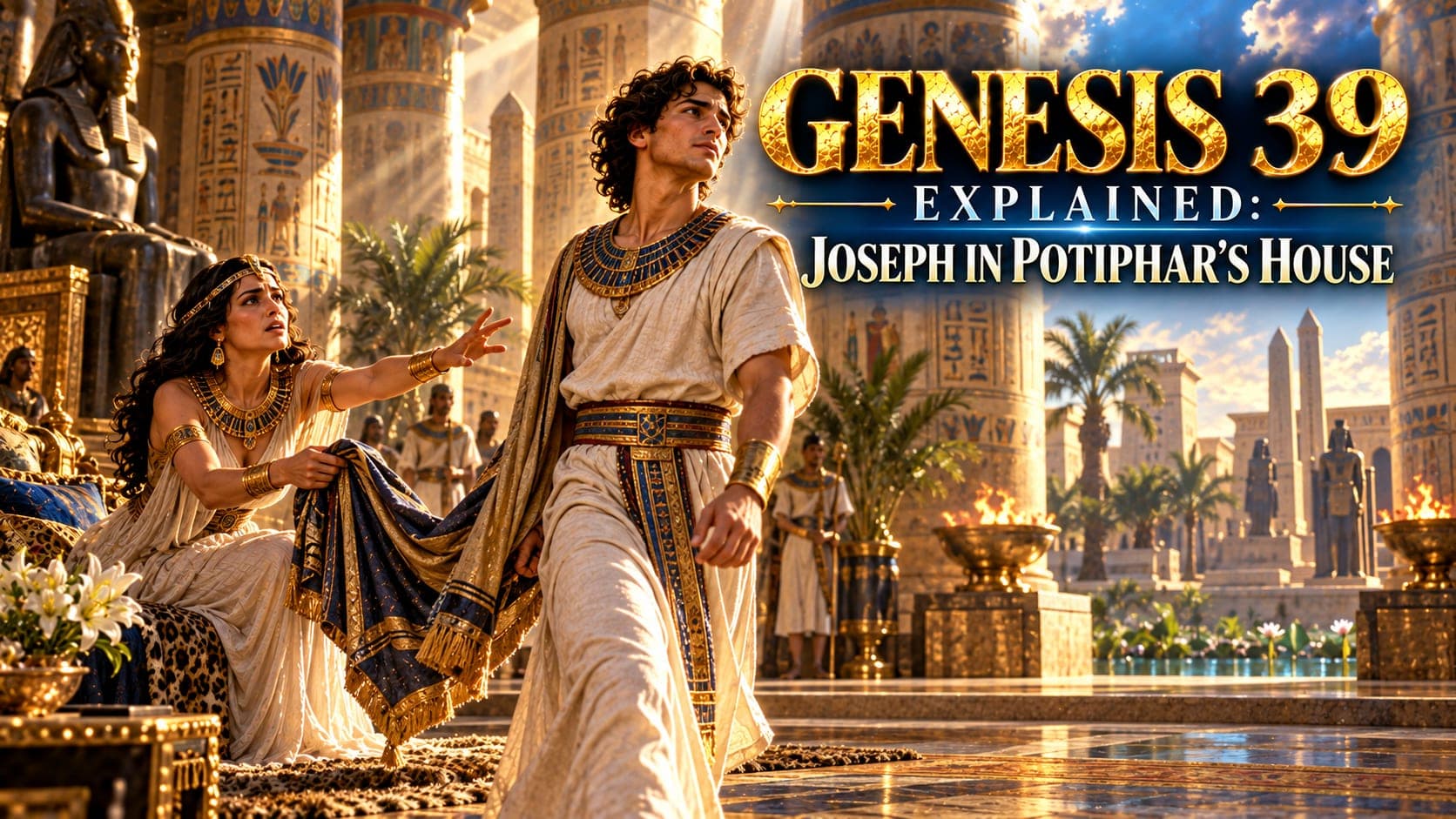
Genesis 37:36 introduces him as an officer of Pharaoh and captain of the guard, the Egyptian official who buys Joseph once he arrives in Egypt. His household is where the next chapters of Joseph's story unfold.
How does Genesis 37 connect to the rest of the Bible?
It opens the story that fills the rest of Genesis, ending with Joseph second in command over Egypt and his family bowing before him exactly as his dreams once showed. Joseph later names the sale directly in Genesis 45 and 50, telling his brothers that what they meant for evil, God meant for good, in order to preserve the very family that sold him.
Final Thoughts
Genesis 37 ends with a father weeping over a son who is not actually dead.
📌 Favoritism spoken out loud does real damage, and this family had already learned that lesson once before it repeated it. Jacob grew up inside a divided home and built the same kind of division in his own.
📌 What looks like the worst outcome is not always the whole story. Jacob believed Joseph was gone for good. The reader already knows otherwise, and so does the rest of Genesis.
📌 Deception has a way of returning to the one who first used it. A goat and a garment once helped Jacob deceive his own father. A goat and a coat now deceive Jacob in turn.
You may know what it is like to be pushed out by the very people who should have protected you.
So here is your one next step.
Keep reading into the chapters that follow, and watch what God does with a story that looks, right now, like it has already ended badly.