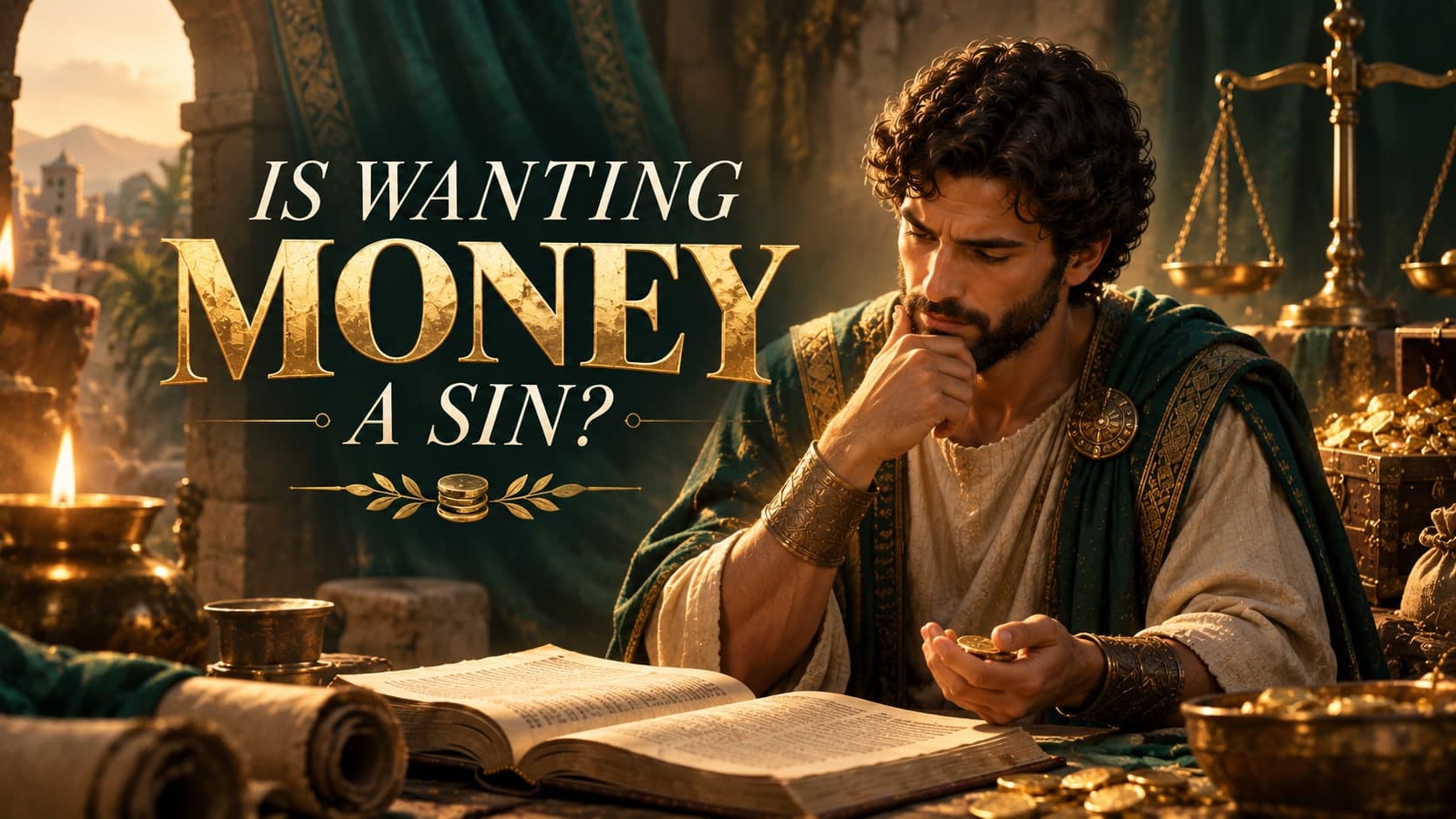
💰 Is Wanting Money a Sin? What the Bible Actually Says About Wealth
You want to build something with your life.
A business. A house that is actually paid off. A future your kids do not have to fight for.
And somewhere along the way, someone quoted a verse at you to shut that down.
"For the love of money is the root of all evil."
You have heard it a hundred times. Usually right after you mentioned a raise, a goal, or a dream that costs money.
📌 It gets used to mean God does not want you rich. That wanting more is greedy. That a real Christian should not care about money at all.
So maybe you have felt guilty for wanting to earn. Guilty for wanting to build. Guilty for dreaming past your next paycheck.
❓ Is wanting money a sin?
Here is the truth. That verse does not say what you think it says. And Paul was not writing to talk you out of ambition.
Paul wrote those words to a young pastor named Timothy, warning him about one very specific danger inside his church.
Not about having money. About what happens when money grabs the seat that belongs to God.
This guide walks through what that verse actually meant in its original setting, what the Greek word behind "love of money" really carries, and why God cares far more about your stewardship than He does about keeping you poor.
By the end, you will know the difference between wanting money and loving money.
And you will see why one of those is dangerous, and the other one is just being human.
This is not a guide about getting rich quick, and it is not a guide about swearing off ambition. It is a guide about getting the order right.
Let's look at what Paul was really saying.
Why This Matters for Your Faith
This is not just an argument about wording.
How you answer this question shapes how you live every single day.
If you believe wanting money is sin, you will feel guilty every time you work hard, negotiate a raise, or dream about paying off debt.
You will hide your ambition from other Christians because it feels unspiritual to admit.
You might even stay stuck somewhere God never asked you to stay stuck, broke and calling it humility.
⚠️ That guilt does not make you holy. It just makes you passive.
And if that guilt sits in your chest long enough, it starts to look a lot like the money worry covered in what the Bible says about anxiety. A different fear, same knot in the stomach.
On the other hand, if you swing the other way and decide money has nothing to do with your walk with God, you miss something just as important.
Money is one of the most repeated subjects in all of Scripture. Jesus talked about it more than He talked about heaven or hell.
That is because money is not neutral ground.
📌 It is one of the clearest windows into what you actually worship.
Get this wrong, and you either live small out of false guilt, or you chase money in a way that quietly replaces God.
Get it right, and money becomes one of the tools God uses to grow your faith, not one of the things competing with it.
That is exactly what the rest of this guide is here to walk you through, one honest step at a time.

What the Bible Actually Says About Wanting Money
1. The Verse Everyone Quotes, And Gets Wrong
Start with the verse itself, word for word.
"For the love of money is the root of all evil: which while some coveted after, they have erred from the faith, and pierced themselves through with many sorrows."
Read it slowly.
It does not say "money is the root of all evil."
It says the love of money.
That is not a small difference. That is the entire verse.
📌 Paul did not put money on trial. He put the love of money on trial.
But that is not how you usually hear it quoted.
It gets dropped into a conversation the moment money comes up, trimmed down to just "money is the root of all evil," as if the Bible put a flat ban on wanting more than you already have.
⚠️ That is not what Paul wrote. That is what people remember him writing.
And that half remembered version has talked a lot of sincere Christians out of dreams God never told them to give up.
2. Who Paul Was Actually Writing To
To understand a verse, you have to know who it was written to, and why.
1 and 2 Timothy are letters. Paul wrote them to a young pastor he was personally mentoring to lead the church at Ephesus.
And Paul was worried.
Not about Timothy chasing wealth. About what he had watched happen inside that church.
False teachers had moved in. Men who had turned faith into a business, using religion to get rich off people who trusted them.
"Perverse disputings of men of corrupt minds, and destitute of the truth, supposing that gain is godliness: from such withdraw thyself."
Read that phrase again. "Supposing that gain is godliness."
These men had started treating financial gain as proof of spiritual success. Faith turned into a hustle.
That is the exact trap Paul was warning Timothy to keep his church away from.
📌 Paul was not writing a general essay on wealth. He was writing a warning letter about specific men doing specific damage.
Once you know that, the famous verse reads completely differently.
Paul was not telling Timothy that money is evil.
He was telling him: do not let what happened to those men happen to you. Do not let the love of money slip in and wreck what God gave you to steward.
That context matters, because a warning aimed at con men in the first century gets twisted into a guilt trip aimed at hardworking Christians in the twenty first century, and Paul never meant for it to travel that far.
3. The Greek Word Nobody Preaches On
Here is something most sermons skip.
The phrase "love of money" in the original Greek is one single word: philargyria.
It is built from two smaller words. Phileo, meaning affection or fondness. And argyros, meaning silver, or money.
Put together, it means an unhealthy craving for wealth. An obsession. A love for money that has grown far bigger than it was ever meant to be.
💡 It is not the Greek word for having money. It is the Greek word for being owned by the desire for it.
Paul uses the same root word, negated, in another letter, describing who should not lead a church:
"Not given to wine, no striker, not greedy of filthy lucre; but patient, not a brawler, not covetous;"
Same danger, named twice. A love for money so strong it disqualifies a man from leadership, because it means money has taken the seat that belongs to God.
❓ So what is the actual line Paul is drawing?
- 🔲 Not, do you have money.
- 🔲 Not, do you want money.
- ✅ But, does your desire for money outrank your desire for God.
That is the whole warning, in one sentence.
4. It Was Never About the Money. It Was About the Order.
This is where a lot of well meaning Christians get the application backwards.
They read "love of money is the root of all evil" and hear "money is dangerous, so want less of it."
But that turns Paul's warning into something it never was. A command about the size of your bank account.
His warning was never about size. It was about order.
📌 What sits on the throne of your heart. That is the entire question.
You can be broke and still love money more than God. Plenty of people scheme, envy, and cut corners chasing money they do not even have yet.
And you can be wealthy and love God first, holding money loosely, using it exactly the way He asks.
❓ Ask it this way instead. If the money disappeared tomorrow, would your faith go with it?
If the answer is yes, that is what Paul was warning Timothy about.
If the answer is no, wanting money was never your problem.
5. Money Is a Mirror, Not a Sin
Jesus said something that lines up perfectly with Paul's warning.
"For where your treasure is, there will your heart be also."
Notice the order of that sentence. Your treasure goes first. Your heart follows it.
Which means the way you handle money does not create your heart condition. It reveals it.
💡 Money does not corrupt people. Money exposes what was already there.
Give a generous heart more money, and it becomes more generous.
Give a fearful heart more money, and it becomes more fearful of losing it.
Give a proud heart more money, and it becomes more proud.
The money is not doing that. It is showing you what you brought into the room.
That is why Jesus could say the next line, and mean every word of it:
"No man can serve two masters: for either he will hate the one, and love the other; or else he will hold to the one, and despise the other. Ye cannot serve God and mammon."
He said this in the same sermon where He called you salt and light.
Jesus was not saying money is your enemy.
He was saying money makes a very convincing rival master, if you let it sit where God belongs.
❓ So the real question is never "how much do I want." It is "who is actually in charge."
6. The Test God Actually Cares About: Stewardship
Here is where the Bible stops sounding like a warning label and starts sounding like an invitation.
Because God does not just tell you what not to do with money. He tells you what He wants you to do with it.
He calls it stewardship.
A steward is not the owner. A steward manages what belongs to someone else, faithfully, on the owner's behalf.
📌 Every dollar you have is on loan from God. You are managing it, not owning it.
Jesus taught a whole parable built around this idea, about a master who left money with three servants before going on a journey.
Two of them put the money to work and doubled it. One of them buried it out of fear and brought back exactly what he was given.
Guess which one the master was pleased with.
"His lord said unto him, Well done, thou good and faithful servant: thou hast been faithful over a few things, I will make thee ruler over many things: enter thou into the joy of thy lord."
Not the one who did the least with what he had. The one who was faithful with it, and grew it.
Jesus made the same point somewhere else, in one short sentence:
"He that is faithful in that which is least is faithful also in much: and he that is unjust in the least is unjust also in much."
How you handle a little tells God everything He needs to know about how you would handle a lot.
📌 That verse is not a warning against having much. It is a description of how trust actually gets built.
Small faithfulness first. Then greater responsibility.
Skip the small faithfulness, and you are not ready for the greater responsibility, no matter how badly you want it.
This is why Moses reminded Israel of something important right before they entered a land full of opportunity to get rich:
"But thou shalt remember the LORD thy God: for it is he that giveth thee power to get wealth, that he may establish his covenant which he sware unto thy fathers, as it is this day."
Notice what that verse assumes. That God's people would get wealth. It does not scold them for wanting it.
It tells them who gets the credit, and why He gave them the ability in the first place. Not so they could serve themselves. So His covenant would move forward through them.
King David said something similar, blessing God right before Israel built the temple with wealth the people had gathered:
"Both riches and honour come of thee, and thou reignest over all; and in thine hand is power and might; and in thine hand it is to make great, and to give strength unto all."
Riches, in David's mouth, were not evidence of a corrupted heart. They were something that came from God's hand, meant to build something bigger than one man's comfort.
📌 Stewardship is the actual test God cares about. Not whether you have money, but whether you can be trusted with it.
That is a test you can start passing today, with whatever amount is sitting in your account right now.
7. Master Money, Or Money Will Master You
Put all of this together and a very different picture forms than the one you grew up hearing.
God does not want you broke. He wants you balanced.
He does not call His people to be poor. He calls them to be responsible.
📌 Money is one of the greatest tests of stewardship there is. And God blesses people who can handle it His way.
Look at Abraham. Scripture just states it plainly, no apology attached:
"And Abram was very rich in cattle, in silver, and in gold."
Look at Job, described as the greatest man in the East, before God even mentions his character.
And after Job lost everything and stayed faithful through it, look at how God chose to end his story:
"So the LORD blessed the latter end of Job more than his beginning: for he had fourteen thousand sheep, and six thousand camels, and a thousand yoke of oxen, and a thousand she asses."
None of these men were rebuked for their wealth. They were trusted with it.
💡 Money is a tool. And a tool does not care who is holding it. You decide who masters who.
Love it, chase it, let it outrank God in your heart, and it will own you the way Paul warned Timothy about.
Steward it, hold it with an open hand, let God stay first, and it will serve you and everyone God puts in your path.
⚠️ One caution here. This is not a promise that giving guarantees a payout, or that faith is a formula for getting rich. That is a different gospel than the one Paul preached, and it is just as far from the truth as poverty guilt is.
📌 This was never about the size of the number in your account. It is about who is sitting on the throne while the number changes.
When your heart is right, money stops being something to feel guilty about and starts becoming something you can use for the Kingdom.
✅ When you build for the Kingdom, God has no problem letting you build.
Master money. Do not let money master you.
Practical Tips: How to Handle Money God's Way
Knowing the truth about money is one thing. Living it out with an actual paycheck is another.
Here are seven ways to put stewardship into practice this week.
- Name what you are actually chasing. Before you set another financial goal, ask yourself why you want it. If the honest answer is that you want it to compete with someone or fill a hole only God can fill, deal with that first.
- Give first, not last. Giving before you budget everything else keeps money in its place as a tool instead of the thing you serve. It does not have to be large. It has to be first.
- Track it like it belongs to someone else, because it does. Good stewards keep good records. A simple budget is not legalism. It is honesty about what you were actually entrusted with.
- Work with excellence, not just for a paycheck. Scripture says a man diligent in his business ends up standing before kings, not before nobodies. Bring your best effort whether or not anyone is watching.
- Practice self control before the money even arrives. Building self control in small purchases now is what keeps a large income from running you later.
- Let God set the pace of your day before money does. Spending real time with God before you check the bank app keeps money in second place all day long.
- Build margin so you can be generous later. Small, consistent saving and giving now is training for bigger stewardship down the road. Faithfulness with a little is how you get trusted with much.
- Enjoy what God gives you, without the guilt. Scripture calls the ability to rejoice in your labor and your portion a gift of God, not a temptation to resist. Thank Him for it out loud instead of quietly apologizing for it.
None of these are complicated.
All of them move money back to where it belongs. Under your feet, not over your heart.
Pick two or three to start this week. Not all eight.
Top 5 Bible Verses About Money and Wealth
You could study this topic for years and still find more.
But if you are starting tonight, start with these five.
1. 1 Timothy 6:10
"For the love of money is the root of all evil: which while some coveted after, they have erred from the faith, and pierced themselves through with many sorrows."
The most misquoted verse about money in the whole Bible, and one of the most important.
It was written to a young pastor about specific false teachers who had turned faith into a business. Not to every Christian who ever wanted a raise.
Read it as a warning about priority, not a ban on provision, and it becomes one of the most freeing verses in Scripture instead of one of the heaviest.
2. Luke 16:10
"He that is faithful in that which is least is faithful also in much: and he that is unjust in the least is unjust also in much."
This is the verse that turns money from a threat into a training ground.
Jesus is not scolding you for wanting much. He is describing exactly how trust gets built, one faithful choice with a little at a time.
If you want God to trust you with more, this is the verse to build your habits around today, with whatever amount is currently in your hands.
3. 1 Timothy 6:17 and 18
"Charge them that are rich in this world, that they be not highminded, nor trust in uncertain riches, but in the living God, who giveth us richly all things to enjoy; That they do good, that they be rich in good works, ready to distribute, willing to communicate;"
Paul writes this a few verses after the one everyone quotes, and almost nobody does.
He does not tell rich believers to give their wealth away and disappear into poverty. He tells them where to put their trust, and what to do with what God gave them.
God who "giveth us richly all things to enjoy." That phrase alone should end the guilt for good.
4. Proverbs 30:8 and 9
"Remove far from me vanity and lies: give me neither poverty nor riches; feed me with food convenient for me: Lest I be full, and deny thee, and say, Who is the LORD? or lest I be poor, and steal, and take the name of my God in vain."
Agur prays for balance, not for the extreme of either side.
Too much, and he fears forgetting God. Too little, and he fears being driven to dishonor God.
This is one of the most honest prayers about money in the entire Bible. Pray it yourself, and let it guard both the greed and the guilt.
5. Ecclesiastes 5:19
"Every man also to whom God hath given riches and wealth, and hath given him power to eat thereof, and to take his portion, and to rejoice in his labour; this is the gift of God."
Solomon, the wealthiest king in Israel's history, calls riches a gift, plainly, without hedging.
Not a temptation to fear by default. A gift, from the hand of God, to be enjoyed and put to work.
This is the verse for the Christian who has never once heard someone call wealth a gift instead of a warning.

Frequently Asked Questions About Money and the Bible
Is wanting money a sin?
No. Wanting to provide, build, and earn is not a sin anywhere in Scripture. What Paul warned against in 1 Timothy 6:10 was the love of money, a craving so strong it pushes God out of first place. Wanting money to pay bills, build a business, or provide for your family is stewardship, not greed. The sin was never the want. It was the wrong order. Ask God to keep that order straight instead of asking Him to shrink your dreams.
What does 1 Timothy 6:10 actually mean?
It means the love of money, not money itself, is the root of ruin. Paul wrote it to Timothy about false teachers who were using ministry to get rich, warning him not to let the same craving take root in his church. The Greek word behind "love of money," philargyria, describes an obsession, a desire for wealth that has grown bigger than your desire for God. It is a warning about priority, not possession.
Does God want Christians to be rich?
God does not promise every Christian riches, and Scripture never turns wealth into a formula you can trigger with enough faith or enough giving. But God is not against wealth either. Abraham, Job, and Solomon were all wealthy and all called faithful. What God wants is a Christian whose heart stays right whether the number in the account is large or small. That is the actual measure of maturity Scripture keeps pointing to.
Is it wrong to want to be wealthy as a Christian?
It is not wrong to want to be wealthy. It becomes a problem when that want outranks your desire for God, or when you would compromise your integrity to get there. Ask yourself whether your faith would survive losing the money. If it would, the desire for wealth is not your enemy.
What is the difference between wanting money and loving money?
Wanting money is a normal human desire to provide, plan, and build. Loving money is letting that desire take the place only God should hold in your heart. Wanting money asks "how do I responsibly get more." Loving money asks "what will I sacrifice, including my integrity or my walk with God, to get more." One is stewardship. The other is idolatry with a bank account attached.
Does the Bible say money is the root of all evil?
No, and this is one of the most common misquotes in Christian culture. The actual verse, 1 Timothy 6:10, says the love of money is a root of all kinds of evil. That two word difference, love of, changes the entire meaning from a ban on money to a warning about the heart behind it.
Is it a sin to want more money?
Wanting more is not automatically greed. Working toward a raise, growing a business, or saving for your family's future is responsible stewardship, not sin. It becomes sin when the wanting turns into envy, dishonesty, or a craving that never rests no matter how much you have. Watch the fruit of the desire, not just the desire itself.
What does the Bible say about being a good steward of money?
The Bible teaches that everything you have belongs to God and is entrusted to you to manage well, not to hoard or waste. Jesus taught this directly in the parable of the talents, where faithfulness with a little led to responsibility over much. Good stewardship looks like working with excellence, giving generously, saving wisely, and keeping God, not the money, as the final authority over your decisions. A good steward asks God before every major financial decision, not just before the tithe.
Can you serve God and still build wealth?
Yes. Abraham, Job, and Solomon all built wealth while walking with God, and Scripture calls all three faithful. Jesus warned that you cannot serve both God and money as two competing masters, but building wealth while serving God as the one true master is exactly what stewardship looks like. The wealth was never the obstacle. Divided loyalty was.
Is it okay for a Christian to be ambitious?
Yes, as long as the ambition serves God rather than replacing Him. Scripture praises the diligent worker and the faithful steward who grows what was entrusted to him. Ambition becomes a problem only when it starts running your life instead of your calling. Bring your goals to God honestly, ask Him to shape them, and build with an open hand instead of a clenched fist. An ambitious Christian who stays teachable is exactly the kind of steward God loves to trust with more.
Final Thoughts
If you remember nothing else from this guide, remember these three things.
📌 The verse was never about money. It was about the love of money. One word, buried by a common misquote, changes everything about how you should read it.
📌 Money reveals your heart. It does not create your heart condition. Where your treasure goes, your heart follows. Guard the order, not the amount.
📌 God does not call you to be broke. He calls you to be a faithful steward. Just like your finances, your body is a temple entrusted to you, not owned by you. The same principle covers everything God puts in your hands.
Master money. Do not let money master you.
That is the whole message, in five words.
So here is your one next step.
Look at one area where money has been quietly running the show, whether that is fear, comparison, or guilt, and bring it to God honestly tonight.
Not with shame. With an open hand.
He is not waiting to scold your ambition.
He is waiting to help you steward it.
Build. Provide. Earn. Just keep Him on the throne while you do.