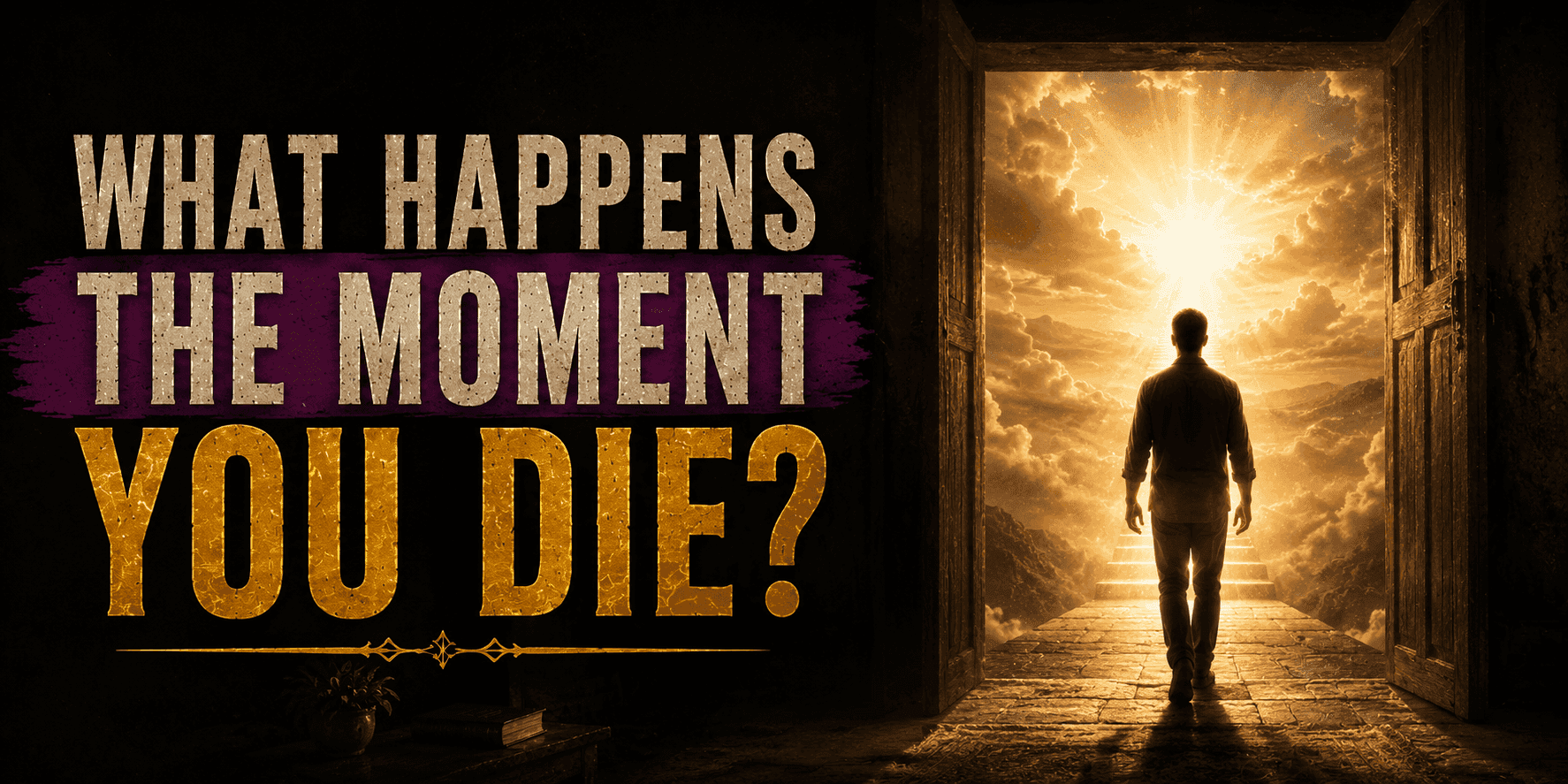
📖 What Happens the Moment You Die? What the Bible Actually Says
Death does not knock first and wait for a good time.
It comes for the grandmother everyone loved and the baby nobody got to know yet.
It comes after a long illness, or in the space of one phone call.
And somewhere underneath the grief, a question rises up that will not stay quiet. What actually happens the moment you die?
Maybe someone you love just did. Maybe a doctor used a word nobody wants to hear, and now the question feels less like curiosity and more like a countdown.
📌 Here is the honest, short answer, right up front. For the Christian, to die is to be with Christ immediately. Not someday. Not after a long wait somewhere in between. The moment you close your eyes here, you open them there.
But that is not the whole answer, and a whole answer matters more than a comforting half of one.
The Bible also promises something your soul alone was never built to carry forever. A body. A real one. Raised. Whole. Yours.
That second half gets skipped so often that most Christians have never heard it preached. We talk about heaven like it is a place made of clouds and harps, and we quietly assume the Christian hope is to become a spirit floating somewhere forever.
That was never the hope. Not once, anywhere in Scripture.
This guide walks through both halves honestly. What happens the instant you die. What your believing loved ones are doing right now, if they already belong to Christ. And why the real Christian hope is a body coming back out of a grave, not a ghost drifting above one.
We will also be honest about where Scripture goes quiet, because it does, and pretending otherwise does not help anyone standing at a graveside. There are questions this guide will not answer with confidence, simply because the Bible itself does not answer them with confidence. That is not a dodge. It is respect for what God actually chose to tell us, and what He chose to leave between Him and you.
You might be reading this at 2 a.m. with your phone brightness turned all the way down so you do not wake anyone up. You might be reading it in a hospital waiting room, or in the quiet after a funeral when everyone else has gone home and the house feels too silent. Wherever you are reading this from, the question deserves a real answer, not a greeting card line and a hug.
Take a breath. This is heavy. It is not hopeless. Let's walk through what God's Word actually says.
Why This Matters for Your Faith
Every other worldview has to guess at this question.
Some cultures picture reincarnation. Some picture nothing at all, just the lights going out. Some borrow a vague, comfortable phrase like "she is in a better place" without anyone being able to say what that place actually is.
⚠️ Christianity is the only faith that answers this question with a body that left an empty tomb.
Jesus did not just teach about death. He walked into it, and He walked back out, and Scripture treats His resurrection as the preview of yours.
That is why this matters for your faith specifically, and not just your comfort.
- ❓ If Christ really rose, what does that promise about you?
- ❓ Is your hope a vague feeling, or a fact with a history?
- ❓ Does your view of death shape how you actually live today?
Paul put the stakes as high as they go. He said if the dead are not raised, then our preaching is empty and our faith is worthless, and Christians are the most pitiable people on earth for believing it. He did not treat this as a side topic for a funeral. He treated it as the hinge the entire gospel swings on.
📌 What you believe about dying will shape how you grieve, how you fear, and how you live every ordinary Tuesday between now and then.
Think about how differently you would plan a trip if you believed your destination was a vague, uncertain fog versus a place with a name, a welcome, and a Person waiting for you there. Belief changes behavior. A Christian who has actually worked through what happens the moment they die tends to carry their fear differently than one who has simply avoided the subject their whole life.
It also shapes how you comfort other people. If your only answer at a funeral is a vague feeling that someone is in a better place, you have nothing solid to hand a grieving friend. If your answer comes from the actual text of Scripture, you can say something true, specific, and steady, even while you are crying right alongside them.
So let's get it right, straight from the text, instead of from a greeting card.
What God's Word Actually Says About Dying
Most of what people believe about dying was never actually read out of a Bible. It was absorbed from movies, from well meaning relatives, from half remembered sermons, and from a general cultural sense that good people become angels or clouds or stars. None of that comes from Scripture.
So before we get to the practical and the comforting, we are going straight to the text itself, in order, so you can see exactly where each idea comes from and exactly how far it goes before Scripture stops talking.
1. The Body Goes Back to the Ground, the Spirit Goes Back to God
Solomon wrote the plainest verse in the whole Bible about what happens at the moment of death.
"Then shall the dust return to the earth as it was: and the spirit shall return unto God who gave it."
Two things happen at once, and Scripture never blurs them together.
- 🟢 The body, formed from dust in Genesis, returns to dust.
- 🟢 The spirit, breathed into that dust by God, returns to Him.
You are not just a body that stops. You are not just a spirit wearing a body like a coat. You are both, and death is the one event that separates what was never meant to be separated.
📌 That separation is temporary. Keep that in mind, because the rest of this guide depends on it. The spirit going to God is not the final chapter. It is the next one.
It is worth sitting with how matter of fact this verse is. Solomon does not dress up death with euphemisms. He names exactly what happens to the two parts of you, in plain language, without flinching. Scripture is not afraid of this subject, so you do not have to be either.
2. For the Christian, Absent From the Body Means Present With the Lord
Paul wrote the clearest line in the New Testament about where a believer's spirit goes the instant it leaves the body.
"Therefore we are always confident, knowing that, whilst we are at home in the body, we are absent from the Lord: (For we walk by faith, not by sight:) We are confident, I say, and willing rather to be absent from the body, and to be present with the Lord."
Read that slowly. Absent from the body. Present with the Lord.
Not absent from the body and waiting somewhere. Not absent from the body and asleep with no awareness at all.
Present with the Lord. Immediately. There is no gap in that sentence for Paul to fill with a waiting room.
He says almost the exact same thing writing to the Philippians, from a prison cell, weighing whether he would rather live or die:
"For I am in a strait betwixt two, having a desire to depart, and to be with Christ; which is far better:"
Notice what Paul connects. Departing, and being with Christ, in the same breath. Not departing, then eventually, someday, being with Christ.
💡 The gap you might imagine between dying and meeting Jesus does not exist for the believer's spirit. It is the nearest thing to instant that human language has.
This should change how you picture a believer's funeral. The body in the casket is not where that person is. It is simply what they left behind, like a coat set down by the door. The person you loved is not paused, waiting, or unaware. They are present with the Lord, right now, while you grieve.
3. Today Shalt Thou Be With Me in Paradise
Jesus said something almost identical while He was dying Himself, hanging next to two criminals on two more crosses.
One of them mocked Him. The other said something nobody expected:
"And he said unto Jesus, Lord, remember me when thou comest into thy kingdom."
That man had done nothing to earn an answer. He had minutes left, no good works, no baptism, no church membership, nothing but a dying request to a dying stranger. And Jesus answered him with a promise that still stuns people who read it closely:
"And Jesus said unto him, Verily I say unto thee, To day shalt thou be with me in paradise."
To day. Not after a long wait. Not after some process of purification. That very day, that thief's spirit would be with Jesus in paradise.
And here is what makes this verse so important for anyone who fears they left things too late. Salvation, for that man, came down to one honest request to the only person who could actually grant it. If you have ever wondered whether God can forgive what you have done, this is Exhibit A. A dying thief, forgiven in his last hour, promised paradise that same day.
Paradise here is not a separate location from being with Christ. It is the same promise, in different words. Presence. Today. With Him.
4. What Scripture Does Not Fully Say, and Why That Is Okay
Here is where a lot of articles start making things up, so let's be honest instead.
Scripture says less about the details of the state between death and the final resurrection than most people assume. We are not told exactly what a disembodied spirit experiences, how time feels without a body, or precisely what paradise looks like beyond being with Christ.
John gives us one glimpse, and it is worth reading carefully because of what it does and does not say:
"And when he had opened the fifth seal, I saw under the altar the souls of them that were slain for the word of God, and for the testimony which they held: And they cried with a loud voice, saying, How long, O Lord, holy and true, dost thou not judge and avenge our blood on them that dwell on the earth? And white robes were given unto every one of them; and it was said unto them, that they should rest yet for a little season, until their fellowservants also and their brethren, that should be killed as they were, should be fulfilled."
Notice what this scene confirms. Souls are conscious. They are aware, they speak, they are given white robes, they are told to rest. That alone rules out the idea that death is simply nothingness.
But notice what it does not hand you. A map. A timeline you can plot on a calendar. A detailed description of daily life in paradise. Scripture gives you enough to trust, not enough to satisfy idle curiosity.
⚠️ Be careful here. A lot of popular books and talk show guests describe tunnels, relatives waving, and detailed tours of heaven. Test every one of those claims against Scripture itself, not the other way around. If a story adds content the Bible never gives, hold it loosely, no matter how comforting it feels.
It is also worth naming a few popular ideas Scripture simply does not teach, so you can recognize them when they show up at a funeral or in a well meaning text message. The Bible never says a person becomes an angel after death. Angels are a separate kind of created being, present in Scripture long before any human dies. The Bible never teaches reincarnation, the idea that a soul returns to live another life in another body.
"And as it is appointed unto men once to die, but after this the judgment:"
Once. Not a second or third attempt in another body. And the Bible never promises that everyone eventually ends up with God regardless of what they believed, no matter how often that idea gets repeated at memorial services to soften the moment.
💡 The honest answer is not a weak answer. You know the one thing that actually matters, which is who you are with. The furniture of the room is not revealed, and that is by design, not by accident.
Jesus told one more story that adds a little more to this picture, and it is worth reading carefully because people argue about whether it is a parable or a real account. Either way, it describes a conscious state right after death, for both a rich man and a poor beggar named Lazarus:
"And it came to pass, that the beggar died, and was carried by the angels into Abraham's bosom: the rich man also died, and was buried; And in hell he lift up his eyes, being in torments, and seeth Abraham afar off, and Lazarus in his bosom."
Notice what this account assumes without arguing for it. Both men are conscious right after death. Both are aware of comfort or torment. And Abraham tells the rich man something sobering about the two states:
"And beside all this, between us and you there is a great gulf fixed: so that they which would pass from hence to you cannot; neither can they pass to us, that would come from thence."
⚠️ That gulf is fixed. Not negotiable later. Not something a good enough excuse can cross after the fact. Whatever this story is classified as, Jesus used it to teach that the choice you make about Him in this life sets something in place that does not change after you die.
5. You Are Not Finished Until You Have a Body Again
Here is the part most people never hear, and it changes everything.
Being present with the Lord as a spirit is not the finish line. It is a real, conscious, wonderful state, and it is still not the full Christian hope.
Paul describes a coming day when that changes, for everyone who has ever died in Christ:
"For the Lord himself shall descend from heaven with a shout, with the voice of the archangel, and with the trump of God: and the dead in Christ shall rise first: Then we which are alive and remain shall be caught up together with them in the clouds, to meet the Lord in the air: and so shall we ever be with the Lord."
The dead in Christ shall rise. Not stay spirits forever. Rise. With a body.
Job said it long before Paul did, in the middle of unimaginable suffering, with nothing left but this conviction:
"For I know that my redeemer liveth, and that he shall stand at the latter day upon the earth: And though after my skin worms destroy this body, yet in my flesh shall I see God: Whom I shall see for myself, and mine eyes shall behold, and not another; though my reins be consumed within me."
📌 In my flesh shall I see God. Not as a disembodied idea. In his flesh. A real body, his own, seeing God with his own eyes.
Jesus made the same claim about Himself to Martha, standing outside her brother's tomb, and He did not just comfort her with a feeling:
"Jesus said unto her, I am the resurrection, and the life: he that believeth in me, though he were dead, yet shall he live: And whosoever liveth and believeth in me shall never die. Believest thou this?"
He did not say I am the escape from the body. He said I am the resurrection. The grave is not the end of the body's story. It is a pause.
And Jesus did not only teach this. A few verses after that conversation, He proved it by calling Lazarus out of a tomb four days dead. That was not a resuscitation trick. It was a preview, in real time, of exactly what He claimed to be.
6. Why Floating Spirits Forever Was Never the Christian Hope
Somewhere along the way, a lot of Christian imagination got replaced by Greek philosophy. The ancient Greeks mostly believed the body was the problem and the soul escaping it was the goal. Plato pictured the spirit finally getting free of its physical prison.
⚠️ That is not the gospel. That is a borrowed idea wearing Christian language.
Scripture never treats your body as a prison to escape. It treats your body as part of you that God designed, and death as the intruder that temporarily breaks what He made whole. Paul is specific about what the resurrection body will be like:
"So also is the resurrection of the dead. It is sown in corruption; it is raised in incorruption: It is sown in dishonour; it is raised in glory: it is sown in weakness; it is raised in power: It is sown a natural body; it is raised a spiritual body."
Sown. Raised. That is the language of a seed going into the ground and coming up as something greater, not a soul being released from a cage. The very next verses describe the moment it happens to everyone still alive when Christ returns:
"Behold, I shew you a mystery; We shall not all sleep, but we shall all be changed, In a moment, in the twinkling of an eye, at the last trump: for the trumpet shall sound, and the dead shall be raised incorruptible, and we shall be changed."
Daniel saw this same moment centuries earlier, and he did not soften the other side of it either:
"And many of them that sleep in the dust of the earth shall awake, some to everlasting life, and some to shame and everlasting contempt."
That verse is sobering on purpose. The resurrection is not only good news. It is good news for those in Christ and a sentence for those who rejected Him. If you want the fuller picture of what Scripture says waits on the other side of that line, read what the Bible actually says about heaven and what the Bible actually says about hell. Both are real destinations, and both matter more than this life convinces you they do.
Paul lands the whole argument with a shout of victory that only makes sense if a body is actually coming back:
"So when this corruptible shall have put on incorruption, and this mortal shall have put on immortality, then shall be brought to pass the saying that is written, Death is swallowed up in victory. O death, where is thy sting? O grave, where is thy victory?"
💡 You do not mock death for leaving. You mock death for having to give something back. That only works if a body walks out of a grave.
This is why the empty tomb matters so much more than most people realize. If Jesus had simply died and His spirit had gone to be with the Father, that alone would be a beautiful story. It would not be the gospel. The gospel needed an empty tomb, because the promise to you is not just that your spirit survives. It is that your grave will one day be empty too.
That is also why the earliest Christians were willing to die for what they preached. They were not dying for a comforting feeling about an afterlife. They were dying as eyewitnesses to a specific claim, that a specific body walked out of a specific tomb on a specific morning, and that His resurrection guaranteed theirs.
7. Why This Should Change How You Live Today
If all of this is true, it is not meant to stay in your head as theology trivia.
It changes how you grieve. It changes how you face your own mortality. It changes what you are actually afraid of, because the worst thing death can do to a believer is temporarily separate a body from a spirit that is already promised back together, forever, improved.
It also means your body matters now, not just later. Scripture says your body is a temple, and that is not just a verse about diet and discipline. It is connected to this whole hope. The body you are living in today is the same body God intends to raise and glorify. He is not finished with it, and neither should you be careless with it.
📌 The question was never only how you die. It is also whether you belong to the One who already walked through death and came back. If you are not certain where you stand with Him, that is the first question worth settling, long before the details of paradise.
Think about how a person who truly believes all of this tends to act differently from someone who has simply never thought it through. They are not reckless with their life, because the body still matters. They are not terrified of their own death, because the worst it can do is temporary. And they do not treat other people's deaths as the end of the conversation, because for everyone in Christ, it is not.

Practical Tips: Facing Death With Real Hope
This is not a topic you resolve once and never think about again.
Death touches you in waves. A diagnosis. A phone call at a strange hour. A birthday that belongs to someone no longer here to celebrate it. Each wave calls for the same truth applied a little differently.
Here are eight things you can actually do with what Scripture says about dying.
- Settle where you stand with Christ before you need to. The thief on the cross had minutes to make his peace with God, and Jesus still answered him. Most of us have more time than that, so use it well instead of assuming it will always be there. Do not wait for a diagnosis or a crisis to ask whether you truly belong to Him.
- Grieve like someone with hope, not someone without it. Paul told grieving believers not to sorrow as others which have no hope. That does not mean do not cry, and it does not mean rush past real loss with forced cheerfulness. It means your tears are not the whole story, because the person you are grieving is present with the Lord right now.
- Hold both halves of the promise together. Your loved one in Christ is present with the Lord right now, and a bodily resurrection is still coming for them and for you. Do not trade one truth for the other just because one feels easier to picture. Scripture never asks you to choose between them.
- Comfort the dying with Scripture, not speculation. You do not need to invent details about heaven to bring comfort to someone who is afraid. Today shalt thou be with me in paradise is enough. Say what the Bible actually says, slowly and plainly, rather than reaching for something that sounds more dramatic.
- Test every near death story against the Bible, not your emotions. A story that feels comforting is not automatically true, no matter how sincerely it is told. Hold popular accounts loosely, and let Scripture correct anything that adds detail the Bible itself never gives.
- Take care of the body you have. It is not a prison you are waiting to escape, and Scripture never treats it that way. It is the very body God intends to raise and glorify, so sleep, eat real food, move, and treat it like something that still matters to Him today.
- Talk honestly with God about your own fear of dying. Jesus Himself asked for the cup to pass in Gethsemane, with sweat like drops of blood. Naming your fear to God out loud is not weak faith. It is exactly what He modeled the night before His own death.
- Get real help if grief or the fear of death is crushing you. If this fear or a fresh loss has you unable to function day to day, talking to a doctor or a counselor is not a lack of faith. God made minds as well as souls, and He often works through wise, trained help just as much as through prayer.
None of these remove death's sting entirely in this life. They put real truth in the exact place fear usually lives.
Top 5 Bible Verses About What Happens When You Die
If you only remember five verses from this whole guide, make it these five.
Write one of them down. Keep it somewhere you will actually see it again, not just in a note you never reopen. These are the verses to reach for in a hospital room, at a graveside, or at 2 a.m. when the question will not let you sleep.
1. 2 Corinthians 5:8
"We are confident, I say, and willing rather to be absent from the body, and to be present with the Lord."
This is the clearest single sentence in Scripture about where a believer's spirit goes the moment it leaves the body. Not a journey. Not a holding pattern. Presence with the Lord.
Paul wrote this with full confidence, not as a guess. If you need one verse to hold at a graveside, start here.
2. Luke 23:43
"And Jesus said unto him, Verily I say unto thee, To day shalt thou be with me in paradise."
Spoken to a dying criminal with nothing to offer but an honest request. If this promise reached him that fast, it is not too late or too small a request for you either.
This is the verse for anyone afraid they have run out of time to make things right with God. It was spoken to a man hours from death with nothing left to offer, and Jesus still said yes. That same door is open to you today.
3. Philippians 1:21 and 23
"For to me to live is Christ, and to die is gain. For I am in a strait betwixt two, having a desire to depart, and to be with Christ; which is far better:"
Paul wrote this from prison, genuinely unsure whether he would be executed. He did not write it as poetry. He wrote it while weighing his own death as a real possibility, and called it gain.
This is the verse for anyone who needs to see that death lost its final power to threaten a believer. Paul was not writing from safety. He was writing while chained, genuinely unsure which outcome he would get, and he still landed on gain.
4. 1 Thessalonians 4:13 and 14
"But I would not have you to be ignorant, brethren, concerning them which are asleep, that ye sorrow not, even as others which have no hope. For if we believe that Jesus died and rose again, even so them also which sleep in Jesus will God bring with him."
This is the verse Paul wrote specifically so grieving Christians would not grieve like everyone else around them. It does not forbid tears. It forbids hopelessness.
Keep this one close the next time you are planning a funeral for someone who belonged to Christ. It does not ask you to pretend the loss does not hurt. It asks you to grieve with a floor under you that someone without Christ does not have.
5. 1 Corinthians 15:54 and 55
"Death is swallowed up in victory. O death, where is thy sting? O grave, where is thy victory?"
This is the last word Scripture leaves you with on death, and it is not a shrug. It is a taunt thrown at an enemy that already lost.
Read it out loud when death feels like it is winning. It already did not.

Frequently Asked Questions About Dying and the Bible
Do Christians go straight to heaven when they die?
Their spirit goes straight to be present with the Lord, which Scripture also calls paradise. That is immediate, not delayed, and Paul and Jesus both describe it that way without hedging. What is still future is the bodily resurrection, when spirit and body are reunited forever in a glorified form. Both things are true at once, and neither cancels the other. If you want the fuller picture of what that destination actually involves, read what the Bible says about heaven in full.
What is the intermediate state?
It is the term theologians use for the time between a believer's death and the final resurrection, when the spirit is with Christ but has not yet been reunited with a glorified body. Scripture confirms it is real and conscious, but gives few details about what it feels like, because the point is not the waiting room. The point is who you are with, and that part is never left vague.
Are loved ones who died in Christ aware of us now?
Scripture does not directly answer that question, and any confident answer either way goes beyond what the text gives us. What it does promise is that they are with Christ, conscious, and at peace, free from the pain that marked their last days here. Resist the pull to fill that silence with speculation, however comforting it might feel in a hard moment.
Does the Bible teach soul sleep?
Some Christians read passages that describe death as sleep and conclude the soul is unconscious until the resurrection. But Revelation 6:9 and 11 describes souls that speak, wait, and receive robes, and Luke 16 describes a rich man and Lazarus both fully conscious right after death. Paul describes being present with the Lord, not unconscious. Sleep in those verses most naturally describes the body resting in the grave, not the spirit going dark.
Is paradise the same as heaven?
Functionally, yes. Paradise describes the immediate presence of Christ that a believer enters at death, and Scripture does not present it as a separate waystation from heaven itself. The word simply emphasizes the garden like restoration of being with God, not a different destination with its own separate rules.
Why do we need a resurrection if we are already with the Lord?
Because being with the Lord as a spirit is real but not the complete picture God designed for you. You were created as a body and a spirit together, and the resurrection restores what death temporarily separates. It is not an upgrade you can skip or an optional extra. It is the finish of a story death only interrupted, and it answers the question how you can know you are truly saved with more than a feeling, since the promise is attached to Christ's own resurrection, not yours alone.
What happens to people who die without Christ?
Scripture is sobering here rather than silent. Daniel 12:2 describes a resurrection to shame and everlasting contempt for those who reject God, alongside the resurrection to life for those in Christ. Luke 16 adds the picture of a fixed gulf that cannot be crossed after death. This guide is not the place to explore that fully, but what the Bible actually says about hell walks through it honestly, without exaggeration and without softening it either.
Will we recognize each other after the resurrection?
Scripture strongly suggests yes. The disciples recognized the risen Jesus, even with a transformed, glorified body, and Paul describes the resurrection body as sown from this one, not an unrelated replacement. The clearest answer Scripture gives is continuity, not erasure, which is part of why grief over a believer's death is real but never final.
Should near death experience stories change what I believe?
Hold them loosely and test them against Scripture, not the other way around. Some accounts may be real experiences, but none carry the authority of God's Word, and some directly contradict it. If a story adds detail the Bible never gives, that detail is not something to build your faith on, no matter how sincere the person telling it is.
Why does God allow death to hurt this much?
Because death was never part of God's original design, and grief is the honest response to something genuinely broken. Jesus Himself wept at a grave He was about to undo minutes later, which tells you grief and faith are not opposites. If this question sits heavier for you than just this topic, why God allows suffering goes deeper into it.
Final Thoughts
If you remember nothing else from this guide, remember these three things.
📌 For the believer, the moment you die, you are present with the Lord. Not someday. That very moment. Today shalt thou be with me in paradise was spoken to a dying thief, and it still holds for you.
📌 That is not the finish line. A real, physical resurrection is still coming. The Christian hope has never been a spirit floating free of a body it was glad to leave behind. It is a body, raised, glorified, and whole again.
📌 Scripture answers enough to give you hope, not every detail curiosity wants. That is not a weakness in the Bible's answer. It is a mercy, pointing you back to the one thing that actually matters: who you belong to.
You will not walk away from this topic with every question settled. Death is still the strangest door any of us will ever walk through.
But you can walk toward it the way Paul did, the way the thief on the cross did, the way Job did in the middle of losing everything. Not with certainty about every detail. With certainty about the One holding the door.
That is the difference this guide was meant to leave you with. Not a complete map of the afterlife, because Scripture never hands you one. A settled confidence in who meets you on the other side of your last breath, and the sure promise that your last breath is not actually the last word on your body either.
So here is your one next step.
If you are not sure where you stand with Christ, settle that today. Not someday. The thief did not get a someday, and neither are you promised one.
He is not finished with your story. Not even death gets the last word on that. Whatever room you are reading this in right now, whatever news you are carrying, you are not reading this by accident.