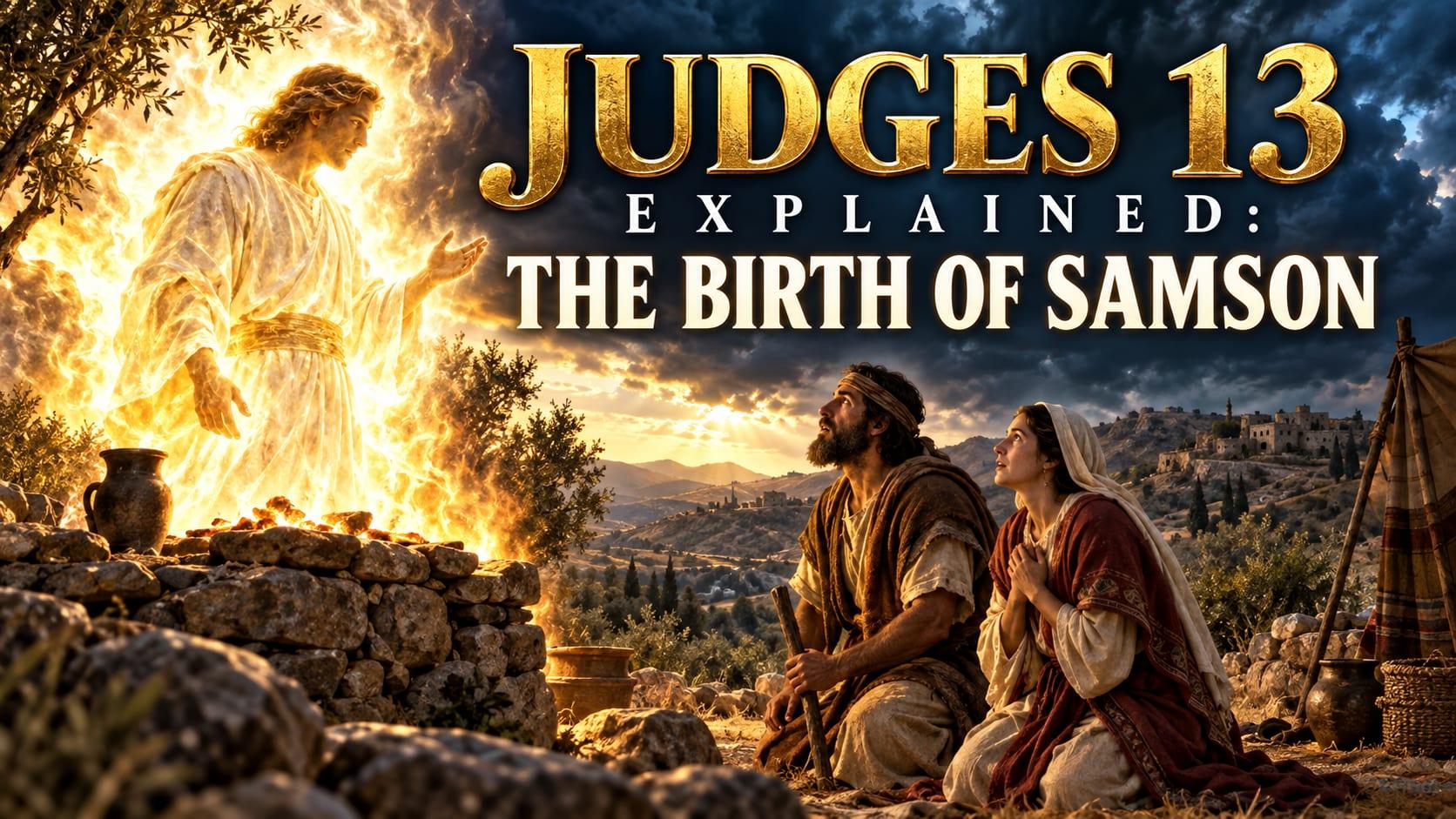
📖 Judges 13 Explained: The Angel Who Would Not Give His Name
No one cries out this time. Israel does not repent, does not beg, does not say a single word to God. And God moves anyway.
Judges 13 explained is the chapter where the deliverer the book has been waiting for finally gets a birth story, and it arrives before any sin is confessed. Forty years under the Philistines, the longest single oppression named in the whole book of Judges, opens the chapter in one blunt sentence. Then the angel of the LORD appears, not to a man in battle, but to a woman with no name of her own in the text, and tells her a son is coming who will begin, only begin, to save Israel.
Maybe you have waited on God for something and wondered if your own lack of words toward Him was the reason nothing moved.
- ❓ Why does this cycle of oppression start without Israel ever crying out to the LORD?
- ❓ Who is the man Manoah and his wife actually meet, and why will he not give his name?
- ❓ What is a Nazarite, and why does a child get that vow before he is even born?
- ❓ Why does Manoah's wife understand what just happened faster than Manoah does?
📌 Judges 13 is the chapter where God starts the rescue on His own initiative, before Israel asks for one, and gives the instructions for raising the deliverer to the one parent most judges in this book never mention at all.
This walkthrough goes through the whole chapter in order: the fortieth year under Philistine rule, the angel's first visit to a barren woman, Manoah's prayer for a second visit, the question about the angel's name, the sacrifice that goes up in flame, the fear that follows it, and the son who is finally born at the very end.
Twenty five verses, one unnamed messenger, and a birth that sets up every chapter that follows it.
What Happened Just Before This Chapter
Judges 12 closed out a stretch of quiet leadership. Jephthah died after six years, and three minor judges, Ibzan, Elon, and Abdon, followed him for twenty five combined years without a single battle recorded between them. No crisis, no cry for a deliverer, just names, children, and burial places.
Judges 13 breaks that quiet completely, and it breaks the pattern of the whole book along with it. A new enemy, the Philistines, is already named as the oppressor in the very first verse, and the usual next step, Israel crying out to the LORD in misery, simply never happens.

Judges 13 Explained Verse by Verse
1. Forty Years, and No Cry for Help (verse 1)
The chapter opens with the same sin named over and over in this book, but this time the oppression runs longer than any before it.
"And the children of Israel did evil again in the sight of the LORD; and the LORD delivered them into the hand of the Philistines forty years."
📌 Forty years under the Philistines is the longest single stretch of oppression named anywhere in Judges. Israel served the king of Mesopotamia eight years, Eglon of Moab eighteen years, the Canaanite king Jabin twenty years, Midian seven years, and Ammon and the Philistines together eighteen years earlier in Judges 10. Forty outlasts every one of them combined into a single number.
⚠️ Every earlier cycle in this book turns on Israel crying out to the LORD before a deliverer is raised up. Othniel, Ehud, Deborah and Barak, Gideon, all of them follow that same cry. Judges 13 never records one. God starts the rescue on His own, with no request from anyone, before the chapter is even five verses old.
2. A Barren Woman, and a Son Already Set Apart (verses 2 to 5)
The text introduces one family, from one tribe, in one small town, and the chapter stays with them for the rest of its length.
"And there was a certain man of Zorah, of the family of the Danites, whose name was Manoah; and his wife was barren, and bare not."
💡 Manoah has a name. His wife never gets one in this entire chapter, called only "the woman" or "his wife" throughout, even though she is the one who receives the angel's message first, understands it fastest, and speaks the chapter's clearest line of faith near the end. Zorah sat in Danite territory, close enough to Philistine country that a Danite deliverer made sense.
"And the angel of the LORD appeared unto the woman, and said unto her, Behold now, thou art barren, and bearest not: but thou shalt conceive, and bear a son."
📌 "The angel of the LORD" is the same title given to the messenger who spoke to Hagar in Genesis 16 and to Moses at the burning bush in Exodus 3. In each case the messenger speaks with God's own authority, and by the end of this chapter even Manoah will call what he saw "God."
"Now therefore beware, I pray thee, and drink not wine nor strong drink, and eat not any unclean thing: For, lo, thou shalt conceive, and bear a son; and no razor shall come on his head: for the child shall be a Nazarite unto God from the womb: and he shall begin to deliver Israel out of the hand of the Philistines."
💡 A Nazarite vow, laid out in full in Numbers 6, normally meant a grown person choosing for a season to avoid wine, avoid cutting their hair, and avoid touching the dead. This child is bound to it from the womb, by someone else's choice, for life. The restrictions on wine and unclean food are given to the mother first, since the vow somehow begins to apply before the son is even born.
📌 "He shall begin to deliver Israel" is a careful word. Not finish. Begin. The text sets up a limited rescue from the very first announcement, long before the reader meets the man who will carry it out.

3. The Wife Reports It, and Manoah Asks for More (verses 6 to 9)
She goes home and tells her husband exactly what she saw, with one honest admission mixed in.
"Then the woman came and told her husband, saying, A man of God came unto me, and his countenance was like the countenance of an angel of God, very terrible: but I asked him not whence he was, neither told he me his name:"
💡 "Very terrible" here means awe inspiring, not frightening in the modern sense. She describes the messenger's appearance accurately and repeats his instructions word for word in the next verse, but she never asked his name or where he came from. That gap is about to matter to her husband.
"Then Manoah intreated the LORD, and said, O my Lord, let the man of God which thou didst send come again unto us, and teach us what we shall do unto the child that shall be born."
📌 Manoah does not doubt his wife's report. He prays for a second visit so he can hear it directly. That is a different instinct than Gideon demanding a sign before he would believe anything at all in Judges 6. Manoah already believes. He simply wants to be included in what God is doing for his own family.
"And God hearkened to the voice of Manoah; and the angel of God came again unto the woman as she sat in the field: but Manoah her husband was not with her."
💡 God answers the prayer, and then sends the angel to the wife a second time anyway, not to Manoah directly. She has to run and fetch her husband before he gets to hear anything at all.
4. Manoah Finally Meets the Messenger (verses 10 to 14)
She fetches him, and Manoah gets his chance to ask his own questions.
"And Manoah arose, and went after his wife, and came to the man, and said unto him, Art thou the man that spakest unto the woman? And he said, I am."
"And Manoah said, Now let thy words come to pass. How shall we order the child, and how shall we do unto him?"
💡 Manoah's question is about the child's upbringing, and the angel's answer is about the mother's diet instead.
"And the angel of the LORD said unto Manoah, Of all that I said unto the woman let her beware. She may not eat of any thing that cometh of the vine, neither let her drink wine or strong drink, nor eat any unclean thing: all that I commanded her let her observe."
📌 The angel repeats nothing new. He simply points Manoah back to what the wife was already told. She already has the full instructions, accurately, and the second visit does not improve on her report at all. It only lets Manoah hear it for himself.
5. A Name "Secret" and a Sacrifice That Will Not Stay on the Altar (verses 15 to 18)
Manoah tries ordinary hospitality next, and the angel turns it into something else.
"And Manoah said unto the angel of the LORD, I pray thee, let us detain thee, until we shall have made ready a kid for thee."
"And the angel of the LORD said unto Manoah, Though thou detain me, I will not eat of thy bread: and if thou wilt offer a burnt offering, thou must offer it unto the LORD. For Manoah knew not that he was an angel of the LORD."
💡 Manoah means to feed a guest a meal. The visitor redirects the whole gesture toward worship instead, refusing food that is offered to him personally and insisting that whatever Manoah prepares belongs to the LORD. The text tells the reader plainly, before Manoah figures it out himself, exactly who he has been talking to.
"And Manoah said unto the angel of the LORD, What is thy name, that when thy sayings come to pass we may do thee honour?"
"And the angel of the LORD said unto him, Why askest thou thus after my name, seeing it is secret?"
📌 "Secret" translates a Hebrew word some Bible teachers connect to the same root behind "Wonderful" in Isaiah's title for the coming child, "Wonderful, Counsellor." The connection is a matter of Hebrew wordplay rather than a stated claim in this chapter itself, but either way, the messenger declines the one thing Manoah actually asked for. He will give instructions. He will not give his identity.

6. The Fire Goes Up, and So Does the Angel (verses 19 to 21)
Manoah offers the sacrifice the angel told him to bring, and what happens next removes any remaining doubt.
"So Manoah took a kid with a meat offering, and offered it upon a rock unto the LORD: and the angel did wonderously; and Manoah and his wife looked on."
"For it came to pass, when the flame went up toward heaven from off the altar, that the angel of the LORD ascended in the flame of the altar. And Manoah and his wife looked on it, and fell on their faces to the ground."
⚠️ The messenger does not simply leave. He rides the flame of the very sacrifice Manoah just offered straight up out of sight. No ordinary visitor does that, and both Manoah and his wife respond the same way the shepherds and the disciples would respond to angels generations later: they fall on their faces.
"But the angel of the LORD did no more appear to Manoah and to his wife. Then Manoah knew that he was an angel of the LORD."
💡 The text had already told the reader this back in verse 16. Now Manoah finally catches up to what his wife seems to have grasped the whole time, without ever needing it spelled out for her.
7. "We Shall Surely Die," and the Wife's Steadier Faith (verses 22 and 23)
Manoah's first reaction to finally understanding is dread, not relief.
"And Manoah said unto his wife, We shall surely die, because we have seen God."
💡 Manoah is drawing on the same fear voiced after other encounters with God's presence, that seeing God directly is fatal to sinful people. It is a real fear with real precedent elsewhere in Scripture, and it is also, in this exact moment, wrong.
"But his wife said unto him, If the LORD were pleased to kill us, he would not have received a burnt offering and a meat offering at our hands, neither would he have shewed us all these things, nor would as at this time have told us such things as these."
📌 She answers panic with plain logic, built from the evidence they both just watched together. A God set on destroying them would not have accepted their offering, given them this much detail, or promised them a son at all. She is the one who understood the message fastest in verse 6, stayed calm through the second visit, and now talks her husband down from the one conclusion the chapter never actually supports.
8. Samson Is Born, and the Spirit Begins to Move Him (verses 24 and 25)
After everything the chapter has built toward, the birth itself takes a single verse.
"And the woman bare a son, and called his name Samson: and the child grew, and the LORD blessed him."
💡 "Samson" is widely understood to come from the Hebrew word for sun, fitting a child born into a story about to be filled with fire, light, and burning. It is the mother who names him, the same way she received the message, carried the vow's restrictions, and understood the night at the altar before her husband did.
"And the Spirit of the LORD began to move him at times in the camp of Dan between Zorah and Eshtaol."
📌 The chapter ends on "began," the same careful word used back in verse 5. Samson's deliverance has not happened yet. The Spirit has only started to move him, between the same two towns the family already lived near, and the next chapter is where that movement turns into action.

Hard Questions Judges 13 Raises
Why does this cycle of oppression start without Israel crying out to the LORD? What the text says: verse 1 moves straight from Israel's sin to the Philistine oppression, with no cry for help recorded anywhere in the chapter, unlike every earlier judge's story in this book. How this is read: many Bible teachers see this as the clearest picture in Judges of grace arriving before repentance does. God raises up a deliverer's family on His own initiative, not because Israel finally asked, which fits the pattern the rest of Scripture shows of God acting first.
Was the angel of the LORD God Himself, or a created being sent by Him? What the text says: Manoah calls what he saw "God" in verse 22, the angel accepts an offering made "unto the LORD" rather than refusing worship, and he ascends in the sacrificial flame itself. How this is read: many Christian readers take these details, alongside similar appearances to Hagar and Moses, as a pre incarnate appearance of the Son of God. Others hold it was a created angel acting with God's full authority and speaking in His name. The chapter itself does not resolve the question with a direct statement either way.
Why will the angel not give his name? What the text says: verse 18 has him answer Manoah's question with a question of his own, calling the name "secret." How this is read: some Bible teachers connect the Hebrew word behind "secret" to the same root used for "Wonderful" in Isaiah's title for the coming child. Whether or not that wordplay was intended here, the chapter's own emphasis falls on what the messenger does, not on a name Manoah is never given.
Why does Manoah's wife understand everything faster than Manoah does? What the text says: she receives both visits directly, reports the instructions accurately without being corrected, and reasons her husband out of his fear with a clear argument in verse 23, all while the text never gives her a name. How this is read: nothing in the chapter treats her as less capable or less trusted than her husband. If anything, the opposite pattern runs through the whole account, with Manoah consistently a step behind what his wife already grasps.
Top Verses From Judges 13
1. Judges 13:5
"For, lo, thou shalt conceive, and bear a son; and no razor shall come on his head: for the child shall be a Nazarite unto God from the womb: and he shall begin to deliver Israel out of the hand of the Philistines."
A deliverer is set apart before he is even conceived, and the text is careful to call it only a beginning, not a finished rescue.
2. Judges 13:8
"Then Manoah intreated the LORD, and said, O my Lord, let the man of God which thou didst send come again unto us, and teach us what we shall do unto the child that shall be born."
A father who already believes his wife still asks God for the chance to be part of what is happening in his own household.
3. Judges 13:18
"And the angel of the LORD said unto him, Why askest thou thus after my name, seeing it is secret?"
A messenger who will give full instructions and still withhold the one thing Manoah actually wanted to know.
4. Judges 13:23
"But his wife said unto him, If the LORD were pleased to kill us, he would not have received a burnt offering and a meat offering at our hands, neither would he have shewed us all these things, nor would as at this time have told us such things as these."
The chapter's clearest piece of reasoning, spoken by the one person in it the text never names.
5. Judges 13:25
"And the Spirit of the LORD began to move him at times in the camp of Dan between Zorah and Eshtaol."
The last word of the chapter is "began," leaving Samson's whole story still ahead of him.
Frequently Asked Questions About Judges 13
What happened in Judges 13?
Israel fell under Philistine oppression for forty years without crying out to the LORD. The angel of the LORD appeared to a barren woman from the tribe of Dan, told her she would bear a son who would begin to deliver Israel, and gave instructions that the boy be raised as a Nazarite from the womb. Her husband Manoah met the angel in a second visit, offered a sacrifice, and watched the angel ascend in its flame. The son, Samson, was born, and the Spirit of the LORD began to move him as he grew.
Who was Manoah's wife?
She is never given a name in Judges 13, called only "the woman" or Manoah's wife, even though she receives the angel's message twice, reports it accurately, and reasons her husband out of his fear near the end of the chapter. She is Samson's mother.
What is a Nazarite in the Bible?
Numbers 6 describes a Nazarite as someone who takes a vow to avoid wine and strong drink, avoid cutting their hair, and avoid contact with the dead for a set time. Samson's vow was unusual because it was imposed before his birth and lasted his entire life, rather than being a vow he chose for a season himself.
Why wouldn't the angel tell Manoah his name?
Verse 18 has the angel answer Manoah's question about his name by calling it secret, without ever stating one. Some Bible teachers connect the Hebrew word used here to the same root behind "Wonderful" in Isaiah 9:6, though the chapter itself makes no direct claim about that connection.
Was the angel of the LORD actually God?
Manoah calls what he saw "God" in verse 22, and the angel accepts sacrifice offered to the LORD rather than refusing it, then ascends in the sacrificial flame. Many Christian readers take this as an appearance of the Son of God before His incarnation; others read it as a created angel speaking and acting fully in God's name. The chapter does not settle the question directly.
Why didn't Israel cry out to God in this chapter?
Judges 13:1 moves straight from Israel's sin to Philistine oppression without recording any cry for help, unlike every earlier judge's story in this book. The deliverer's birth is announced anyway, which many readers take as a picture of God acting first, before any request is made.
What does Samson's name mean?
Samson is widely understood to come from a Hebrew word related to the sun. His mother is the one who names him in verse 24, the same way she is the one who first receives and understands the angel's message throughout the chapter.
Why did Manoah think he and his wife would die?
Verse 22 shows Manoah drawing on the belief that seeing God directly brings death to sinful people. His wife answers in verse 23 that the LORD's acceptance of their offering and the details He had already shared were proof He meant to bless them, not destroy them.
How long did the Philistines oppress Israel in Judges 13?
Verse 1 states forty years, the longest single period of oppression named anywhere in the book of Judges.
Final Thoughts
Judges 13 is a quiet chapter by this book's standards, no war, no vow gone wrong, no civil war. It still carries real weight.
📌 God can start a rescue before anyone asks for one. Every other cycle in Judges turns on Israel's cry for help. This one turns on nothing but God's own initiative.
📌 Faith does not always need a name attached to the one who shows it. Manoah's wife is never named in this chapter, and she is also the clearest thinking, fastest believing person in it.
📌 "Began" is sometimes the most honest word Scripture can use. Samson's story opens on a promise that is only a beginning, and most real deliverance in your own life will look less like an ending and more like a start.
So here is your one next step.
Notice where God may already be moving in your life before you ever got around to asking Him to.