📖 Genesis 16 Explained: Hagar, Ishmael, and the God Who Sees
A promise that has not shown up yet. A wife tired of waiting on it. A plan that felt reasonable at the time.
Genesis 16 explained is the chapter where Sarai stops waiting for God to open her womb and hands Abram a shortcut instead: her Egyptian servant, Hagar. The plan works, in the sense that a child is born. It also breaks something that never fully heals in this family, and sends a pregnant, mistreated servant woman running alone into the wilderness.
Maybe you have grown tired of waiting on something God promised and started building your own way there.
- ❓ Was it actually a sin for Sarai to give Hagar to Abram?
- ❓ Who is the angel of the LORD who finds Hagar in the desert?
- ❓ Why does God tell a mistreated woman to go back and submit to it?
- ❓ And why does a runaway slave become the first person in the Bible to name God?
📌 Nobody in this chapter is a hero, yet God still finds the one person everyone else had used and thrown away, and tells her plainly that He sees her.
Here is the whole chapter in order: Sarai's plan, Hagar's pregnancy and the contempt that follows, her flight into the wilderness, the angel who meets her there, the name she gives God, and the son born from all of it.
If you have ever felt used, overlooked, or forgotten in the middle of someone else's story, this chapter was written with you in mind too.
What Happened Just Before This Chapter
Genesis 15 ended with God sealing His land promise to Abram in a covenant ceremony where Abram never lifted a finger. He fell into a deep sleep, and a smoking furnace and burning lamp representing God's own presence passed alone between the divided animals. God bound Himself to keep the promise no matter what Abram did or failed to do.
But the other half of the promise, a son, still had not arrived. Abram had first heard that promise years earlier in Genesis 12, when he left Ur with a wife the text already calls barren. By the time Genesis 16 opens, Sarai has watched years pass with no child and a husband who keeps hearing fresh assurances that do not change her body.
📌 Genesis 15 showed a promise God alone guaranteed. Genesis 16 shows two people who decide to guarantee it themselves.
Genesis 16 Explained Verse by Verse
1. Sarai's Plan (verses 1 to 3)
The chapter opens by naming the problem before it names the plan.
"Now Sarai Abram's wife bare him no children: and she had an handmaid, an Egyptian, whose name was Hagar."
Hagar is introduced as Egyptian, which points most readers back to Abram's trip into Egypt during the famine, where Pharaoh loaded him with servants along with silver and gold. If that is where Hagar came into the household, then a woman picked up during Abram's worst chapter of fear and deception is about to become central to his next one.
Sarai speaks first, and her reasoning sounds careful, even godly, on the surface.
"And Sarai said unto Abram, Behold now, the LORD hath restrained me from bearing: I pray thee, go in unto my maid; it may be that I may obtain children by her. And Abram hearkened to the voice of Sarai. And Sarai Abram's wife took Hagar her maid the Egyptian, after Abram had dwelt ten years in the land of Canaan, and gave her to her husband Abram to be his wife."
📌 Sarai does not blame God quietly. She names Him directly as the reason she is childless. Then she offers a plan that a woman in her world would have recognized instantly. Giving a servant to a husband so his household could still gain an heir through his wife's maid was an accepted practice among the surrounding peoples of that era. Nothing in the text says Sarai invented something scandalous. What she did was borrow a normal solution from the culture around her instead of asking God for one.
💡 The ten years marked in verse 3 matter. That is roughly how long Abram had been sitting on a promise with nothing to show for it. Waiting is not the same as doing nothing, but after ten years it can start to feel that way.
"And Abram hearkened to the voice of Sarai." is a short, quiet sentence, and it is doing real work. The last time Scripture used almost this exact pairing was in Genesis 3, where Adam listened to his wife instead of what God had already said. Genesis 16 does not say Abram sinned by listening to Sarai here the way Adam did in Eden, but the echo is hard to miss: a husband going along with his wife's solution instead of bringing the problem back to God.
2. Contempt and Cruelty (verses 4 to 6)
The plan works immediately, and it starts unraveling just as fast.
"And he went in unto Hagar, and she conceived: and when she saw that she had conceived, her mistress was despised in her eyes."
⚠️ One pregnancy, and the household's whole balance of respect flips. Hagar, a servant with no legal standing of her own, now holds something Sarai could not produce. The text does not excuse what Hagar does with that new status, only reports it plainly: she starts to despise the woman who still technically owns her.
Sarai does not confront Hagar first. She goes straight to Abram, and the blame lands on him too.
"And Sarai said unto Abram, My wrong be upon thee: I have given my maid into thy bosom; and when she saw that she had conceived, I was despised in her eyes: the LORD judge between me and thee."
📌 Sarai calls on the LORD to judge between her and Abram, over a plan she herself proposed two verses earlier. It is the same instinct Genesis has already shown more than once: a problem someone creates has a way of becoming someone else's fault by the time it hurts.
"But Abram said unto Sarai, Behold, thy maid is in thy hand; do to her as it pleaseth thee. And when Sarai dealt hardly with her, she fled from her face."
💡 Abram hands the authority straight back to Sarai and steps out of the conflict entirely. Whatever "dealt hardly" involved, it is severe enough that a pregnant woman with nowhere else to go chooses the open wilderness over staying in that tent. Three people built this situation together. Only one of them pays for it with her body and her safety.
3. The Angel of the LORD Finds a Runaway (verses 7 to 9)
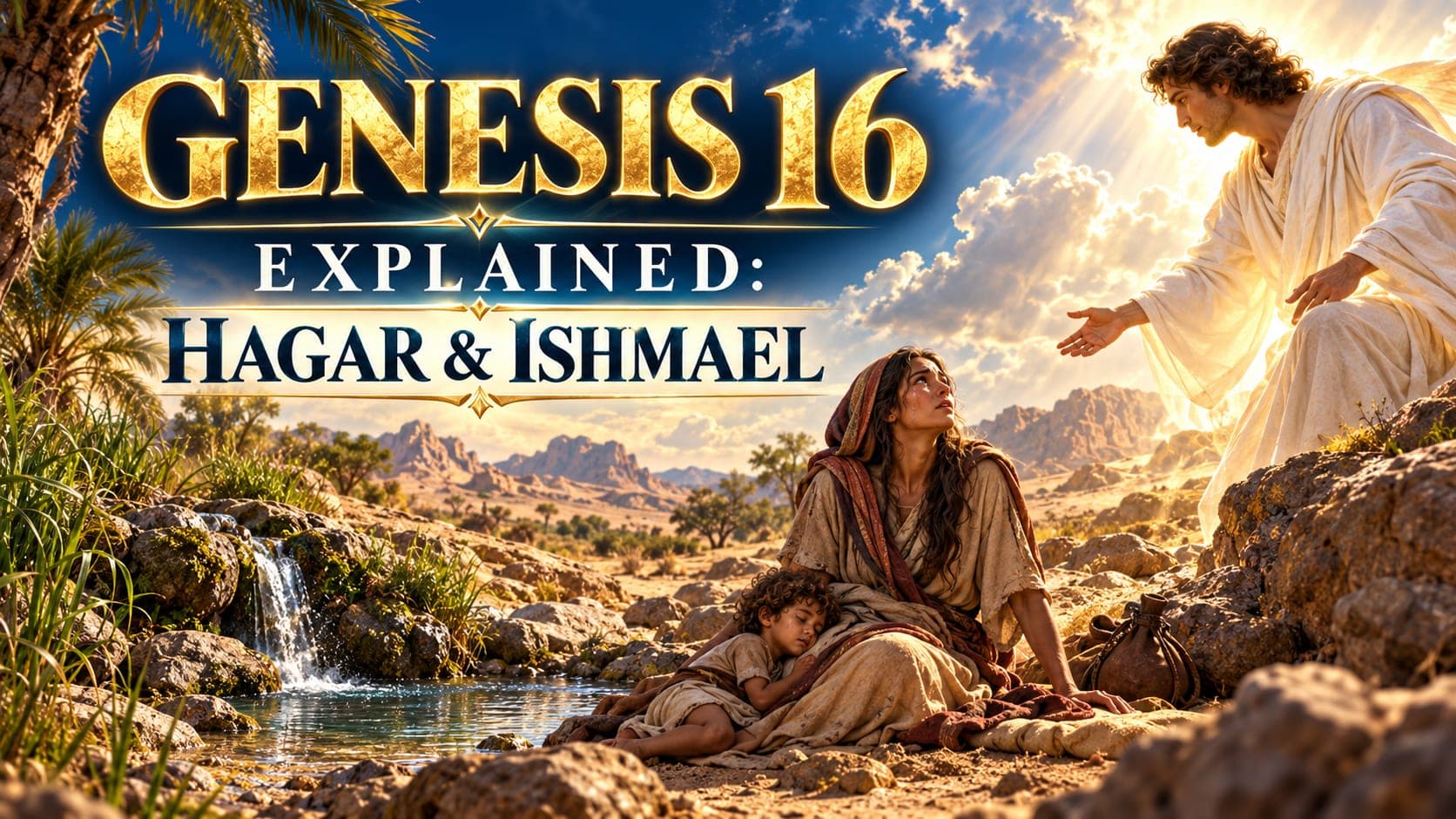
Hagar runs toward Egypt, the direction home, and gets as far as a spring in the desert before anyone finds her.
"And the angel of the LORD found her by a fountain of water in the wilderness, by the fountain in the way to Shur."
📌 This is the first time the phrase "the angel of the LORD" appears anywhere in the Bible, and it appears for a pregnant servant fleeing a household that failed her, not for Abram. Whoever this messenger is, God's first recorded move in this chapter is to go looking for the person with the least power in it.
He does not open with a rescue plan. He opens with two questions that make her say her situation out loud.
"And he said, Hagar, Sarai's maid, whence camest thou? and whither wilt thou go? And she said, I flee from the face of my mistress Sarai."
💡 He calls her by name, the first time anyone in this chapter has spoken to her instead of about her. Then comes an instruction that is much harder to hear than the question.
"And the angel of the LORD said unto her, Return to thy mistress, and submit thyself under her hands."
⚠️ God does not tell Hagar to stay lost in the wilderness, and He also does not pretend the household she is returning to has changed. He sends her back into a hard situation, but not without something new to carry into it.
4. A Promise to the Rejected (verses 10 to 12)
The instruction to return comes with a promise attached to it, and it is a big one.
"And the angel of the LORD said unto her, I will multiply thy seed exceedingly, that it shall not be numbered for multitude."
📌 Read that promise again, and notice what it echoes. God told Abram his seed would be too many to count back in Genesis 15. Now He tells a servant woman running from that same household something almost identical, about the son she is carrying, not Sarai's.
"And the angel of the LORD said unto her, Behold, thou art with child, and shalt bear a son, and shalt call his name Ishmael; because the LORD hath heard thy affliction."
💡 Ishmael means "God hears," and the verse tells you exactly what He heard: her affliction. Not her faith, not a prayer she is recorded as praying, just her suffering. That is enough for God to name a child and shape a nation around.
Then comes a description of who this boy will grow up to be.
"And he will be a wild man; his hand will be against every man, and every man's hand against him; and he shall dwell in the presence of all his brethren."
The Hebrew image behind "wild man" pictures a wild donkey, untamed and free roaming, not a domesticated animal answering to anyone. It is not a moral verdict on Ishmael's character so much as a forecast of independence: a people who will not settle quietly under anyone else's rule, living in tension with the very brothers his descendants will constantly encounter.
5. Thou God Seest Me (verses 13 and 14)
Hagar responds to everything she has just heard, and what she does next has never happened before in the Bible.
"And she called the name of the LORD that spake unto her, Thou God seest me: for she said, Have I also here looked after him that seeth me?"
📌 Hagar is the first person in the entire Bible recorded giving God a name. Not Abram, who has already had three separate conversations with Him by this point. A pregnant, mistreated foreign servant, alone at a well, is the one Scripture credits with it. She names Him for exactly what just happened to her: He saw her when everyone else in her life had stopped looking.
The place gets a name too, one that stays on the map long after this chapter ends.
"Wherefore the well was called Beerlahairoi; behold, it is between Kadesh and Bered."
💡 Beerlahairoi means "well of the Living One who sees me." A location most people would have walked past becomes a permanent marker of the moment a nobody found out God had been watching her the whole time.
6. Ishmael Is Born (verses 15 and 16)
Hagar does what the angel told her to do, and the chapter closes with a birth.
"And Hagar bare Abram a son: and Abram called his son's name, which Hagar bare, Ishmael. And Abram was fourscore and six years old, when Hagar bare Ishmael to Abram."
📌 Abram uses the exact name the angel gave Hagar in the wilderness. Even though the angel spoke to her, not to him, Abram accepts it without argument, which suggests Hagar told him everything that happened at that well. Abram is eighty six here. The very next chapter opens with him at ninety nine, a thirteen year gap in which Ishmael grows up as the only son in the house, believing for over a decade that he is the promised heir.
Hard Questions Genesis 16 Raises
Was it a sin for Sarai to give Hagar to Abram? Genesis 16 never states outright that it was sinful, and the surrogacy arrangement itself was a recognized custom of the ancient world, not something Sarai invented. What the text does show is a couple solving a problem through a cultural workaround instead of asking God about it, and every verse after that decision records pain: contempt, cruelty, a woman fleeing into the desert. Genesis lets the consequences carry the verdict rather than stating one directly.
Did Abram sin by marrying Hagar as a second wife? Polygamy appears repeatedly in Genesis without a direct command against it at this point in the story, and the text does not label Abram's marriage to Hagar a sin in so many words. It does show, here and in every later polygamous household in Genesis, that a second wife brings rivalry, not peace. The narrative pattern argues against the practice even where a direct command has not yet been given.
Who is the angel of the LORD? The text moves between calling this figure "the angel of the LORD" and having Hagar respond as though she has spoken with God Himself, calling Him by name in verse 13. Many Christians read these early angel of the LORD appearances in the Old Testament as a Christophany, a pre incarnate appearance of the Son, since the figure both delivers a message and is treated as God in the same passage. Others read it as a created angel who spoke and acted with God's full authority, the same way a royal messenger in the ancient world could speak in the king's own voice. Genesis 16 does not settle which view is correct.
Why does God send a mistreated woman back into mistreatment? The command to return and submit is hard to read comfortably, and the text does not soften it. What it adds alongside the command matters: a name for her unborn son, a promise about his future, and the assurance that her affliction has been heard. God does not tell Hagar the situation is fine. He tells her she is not facing it unseen, and that this is not the end of her story or her son's.
How does Genesis 16 connect to Galatians 4? Paul later uses Hagar and Sarah to build an argument about two covenants.
"For it is written, that Abraham had two sons, the one by a bondmaid, the other by a freewoman. But he who was of the bondwoman was born after the flesh; but he of the freewoman was by promise."
Paul calls this comparison an allegory, using Hagar to represent a life built on human effort and Sarah to represent a life resting on God's own promise. It is a later theological reading built on top of the Genesis account, not something Genesis 16 itself claims, but it takes the chapter's core tension, a promise rushed by human planning versus a promise God keeps in His own timing, and applies it directly to how a person is made right with God.
Top 5 Bible Verses From Genesis 16
1. Genesis 16:2
"And Sarai said unto Abram, Behold now, the LORD hath restrained me from bearing: I pray thee, go in unto my maid; it may be that I may obtain children by her. And Abram hearkened to the voice of Sarai."
The moment a decade of waiting turns into a plan to make the promise happen without waiting on God any longer.
2. Genesis 16:7 to 9
"And the angel of the LORD found her by a fountain of water in the wilderness, by the fountain in the way to Shur. And he said, Hagar, Sarai's maid, whence camest thou? and whither wilt thou go? And she said, I flee from the face of my mistress Sarai. And the angel of the LORD said unto her, Return to thy mistress, and submit thyself under her hands."
God goes looking for the one person in this story with no power, no status, and nowhere left to run.
3. Genesis 16:11
"And the angel of the LORD said unto her, Behold, thou art with child, and shalt bear a son, and shalt call his name Ishmael; because the LORD hath heard thy affliction."
A name that means "God hears," given to a woman whose suffering, not her standing, was enough to reach Him.
4. Genesis 16:13
"And she called the name of the LORD that spake unto her, Thou God seest me: for she said, Have I also here looked after him that seeth me?"
The first person in the Bible to name God does it from a wilderness well, as a rejected servant instead of a patriarch.
5. Genesis 16:6
"But Abram said unto Sarai, Behold, thy maid is in thy hand; do to her as it pleaseth thee. And when Sarai dealt hardly with her, she fled from her face."
The cost of the whole plan lands hardest on the one person in the household who never got a vote in making it.

Frequently Asked Questions About Genesis 16
What does Genesis 16 mean?
It records Sarai giving her Egyptian servant Hagar to Abram so he could have a son through her, since Sarai remained childless. Hagar conceives, contempt and cruelty follow, Hagar flees into the wilderness, and the angel of the LORD finds her there, promises her son a future, and sends her back with the name Ishmael already chosen.
Why did Sarai give Hagar to Abram?
Genesis 16:2 gives her own reasoning: she believed the LORD had kept her from bearing children, and giving her servant to Abram was a recognized way in that culture for a childless wife to still gain an heir through her household. It was a human solution to a problem she had decided God was not solving fast enough.
Was Hagar a slave?
The text calls her a handmaid and later a bondwoman in Galatians 4, meaning she was a servant without the freedom to refuse what Sarai and Abram decided for her. She had no legal standing to object to being given to Abram or to the treatment she received afterward.
Who is the angel of the LORD in Genesis 16?
Genesis 16:7 is the first time this exact title appears in the Bible. The figure speaks with God's own authority and is addressed by Hagar as God Himself in verse 13, which leads many Christians to see these Old Testament appearances as a pre incarnate appearance of Christ, while others see a created angel speaking fully on God's behalf.
Why did the angel tell Hagar to go back and submit to Sarai?
Genesis 16:9 records the instruction plainly, without explaining why staying in the wilderness alone and pregnant was not the safer option. The command comes bundled with a promise about her son's future, suggesting God was not abandoning her to the hardship but giving her a reason to endure it that she did not have before.
What does the name Ishmael mean?
It means "God hears." Genesis 16:11 ties the name directly to God hearing Hagar's affliction, making the boy's name a permanent record of what happened to his mother at that well.
What does "Thou God seest me" mean?
It is the name Hagar gives God in Genesis 16:13, after realizing He had been watching her situation even when she felt completely alone and unseen by everyone else. It is often referred to by the Hebrew title El Roi, meaning the God who sees.
Why is Ishmael described as a wild man in verse 12?
The Hebrew phrasing pictures a wild donkey, untamed and roaming free rather than domesticated. It describes the independent, unsettled character of Ishmael and his descendants living in constant tension with those around them, not a moral judgment on Ishmael personally.
How old was Abram when Ishmael was born?
Genesis 16:16 says Abram was eighty six. He had already been in Canaan ten years by the time Sarai proposed giving him Hagar, according to verse 3.
How does Genesis 16 connect to Galatians 4?
Paul uses Hagar and Sarah in Galatians 4:22 to 26 as an allegory for two covenants, one built on human effort represented by Hagar's bondwoman status, and one resting on God's own promise represented by Sarah. It is a later New Testament application of the Genesis account, not a claim Genesis 16 makes about itself.
Final Thoughts
Genesis 16 does not have a clean hero, and it does not need one to still be worth reading closely.
📌 A shortcut around waiting on God rarely stays contained to just the person who took it. Sarai's plan reshaped Hagar's life and Ishmael's entire future, neither of whom had a say in the decision that changed everything for them.
📌 God sees the person everyone else in the story overlooks. Hagar had no status, no power, and no one advocating for her when she fled into the wilderness. She is still the one this chapter says God went looking for by name.
📌 Consequences do not cancel out God's attention. Hagar returns to a hard situation she did not choose, and she carries a real promise back into it, not a vague comfort.
You may be carrying your own version of Sarai's ten years, a promise that has not arrived on the timeline you expected.
So here is your one next step.
Before you build your own shortcut to a promise God has not delivered yet, ask Him for it plainly, the way Sarai never did.