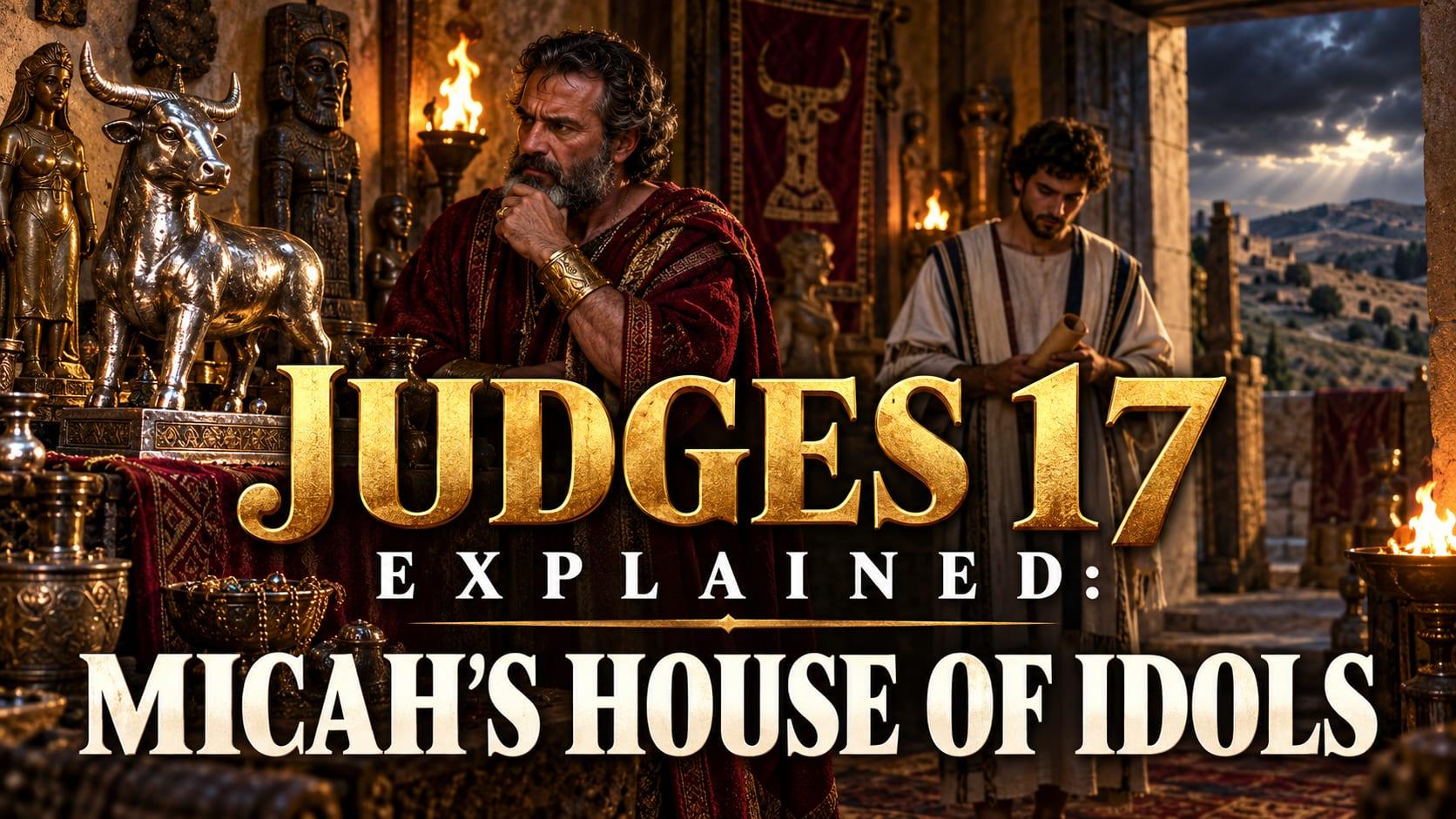
📖 Judges 17 Explained: Micah's Idols and a Priest for Hire
A mother blesses her son in the name of the LORD.
Then she melts stolen silver into an idol for his house.
Judges 17 explained is the chapter where a family builds its own private religion out of the pieces lying around them, a confession, a blessing, a graven image, a hired priest, and never once stops to ask whether any of it actually pleases God. Nobody in this chapter breaks into a sweat over what they are doing. Everyone sounds perfectly comfortable.
Maybe you have met people like that, people who talk about God constantly while quietly worshipping something else.
- ❓ Why does a mother curse a theft, then bless the thief, then dedicate the stolen silver to the LORD?
- ❓ What was Micah actually keeping in his house of gods?
- ❓ Why would a Levite, set apart for God's service, agree to work for one man's private shrine?
- ❓ How can Micah say "I know the LORD will do me good" while standing inside a room full of idols?
📌 Judges 17 is thirteen verses of people who never meant to leave God, and never noticed they had.
This walkthrough covers the whole chapter in order: the stolen silver and the curse that forced a confession, the house full of gods, the verse that explains why any of this was even possible, the Levite who needed somewhere to live, and the confidence Micah built on exactly the wrong foundation.
No judge rises in this chapter. No enemy attacks. The danger here comes from inside one ordinary household.
What Happened Just Before This Chapter
Judges 16 ended with Samson dead under a collapsed temple, buried by his own family, and a single closing line: twenty years of judging Israel were over. That sentence usually marks the end of a cycle in Judges, sin, oppression, a cry for help, and a deliverer God raises up to answer it.
Judges 17 explained does not continue that pattern at all. There is no new judge, no foreign army, no cry to the LORD for rescue. The last five chapters of the book, this one included, step away from the judges entirely and show something smaller and in some ways more disturbing, what ordinary Israelite life looked like with no one enforcing what God had actually commanded.

Judges 17 Explained Verse by Verse
1. A Stolen Fortune and a Mother's Curse (verses 1 to 4)
The chapter opens by naming its main character, then immediately drops us into a family crisis already in progress.
"And there was a man of mount Ephraim, whose name was Micah."
💡 Mount Ephraim was the hill country that ran through the center of the land, home territory for the tribe of Ephraim and a region that shows up repeatedly through Judges. Micah is not a soldier, a judge, or a tribal leader. He is simply a man with a household, which is exactly the point of this whole chapter.
"And he said unto his mother, The eleven hundred shekels of silver that were taken from thee, about which thou cursedst, and spakest of also in mine ears, behold, the silver is with me; I took it. And his mother said, Blessed be thou of the LORD, my son."
📌 Micah confesses because of a curse, not because of a guilty conscience that simply caught up with him. His mother had pronounced a curse over whoever took her silver, not knowing it was her own son, and he heard it with his own ears. In a culture that took a spoken curse seriously, fear of what that curse might do to him seems to be what finally pried the truth out.
Notice how fast his mother's words flip. One sentence after cursing an unknown thief, she is blessing her son in the name of the LORD, with no mention at all of returning what was stolen or any consequence for taking it.
"And when he had restored the eleven hundred shekels of silver to his mother, his mother said, I had wholly dedicated the silver unto the LORD from my hand for my son, to make a graven image and a molten image: now therefore I will restore it unto thee. Yet he restored the money unto his mother; and his mother took two hundred shekels of silver, and gave them to the founder, who made thereof a graven image and a molten image: and they were in the house of Micah."
💡 Hebrew narrators sometimes circle back and restate a key handoff before moving the story forward, which is likely what is happening here. The silver changes hands twice in these two verses, and the mother's own words describe dedicating it "unto the LORD" for the specific purpose of making a graven image and a molten image, the very thing the Ten Commandments forbid in Exodus 20.
⚠️ Only two hundred of the eleven hundred shekels actually go toward the idols. The text never says what happened to the other nine hundred. It simply is not part of the story Judges is interested in telling.
2. A House Full of Gods (verse 5)
One verse lists everything Micah now owns, and the list keeps growing.
"And the man Micah had an house of gods, and made an ephod, and teraphim, and consecrated one of his sons, who became his priest."
💡 A "house of gods" was a private shrine, a dedicated space for worship inside Micah's own home rather than at the tabernacle. The ephod here is not the elaborate priestly garment with the breastplate that Aaron wore. It functions instead as another worship object inside an unauthorized shrine. The teraphim were small household idols, the same kind Rachel hid under herself to keep her father from finding them in Genesis 31.
📌 Micah does not stop at one idol. He builds an entire religious system: a shrine, carved and cast images, an ephod, household gods, and a priest, all under his own roof, all under his own authority. The son he appoints is not a Levite. He is simply whichever son Micah picked.

3. "Every Man Did That Which Was Right in His Own Eyes" (verse 6)
Right in the middle of Micah's story, the narrator steps in with a sentence that explains everything around it.
"In those days there was no king in Israel, but every man did that which was right in his own eyes."
📌 This one line is the key to the entire final section of Judges. God had already told Israel exactly where to worship and how, one tabernacle, one set of commands, laid out in passages like Deuteronomy 12. With no king and no judge actively holding the nation to that standard, a man like Micah simply built whatever felt right to him instead, and nobody around him stopped it.
A near copy of this sentence reappears at the start of the next chapter and again near the very end of the book. Judges keeps repeating it on purpose, as a verdict on this entire stretch of Israel's history, not just on one family in the hill country of Ephraim.
4. A Levite Who Needed Somewhere to Live (verses 7 to 12)
Into this household walks a second main character, introduced by his tribe before he is ever introduced by name.
"And there was a young man out of Bethlehemjudah of the family of Judah, who was a Levite, and he sojourned there. And the man departed out of the city from Bethlehemjudah to sojourn where he could find a place: and he came to mount Ephraim to the house of Micah, as he journeyed. And Micah said unto him, Whence comest thou? And he said unto him, I am a Levite of Bethlehemjudah, and I go to sojourn where I may find a place. And Micah said unto him, Dwell with me, and be unto me a father and a priest, and I will give thee ten shekels of silver by the year, and a suit of apparel, and thy victuals. So the Levite went in."
💡 Levites were set apart to serve at God's tabernacle and were meant to be supported through the offerings of the whole nation, not hired out by a single household. That this young man is "sojourning," wandering to find any place that will support him, already hints at how badly that system had broken down by this point in Israel's history.
Micah's offer is specific: ten shekels of silver a year, clothing, and food. It is a wage, a job, stated as plainly as any employment contract in Scripture.
"And the Levite was content to dwell with the man; and the young man was unto him as one of his sons. And Micah consecrated the Levite; and the young man became his priest, and was in the house of Micah."
📌 Nobody forces this Levite into anything. He is content to take the job, and Micah happily upgrades from a homemade priest, his own son, to someone with an actual priestly pedigree. The shrine does not change. It simply gets a more credible face attached to it.
5. "Now I Know the LORD Will Do Me Good" (verse 13)
The chapter ends with Micah drawing a conclusion that sums up everything wrong with what he has built.
"Then said Micah, Now know I that the LORD will do me good, seeing I have a Levite to my priest."
⚠️ Micah treats having the right staff as a guarantee of God's favor, regardless of what that staff is actually serving. He is not worried about the graven image, the molten image, the ephod, or the teraphim sitting in his house of gods. To him, a genuine Levite as his personal priest is proof that the LORD is now obligated to bless him.
That confidence is about to be tested. The very next chapter shows exactly how little any of it was worth protecting once someone stronger wanted it for themselves.

Hard Questions Judges 17 Raises
Did Micah's mother really dedicate all the silver to God? What the text says: verse 3 has her say she "wholly dedicated" the eleven hundred shekels to the LORD for making idols, but verse 4 only accounts for two hundred shekels actually going to the founder. How this is read: Scripture never explains the gap between what she said and what she did. The honest answer is that the text leaves the other nine hundred shekels unaccounted for, and nothing in the chapter supports guessing further than that.
Was Micah worshipping the LORD, an idol, or both? What the text says: his mother blesses him in the LORD's name, dedicates silver to the LORD, and Micah credits the LORD for his future blessing, all while a graven image, a molten image, an ephod, and teraphim sit in his house. How this is read: this is a household blending the name of the true God with worship practices God had explicitly forbidden. The chapter gives no sign that Micah or his mother saw any contradiction in that at all.
Why would a Levite leave his calling to serve one man's private shrine? What the text says: he is introduced while sojourning, looking for anywhere to settle, and accepts Micah's wage without objecting to the idols already in the house. How this is read: the text gives his circumstances, not his reasoning. It lets his willingness speak for itself, and the picture it leaves is a man who needed support more than he needed to ask what he was agreeing to support.
Was the ephod in Micah's house the same as Israel's lawful priestly ephod? What the text says: verse 5 lists Micah's ephod in the same breath as his graven image, molten image, and teraphim, all objects inside his house of gods. How this is read: the word is the same, but the object is not functioning the way the high priest's ephod did at the tabernacle. Here it is one more piece of furniture in an illegitimate shrine, likely tied to the kind of unauthorized seeking of guidance Scripture elsewhere condemns.
Top Verses From Judges 17
1. Judges 17:6
"In those days there was no king in Israel, but every man did that which was right in his own eyes."
The verse that explains the whole final section of Judges, repeated more than once, naming exactly why a household like Micah's could invent its own religion with nobody stopping it.
2. Judges 17:13
"Then said Micah, Now know I that the LORD will do me good, seeing I have a Levite to my priest."
Confidence built on the wrong foundation, mistaking the right staff for the right worship, right before the next chapter shows how little that confidence was worth.
3. Judges 17:5
"And the man Micah had an house of gods, and made an ephod, and teraphim, and consecrated one of his sons, who became his priest."
One household quietly builds an entire counterfeit worship system, piece by piece, without a single outside voice questioning any of it.

4. Judges 17:3
"And when he had restored the eleven hundred shekels of silver to his mother, his mother said, I had wholly dedicated the silver unto the LORD from my hand for my son, to make a graven image and a molten image: now therefore I will restore it unto thee."
Stolen money, a curse, and the LORD's own name all tangled together in one sentence about building an idol, with nobody in the room sensing anything was wrong.
Frequently Asked Questions About Judges 17
What happened in Judges 17?
A man named Micah confessed to stealing eleven hundred shekels of silver from his mother after hearing her curse the theft. She blessed him instead and dedicated the silver to the LORD to make idols, though only two hundred shekels actually went toward them. Micah built a private house of gods with a graven image, a molten image, an ephod, and teraphim, first appointing his own son as priest. A traveling Levite later arrived, and Micah hired him as his personal priest for ten shekels of silver a year, clothing, and food, leaving Micah confident the LORD would now bless him.
Who was Micah in the Bible?
This Micah was an ordinary man from the hill country of mount Ephraim, not connected to the prophet Micah who wrote the later Old Testament book of the same name. Judges 17 introduces him only through his family and his household shrine, not through any public role or title.
What is a graven image and a molten image?
A graven image was carved, usually from wood or stone, while a molten image was cast from metal that had been melted and poured into a mold. Verse 4 shows both being made from the same silver by a professional founder, and both were explicitly forbidden as objects of worship under the Ten Commandments.
What is an ephod, and is it the same ephod from Exodus?
The word is the same, but the object in Micah's house functions very differently from the high priest's ephod worn with the breastplate at the tabernacle. Here it sits alongside idols and teraphim inside an unauthorized private shrine, suggesting a very different, unsanctioned use.
What are teraphim?
Teraphim were small household idols kept in homes, sometimes connected to seeking guidance or protection. Genesis 31 shows Rachel hiding her father Laban's teraphim rather than leave them behind, which gives a sense of how personally attached families could become to them.
Why did the Levite agree to become Micah's private priest?
Verses 8 and 9 describe him as sojourning, searching for any place that would support him, and Micah's offer of steady wages, clothing, and food apparently answered that need. The text records his acceptance without explaining whether he had any hesitation about the idols already filling the house he was agreeing to serve.
What does "every man did that which was right in his own eyes" mean?
It means Israel had no king and no active judge enforcing God's actual commands, so people simply followed their own sense of what seemed right instead. Judges 17:6 uses this line to explain how a household like Micah's could build its own religion without any resistance at all.
Did Micah think he was doing something wrong?
Nothing in the chapter suggests he did. He speaks the LORD's name comfortably, credits the LORD for his future blessing in verse 13, and shows no hesitation or guilt about the idols in his own house. The chapter lets that confidence stand without comment, which is part of what makes it so unsettling.
How does Judges 17 connect to Judges 18?
Judges 17 sets up everything the next chapter takes away. The house of gods, the ephod, the teraphim, the graven and molten images, and the Levite Micah hired all become the center of what happens when a tribe looking for new territory passes through his house.
Final Thoughts
Judges 17 never raises its voice, and that is exactly what makes it so unsettling.
📌 Using God's name does not make something God's worship. Micah and his mother speak of the LORD comfortably while building idols with their own hands. The vocabulary was right. The substance was not.
📌 The right staff is not the same as God's actual approval. Micah mistook a genuine Levite for a guarantee of blessing, when the real issue was never who ran the shrine but what the shrine was built to honor.
You are not likely to melt silver into an idol this week. But it is worth asking whether any part of your own faith has quietly become something you built because it felt right, rather than something you received because God commanded it.
So here is your one next step.
Take one thing in your life you currently trust will bless you, and ask honestly whether God actually said so, or whether, like Micah, you only assumed He did.