📖 Deuteronomy 12 Explained: Why God Demanded One Place to Worship
Moses has spent eleven chapters telling Israel why they should love God. Now he finally says how.
Deuteronomy 12 explained is the first law in the whole book of Deuteronomy, and it is not about food, or marriage, or courts. It is about where Israel is allowed to worship at all. Every pagan altar on every hill has to come down, and in its place God names exactly one location where sacrifice can happen.
Maybe you have read this chapter wondering why location would ever matter that much to God.
- ❓ Why did every Canaanite high place have to be destroyed, not just avoided?
- ❓ Why does God refuse to name the place He has chosen?
- ❓ Why does Moses suddenly give permission to eat meat without sacrificing it?
- ❓ Why is eating blood forbidden here, and what does it have to do with child sacrifice two verses later?
📌 Deuteronomy 12 is the law that keeps Israel's worship from quietly becoming Canaanite worship with God's name stapled onto it.
The chapter moves from tearing down every rival altar, to one chosen place for sacrifice, to a new everyday freedom for the dinner table, to the one rule that overrides every craving: never touch the blood. It closes on a warning not to let curiosity about how the nations worshiped their gods turn into imitation.
Thirty two verses, and they set the shape of Israel's worship for the rest of the Old Testament.
What Happened Just Before This Chapter
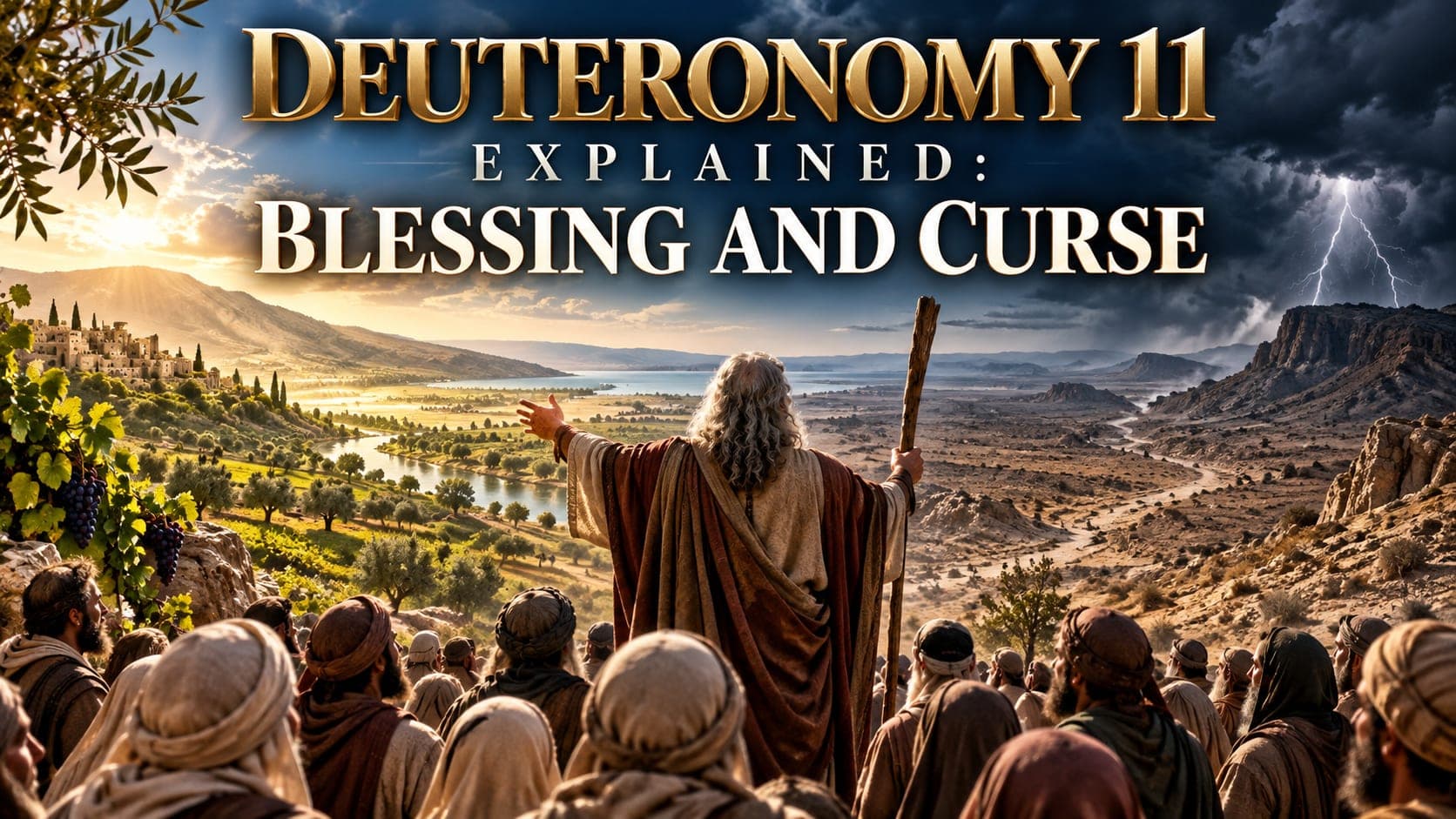
Deuteronomy 11 ended with Moses setting a blessing and a curse before Israel and pointing to two real mountains, Gerizim and Ebal, where that choice would be acted out. Everything in chapters 5 through 11 has been motivation: why obey, who God is, what He has already done, what is at stake.
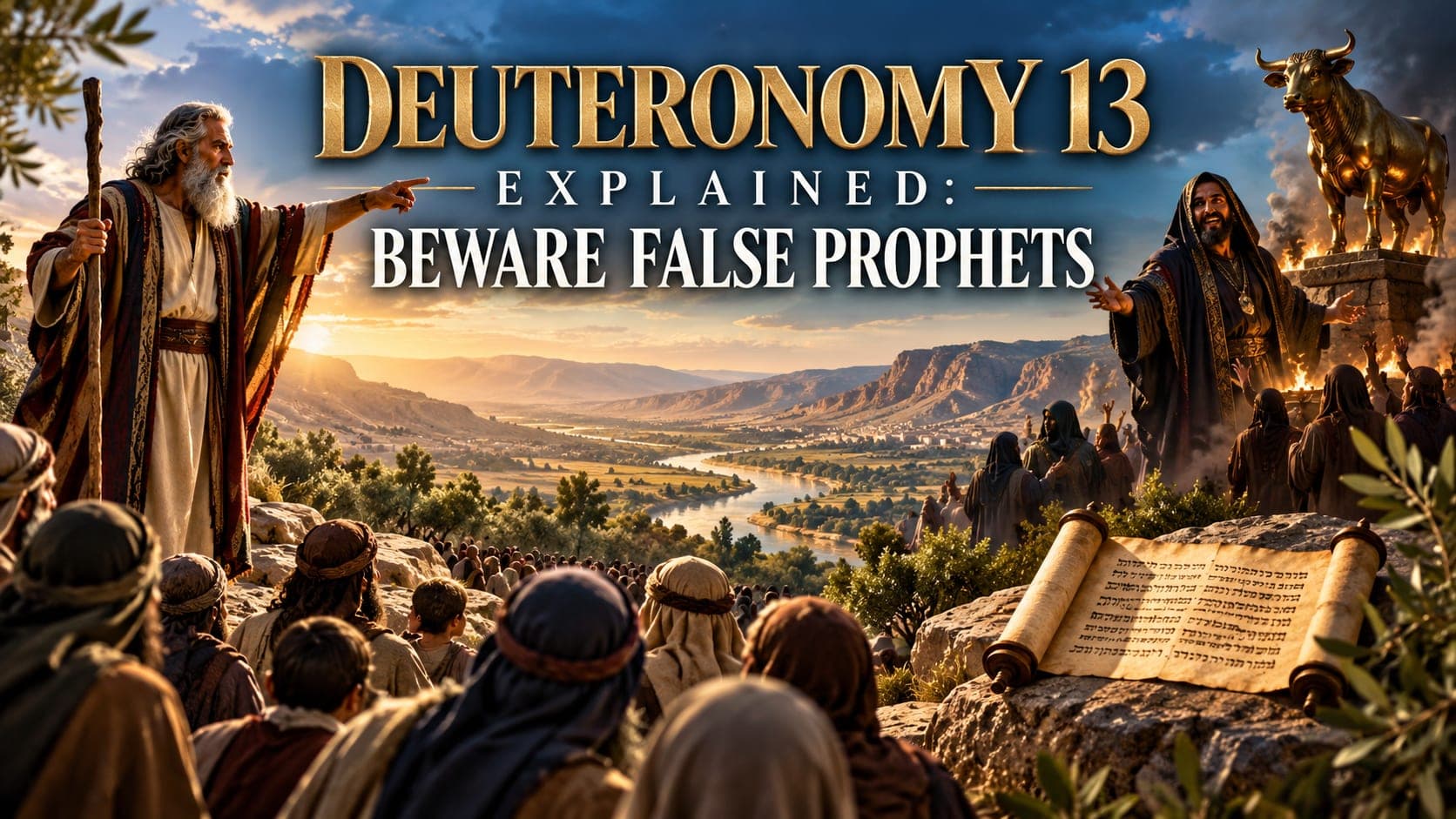
Deuteronomy 12 is the turn from why to what. It is the first actual statute of the book, and Moses chooses to start, not with murder or theft or marriage, but with worship itself. Before Israel can be told how to treat each other, they have to be told who they are allowed to bow down to, and where.

Deuteronomy 12 Explained Verse by Verse
1. Tear Down Every High Place First (verses 1 to 4)
The chapter opens by naming what these laws are and where they apply.
"These are the statutes and judgments, which ye shall observe to do in the land, which the LORD God of thy fathers giveth thee to possess it, all the days that ye live upon the earth."
The very first command is not gentle.
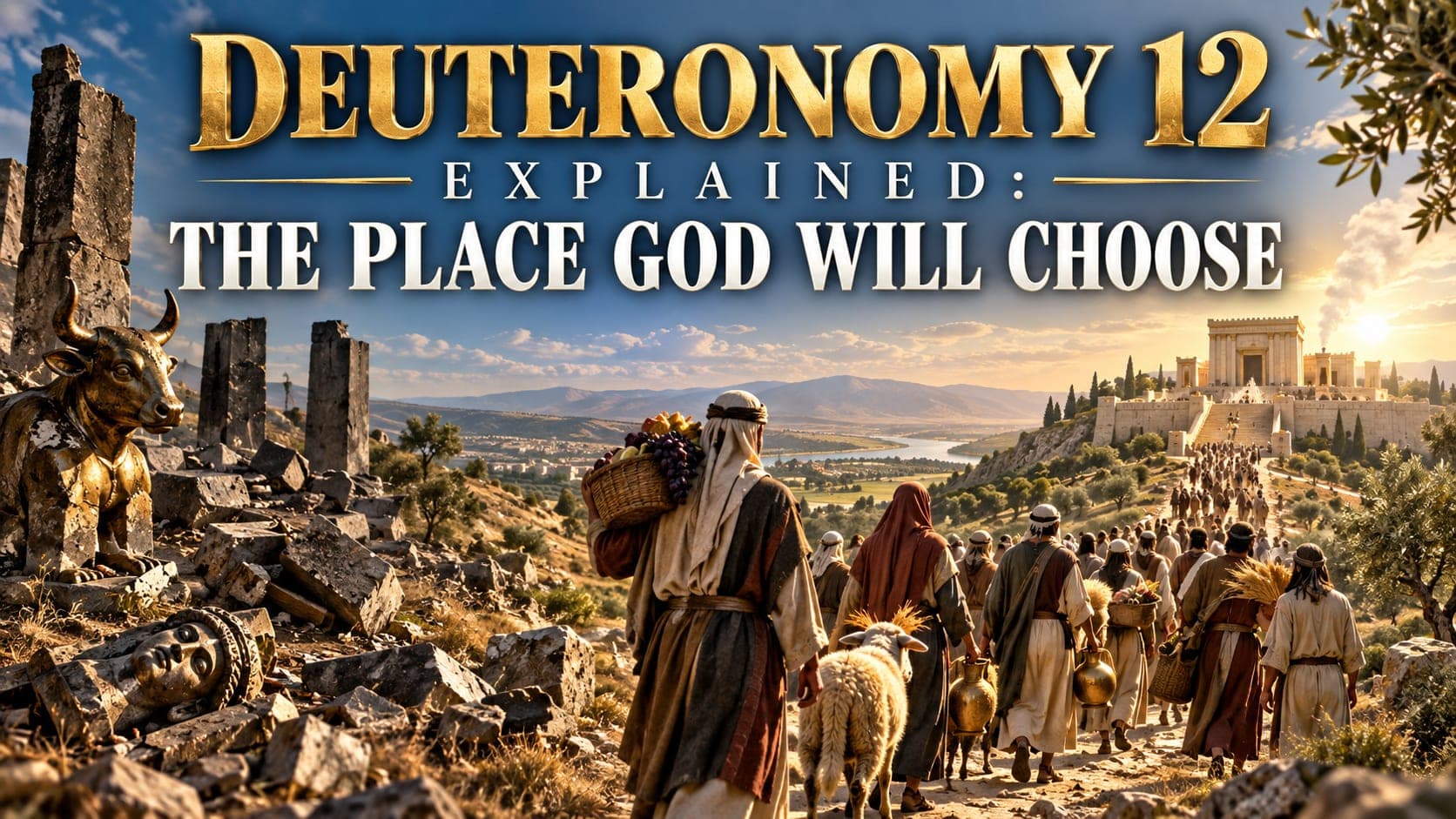
"Ye shall utterly destroy all the places, wherein the nations which ye shall possess served their gods, upon the high mountains, and upon the hills, and under every green tree: And ye shall overthrow their altars, and break their pillars, and burn their groves with fire; and ye shall hew down the graven images of their gods, and destroy the names of them out of that place."
📌 Four different verbs for destruction land in two verses: overthrow, break, burn, hew down. Canaanite worship took place outdoors, on hilltops and under shady trees, with standing stone pillars and wooden poles called Asherim. Moses does not ask Israel to simply ignore these sites. He commands them demolished, down to erasing the very names attached to them.
Then comes the line the rest of the chapter unpacks.
"Ye shall not do so unto the LORD your God."
💡 Worship scattered across hilltops, wherever a person felt moved to build an altar, was exactly how Canaanite religion worked. God is not only banning other gods here. He is banning the method, the whole scattered, do-it-yourself shape of pagan worship, even if someone tried to aim it at Him.
2. One Place God Will Choose (verses 5 to 14)
Against that scattered backdrop, God names His own pattern.
"But unto the place which the LORD your God shall choose out of all your tribes to put his name there, even unto his habitation shall ye seek, and thither thou shalt come: And thither ye shall bring your burnt offerings, and your sacrifices, and your tithes, and heave offerings of your hand, and your vows, and your freewill offerings, and the firstlings of your herds and of your flocks:"
📌 God never names the place in this chapter. He only promises He will choose it. That is deliberate. Naming a town in the law would make the location the point. Leaving it open keeps the point on God's choice, not on geography. Israel would later worship at Shiloh for generations before the ark finally came to rest in Jerusalem under David and Solomon. Moses says none of that here. He only says there will be one place, and God will be the one to pick it.
Worship at that one place is not meant to be grim.
"And there ye shall eat before the LORD your God, and ye shall rejoice in all that ye put your hand unto, ye and your households, wherein the LORD thy God hath blessed thee."
Then Moses draws a sharp line between the wilderness years and the settled life ahead.
"Ye shall not do after all the things that we do here this day, every man whatsoever is right in his own eyes. For ye are not as yet come to the rest and to the inheritance, which the LORD your God giveth you."
⚠️ In the wilderness, with no settled borders and the camp moving constantly, worship had been looser out of necessity. Once Israel crosses the Jordan and God gives them rest from their enemies, that looseness ends. Settled life in the promised land gets a settled, singular place of worship.
Verses 11 through 14 repeat the command, almost word for word, to make sure it lands.
"Then there shall be a place which the LORD your God shall choose to cause his name to dwell there; thither shall ye bring all that I command you; your burnt offerings, and your sacrifices, your tithes, and the heave offering of your hand, and all your choice vows which ye vow unto the LORD: And ye shall rejoice before the LORD your God, ye, and your sons, and your daughters, and your menservants, and your maidservants, and the Levite that is within your gates; forasmuch as he hath no part nor inheritance with you."
Notice who gets named alongside sons and daughters and servants in that celebration: the Levite. He is mentioned here for a specific reason, stated plainly in the same breath, he has no inheritance of land like the other tribes. The chapter will not let that detail be forgotten.
3. Freedom to Eat Meat Once You Are Spread Out (verses 15 to 25)
Having centralized sacrifice down to one place, Moses now answers the obvious question. What about dinner, when the nearest altar is days away?
"Notwithstanding thou mayest kill and eat flesh in all thy gates, whatsoever thy soul lusteth after, according to the blessing of the LORD thy God which he hath given thee: the unclean and the clean may eat thereof, as of the roebuck, and as of the hart."
💡 "Lusteth after" sounds like a warning in modern English. In 1611 English it simply meant desires or craves, with no sinful weight attached. The verse is permission, not a rebuke. Ordinary meat for the table no longer requires a trip to the tabernacle, something that had not been allowed while Israel lived together in one camp in the wilderness, where every animal killed had to be brought to the door of the tabernacle itself, as Leviticus 17 commanded.
One line of that older law does not change at all.
"Only ye shall not eat the blood; ye shall pour it upon the earth as water."
What must still go to the one place is anything already set apart to God: tithes, vows, and offerings.
"Thou mayest not eat within thy gates the tithe of thy corn, or of thy wine, or of thy oil, or the firstlings of thy herds or of thy flock, nor any of thy vows which thou vowest, nor thy freewill offerings, or heave offering of thine hand: But thou must eat them before the LORD thy God in the place which the LORD thy God shall choose, thou, and thy son, and thy daughter, and thy manservant, and thy maidservant, and the Levite that is within thy gates: and thou shalt rejoice before the LORD thy God in all that thou puttest thine hands unto."
📌 The dividing line is simple once you see it. Ordinary meat belongs at home. Anything dedicated to God belongs at His place, and nowhere else. Right in the middle of that instruction comes a command easy to skip past.
"Take heed to thyself that thou forsake not the Levite as long as thou livest upon the earth."
The Levite shows up for the third time in this one chapter, because the whole system Moses is building depends on households actually remembering a tribe with no farmland of its own. Numbers 18lays out exactly why the Levites were given tithes instead of territory, and this chapter keeps that arrangement in view at every turn.
Verses 20 through 25 then repeat almost the entire allowance a second time, with one change.
"When the LORD thy God shall enlarge thy border, as he hath promised thee, and thou shalt say, I will eat flesh, because thy soul longeth to eat flesh; thou mayest eat flesh, whatsoever thy soul lusteth after. If the place which the LORD thy God hath chosen to put his name there be too far from thee, then thou shalt kill of thy herd and of thy flock, which the LORD hath given thee, as I have commanded thee, and thou shalt eat in thy gates whatsoever thy soul lusteth after."
📌 This is not Moses running low on material. It is the land of Deuteronomy 11:24 showing up inside a dinner table law. Once Israel's borders stretch out, the one place will sit farther from more and more households. Rather than let distance quietly undo the rule, Moses restates the exact same freedom in advance, tied this time to growth rather than present need. The law is built to keep working as the nation expands, not just as it stands today.
The blood prohibition gets restated too, with the reason spelled out plainly this time.
"Only be sure that thou eat not the blood: for the blood is the life; and thou mayest not eat the life with the flesh. Thou shalt not eat it; thou shalt pour it upon the earth as water. Thou shalt not eat it; that it may go well with thee, and with thy children after thee, when thou shalt do that which is right in the sight of the LORD."
4. The Blood Is the Life (verses 16 and 23 to 25)
This rule is not new to Deuteronomy. God first gave it to every living person on earth, not just Israel, right after the flood, in Genesis 9. By the time Moses repeats it here, it is already centuries old.
💡 Blood represented life itself to a reader of this chapter, not symbolically but literally, since an animal's life visibly drains out with its blood. Pouring it on the ground "as water" rather than consuming it was a way of returning life to God rather than treating it as ordinary food. It is the same reasoning behind the whole sacrificial system Leviticus 7 describes: the blood belongs to God because the life belongs to God.
📌 Twice in three verses Moses says the same sentence, thou shalt not eat it, pour it on the earth as water. Repetition in this chapter never signals filler. Every time Moses says something twice, it is because the thing matters enough to risk sounding repetitive.
5. The Warning Against Learning Their Ways (verses 29 to 31)
Moses closes the chapter by naming the exact temptation that will follow victory.
"When the LORD thy God shall cut off the nations from before thee, whither thou goest to possess them, and thou succeedest them, and dwellest in their land; Take heed to thyself that thou be not snared by following them, after that they be destroyed from before thee; and that thou enquire not after their gods, saying, How did these nations serve their gods? even so will I do likewise."
⚠️ The danger is not open rebellion. It is curiosity dressed up as research. "How did these nations serve their gods" sounds almost academic, but Moses treats it as a snare, a trap sprung the moment Israel starts studying pagan worship as a method to borrow from rather than a danger to avoid.
Then he states exactly why that curiosity is so dangerous.
"Thou shalt not do so unto the LORD thy God: for every abomination to the LORD, which he hateth, have they done unto their gods; for even their sons and their daughters they have burnt in the fire to their gods."
That is not rhetorical exaggeration. Child sacrifice to gods like Molech was a real practice among Canaan's neighboring nations, and later Scripture records Israel's own kings falling into it long after Moses gave this warning. The chapter that opened with tearing down altars ends by naming the worst thing those altars were used for.
6. Do Not Add to It, Do Not Take From It (verse 32)
The chapter ends on a single sentence that functions like a seal on everything just given.
"What thing soever I command you, observe to do it: thou shalt not add thereto, nor diminish from it."
📌 This is the same guardrail Scripture closes with at the very end of Revelation. A law code that just spent thirty one verses drawing a hard line against borrowing from Canaanite worship ends by drawing the same hard line around its own words. Nothing added, nothing removed, from either direction.

Hard Questions Deuteronomy 12 Raises
Why did pagan altars have to be destroyed instead of just abandoned? Leaving a Canaanite altar standing, even unused, left a working temptation in place for the next generation. Moses treats half measures as unsafe, which is why verses 2 and 3 stack four separate verbs of destruction rather than a single command to walk away.
Why does God refuse to name the one place in this chapter? Naming a town in the law itself would have made geography the point instead of God's choice. History shows the place was not even fixed right away. Israel worshiped at Shiloh for generations before the ark finally settled in Jerusalem under David and Solomon, and the text leaves room for that unfolding.
Does "whatsoever thy soul lusteth after" in verses 15 and 20 encourage sinful desire? No. In the English of this translation, "lust after" simply means to crave or desire, without the sinful connotation the phrase carries today. The verse is a dietary permission, allowing ordinary meat at home, not a license for anything the word suggests in modern usage.
Is the child sacrifice mentioned in verse 31 describing a real historical practice? Yes. Burning children as offerings to gods such as Molech was practiced among nations surrounding Israel, and later books of the Old Testament record it happening again when Israelite kings copied the very worship this chapter warns against. Moses is not inventing a worst case scenario to scare his audience. He is naming something that genuinely happened in the land they were about to enter.
Top Verses From Deuteronomy 12
1. Deuteronomy 12:5 and 6
"But unto the place which the LORD your God shall choose out of all your tribes to put his name there, even unto his habitation shall ye seek, and thither thou shalt come."
The heart of the whole chapter. Worship is not wherever a person decides. It is wherever God decides, and the rest of the chapter simply works that idea out in practice.
2. Deuteronomy 12:8
"Ye shall not do after all the things that we do here this day, every man whatsoever is right in his own eyes."
Generations later, the book of Judges describes Israel's collapse in almost this exact phrase, as a nation where everyone did what was right in their own eyes. Moses names the danger here before Israel ever falls into it.
3. Deuteronomy 12:23
"Only be sure that thou eat not the blood: for the blood is the life; and thou mayest not eat the life with the flesh."
A rule older than Israel itself, given to all humanity after the flood, repeated here with the reason stated outright. Blood is treated as life, not as food.
4. Deuteronomy 12:28
"Observe and hear all these words which I command thee, that it may go well with thee, and with thy children after thee for ever, when thou doest that which is good and right in the sight of the LORD thy God."
Obedience here is tied to generations, not just the person listening. What this crowd does with these laws reaches children not yet born.
5. Deuteronomy 12:32
"What thing soever I command you, observe to do it: thou shalt not add thereto, nor diminish from it."
The same warning Scripture repeats at the very close of Revelation. God's word is not raw material for editing in either direction.

Frequently Asked Questions About Deuteronomy 12
What is Deuteronomy 12 about?
Deuteronomy 12 commands Israel to destroy every pagan worship site in Canaan and bring all sacrifices to one place God will choose, while also permitting ordinary meat to be eaten at home and forbidding the eating of blood.
Why did every Canaanite high place have to be destroyed?
A standing altar, even an unused one, left behind a working temptation for the next generation. Moses commands total destruction, overthrowing, breaking, burning, and hewing down, rather than simply telling Israel to avoid the sites.
What was the place God chose in Deuteronomy 12?
The chapter never names it. Israel first worshiped at Shiloh for generations after entering the land, and the ark later came to rest permanently in Jerusalem under David and Solomon. The law was written to apply regardless of which specific site God chose.
Why could Israel suddenly eat meat without sacrificing it?
While Israel lived together in one wilderness camp, every animal killed had to be brought to the tabernacle. Once the nation spread out across the land, that was no longer practical, so Deuteronomy 12 allows ordinary meat to be eaten locally while still requiring tithes and offerings to go to the one chosen place.
Why is eating blood forbidden in the Bible?
Genesis 9 first gives this command to all humanity after the flood. Blood represented life itself, and pouring it out rather than consuming it treated life as belonging to God rather than as ordinary food.
Who was the Levite that Deuteronomy 12 keeps mentioning?
The Levites received no tribal territory of their own and depended on tithes and offerings from the other tribes instead. Deuteronomy 12 repeats the command not to forget the Levite three separate times to make sure that dependence was not overlooked.
Did Canaanites really sacrifice their children?
Yes. Child sacrifice to gods such as Molech was practiced among nations near Israel, and later Old Testament books record Israelite kings copying this same practice, exactly the outcome Deuteronomy 12:31 warns against.
What does "thou shalt not add thereto, nor diminish from it" mean?
It means God's commands were not open for editing, in either direction. Scripture uses this same warning again at the close of Revelation, protecting the text from being expanded or trimmed by anyone who comes after.
Does Deuteronomy 12 still apply to Christians today?
The specific command to bring sacrifices to one physical location belonged to Israel's covenant and ended with the final sacrifice of Christ. The principle underneath it, refusing to let God's worship absorb the world's methods, still applies.
Final Thoughts
Deuteronomy 12 is about more than architecture. It is about where you let your worship come from.
📌 God cares about the shape of worship, not only its target. Israel could not simply aim Canaanite methods at the true God. The method itself had to go, not just the name on the altar.
📌 Repetition in this chapter is never filler. It is emphasis. The blood command, the Levite command, and the freedom to eat meat all get restated, because Moses knows which instructions are the easiest to let slide once the land is settled.
📌 Curiosity about how others worship can become the doorway sin walks through. Verse 30 names research, not rebellion, as the snare. Studying a rival altar as a method to copy is already the first step away from God's way.
You do not bring sacrifices to one physical place anymore. But you still choose, every week, whether your worship takes its shape from Scripture or borrows its shape from somewhere else.
So here is your one next step.
Name one place where your own faith has quietly started copying a method the world uses instead of one Scripture actually teaches, and bring that one thing back in line this week.