📖 Leviticus 11 Explained: Clean and Unclean Animals, and Why It Mattered
No sacrifice happens in this chapter. No blood touches an altar. No priest is ordained.
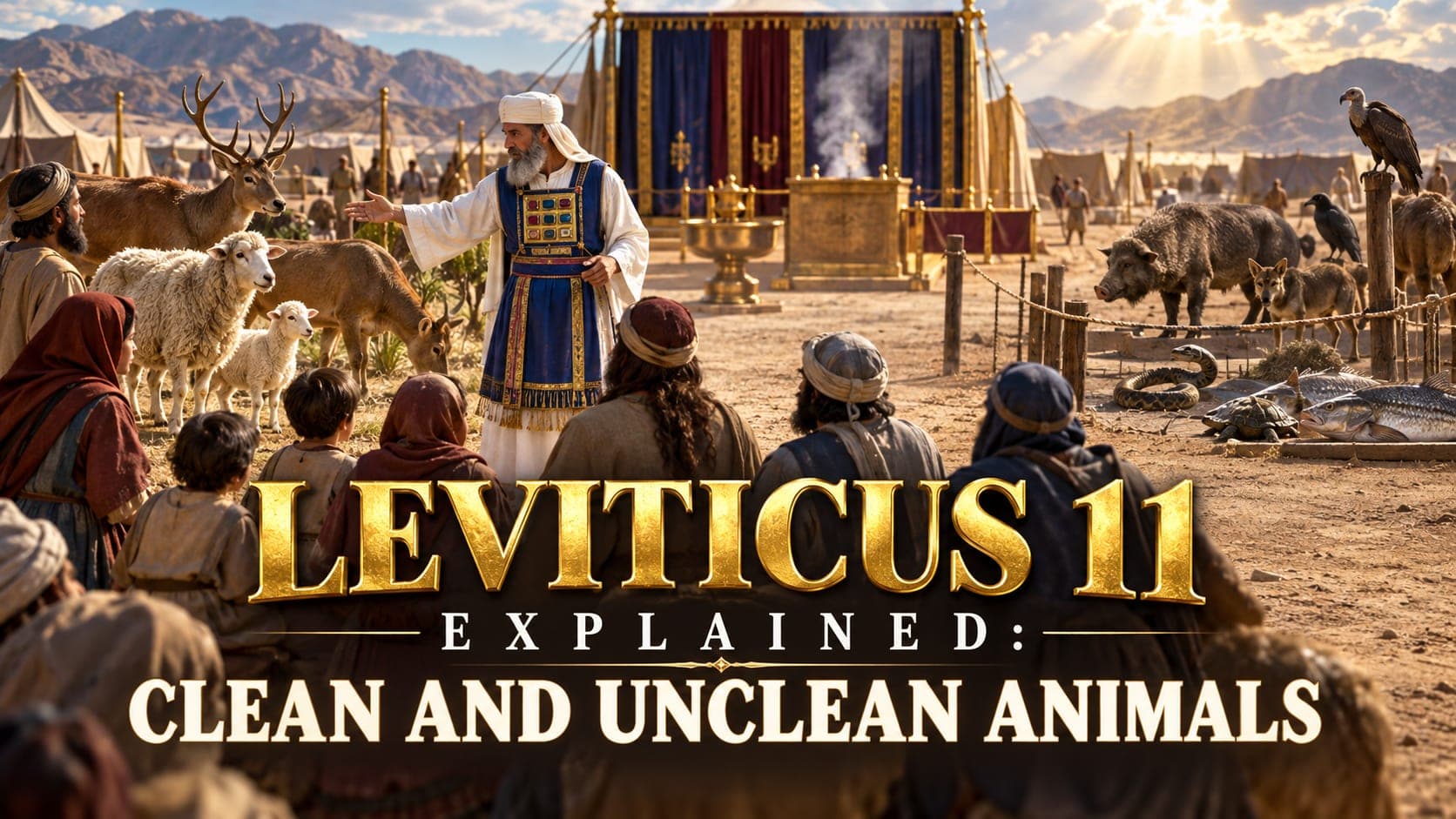
Leviticus 11 explained is the chapter where God turns His attention from the tabernacle to the dinner table. For the first time since the law began, the instructions are not for priests only. They are for every single Israelite, every single day, every single meal.
Maybe you have skimmed this chapter and filed it away as an ancient grocery list.
- ❓ Why does the hoof and the cud decide what lands on the plate?
- ❓ Why does a rabbit get called unclean for chewing the cud when it does not actually chew the cud?
- ❓ Why does touching a dead mouse make a whole clay pot unusable?
- ❓ And are Christians today still bound by any of this?
📌 Leviticus 11 never claims these animals are dirty or dangerous. It claims they are a daily reminder of something else entirely.
This walkthrough goes through the whole chapter in order: the hoof and cud rule for land animals, fins and scales for water creatures, the forbidden birds, the one exception for certain flying creeping things, how touching a carcass spreads uncleanness to clothing and pottery and water, and the sentence at the end that explains why any of it mattered at all.
Read slowly. This chapter asks something no earlier chapter in Leviticus has asked yet.
What Happened Just Before This Chapter
Leviticus 10 ended with Moses naming the actual job a priest existed to do: "put difference between holy and unholy, and between unclean and clean," and teach that difference to Israel. That sentence landed in the middle of grief, right after Nadab and Abihu died for bringing fire God never authorized.
Leviticus 11 is that teaching, put into words for the very first time. The chapter does not open with a new scene or a new location. It opens with the LORD simply continuing to speak, and for the first time in the sacrificial section of this book, the subject is not an offering. It is a dinner.
Leviticus 11 Explained Verse by Verse
1. Land Animals: The Hoof and the Cud (verses 1 to 8)
The chapter opens by naming who this instruction is for, and it is not a narrow audience.
"And the LORD spake unto Moses and to Aaron, saying unto them, Speak unto the children of Israel, saying, These are the beasts which ye shall eat among all the beasts that are on the earth."
📌 Every earlier chapter in Leviticus spoke to priests, or to a worshipper bringing an offering. This one speaks to the whole nation, about something every single person in it does three times a day.
The rule for land animals is stated as one clean test with two parts.
"Whatsoever parteth the hoof, and is clovenfooted, and cheweth the cud, among the beasts, that shall ye eat."
💡 Both conditions have to be true at once. The hoof has to be split into two parts, and the animal has to chew the cud, meaning it brings food back up from an earlier stomach and chews it a second time. Miss either half and the animal is unclean, whatever else it has going for it.
The next verses name four animals that each fail the test in a different way.
"Nevertheless these shall ye not eat of them that chew the cud, or of them that divide the hoof: as the camel, because he cheweth the cud, but divideth not the hoof; he is unclean unto you. And the coney, because he cheweth the cud, but divideth not the hoof; he is unclean unto you. And the hare, because he cheweth the cud, but divideth not the hoof; he is unclean unto you. And the swine, though he divide the hoof, and be clovenfooted, yet he cheweth not the cud; he is unclean to you."
📌 Three animals fail by hoof, one fails by cud, and the text makes sure to name both kinds of failure. The camel, the coney, and the hare chew something that looks like cud chewing but do not have a split hoof. The swine has the split hoof but does not chew the cud at all. Neither mistake is treated as the lesser one.
Coney is an old word for a rock badger or hyrax, a small animal common in the hill country of the region, not the modern rabbit the word sometimes suggests in English. Verse 8 closes the land animal section with the plainest instruction in the passage.
"Of their flesh shall ye not eat, and their carcase shall ye not touch; they are unclean to you."
Not eating was only the first half of the rule. Not touching the body was already part of it, long before the chapter explains later exactly what touching a carcass does to a person or an object.
2. Water Creatures: Fins and Scales (verses 9 to 12)
The sea and the rivers get their own test, simpler than the one for land animals.
"These shall ye eat of all that are in the waters: whatsoever hath fins and scales in the waters, in the seas, and in the rivers, them shall ye eat."
"And all that have not fins and scales in the seas, and in the rivers, of all that move in the waters, and of any living thing which is in the waters, they shall be an abomination unto you."
💡 Two features, fins and scales, both present, or the creature is unclean. This single test quietly rules out shellfish, eels, and catfish along with anything else in the water lacking either feature, without the chapter ever naming a single one of them by species. The rule is built to cover an entire category, not a list of specific animals.
Abomination is a stronger word than "unclean" alone, and the chapter uses it on purpose here. Verse 11 repeats the warning before moving on, making sure no reader mistakes this for a minor preference.
"They shall be even an abomination unto you; ye shall not eat of their flesh, but ye shall have their carcases in abomination."
3. Birds and Flying Things: The Forbidden List (verses 13 to 20)
Unlike the land animals and the water creatures, the birds get no single test. They get a list, by name.
"And these are they which ye shall have in abomination among the fowls; they shall not be eaten, they are an abomination: the eagle, and the ossifrage, and the ospray, And the vulture, and the kite after his kind; Every raven after his kind; And the owl, and the night hawk, and the cuckow, and the hawk after his kind, And the little owl, and the cormorant, and the great owl, And the swan, and the pelican, and the gier eagle, And the stork, the heron after her kind, and the lapwing, and the bat."
💡 Twenty names in a row, though a few of the underlying Hebrew bird names are uncertain in exactly which species they point to, and nearly every one shares something in common: birds of prey, scavengers, and birds that eat carrion or fish rather than grain. The bat is listed last, grouped here by the way it flies rather than by any modern zoological category the original readers were not using.
The chapter then widens the category beyond birds to anything that flies close to the ground on legs.
"All fowls that creep, going upon all four, shall be an abomination unto you."
📌 That single verse sets up the exception that follows it, and the exception is easy to miss on a fast read.
4. The One Exception: Locusts and Their Kind (verses 21 to 23)
Right after the broadest ban in the chapter comes the only exception in it.
"Yet these may ye eat of every flying creeping thing that goeth upon all four, which have legs above their feet, to leap withal upon the earth; Even these of them ye may eat; the locust after his kind, and the bald locust after his kind, and the beetle after his kind, and the grasshopper after his kind."
💡 The distinguishing mark named in the text is "legs above their feet," jointed back legs built for leaping, the feature that separates a locust or grasshopper from every other small creeping thing the chapter has just forbidden. Everything else that creeps on all four without that leaping leg stays an abomination.
This is not a footnote. John the Baptist's diet centuries later, "locusts and wild honey," was not a sign of extreme poverty breaking the law. It was ordinary food this exact verse had always allowed.
5. How Uncleanness Spreads: Touching the Dead (verses 24 to 38)
The chapter now turns from what goes in the mouth to what happens when skin, cloth, or clay touches a body that is already dead.
"And for these ye shall be unclean: whosoever toucheth the carcase of them shall be unclean until the even. And whosoever beareth ought of the carcase of them shall wash his clothes, and be unclean until the even."
💡 Touching costs less than carrying. Simple contact means a person is unclean until evening. Actually carrying the carcase adds a requirement to wash clothes before that same evening arrives. The chapter grades the contact, not just names it.
A short list of small land creatures gets named specifically before the rule widens again.
"These also shall be unclean unto you among the creeping things that creep upon the earth; the weasel, and the mouse, and the tortoise after his kind, And the ferret, and the chameleon, and the lizard, and the snail, and the mole."
Then the chapter does something it has not done yet. It follows uncleanness off the animal and into the house.
"And upon whatsoever any of them, when they are dead, doth fall, it shall be unclean; whether it be any vessel of wood, or raiment, or skin, or sack, whatsoever vessel it be, wherein any work is done, it must be put into water, and it shall be unclean until the even; so it shall be cleansed."
"And every earthen vessel, whereinto any of them falleth, whatsoever is in it shall be unclean; and ye shall break it."
📌 A wooden bowl or a cloth sack can be washed and used again by evening. A clay pot cannot be washed clean at all. It has to be broken. The text never explains why clay is treated differently from wood or cloth, but the distinction is stated plainly and applied consistently through the rest of the section, down to ovens and cooking ranges in verse 35, which must be broken down the same way.
Even water itself gets a rule, and it runs in a direction some readers expect to run the other way.
"Nevertheless a fountain or pit, wherein there is plenty of water, shall be clean: but that which toucheth their carcase shall be unclean."
"And if any part of their carcase fall upon any sowing seed which is to be sown, it shall be clean. But if any water be put upon the seed, and any part of their carcase fall thereon, it shall be unclean unto you."
💡 Dry seed with a dead creature on it stays clean. The same seed becomes unclean the moment water has been added to it. Moisture, not the seed itself, is what lets uncleanness take hold. A fresh spring stays clean by its own volume and flow even though a carcase can make still, standing water unclean. The pattern across all of verses 32 to 38 is the same question asked of wood, cloth, clay, ovens, seed, and water alike: can contact be undone, or does it have to be destroyed or washed away.
6. Carcasses of Clean Animals, and Creeping Things One More Time (verses 39 to 43)
The chapter adds one more case that is easy to overlook: what happens when an animal that was perfectly fine to eat simply dies on its own.
"And if any beast, of which ye may eat, die; he that toucheth the carcase thereof shall be unclean until the even."
📌 Even a clean animal, one that passed every test in verses 3 to 8, becomes a source of uncleanness the moment it dies outside of a proper sacrifice or a proper slaughter. Cleanness in this chapter was never only about species. Death itself carried a cost, whatever kind of creature it touched.
Verses 41 to 43 then return one last time to creeping things, repeating the ban in slightly different words, "whatsoever goeth upon the belly," "whatsoever goeth upon all four," "whatsoever hath more feet," covering every way a small creature can move along the ground, as if closing a door from every possible angle at once before the chapter turns to its final point.
7. The Reason Behind It All: Be Holy, For I Am Holy (verses 44 to 47)
After forty-three verses of specific animals and specific rules, the chapter finally says why any of it mattered.
"For I am the LORD your God: ye shall therefore sanctify yourselves, and ye shall be holy; for I am holy: neither shall ye defile yourselves with any manner of creeping thing that creepeth upon the earth."
"For I am the LORD that bringeth you up out of the land of Egypt, to be your God: ye shall therefore be holy, for I am holy."
💡 Verse 45 roots the whole chapter in a historical fact, not a timeless philosophy: the LORD who just brought Israel out of Egypt is now asking something of them. The food laws are tied directly to who rescued them, not to a general theory about hygiene or diet.
📌 "Be holy, for I am holy" repeats twice in two verses. First Peter later quotes this exact line almost word for word, applying it to Christians who never kept a single one of these food laws.
"But as he which hath called you is holy, so be ye holy in all manner of conversation; Because it is written, Be ye holy; for I am holy."
Peter lifts the command straight out of Leviticus 11 and applies it to an entirely different kind of obedience. The call to be holy outlived the specific animals that first carried it.
The chapter's closing verse states its own purpose in one sentence, almost like a summary written for the reader.
"To make a difference between the unclean and the clean, and between the beast that may be eaten and the beast that may not be eaten."
📌 "To make a difference" is the same phrase Leviticus 10 used to describe a priest's entire job. This chapter hands that same skill to every Israelite at every meal. Telling clean from unclean was never meant to stay inside the tabernacle.
Hard Questions Leviticus 11 Raises
Why these specific animals? Leviticus 11 never states one single reason, and Bible teachers genuinely disagree on why these particular categories were chosen. Some point to the pattern itself, that the animals rejected are disproportionately predators, scavengers, and creatures that eat carrion or filth, and argue the list draws a visible line between what consumes death and what does not. Others focus on verses 44 to 47 and argue the specific animals matter less than the daily, repeated act of obedience itself, a constant reminder that Israel belonged to a holy God. The text supports both readings without settling between them, and no verse claims these animals were unsafe to eat.
Do rabbits and rock badgers actually chew the cud? Not in the way a cow or a sheep does, chewing food brought back up from a true multi-chambered stomach. Verses 5 and 6 still describe the coney and the hare this way. The honest answer is that the Hebrew phrase describes a visible chewing motion these animals do make, a jaw movement that looks like cud chewing to an observer, rather than a technical claim about their digestive system matching a cow's. Scripture is describing what an ordinary Israelite could see with their own eyes, not writing a zoology manual.
Are Christians today required to keep Leviticus 11's food laws? What the text itself says is that this was given to Israel specifically, tied to their identity as a people the LORD had just brought out of Egypt. How Christians have read that since is where real interpretation starts. Jesus taught that nothing entering a person from outside can defile them, only what comes from within. Peter's vision in Acts 10 and the decision of the apostles in Acts 15 both moved the early church away from treating these food laws as binding on new believers, and Paul states plainly in Romans 14 that no food is unclean in itself. Most Christian traditions read Leviticus 11 as part of a civil and ceremonial code fulfilled in Christ, not a command still in force, though the exact line between what carries forward and what does not is a question Christians have debated since the first century, not one this chapter settles on its own.
Why is the pig named so specifically, when the chapter never names most other unclean land animals? Verse 7 is one of only four land animals named outright, alongside the camel, the coney, and the hare. The text gives no special explanation for why the pig gets singled out over any other unclean creature. What later history shows is that the pig became the most visible marker of Jewish identity against surrounding nations, which is why it carries far more symbolic weight in later Jewish and Christian memory than the text of Leviticus 11 itself assigns to it.
Top Verses From Leviticus 11
1. Leviticus 11:7 and 8
"And the swine, though he divide the hoof, and be clovenfooted, yet he cheweth not the cud; he is unclean to you. Of their flesh shall ye not eat, and their carcase shall ye not touch; they are unclean to you."
The verse that gave Israel its most lasting dietary marker. A split hoof alone was never enough; the cud test had to pass too.
2. Leviticus 11:9 and 10
"These shall ye eat of all that are in the waters: whatsoever hath fins and scales in the waters, in the seas, and in the rivers, them shall ye eat. And all that have not fins and scales in the seas, and in the rivers, of all that move in the waters, and of any living thing which is in the waters, they shall be an abomination unto you."
A two-part test covering an entire category of sea and river life without naming a single species.
3. Leviticus 11:44
"For I am the LORD your God: ye shall therefore sanctify yourselves, and ye shall be holy; for I am holy: neither shall ye defile yourselves with any manner of creeping thing that creepeth upon the earth."
The reason behind forty-three verses of rules, stated plainly at last, and the exact line Peter later quotes for Christians who never kept a single dietary law here.
4. Leviticus 11:45
"For I am the LORD that bringeth you up out of the land of Egypt, to be your God: ye shall therefore be holy, for I am holy."
The food laws tied directly to a historical rescue, not to a general theory of health or hygiene.
5. Leviticus 11:47
"To make a difference between the unclean and the clean, and between the beast that may be eaten and the beast that may not be eaten."
The chapter's own summary of its purpose, handing every Israelite the same skill Leviticus 10 named as a priest's core job.
Frequently Asked Questions About Leviticus 11
What is Leviticus 11 about?
Leviticus 11 lists the animals Israel could and could not eat: land animals that chew the cud and have a split hoof, water creatures with fins and scales, a named list of forbidden birds, an exception for locusts and similar flying creeping things, and detailed rules about how touching a dead unclean animal spreads uncleanness to people, clothing, pottery, and water.
Why did God forbid eating pork?
Leviticus 11:7 forbids the pig because it does not chew the cud, failing one half of the two-part test for land animals, even though it has a split hoof. The chapter does not give a health reason or a hygiene reason directly; it simply states the test and applies it.
Do rabbits and hares really chew the cud?
Not in the technical sense a cow does, with a multi-chambered stomach bringing food back up. Leviticus 11:6 describes a visible jaw motion these animals make that looks like cud chewing to an observer, which is the kind of everyday observation the text is working from, not a modern biological classification.
Are Christians still required to follow these food laws?
Most Christian traditions say no. Jesus taught in Mark 7 that defilement comes from within a person, not from food. Peter's vision in Acts 10 and the apostles' decision in Acts 15 moved the early church away from requiring these laws of new believers, and Romans 14:14 states that no food is unclean in itself. The debate over exactly how Old Testament law applies after Christ is a real one, but the specific dietary code of Leviticus 11 is not treated as binding by most of the church.
What does "unclean" mean in Leviticus 11?
It describes a state that made a person unfit to approach the tabernacle or share in holy things until it passed, usually by evening or by washing. It is a ceremonial category in this chapter, not a claim about disease or physical danger, and the text never says an unclean animal would make someone sick.
Why are shellfish considered unclean in the Bible?
Leviticus 11:9 and 10 require water creatures to have both fins and scales to be clean. Shellfish, along with eels and similar creatures, lack one or both features, placing them in the same forbidden category without the chapter naming them individually.
What insects could Israelites eat according to Leviticus 11?
Leviticus 11:21 and 22 allow flying creeping things with jointed legs built for leaping, naming the locust, the bald locust, the beetle, and the grasshopper after their kind. This is the same food John the Baptist later ate in the wilderness alongside wild honey.
How does Leviticus 11 connect to Jesus?
Jesus directly addressed the logic behind this chapter in Mark 7, teaching that nothing entering a person from outside can defile them, only what comes from within the heart. First Peter 1:15 and 16 also quotes Leviticus 11:44 word for word, applying the call to be holy to Christians living under an entirely different covenant.
What was Peter's vision in Acts 10 about?
Peter saw a sheet full of animals Leviticus 11 called unclean lowered from heaven, with a voice telling him to kill and eat. When he objected, the voice answered, "What God hath cleansed, that call not thou common." The vision used this exact chapter's categories to prepare Peter to welcome Gentiles into the church without requiring them to keep Israel's food laws first.
Why does the chapter end by saying "be ye holy, for I am holy"?
Verses 44 and 45 state the entire reason for the chapter at its close: Israel's diet was meant to be a daily, repeated reminder that the LORD who rescued them from Egypt was holy, and expected them to live differently from the nations around them because of it.
Were these food laws about health and hygiene?
Leviticus 11 never states a health reason anywhere in the chapter. Some Bible teachers have suggested the animals excluded carried more disease risk in the ancient world, but this is an inference drawn from the pattern, not something the text itself claims. The reason the chapter actually gives, repeated twice in verses 44 and 45, is holiness, not hygiene.
Final Thoughts
Leviticus 11 looks like a list of animals. It is really a lesson about everyday life.
📌 Holiness was never meant to live only inside the tabernacle. The same chapter that follows seven chapters of priestly law hands the skill of "making a difference" to every Israelite at every meal.
📌 The rules were tied to a rescue, not a theory. Verse 45 grounds the whole chapter in the fact that the LORD had just brought Israel out of Egypt, not in a claim about health or danger.
📌 What outlived the specific animals was the call itself. "Be holy, for I am holy" moved straight from a chapter about diet into Peter's letter to Christians who kept none of these rules.
You will likely never worry about a hoof or a scale before your next meal. But this chapter still asks whether ordinary, repeated choices in your life quietly shape who you belong to.
So here is your one next step.
Pick one ordinary habit this week and ask whether it reflects who called you, the same question Leviticus 11 asked Israel about something as plain as dinner.