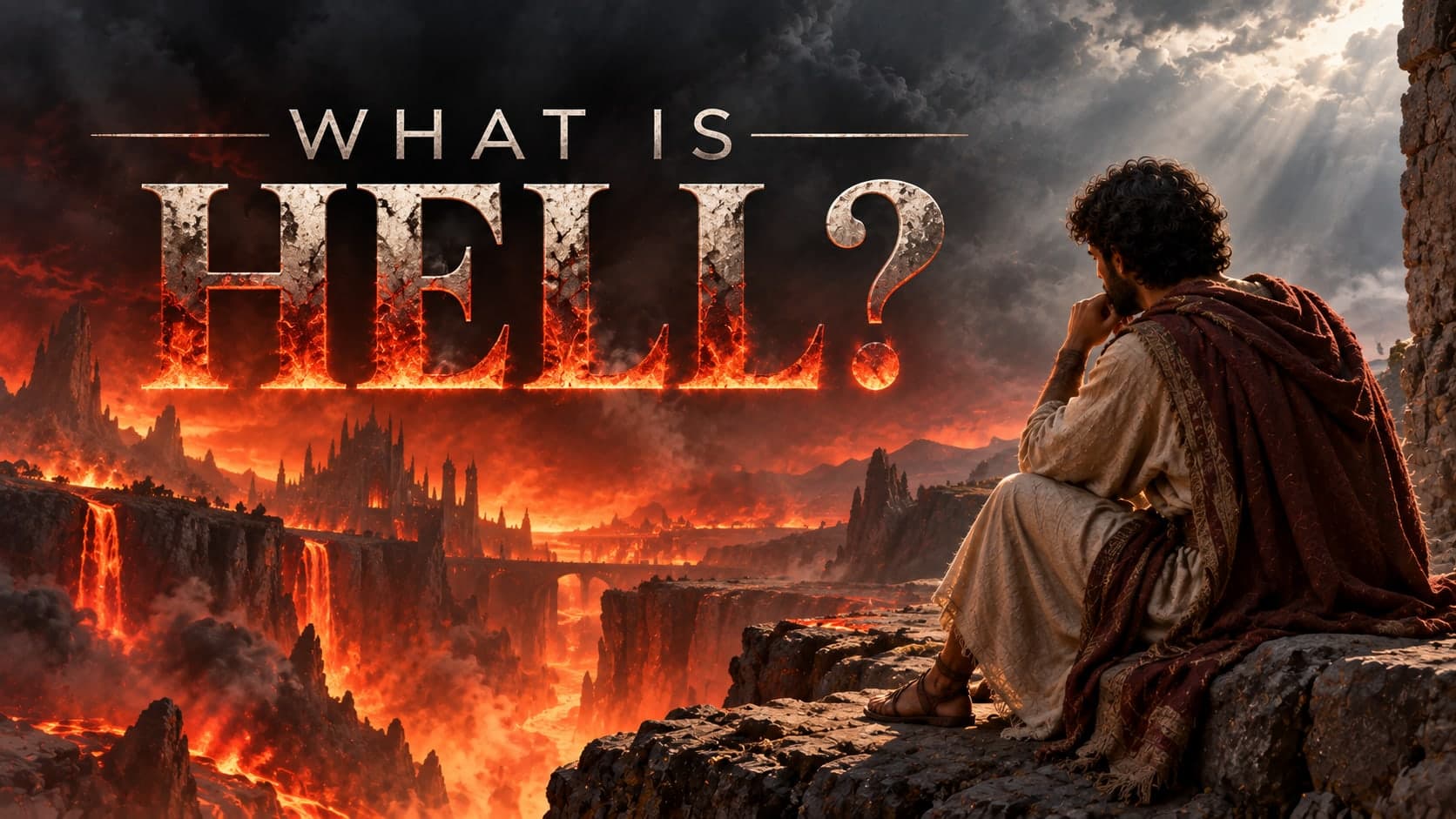
🔥 What Is Hell? What the Bible Actually Says
Maybe someone you love died and you do not know if they knew Jesus.
Maybe you grew up scared of a cartoon devil with a pitchfork and you are not sure how much of that is actually in the Bible.
Maybe you are just tired of vague answers and you want to know what Scripture really says about hell.
Whatever brought you here, you are asking the right question in the right place.
📌 Hell is one of the most misunderstood topics in the whole Bible, and also one of the most serious.
Most of what people believe about hell did not come from Scripture.
It came from movies. From medieval paintings. From jokes about pitchforks and red suits.
The real picture in the Bible is different. It is more careful. It unfolds in stages instead of arriving all at once.
And the Bible uses several different words that our English translations often flatten into one word: hell. Sheol. Hades. Gehenna. The lake of fire.
Each one means something a little different, and the differences actually matter.
This guide will walk you through what each word means, what the Bible says happens after death, why this doctrine matters for your faith, and honest answers to the hard questions people actually ask.
Including whether hell lasts forever. Including what happens to people who never heard the gospel. Including what to say to someone grieving a loved one who may not have known the Lord.
This is heavy ground. Take it slow.
Let's open the Word and look at what is actually there.
Why This Matters for Your Faith
It would be easier to skip this topic.
Hell is not a comfortable subject. It is not the kind of thing you bring up at dinner.
But Jesus talked about hell more than almost anyone else in Scripture.
📌 He did not talk about it to scare people for no reason. He talked about it because He loves people, and eternity is real.
If hell is not real, none of this matters much. But if it is real, it is the single most urgent fact about the world you have ever heard.
It changes how you see the people around you who do not know Jesus. It changes how you pray for them and how you live your own life today.
This is also where a lot of people quietly wrestle with why a good and loving God would allow judgment at all, and part of the answer starts with understanding what hell actually is and is not.
The world's answer to hell is usually one of two extremes. Either laugh it off as a fairy tale, or picture it so cartoonishly it stops feeling real.
💡 Scripture does neither. The Bible treats hell with total seriousness, and it treats the cross with even more seriousness, because the cross is God's answer to hell.
The stakes here are not abstract theology. The stakes are the people you know who do not yet know Jesus.
What the Bible Actually Teaches About Hell
1. One English Word Covers Several Biblical Ideas
The Old Testament was written in Hebrew. The New Testament was written in Greek.
Neither language has a single word that matches everything English speakers mean by hell.
Instead, Scripture uses several different words.
- 📜 Sheol, a Hebrew word for the realm of the dead
- 📜 Hades, the Greek word the New Testament uses in the same way
- 📜 Gehenna, a word Jesus used for final judgment
- 🔥 The lake of fire, described in Revelation as hell's final and permanent form
Here is something that surprises a lot of people. The King James Bible never actually prints the words Sheol or Hades on the page. Instead, the translators rendered those Hebrew and Greek words as grave, pit, or hell depending on the context.
So when you read the word hell in an old English Bible, it might be translating any one of these different ideas. That blending is exactly where most of the confusion comes from.
📌 The Bible is more precise than the English translations sometimes let on. Let's take each idea one at a time, in the order Scripture reveals them.
2. Sheol: The Realm of the Dead in the Old Testament
The first clear reference to Sheol comes in Genesis 37.
Jacob believes his son Joseph is dead, torn apart by a wild animal. Listen to his grief.
"And all his sons and all his daughters rose up to comfort him; but he refused to be comforted; and he said, For I will go down into the grave unto my son mourning. Thus his father wept for him."
The King James renders the Hebrew word here as grave. But the underlying Hebrew word is Sheol, and it shows up again and again across the Old Testament.
Jacob is not describing a lake of fire. He is not describing final judgment.
He is describing the place the dead go. Simply that.
- ⚰️ The grave
- ☠️ Death itself
- 🌑 The unseen realm where the dead rest
Sheol is not mapped out in fine detail in the Old Testament. But it is presented as the destination of the righteous and the wicked alike after death.
David speaks of it with hope, trusting God even there.
"For thou wilt not leave my soul in hell; neither wilt thou suffer thine Holy One to see corruption."
Here the King James actually uses the word hell, translating that same Hebrew word Sheol.
💡 Grave, hell, pit. All three English words translate that same Hebrew word Sheol. The Old Testament establishes that death leads somewhere, but the details stay limited.
The New Testament is where the picture sharpens.
3. Hades and the Rich Man Who Was in Torment
When the language shifts from Hebrew to Greek in the New Testament, Sheol becomes Hades.
The clearest teaching comes straight from Jesus, in His story of a rich man and a beggar named Lazarus.
"And it came to pass, that the beggar died, and was carried by the angels into Abraham's bosom: the rich man also died, and was buried; And in hell he lift up his eyes, being in torments, and seeth Abraham afar off, and Lazarus in his bosom."
The King James translates the Greek word Hades as hell in verse 23. Both men enter the same realm, but their experiences are opposite.
- 🔥 One man is in torment
- 🤍 One man is comforted, resting in Abraham's bosom
Resting against someone's chest at a meal pictured closeness in that culture, so being at Abraham's side pictures the righteous resting safely within the covenant promise he represents.
Jesus describes an uncrossable line between the two men.
"And beside all this, between us and you there is a great gulf fixed: so that they which would pass from hence to you cannot; neither can they pass to us, that would come from thence."
The chasm is fixed. It will not move.
⚠️ Jesus tells this story to make one thing unmistakably clear: the choices you make in this life echo into the next one, and there is no undoing them afterward.
Hades is not one shared experience. It contains real separation, comfort on one side and anguish on the other, and Jesus taught this Himself, in plain language.
4. What Changed for Believers After the Resurrection
Scripture indicates that after Jesus died, He proclaimed victory in that realm of the dead.
"For Christ also hath once suffered for sins, the just for the unjust, that he might bring us to God, being put to death in the flesh, but quickened by the Spirit: By which also he went and preached unto the spirits in prison"
After the resurrection, the New Testament describes a believer's death differently than the Old Testament described Sheol.
"We are confident, I say, and willing rather to be absent from the body, and to be present with the Lord."
Paul does not say absence from the body means waiting quietly somewhere. He says it means being at home with the Lord, immediately.
✅ For those who belong to Jesus, death is no longer a holding place. It is the doorway straight into His presence.
Hades still exists in Scripture's picture of things, but now it functions as a temporary place for the wicked, waiting for a final judgment that has not happened yet.
5. Gehenna: The Word Jesus Used for Final Judgment
When Jesus warns about final punishment, He most often uses a different word entirely: Gehenna.
Gehenna was a real valley outside Jerusalem, and every listener knew what it meant. Israel's kings once burned their own children there in idol worship, an evil so dark Jeremiah pronounced God's judgment on the place by name.
"And they have built the high places of Tophet, which is in the valley of the son of Hinnom, to burn their sons and their daughters in the fire; which I commanded them not, neither came it into my heart."
Later, the same valley became Jerusalem's burning garbage dump, a place of waste and fire that never fully went out.
When Jesus reached for a word to describe final judgment, He reached for a place His listeners could already picture.
"And fear not them which kill the body, but are not able to kill the soul: but rather fear him which is able to destroy both soul and body in hell."
The King James renders Gehenna as hell here again.
📌 Gehenna is not the temporary waiting place of Hades. It points forward to something final.
Which brings us to the last stage the Bible describes.
6. The Lake of Fire: Hell's Final Form
Revelation shows what happens at the very end of the story, after every other stage.
"And the sea gave up the dead which were in it; and death and hell delivered up the dead which were in them: and they were judged every man according to their works."
"And death and hell were cast into the lake of fire. This is the second death."
"And whosoever was not found written in the book of life was cast into the lake of fire."
Notice the sequence.
- ☠️ Physical death
- 🌑 Sheol or Hades, the realm of the dead
- ⏳ A period of waiting
- ⚖️ Final judgment before God
- 🔥 The lake of fire
Even death and hell itself are thrown into the lake of fire. Nothing about this stage is temporary. Jesus describes this same final place in His own words.
"Then shall he say also unto them on the left hand, Depart from me, ye cursed, into everlasting fire, prepared for the devil and his angels"
📌 That single line matters. Scripture says this fire was prepared for the devil and his angels, not originally for people. Hell was never God's desired ending for you, which is why what the Bible says heaven actually is matters just as much as understanding hell. One is what He built for you. The other is what people choose by refusing Him.
7. Is Hell Eternal? Where Faithful Christians Disagree
This is worth answering honestly, including the part where good, Bible believing Christians land in different places.
The majority view across church history is eternal conscious torment, unending suffering forever.
"And these shall go away into everlasting punishment: but the righteous into life eternal."
The same Greek word for everlasting describes the punishment and the life in that verse. If life eternal never ends, this view says, neither does the punishment.
A smaller number of faithful Christians hold a different view, called annihilationism. They point to language of death and destruction rather than unending consciousness.
"Who shall be punished with everlasting destruction from the presence of the Lord, and from the glory of his power"
In this view, the wicked are ultimately destroyed rather than kept alive to suffer without end.
💡 Both views take hell with total seriousness, and both agree it is exactly what Jesus died on the cross to save you from. You do not have to settle every detail to settle the one thing that determines your eternity: whether you belong to Jesus.

How This Should Change the Way You Live
Doctrine about hell was never meant to stay in your head.
It is meant to shape how you love people, how you pray, and how you live today.
Here are eight ways to let it.
- Let it give your evangelism real urgency. If hell is real, then sharing Jesus is not a hobby for extra spiritual people. It is the most loving thing you can do for someone you care about.
- Pray by name for the people you love who do not know Christ. Do not just worry about them quietly. Bring their names to God on purpose, regularly, and ask Him to open their eyes.
- Rest in your own assurance instead of fear. If you belong to Jesus, this doctrine is not meant to make you anxious about your own soul. You can actually know you are saved, and that certainty is a gift, not arrogance.
- Comfort grieving people with truth, not with guesses. If someone lost a loved one whose faith was unclear, do not promise a certainty the Bible does not give you. Point them to God's justice and mercy, both more perfect than yours.
- Never use hell to manipulate or humiliate anyone. Jesus warned about hell out of love. Using it to win an argument or shame someone handles something sacred carelessly.
- Let it deepen your gratitude for the cross. Every time you read about judgment, remember that Jesus took the weight of it Himself so you would not have to.
- Teach children the truth at an age they can carry it. You do not need to terrify a five year old with fire and smoke. Teach that sin separates us from God and Jesus makes a way back, then build from there as they grow.
- Do not build your own security on being a good person. The rich man in Luke 16 likely thought his life looked successful. What saves you is trusting Christ, not comparing yourself to people who seem worse than you.
None of these habits require you to have every question about hell fully resolved.
They just require you to take what you already know seriously.
Pick one and start there this week.
Top Bible Verses About Hell
If you only remember a handful of verses from this whole guide, remember these.
1. John 3:16
"For God so loved the world, that he gave his only begotten Son, that whosoever believeth in him should not perish, but have everlasting life."
This is the verse that has to sit beside every conversation about hell.
Notice the word perish. Scripture assumes there is a real alternative to everlasting life, and it is not a neutral one.
But look at what drives the whole verse: love. God sent Jesus because He loved the world, including you. The cross is His love and His justice meeting in the same place.
2. Romans 6:23
"For the wages of sin is death; but the gift of God is eternal life through Jesus Christ our Lord."
Wages are what you earn. A gift is what you cannot earn.
What sin earns is death, in the fullest sense the Bible means by that word. What God offers instead is a gift, paid for by Christ.
Hell, in the end, is simply receiving what was earned instead of receiving the gift that was offered.
3. Matthew 25:46
"And these shall go away into everlasting punishment: but the righteous into life eternal."
This verse closes Jesus's teaching on the final judgment, and it is one of the clearest statements about hell's seriousness in all of Scripture.
Jesus puts two destinations side by side in one sentence, with no third option offered anywhere. He is not speaking in riddles here. He speaks plainly because the stakes are real.
This is the verse to sit with if you have ever been tempted to think hell is just an old idea nobody really taught. Jesus taught it, in these exact words.
4. 2 Peter 3:9
"The Lord is not slack concerning his promise, as some men count slackness; but is longsuffering to us-ward, not willing that any should perish, but that all should come to repentance."
This verse is the heart behind every hard truth in this guide.
God is not eager for anyone to face judgment. He is patient, on purpose, giving people time to turn to Him.
That patience is not permission to wait forever. It is an invitation to respond while there is still time.

Frequently Asked Questions About Hell
Is hell a real place or just symbolic?
The Bible speaks of hell as a real destination, not just a metaphor. Jesus described it with concrete language, fire, torment, and a real chasm between the rich man and Lazarus. Some of the imagery may be symbolic of something worse than the picture, not less real than it.
Is hell eternal, or will it end?
Most Christians throughout history have held that hell is everlasting, based on verses like Matthew 25:46. A smaller number of faithful believers hold that the wicked are ultimately destroyed rather than kept alive forever, pointing to language like everlasting destruction in 2 Thessalonians 1:9. Both views agree there is no exit from it once final judgment happens.
What about people who never heard about Jesus?
Scripture says everyone has some knowledge of God through creation, so no one is entirely without excuse. Christians genuinely disagree on the details of how God judges someone who never heard the gospel preached. What Scripture is emphatic about is the church's responsibility to take the gospel to people who have never heard, rather than resting on speculation about their fate.
Do all religions believe in hell?
Many religions have some concept of punishment after death, but the details differ enormously from Scripture. The Bible ties the outcome directly to a person's response to Jesus, not to a scale of good and bad deeds.
Will there be a second chance after death?
Scripture does not offer that hope. The rich man and Lazarus show a chasm that cannot be crossed once someone has died. It is appointed for people to die once, and after that comes judgment, which is why the Bible pushes so hard for a decision now.
What is the difference between Sheol, Hades, Gehenna, and the lake of fire?
Sheol and Hades both describe the realm of the dead, the Hebrew and Greek words for the same idea. Gehenna is the word Jesus used most for final punishment, drawing on a real valley tied to judgment. The lake of fire is the final, permanent form of judgment, after everything temporary is done away with.
Why would a loving God send anyone to hell?
God does not delight in anyone's judgment. Ezekiel says plainly He has no pleasure in the death of the wicked and would rather see them turn and live. Hell is what people choose when they refuse the rescue God offers through Jesus as the only way to God, not something forced on people who wanted Him.
Can a Christian who still sins end up in hell?
No true believer ends up in hell because of remaining sin they are still fighting. Salvation rests on trusting Christ, not on sinless perfection. The question is never whether you still sin. The question is whether you belong to Jesus.
What happens to babies or people who could not understand the gospel?
Scripture does not give a single direct verse on this, and Christians hold their answers with real humility here. Many point to God's consistent character, a God more merciful and more just than we are, as reason for confidence in how He handles these cases.
How can I know I am not going to hell?
Trust in Jesus Christ, not your own record. Scripture says whosoever calls on the name of the Lord shall be saved, no exceptions attached. If you have never done that honestly, you can do it right now, in your own words. That decision, not a feeling afterward, is what settles the question for good.
Final Thoughts
If you remember nothing else from this guide, remember these three things.
📌 The Bible describes hell in stages, not one simple picture. Sheol, Hades, Gehenna, and the lake of fire each mean something specific, and understanding them clears up confusion instead of removing the seriousness.
📌 Hell was never God's desired ending for you. The fire in Matthew 25 was prepared for the devil and his angels. God's whole heart, shown fully at the cross, is to rescue people from it.
📌 The way out was never in question. It is Jesus. Not being a good enough person. Not hoping you land on the right side of some invisible scale. Just Jesus.
You may still have questions this guide did not fully answer.
That is honest. Some of these details are genuinely hard, and Scripture leaves a few of them open.
But the most important question in the whole topic is not open at all.
Have you trusted Jesus with your own soul?
If you have, you can rest. Not because the topic stopped being serious, but because your name is already written down.
If you have not, there is no better moment than the one you are in right now.