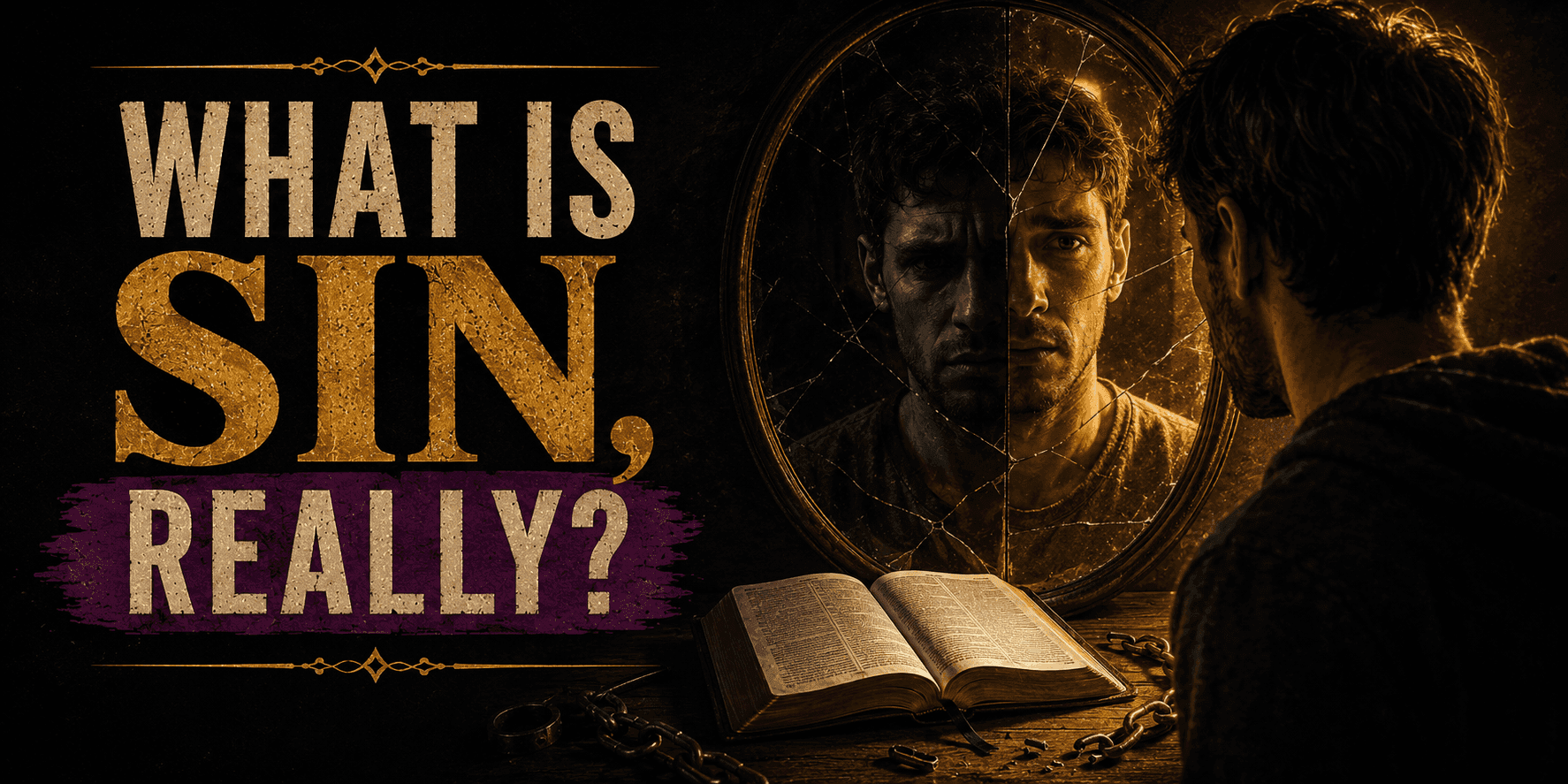
📖 What Is Sin, Really? A Complete Guide for Christians
You have probably heard a hundred answers to the question "what is sin."
A list of rules. A list of don'ts. A finger pointed at somebody else's life.
Maybe you grew up being told sin was smoking, drinking, or missing church.
Maybe you have quietly decided you are a good person, so the word does not really apply to you.
📌 Here is the honest answer. Sin is not first a rule you broke. It is a relationship broken.
That changes everything about how you should think about it.
The Bible does not open with a list of forbidden foods or a courtroom.
It opens with a garden, two people who knew God face to face, and a choice.
This guide will walk you through what sin actually is, straight from Scripture.
- 🔲 Why sin is better described as missing the mark than breaking a rule.
- 🔲 The difference between sins of doing and sins of not doing.
- 🔲 Why Jesus moved the whole conversation from your hands to your heart.
- 🔲 Why "I'm a good person" misses the actual question.
- 🔲 What God does with sin once it is brought into the light.
This question is also bigger than a church word for bad behavior.
It touches your marriage, your friendships, your habits, and the quiet conversations you have with yourself at night.
One thing before you keep reading.
📖 This is not written to crush you. It is written to be honest with you, because the real answer to "what is sin" is also the doorway to the best news in the Bible.
You are not being condemned for asking this question.
Asking it is the beginning of getting free.
Let's go to the root of it.
Why This Matters for Your Faith
You could skip this question and still go to church every Sunday.
You could sing the songs and never once ask what sin really is.
But eventually something cracks that approach open.
A habit you cannot shake. A thought you are ashamed of. A fight that keeps repeating.
⚠️ If you misunderstand sin, you will misunderstand almost everything else in your faith.
Get sin wrong and you will get grace wrong too.
- ❓ Think sin is just rule breaking, and grace becomes a loophole.
- ❓ Think sin is only the big, obvious stuff, and your own heart stays hidden from you.
- ❓ Think you are basically fine, and the cross stops making any sense at all.
The world has its own answer to sin, and it is not enough.
The world says there is no such thing, only mistakes, bad habits, trauma responses.
Some of that language is true as far as it goes.
But it cannot explain why you still feel guilty after you have forgiven yourself.
It cannot explain why an apology sometimes does not fix anything on the inside.
📌 That is because sin is not only a problem between you and other people. It is first a problem between you and God.
Learning why people drift from their faith usually starts right here, with a wrong picture of sin that either crushes someone or never convicts them at all.
Picture it like a smoke detector with a dead battery.
A wrong view of sin either goes off constantly over nothing, until you rip it off the ceiling just to get some peace, or it stays silent while real smoke fills the room.
Neither one is safe. You need an alarm that tells you the truth, which is exactly what Scripture does.
Get this right, and the rest of the Bible opens up.
The law. The prophets. The cross. The empty tomb.
All of it is God's answer to the exact thing this article is about to explain.
What God's Word Actually Says About Sin
Scripture never gives you one tidy sentence and moves on.
It gives you a picture, a story, a warning, and a promise, each one building on the last.
Walk through all seven together and you will come out with more than a definition.
You will come out with a way of seeing your own heart that you did not have before.
1. Sin Is Missing the Mark, Not Just Breaking a Rule
Picture an archer aiming at a target.
He is not trying to break a rule written on a sign nearby.
He has one job. Hit the mark.
Scripture describes sin the same way.
"For all have sinned, and come short of the glory of God;"
Come short is the picture. Not hitting what you were aiming at.
And what are you aiming at?
The glory of God. Reflecting Him. Living the way He made you to live.
📌 Sin is any way, big or small, that you fall short of that.
That is a much bigger category than a list of forbidden actions.
It is also a far more personal one.
A rule is something outside you that you either keep or break.
Missing a mark you were made for is something that happens inside you, every day.
Scripture does give sin a legal name too, so you can hold both truths at once.
"Whosoever committeth sin transgresseth also the law: for sin is the transgression of the law."
So sin really does break God's law. That part is true.
💡 But the law was never the point. The law was always pointing at something underneath it.
A target. A relationship. A Person.
2. A Relationship Broken Before It Is a Rule Broken
Go back to the very first sin in the Bible.
Adam and Eve eat the fruit they were told not to eat.
Watch what happens one verse later.
"And they heard the voice of the LORD God walking in the garden in the cool of the day: and Adam and his wife hid themselves from the presence of the LORD God amongst the trees of the garden."
They did not run from a rulebook.
They ran from a Person they used to walk with in the cool of the day.
God calls after them, and the question He asks is not an accusation. It is an invitation.
"And the LORD God called unto Adam, and said unto him, Where art thou?"
God knew exactly where Adam was standing.
He was asking where Adam was on the inside.
Adam answers with the real diagnosis of sin, whether he realized it or not:
"And he said, I heard thy voice in the garden, and I was afraid, because I was naked; and I hid myself."
Afraid. Hiding. That is what sin does to a relationship before it does anything else.
Isaiah names the same thing centuries later, in plain language.
"But your iniquities have separated between you and your God, and your sins have hid his face from you, that he will not hear."
⚠️ Sin separates. That is its first and deepest effect, before guilt, before consequence, before shame.
📌 Every sin is a small act of hiding from God, dressed up as something else.
That reframes the whole question.
Sin is not mainly "did I break a rule today."
Sin is mainly "did I walk toward God today, or did I hide."
David understood this all the way down, after a season of sin he had tried to hide for months.
"Against thee, thee only, have I sinned, and done this evil in thy sight: that thou mightest be justified when thou speakest, and be clear when thou judgest."
David had wronged other people badly. He knew that.
But when he finally stopped hiding, the person he named was God.
💡 That is not David minimizing the damage he did to others. It is David seeing where the damage actually started.
Every sin against a person is first a sin against the God who made that person.
And David did not stop at confession. He asked for something rules alone can never give him.
"Create in me a clean heart, O God; and renew a right spirit within me."
Not "help me behave better next time."
📌 A new heart. That is always the real request underneath genuine repentance, and it is a prayer only God can answer.
3. Sins of Doing: What the Bible Calls Transgression
The most obvious category is the one everyone already pictures.
Lying. Stealing. Cheating. Striking out at someone in anger.
These are sins of commission. You did a thing God said not to do.
God gave Israel a short, blunt list of these early on.
"Thou shalt not kill. Thou shalt not commit adultery. Thou shalt not steal. Thou shalt not bear false witness against thy neighbour."
Four commands. No wiggle room, no exceptions clause.
Scripture never softens this category. It calls it transgression, a crossing of a line God drew.
And the line is not arbitrary. It is drawn for the same reason a guardrail is drawn on a mountain road.
Not to limit you for no reason, but to keep you from a drop you cannot see from the car.
📌 Every command God gives against sin is a command toward your own good, not a leash.
That is worth remembering the next time a boundary in Scripture feels restrictive.
It usually is not. It is protective, the same way learning real self control protects you rather than limits you.
Paul later gives a longer list, less like a courtroom and more like a diagnosis.
"Now the works of the flesh are manifest, which are these; Adultery, fornication, uncleanness, lasciviousness, Idolatry, witchcraft, hatred, variance, emulations, wrath, strife, seditions, heresies, Envyings, murders, drunkenness, revellings, and such like."
Notice how different that list is from the Ten Commandments.
Half of it is actions. The other half, hatred, variance, envyings, strife, is attitude.
💡 Paul already refuses to let you draw a clean line between sins of doing and sins of the heart. They come from the same root.
Every item on that list grew from the same soil as Adam hiding in the trees. A heart that trusted something other than God.
4. Sins of Not Doing: The Warning in James 4:17
Here is the category most people never think about.
You can sin without ever doing a single forbidden thing.
"Therefore to him that knoweth to do good, and doeth it not, to him it is sin."
Read that again slowly.
It does not say sin is doing the wrong thing. It says sin is knowing the right thing and not doing it.
The friend you knew needed a call and never made.
The apology you knew you owed and kept putting off.
The truth you knew you should have said and swallowed instead.
💡 Sins of omission do not feel as dramatic as sins of commission, so they are easy to miss.
But James puts them in the same category. Not a lesser category. The same one.
This is part of what it means that being a Christian is not only about avoiding the bad. It is about actually doing the good you already know to do.
5. Jesus Moves the Whole Conversation to the Heart
If sin were only about outward actions, plenty of people could relax.
Jesus will not let anyone relax.
In the Sermon on the Mount, He takes two commands everyone agreed on and goes underneath them.
"Ye have heard that it was said by them of old time, Thou shalt not kill; and whosoever shall kill shall be in danger of the judgment: But I say unto you, That whosoever is angry with his brother without a cause shall be in danger of the judgment."
Nobody in the crowd that day had murdered anyone.
Jesus just told them they had already broken that command in their hearts.
He does the same thing with another command.
"Ye have heard that it was said by them of old time, Thou shalt not commit adultery: But I say unto you, That whosoever looketh on a woman to lust after her hath committed adultery with her already in his heart."
⚠️ Jesus is not raising the bar out of cruelty. He is showing you where the bar actually was the whole time.
A list of outward rules can make a person look clean while staying rotten underneath.
Jesus refuses to let religion stop at the surface.
He is not interested in managing your behavior.
📌 He is after your heart, because that is where sin actually starts.
This is not meant to leave you despairing over every stray thought.
It is meant to show you why you need more than willpower.
Nobody polishes their way to a clean heart. Only God can give you one.
Think about why Jesus picked anger and lust specifically, rather than murder and adultery on their own.
Almost nobody listening that day had actually killed or committed adultery. Everybody listening had been angry without cause, and nearly everybody had lusted after someone they had no right to.
💡 Jesus picked the two sins the whole crowd was already guilty of, on purpose. He was not describing an exotic failure far away from His listeners. He was describing the room they were sitting in.
6. Why "I'm a Good Person" Misses the Point
Once you see sin as missing a mark and not just breaking a rule, this gets easier to explain.
Compared to a lot of people, you might genuinely be a good person.
You pay your bills. You are kind to your neighbors. You have never robbed a bank.
📌 But "good person" is answering a question sin was never asking.
Sin is not asking "are you better than your neighbor."
It is asking "have you come short of the glory of God."
Measured against other people, you might come out ahead.
Measured against the mark you were actually made for, everyone comes short, including you.
Jesus told a short story about exactly this comparison trap.
"Two men went up into the temple to pray; the one a Pharisee, and the other a publican. The Pharisee stood and prayed thus with himself, God, I thank thee, that I am not as other men are, extortioners, unjust, adulterers, or even as this publican. I fast twice in the week, I give tithes of all that I possess."
On paper, the Pharisee was right. He probably was not an extortioner or an adulterer.
He fasted. He tithed. By any human measuring stick, he was doing well.
Across the temple, a tax collector would not even lift his eyes.
"And the publican, standing afar off, would not lift up so much as his eyes unto heaven, but smote upon his breast, saying, God be merciful to me a sinner."
No résumé. No comparison to anyone else. Just an honest word: sinner.
Jesus tells you plainly who walked away right with God that day.
"I tell you, this man went down to his house justified rather than the other: for every one that exalteth himself shall be abased; and he that humbleth himself shall be exalted."
⚠️ The Pharisee's mistake was not that he lived badly. It was that he was measuring the wrong thing.
He compared himself to the publican instead of to God's glory.
Paul said the same thing about himself, a man who kept the law more carefully than almost anyone alive.
Same verse as before, on purpose:
"For all have sinned, and come short of the glory of God;"
All have sinned. Not just the people whose sins made the news.
💡 Realizing this is not meant to make you feel worthless. It is meant to stop you from comparing yourself to the wrong standard.
You were never competing against your neighbor.
You were made for something higher than "good enough compared to most people."
7. Sin Brought Into the Light: What God Does With It
Here is where this has to land, or none of the rest of it is good news.
Remember Adam and Eve, hiding in the trees.
God did not leave them there.
He came looking. He asked the question. He made a way to cover them, even then.
That pattern never changes.
"But God commendeth his love toward us, in that, while we were yet sinners, Christ died for us."
While we were yet sinners. Not after we cleaned up. Not once we deserved it.
He went looking for you while you were still hiding in the trees.
And the price was not small.
"For the wages of sin is death; but the gift of God is eternal life through Jesus Christ our Lord."
Wages is an earned word. Death is what sin actually earns.
Gift is the opposite kind of word. Eternal life is not earned at all.
That is the whole weight of the cross in one verse.
Jesus faced a woman everyone wanted exposed and condemned, and this is what He did instead:
"So when they continued asking him, he lifted up himself, and said unto them, He that is without sin among you, let him first cast a stone at her."
One by one, every accuser walked away.
Only Jesus was left standing there who actually had the right to throw a stone.
"She said, No man, Lord. And Jesus said unto her, Neither do I condemn thee: go, and sin no more."
📌 Not "go, and feel how terrible you are." Not condemned.
And not told to stay as she was either. "Sin no more" is real freedom, not permission.
That is what bringing sin into the light actually looks like.
"But if we walk in the light, as he is in the light, we have fellowship one with another, and the blood of Jesus Christ his Son cleanseth us from all sin."
John will not let you skip the honest step before the comfort, either.
"If we say that we have no sin, we deceive ourselves, and the truth is not in us."
⚠️ Pretending you have no sin does not make you innocent. It just adds self deception on top of the original problem.
Thankfully John does not leave you stuck in verse 8.
"If we confess our sins, he is faithful and just to forgive us our sins, and to cleanse us from all unrighteousness."
Hiding kept Adam and Eve in the trees.
Confession is what brings anyone back out into the open with God.
And God made Him this promise about what happens to sin once it is actually confessed:
"Come now, and let us reason together, saith the LORD: though your sins be as scarlet, they shall be as white as snow; though they be red like crimson, they shall be as wool."
Scarlet does not fade on its own. Crimson does not wash out with a little effort.
Only God can do what this verse describes, and He offers to do it for free.
Notice that God calls this reasoning together, not a courtroom He wants to drag you into.
He already knows the verdict. He is the one who paid for it. What He wants is for you to stop arguing with Him about what you both already know is true, and let Him actually do what only He can do with it.
💡 So here is the whole answer to "what is sin." It is missing the mark you were made for, a relationship broken before it is a rule broken. And it is the exact thing God already dealt with at the cross, for anyone willing to stop hiding and come into the light.
Practical Tips: Living Honestly With Sin Today
Understanding sin correctly should change how you live this week, not just what you believe.
Here are eight ways to start.
- Name it specifically when you pray. Not "forgive me for everything" but "Father, I lied to my wife today." Specific confession keeps you honest with yourself, not just with God, the same way David's confession in Psalm 51 names the exact wrong rather than a vague feeling of guilt.
- Stop ranking sins by how they look to other people. A private sin of the heart is just as real as a public one. Judge your own heart by Matthew 5, not by what made the news, since Jesus already told you anger and lust count before they ever become visible.
- Check your sins of omission, not just commission. Ask what good you knew to do this week and skipped. James 4:17 counts that the same way as an outright wrong, so make a habit of reviewing your undone good deeds, not only your bad ones.
- Resist comparing yourself to other people. "I'm better than him" is not the same question as "have I come short of the glory of God." Keep the right measuring stick, the way the publican in Luke 18 did instead of the Pharisee standing next to him.
- Bring it into the light fast. The longer a sin stays hidden, the heavier it gets. Tell God first, then a trusted believer if it is the kind of thing that grows in the dark, because secrecy is almost always what lets a small sin become a controlling one.
- Receive forgiveness, do not just request it. 1 John 1:9 is a promise, not a maybe. Once you have confessed it honestly, stop re-litigating it in your own head; doubting a promise God already kept is its own quiet form of unbelief.
- Watch for the guardrail, not just the ditch. God's commands are protective, not restrictive. When a boundary feels heavy, ask what it is actually protecting in you, your marriage, your witness, your own heart, rather than assuming God is simply withholding something good.
- Let conviction do its job and then stop. Conviction from God points you to repentance and then to grace. Shame just keeps you circling. Learn to tell the two apart: conviction always has a next step, shame just has a worse feeling.
Pick one of these and actually do it today.
Small, honest obedience does more than a long list you never start.
Top 5 Bible Verses About Sin
If you only remember five verses from this whole guide, make it these.
1. Romans 3:23
"For all have sinned, and come short of the glory of God;"
The most honest sentence you will ever read about yourself, and it includes everyone.
Not a verse to use on somebody else. A verse that puts you in the same room as every other person who has ever lived.
Nobody gets to stand outside this one, which is exactly why it is such good news later.
Paul wrote it in the middle of a long argument that Jew and Gentile, religious and irreligious, all stand on the exact same ground before God.
If that sentence had an exception clause, somebody would have found it by now.
2. James 4:17
"Therefore to him that knoweth to do good, and doeth it not, to him it is sin."
The verse that closes the easiest loophole.
You cannot define sin down to only the dramatic stuff you avoided this week.
The good you knew to do and skipped counts too.
Notice the condition James sets. It is not ignorance. It is knowledge followed by inaction, which is a much more common trap than most people admit.
Read this one on a day you are tempted to feel proud of everything you did not do wrong.
3. Matthew 5:28
"But I say unto you, That whosoever looketh on a woman to lust after her hath committed adultery with her already in his heart."
The verse that moves the whole conversation inside.
Jesus is not adding a harder rule. He is showing you the real location sin starts in, so you stop thinking a clean outside is the same thing as a clean heart.
This verse should not leave you despairing over a stray thought you did not choose. It should leave you honest about the direction your heart tends to drift, and desperate for God to change it rather than you managing it alone.
4. Romans 6:23
"For the wages of sin is death; but the gift of God is eternal life through Jesus Christ our Lord."
Two kinds of pay in one sentence. One you earn. One you only ever receive.
If you read nothing else about sin today, read this one twice and let the contrast between wages and gift actually sink in.
Wages always show up on time, whether you want them or not. The gift only ever comes through one Person, and Paul names Him by name at the end of the verse so nobody mistakes where it comes from.
5. 1 John 1:9
"If we confess our sins, he is faithful and just to forgive us our sins, and to cleanse us from all unrighteousness."
The verse for the moment right after you realize what you just did.
Not a maybe. A promise, backed by God's own faithfulness and justice.
Keep this one close. You will need it again, and that is fine. Everyone does.
Notice it says faithful and just, not merely merciful. Forgiving you is not God bending His own standard. It is God keeping a promise He already made good on at the cross.

Frequently Asked Questions About Sin
What is the biblical definition of sin?
Sin is missing the mark God made you for, which Scripture also calls coming short of His glory (Romans 3:23) and transgressing His law (1 John 3:4). At its root it is a broken relationship with God, shown first when Adam and Eve hid from Him in the garden. Every other definition grows out of that one.
What is the difference between sin and a mistake?
A mistake is usually unintentional, like a wrong answer on a test. Sin involves your will, something you knew or should have known was against God's way and did anyway, or something good you knew to do and did not (James 4:17). The line is not always obvious, but your conscience and the Holy Spirit will usually tell you which one you are looking at. When you are not sure, bring the whole thing to God honestly rather than trying to settle the label on your own.
Where did sin come from?
Sin entered the human story in the garden, when Adam and Eve chose to disobey God's one command (Genesis 3). It did not begin with God, who made everything good. It began with a choice to trust a lie about God's character over God's own word. That one choice is also why the Bible says sin and death spread to every person after them, not just to Adam and Eve themselves.
Why does my sin affect other people?
Because you were made for relationship, not isolation, so your choices never stay sealed off inside you. Jezebel's influence pulled an entire nation into idolatry, and Ahab's own sin is described as something Jezebel stirred up in him, not something she forced. The same pattern plays out smaller every day: what you normalize at home or online tends to spread to the people who trust you most.
Are all sins the same in God's eyes?
Every sin separates you from God the same way, which is the sense in which sin is sin. But Scripture does treat some sins as more serious in their consequences than others; Jesus himself told Pilate that one sin carried the greater guilt. What matters most is not ranking your sin against someone else's, but bringing all of it honestly to God, since both minimizing sin and despairing over it miss the actual point.
Can a sin of thought really count as sin?
Yes. Jesus said so plainly, naming anger as a heart form of murder and lust as a heart form of adultery (Matthew 5:21-28). That is not meant to crush you over every stray thought that passes through your mind uninvited. It is meant to show you why you need more than better behavior. You need a changed heart, which only God can give, which is exactly what David asked for in Psalm 51:10.
If I'm a good person, am I still a sinner?
Yes, and that is not meant as an insult. "Good person" compares you to other people, but sin is measured against the glory of God, a mark Romans 3:23 says everyone comes short of. Being kinder than your neighbor was never the actual test, the way the Pharisee in Luke 18 discovered too late. Seeing that clearly is not meant to flatten you. It is meant to point you to the same mercy the publican asked for and received.
Does God hate me because of my sin?
No. Romans 5:8 says Christ died for you while you were still a sinner, not after you cleaned up. God hates what sin does to you and to the people around you, but His pursuit of you has never stopped. He came looking for Adam and Eve while they were still hiding, and He is still doing that now. That same faithfulness is also why losing your salvation over a struggle with sin is not what Scripture teaches once you belong to Him.
Is it possible to stop sinning completely?
Not perfectly, not in this life. Even the apostle John wrote to believers assuming they would still sin, which is why 1 John 1:9 exists at all. The goal is not a flawless record. It is a heart that keeps turning back toward God every time it drifts, growing more like Christ over time, which the Bible calls sanctification rather than sinless perfection.
What is the unforgivable sin?
Jesus called it blasphemy against the Holy Spirit, a settled, final rejection of the very Spirit who convicts a person of sin and points them to Christ. If you are worried you have committed it, that worry is itself strong evidence you have not, since the sin describes a hardened refusal to care, not an anxious conscience. The fact that you are asking the question at all is a sign the Spirit is still working on you. A heart that has truly crossed that line stops asking these questions altogether, because it no longer wants an answer.
Final Thoughts
If you remember nothing else from this guide, remember these three things.
📌 Sin is missing the mark, a relationship broken before it is a rule broken. That is why no amount of rule keeping can fix it on its own.
📌 Sin shows up in what you do, what you leave undone, and what happens quietly in your heart. Jesus cares about all three, because He cares about all of you.
📌 God already knows, and He already made a way. While you were still a sinner, Christ died for you. The scarlet really can become white as snow.
You were never meant to carry this question alone, or answer it by hiding in the trees.
Whatever you are carrying is not too far for what the cross already covered.
Not the thing you have never told anyone. Not the thing you keep promising to stop and do not.
David wrote an entire psalm about his worst failure, and God put it in Scripture on purpose.
That is not an accident. It is an invitation to bring your worst failure too.
So here is your one next step.
Stop managing the sin you already know about. Name it honestly to God tonight.
Then let this same honesty carry into every hard question you bring Him next.
He is not waiting to condemn you.
He is waiting at the door, the way He always has been, asking "where art thou."