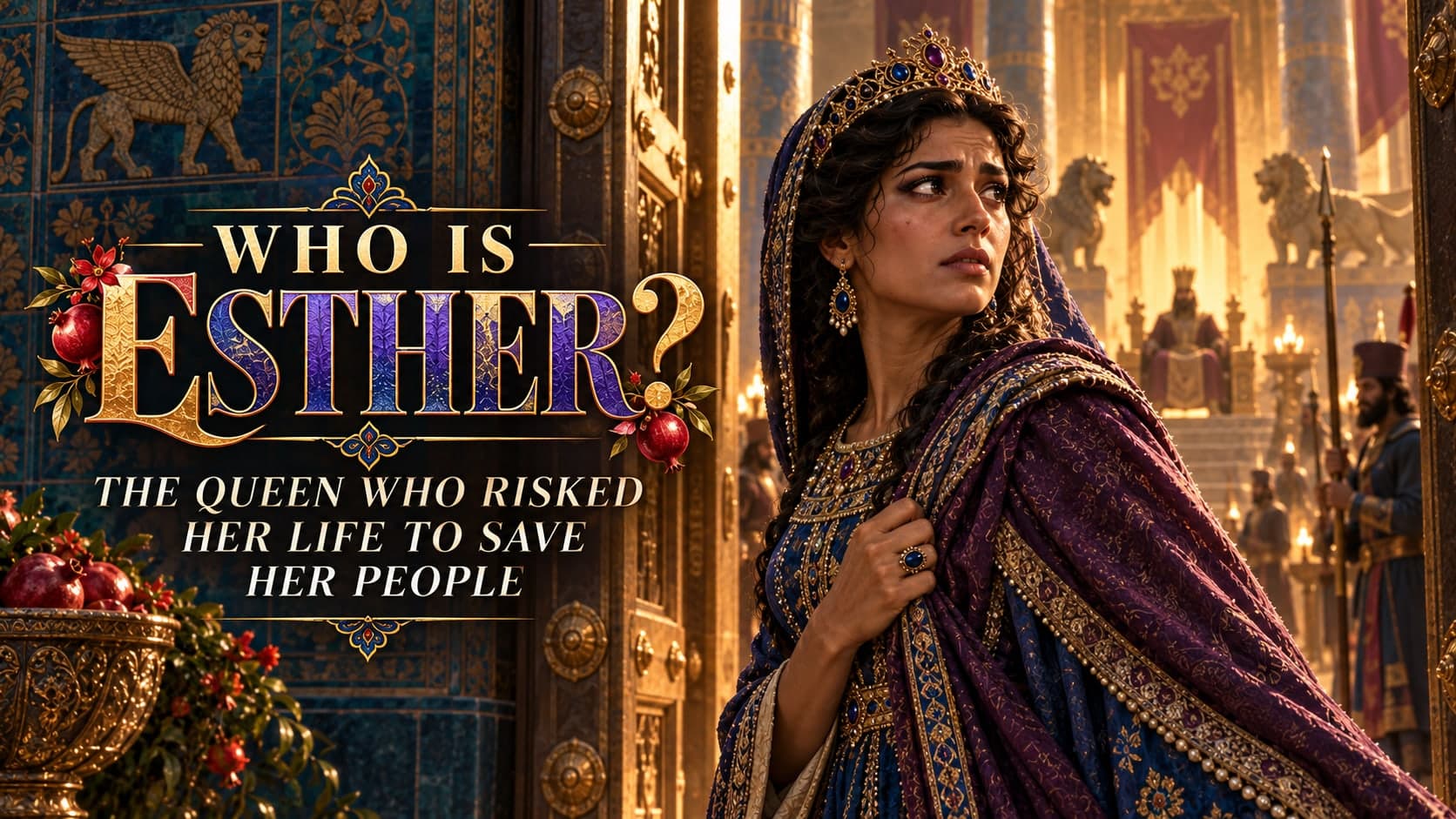
📖 Who Was Esther in the Bible? The Queen Who Risked Her Life to Save Her People
She was an orphan with no power and no family name that mattered.
She was taken from her home and placed inside a palace she never asked to enter.
She hid the one thing that made her who she was, the fact that she was Jewish.
📌 Then one day she had to choose between staying quiet and safe, or speaking up when speaking up could get her killed.
Maybe you know a smaller version of that fear.
The moment where doing the right thing could actually cost you something real.
A job. A friendship. Your place in a room full of people who do not know the real you. Most of us never have to risk our lives over it. Esther did.
An entire nation was marked for destruction, and one young queen was the only person in a position to say anything about it. Saying it might have ended her life on the spot.
This is the full story of Esther in the Bible, told in order, straight from the text. How an orphan girl became a queen. The enemy who plotted to wipe out her people. The cousin who told her plainly what was at stake. And the terrifying decision she made when staying silent was the easy road and speaking up was the only hope anyone had.
Let's start with who she was before any of that happened.
Who Esther Was
Esther was a Jewish orphan whose birth name was Hadassah, which means myrtle tree.
Esther was likely a Persian name given to her later, possibly connected to the word for star.
Her parents died while she was young, so her older cousin Mordecai raised her as his own daughter.
📌 They were living in Persia, far from Jerusalem, during a season called the exile. Years earlier the Babylonians had conquered Judah and carried the Jewish people away from their homeland. Persia later conquered Babylon, so by Esther's time her family had lived as foreigners in a foreign land for generations.
The king of Persia at that time was Ahasuerus, also known as Xerxes in history books outside the Bible. His kingdom stretched from India to Ethiopia, over a hundred and twenty seven provinces.
When the king needed a new queen, Esther was taken into his harem, a household of women kept for the king. She was eventually chosen and made queen of the whole empire.
💡 Her entire story is told in one book of the Bible, the book of Esther, just ten chapters long. It reads like a true account with a hidden hand behind every turn, because that is exactly what it is.
Now here is how her story actually unfolds.

Esther's Story
1. An Orphan Who Learned to Hide
Esther's story opens with loss.
"And he brought up Hadassah, that is, Esther, his uncle's daughter: for she had neither father nor mother, and the maid was fair and beautiful; whom Mordecai, when her father and mother were dead, took for his own daughter."
No father. No mother. No say in what happened to her.
📌 Esther started her story with nothing but a cousin who loved her enough to raise her as his own.
When King Ahasuerus removed his previous queen, his officials searched the empire for beautiful young women to bring to the palace. Esther was gathered up along with many others and brought into the king's house in the capital city of Shushan.
Mordecai gave her one instruction before she went in.
"Esther had not shewed her people nor her kindred: for Mordecai had charged her that she should not shew it."
Do not tell them you are Jewish.
⚠️ In a foreign palace, being part of a scattered, sometimes hated minority was not a safe thing to announce. Mordecai understood that better than anyone, and Esther obeyed him.
💡 Think about what that meant every single day. She could not fully be herself with anyone around her. She carried a secret inside the most watched building in the empire.
2. From the Harem to the Throne
Esther spent months going through beauty preparations before she was ever brought before the king. When her turn finally came, something happened that nobody could have planned.
"And the king loved Esther above all the women, and she obtained grace and favour in his sight more than all the virgins; so that he set the royal crown upon her head, and made her queen instead of Vashti."
An orphan girl with no family name was now wearing the royal crown of Persia.
📌 She had no power the day she walked into that palace. Now she had a crown, a husband who ruled most of the known world, and still, a secret she was not allowed to tell.
Not every woman who reaches a position of power uses it well. Compare Esther later to Jezebel, another queen who had far more freedom to speak and used it to destroy God's people rather than save them.
3. The Man Who Would Not Bow
Not long after Esther became queen, the king promoted a man named Haman above every other official in the kingdom.
"And all the king's servants, that were in the king's gate, bowed, and reverenced Haman: for the king had so commanded concerning him. But Mordecai bowed not, nor did him reverence."
Everyone bowed. Mordecai did not.
Scripture does not fully explain why. Mordecai was a Jew, and bowing to a man in that way may have felt like the kind of worship that belonged to God alone. Whatever the reason, he held his ground day after day while everyone around him watched.
"And when Haman saw that Mordecai bowed not, nor did him reverence, then was Haman full of wrath."
One man refused to bow, and Haman's anger did not stay small.
"And he thought scorn to lay hands on Mordecai alone; for they had shewed him the people of Mordecai: wherefore Haman sought to destroy all the Jews that were throughout the whole kingdom of Ahasuerus, even the people of Mordecai."
⚠️ Haman did not just want to punish one man. He decided an entire people should die because one of them would not bow to him.
❓ Notice how quickly one wounded ego turned into a plan for mass murder.
4. A Plan to Wipe Out a Whole People
Haman took his plan straight to the king, and he did not mention the real reason.
"And Haman said unto king Ahasuerus, There is a certain people scattered abroad and dispersed among the people in all the provinces of thy kingdom; and their laws are diverse from all people; neither keep they the king's laws: therefore it is not for the king's profit to suffer them."
"If it please the king, let it be written that they may be destroyed: and I will pay ten thousand talents of silver to the hands of those that have the charge of the business, to bring it into the king's treasuries."
⚠️ Haman offered to personally fund the murder of an entire nation, and the king agreed without asking who the people were.
Letters went out across the empire, in every language, sealed with the king's own ring.
"And the letters were sent by posts into all the king's provinces, to destroy, to kill, and to cause to perish, all Jews, both young and old, little children and women, in one day, even upon the thirteenth day of the twelfth month, which is the month Adar, and to take the spoil of them for a prey."
A date was set for the death of every Jewish man, woman, and child in the kingdom.
📌 Esther was Jewish. The queen of Persia was on the same death list as everyone else, and almost nobody in the palace knew it.
5. For Such a Time as This
Mordecai heard about the edict and tore his clothes in grief, a common way of showing deep sorrow in that culture. He sent word to Esther asking her to go to the king and beg for her people.
Esther sent back an answer. There was a law that anyone who approached the king without being called could be put to death, unless the king held out his golden scepter to spare them. She had not been called to him in thirty days.
Mordecai answered her plainly, and this is the heart of the whole book.
"Then Mordecai commanded to answer Esther, Think not with thyself that thou shalt escape in the king's house, more than all the Jews."
"For if thou altogether holdest thy peace at this time, then shall there enlargement and deliverance arise to the Jews from another place; but thou and thy father's house shall be destroyed: and who knoweth whether thou art come to the kingdom for such a time as this?"
Being queen would not protect her. Silence would not protect her.
📌 Who knoweth whether thou art come to the kingdom for such a time as this. Mordecai believed her whole life, including the parts that felt like an accident, had been leading to this exact moment.
❓ If you have ever wondered whether the strange path your life has taken actually has a purpose, this is the verse to sit with. If fear is what is holding you back from answering that call, it may help to read what the Bible says about fear before you go any further.
Esther asked Mordecai to gather the Jews in Shushan and fast for her three days. She would fast too. Then she gave her answer.
"Go, gather together all the Jews that are present in Shushan, and fast ye for me, and neither eat nor drink three days, night or day: I also and my maidens will fast likewise; and so will I go in unto the king, which is not according to the law: and if I perish, I perish."
✅ If I perish, I perish. She chose to act, knowing the cost could be her own life, and she chose it anyway.
That is not confidence that everything would turn out fine. That is courage in spite of the fear.
6. The Sceptre, the Banquet, and the Gallows
On the third day, Esther put on her royal robes and walked into the inner court, uninvited.
"And it was so, when the king saw Esther the queen standing in the court, that she obtained favour in his sight: and the king held out to Esther the golden sceptre that was in his hand. So Esther drew near, and touched the top of the sceptre."
✅ The king held out the golden sceptre. Her life was spared the moment she walked in.
Rather than making her request right away, Esther invited the king and Haman to a private banquet, and then to a second banquet the next day.
Haman left that first banquet feeling like the most important man in the empire.
"Then went Haman forth that day joyful and with a glad heart: but when Haman saw Mordecai in the king's gate, that he stood not up, nor moved for him, he was full of indignation against Mordecai."
One man refusing to bow was still ruining Haman's good mood.
He bragged to his wife and friends about his wealth, his sons, and his closeness to the king and queen. Then he admitted the one thing that ate at him.
"Yet all this availeth me nothing, so long as I see Mordecai the Jew sitting at the king's gate."
His wife Zeresh and his friends had a solution ready.
"Then said Zeresh his wife and all his friends unto him, Let a gallows be made of fifty cubits high, and to morrow speak thou unto the king that Mordecai may be hanged thereon: then go thou in merrily with the king unto the banquet. And the thing pleased Haman; and he caused the gallows to be made."
⚠️ Haman built a gallows fifty cubits high, about seventy five feet, to hang the one man who would not bow to him.
He went to bed satisfied. He had no idea what the next twenty four hours held.
7. The Second Banquet, Haman's Fall, and a Feast Called Purim
That same night, the king could not sleep.
"On that night could not the king sleep, and he commanded to bring the book of records of the chronicles; and they were read before the king."
💡 Out of every night in the story, the king lost sleep on this one. The records that were read to him happened to include the time Mordecai uncovered a plot to assassinate the king, a good deed that had never been rewarded.
The next morning, the king asked Haman a question, without saying who he meant.
"So Haman came in. And the king said unto him, What shall be done unto the man whom the king delighteth to honour? Now Haman thought in his heart, To whom would the king delight to do honour more than to myself?"
Haman assumed the honor was for himself and described an elaborate parade through the city.
"Then the king said to Haman, Make haste, and take the apparel and the horse, as thou hast said, and do even so to Mordecai the Jew, that sitteth at the king's gate: let nothing fail of all that thou hast spoken."
⚠️ Haman had to personally dress Mordecai in royal robes and lead him through the streets, announcing his honor to the whole city.
The gallows he had built for Mordecai was still standing when he went to Esther's second banquet that evening. That is when Esther finally made her request.
"For we are sold, I and my people, to be destroyed, to be slain, and to perish. But if we had been sold for bondmen and bondwomen, I had held my tongue, although the enemy could not countervail the king's damage."
The king demanded to know who would dare do such a thing. Esther pointed at the man sitting right beside him.
"And Esther said, The adversary and enemy is this wicked Haman. Then Haman was afraid before the king and the queen."
📌 The queen who had hidden her identity for years finally said it out loud, in front of the two most powerful men in the empire, at the exact moment it mattered most.
"So they hanged Haman on the gallows that he had prepared for Mordecai. Then was the king's wrath pacified."
⚠️ Haman died on the very gallows he built for the man he hated.
There was still a problem. A law signed with the king's ring could not simply be canceled once it was sent out. So the king let Mordecai and Esther write a new decree giving the Jews the right to defend themselves on the day they were meant to be destroyed. When that day came, the Jews survived, and their enemies did not prevail against them.
The Jewish people turned their sorrow into a yearly celebration called Purim, still kept by Jewish families today.
"As the days wherein the Jews rested from their enemies, and the month which was turned unto them from sorrow to joy, and from mourning into a good day: that they should make them days of feasting and joy, and of sending portions one to another, and gifts to the poor."
💡 Here is something worth pausing on. The book of Esther never once mentions the name of God directly. Not one time in ten chapters.
📌 And yet everything in the story lines up too perfectly to be an accident. An orphan happens to become queen right before her people need her. A king happens to lose sleep on the one night it mattered. A forgotten good deed happens to be read aloud at the exact right moment.
✅ God is never named in this book, and He is present on every single page. That is a lesson worth carrying into your own life, especially on the days when you cannot see Him working at all.

Lessons From Esther's Life
1. God works even when He is not mentioned
Esther is the only book in the Bible that never names God directly.
Every detail still lines up like pieces of a plan.
💡 Just because you cannot see God's name on a situation does not mean His hand is not on it.
2. Your position might exist for a reason bigger than you
Esther did not seek out the crown. It was placed on her through circumstances she never chose.
📌 The place you are standing right now, the job, the family, the community, might not be random either.
3. Courage is not the absence of fear
Esther fasted for three days before she acted. She was clearly terrified.
She went in anyway, saying if I perish, I perish.
⚠️ Waiting for fear to disappear before you obey is a wait that may never end.
4. Doing right rarely feels convenient
Esther could have stayed quiet and probably survived, at least for a while.
Speaking up cost her comfort, safety, and possibly her life.
She did it anyway because staying silent had a cost too, even if it was less visible.
5. Pride and cruelty tend to build their own downfall
Haman built a gallows for a man who had done him no wrong.
He died on it himself.
📌 Scripture keeps showing this pattern. Evil plans have a way of turning back on the person who made them.
Key Verses From Esther's Story
1. Esther 4:14
"For if thou altogether holdest thy peace at this time, then shall there enlargement and deliverance arise to the Jews from another place; but thou and thy father's house shall be destroyed: and who knoweth whether thou art come to the kingdom for such a time as this?"
The most famous line in the whole book.
Mordecai told Esther plainly that her position was not just for her own comfort.
📌 Your current season may be preparing you for something you cannot see yet.
2. Esther 4:16
"Go, gather together all the Jews that are present in Shushan, and fast ye for me, and neither eat nor drink three days, night or day: I also and my maidens will fast likewise; and so will I go in unto the king, which is not according to the law: and if I perish, I perish."
Four words carry the weight of the whole decision. If I perish, I perish.
She did not know how the story would end. She acted anyway.
💡 Real courage is doing the right thing without a guarantee of the outcome.
3. Esther 2:17
"And the king loved Esther above all the women, and she obtained grace and favour in his sight more than all the virgins; so that he set the royal crown upon her head, and made her queen instead of Vashti."
An orphan with no name became queen of the largest empire on earth.
📌 God can lift up the overlooked person in ways nobody in the room would have predicted.
4. Esther 7:6
"And Esther said, The adversary and enemy is this wicked Haman. Then Haman was afraid before the king and the queen."
The moment years of hiding turned into one sentence of truth.
💡 Truth spoken at the right time can undo damage that has been building for years.
5. Esther 9:22
"As the days wherein the Jews rested from their enemies, and the month which was turned unto them from sorrow to joy, and from mourning into a good day: that they should make them days of feasting and joy, and of sending portions one to another, and gifts to the poor."
Sorrow turned into joy. Mourning turned into a good day.
✅ That turn did not happen by accident, and it is a pattern God repeats far beyond this one story.

Frequently Asked Questions About Esther
Was Esther a real person?
The book of Esther presents her as a real historical queen of Persia, married to king Ahasuerus, who is widely identified with the historical king Xerxes the first. The book reads as detailed history, naming real places, real customs, and a specific timeline, rather than as a symbolic story.
Why doesn't the book of Esther mention God?
Scripture never explains why. God's name simply never appears in the text, which makes Esther unique among the books of the Bible. What the book does show, again and again, is a series of events that only make sense if someone unseen is arranging them. Many readers see that as the whole point. God does not need His name printed on a page to be at work in it.
What does for such a time as this mean?
It is Mordecai's question to Esther in chapter four, asking whether her rise to become queen happened specifically so she would be positioned to save her people in this crisis. It has become a phrase people use to describe a moment when their circumstances, skills, or position suddenly line up with a need only they can meet.
What happened to Haman?
Haman built a gallows to execute Mordecai, the man who would not bow to him. After Esther exposed his plan to destroy the Jews at her second banquet, the king ordered Haman hanged on that same gallows. His plan against Mordecai ended up killing him instead.
Was Esther's real name Hadassah?
Yes. Hadassah was her Hebrew name and it means myrtle tree. Esther appears to be a name she took, or was given, once she entered the Persian court, possibly connected to the Persian word for star.
Who was Ahasuerus, and is he the same as Xerxes?
Ahasuerus was the king of Persia who made Esther his queen. Most historians identify him with Xerxes the first, who ruled Persia in the fifth century before Christ over a vast empire reaching from India to Ethiopia.
Why did Mordecai refuse to bow to Haman?
The text does not state his exact reason. He was a Jew, and the kind of bowing being demanded may have felt like the kind of honor reserved for God alone. Whatever his reasons, his refusal is what set Haman's entire plot against the Jewish people in motion.
What is Purim and why does it matter?
Purim is the yearly Jewish celebration established at the end of the book of Esther, marking the day the Jewish people were saved from destruction. It is still celebrated today with feasting, gifts, and readings of the book of Esther, keeping the memory of that rescue alive across generations.
Was it wrong for Esther to hide that she was Jewish?
Scripture does not condemn her for it. Mordecai instructed her to keep it hidden, likely out of concern for her safety in a foreign court. When the moment finally came that required the truth, she told it, at real risk to herself. Her silence was not permanent, and it was not cowardice. It was timing.
Did Esther choose to enter the king's harem?
The text does not describe her as volunteering. Officials gathered young women from across the empire, and Esther was among those brought in. Once there, she had little control over what came next, which makes her later boldness even more remarkable.
What can we learn from Esther today?
That God can place ordinary people in unlikely positions on purpose. That courage often looks like acting while still afraid, not waiting for fear to leave first. And that even when His name never appears on the page of your circumstances, He may be arranging every detail of them anyway.
Final Thoughts
Esther did not choose the danger she found herself in.
She chose how to respond to it.
📌 God can place you exactly where you are for a reason you may not see yet.
📌 Courage does not mean the fear is gone. It means you act while it is still there.
📌 God does not need His name on the page to be working through every detail of your story.
She risked everything for people who might never know her name. In the end, her name is the one still remembered, thousands of years later.
Read the book of Esther for yourself this week, all ten chapters, from beginning to end. If you want help building a habit of reading Scripture like that regularly, start with how to read the Bible. Then ask yourself the question Mordecai asked her. Who knows whether you have come to this exact place, at this exact time, for a reason bigger than yourself.