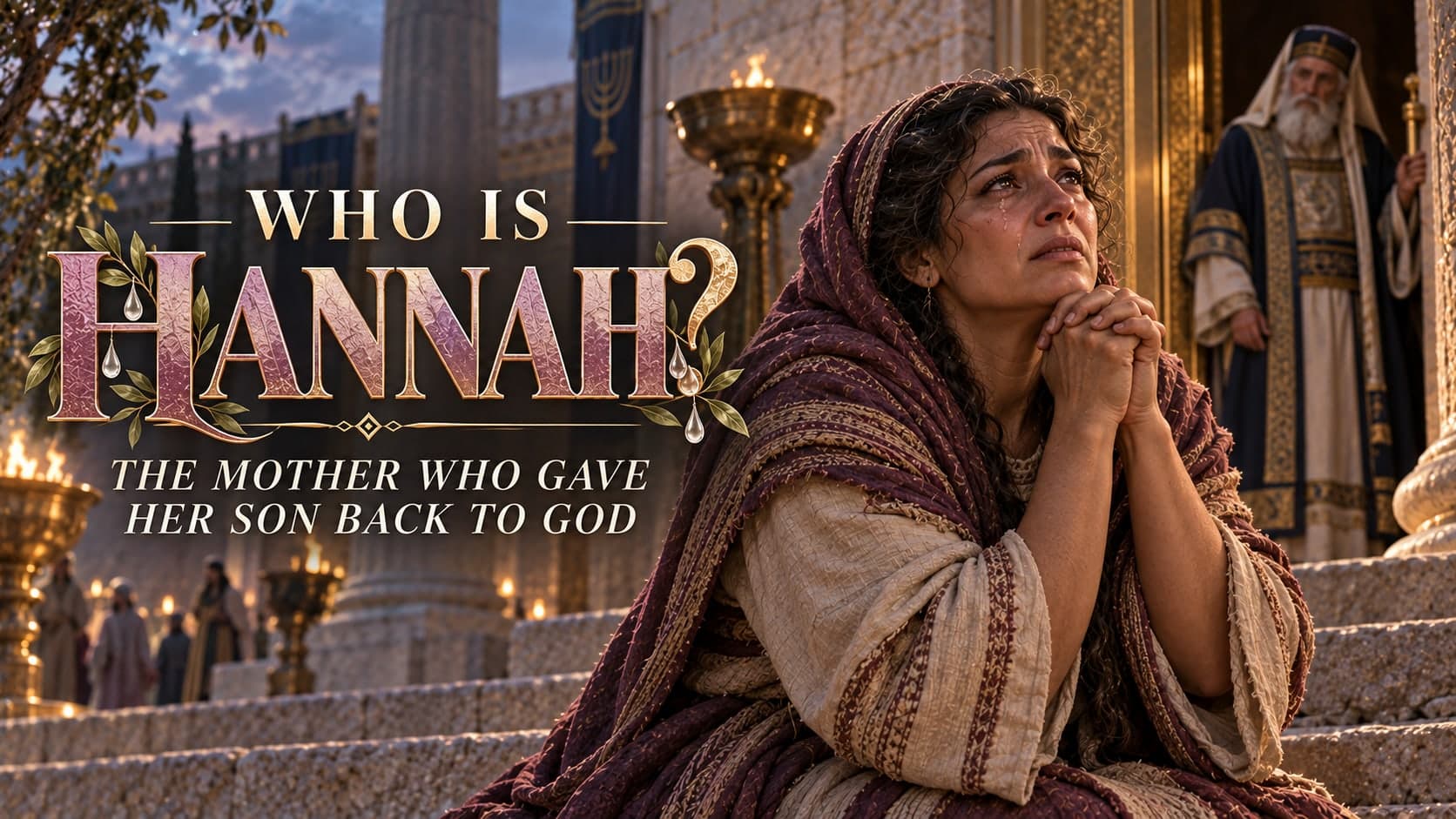
📖 Who Was Hannah in the Bible? The Mother Who Gave Her Son Back to God
Year after year, nothing changed.
No baby. No answer. Just the same ache, showing up again every single year.
And every year, the other wife made sure Hannah felt it.
📌 Hannah lived for years wanting one thing God had not given her, while someone in her own house mocked her for not having it.
Maybe you know a version of that wait.
A prayer you have prayed so many times you have lost count.
A door that stays shut no matter how hard you knock.
A person nearby who somehow always knows exactly where it hurts.
Hannah cried so hard one day that a priest thought she was drunk.
That is how much this wait cost her.
And then, in one of the strangest and most beautiful turns in the whole Bible, the moment God finally answered her, she turned around and gave the answer away.
This is the full story of Hannah, told in order, straight from 1 Samuel. Her pain, her prayer, her promise, and the son she loved enough to let go.
Who Hannah Was
Hannah was one of two wives married to a man named Elkanah.
Elkanah was an Ephraimite, a man from the tribe of Ephraim, living in the hill country of Israel.
His other wife was named Peninnah.
📌 Peninnah had children. Hannah had none. That one fact sits at the center of everything that happens next.
Having two wives at once was allowed under the culture of the time, but it was rarely peaceful.
This household was no exception.
Her story is told in 1 Samuel 1 and 2, right at the very start of the book of 1 Samuel.
💡 That placement matters. This happens right before Israel asks for its first king, and Hannah's son Samuel is the prophet who will anoint that king.
Now here is how her story actually unfolds.

Hannah's Story
1. Provoked Every Single Year
Every year, Elkanah traveled to a place called Shiloh to worship and offer a sacrifice to God.
Shiloh was where the tabernacle stood at that time, the tent where Israel worshipped before there was a temple.
The whole family went. And every year, the same thing happened.
"And he had two wives; the name of the one was Hannah, and the name of the other Peninnah: and Peninnah had children, but Hannah had no children."
Elkanah gave portions of the sacrifice to Peninnah and all her children.
He gave Hannah a worthy portion too, because he loved her. But the Bible is honest about the real problem underneath.
"And her adversary also provoked her sore, for to make her fret, because the LORD had shut up her womb. And as he did so year by year, when she went up to the house of the LORD, so she provoked her; therefore she wept, and did not eat."
⚠️ Peninnah did not mock Hannah once. She did it year by year, on purpose, at the one trip that was supposed to be about worship.
Notice the phrase the LORD had shut up her womb.
Scripture does not pretend Hannah's pain came from nowhere.
It says plainly that this was something God had allowed, which makes the story harder, not easier.
❓ Have you ever hurt over something and had someone close to you make it worse instead of better?
That was Hannah's reality, year after year, with no relief in sight.
2. Am Not I Better to Thee Than Ten Sons
One year, the weeping got so bad that Hannah stopped eating altogether.
Her husband noticed and tried to comfort her, in the only way he knew how.
"Then said Elkanah her husband to her, Hannah, why weepest thou? and why eatest thou not? and why is thy heart grieved? am not I better to thee than ten sons?"
Elkanah's question is tender, but it also misses the point completely.
💡 He was not wrong that he loved her. He was wrong to think his love could fill a hole that only God could fill.
Sometimes the people who love us most cannot fix the specific thing we are grieving.
Hannah did not argue with him. She did something better. She went to God with it directly.
3. A Vow Made in Bitterness of Soul
After the meal, Hannah got up and went to the tabernacle at Shiloh to pray.
Eli the priest was sitting nearby, by a post of the temple of the LORD.
Scripture describes exactly what condition Hannah was in when she prayed.
"And she was in bitterness of soul, and prayed unto the LORD, and wept sore."
Then she made a vow, a serious promise to God, tied to the one thing she wanted most.
"And she vowed a vow, and said, O LORD of hosts, if thou wilt indeed look on the affliction of thine handmaid, and remember me, and not forget thine handmaid, but wilt give unto thine handmaid a man child, then I will give him unto the LORD all the days of his life, and there shall no razor come upon his head."
📌 Hannah did not just ask for a son. She promised, in advance, to give that son back.
The part about no razor coming upon his head meant he would be a Nazarite, a person set apart for God's service in a special way, for his whole life.
This is not a small prayer bargain. This is a woman promising to hand over the very thing she is begging God for, before she even has it. Her prayer looks nothing like the way Eve reached for something God had not given her in the garden. Hannah asked and waited on God's answer instead of taking matters into her own hands.
4. Mistaken for Drunk
Hannah kept praying, but no sound came out.
"And it came to pass, as she continued praying before the LORD, that Eli marked her mouth. Now Hannah, she spake in her heart; only her lips moved, but her voice was not heard: therefore Eli thought she had been drunken."
Eli, the priest watching her, jumped to the wrong conclusion and told her to put away her wine.
⚠️ The man in charge of worship at Shiloh looked at a woman pouring her heart out to God and assumed the worst.
Hannah did not get angry. She simply told him the truth.
"And Hannah answered and said, No, my lord, I am a woman of a sorrowful spirit: I have drunk neither wine nor strong drink, but have poured out my soul before the LORD."
💡 I have poured out my soul before the LORD. That phrase describes prayer that holds nothing back. No polished words. No performance. Just the whole truth, given to God.
❓ When was the last time you prayed like that, with nothing held back?
5. Go in Peace
Once Eli understood, his tone changed completely.
"Then Eli answered and said, Go in peace: and the God of Israel grant thee thy petition that thou hast asked of him."
Nothing had actually changed yet. Hannah still had no child. Her circumstances were exactly the same as they had been an hour earlier.
"And she said, Let thine handmaid find grace in thy sight. So the woman went her way, and did eat, and her countenance was no more sad."
✅ Her countenance was no more sad. She left that prayer with peace before she had the answer.
💡 Sometimes the peace comes before the promise. Hannah trusted God with the outcome the moment she finished praying, not months later when the baby finally arrived.
6. The Son She Asked For
Some time later, Hannah conceived and had a son.
"Wherefore it came to pass, when the time was come about after Hannah had conceived, that she bare a son, and called his name Samuel, saying, Because I have asked him of the LORD."
The name Samuel sounds like the Hebrew phrase for asked of God, or heard by God.
📌 Every time anyone said his name for the rest of his life, it retold the story of Hannah's prayer.
Years of provoking, weeping, and being misunderstood ended with one small boy whose very name was a testimony.
7. For This Child I Prayed
Hannah did not go up to Shiloh with Elkanah the next year. She waited until Samuel was weaned, which in that culture often meant he was two or three years old.
Then she brought him herself, along with an offering, and kept the promise she had made years earlier.
"For this child I prayed; and the LORD hath given me my petition which I asked of him: Therefore also I have lent him to the LORD; as long as he liveth he shall be lent to the LORD."
⚠️ Hannah waited years for this child, and then gave him away to live at the tabernacle, to serve there for the rest of his life.
Think about what that actually meant. She would not raise him day to day. She would see him once a year, at the yearly sacrifice.
💡 A prayer that costs God nothing is easy to pray. Hannah's vow cost her the very thing she prayed for.
8. A Prayer of Praise
Right after she left Samuel at Shiloh, Hannah prayed again. This time it was not a request. It was praise.
"And Hannah prayed, and said, My heart rejoiceth in the LORD, mine horn is exalted in the LORD: my mouth is enlarged over mine enemies; because I rejoice in thy salvation. There is none holy as the LORD: for there is none beside thee: neither is there any rock like our God."
Notice she mentions her enemies. That is Peninnah, and years of being provoked, finally spoken of out loud and settled.
📌 Hannah did not just get a son back from God. She got her whole story back from the people who had mocked her for years.
Her prayer goes on to describe a God who lifts up the poor and the needy, who brings down the proud, and who gives strength to His people. It is one of the most beautiful prayers in the whole Old Testament, and centuries later Mary's own song of praise in Luke echoes it closely.
9. A Little Coat, Made Every Year
Hannah did not disappear from Samuel's life after she left him at Shiloh. She kept showing up, once a year, with something she made herself.
"Moreover his mother made him a little coat, and brought it to him from year to year, when she came up with her husband to offer the yearly sacrifice."
💡 Giving Samuel to God did not mean Hannah stopped being his mother. She just loved him from a different distance, one handmade coat at a time.
Picture her sewing that coat all year, thinking of him the whole time, then walking the long road back to Shiloh to hand it to him herself.
That is not a woman who gave up on her son. That is a woman who kept loving him inside the promise she made.
10. Five More Children
Eli blessed Elkanah and Hannah every year, asking God to give them more children because of the one they had lent to the LORD. God answered that blessing too.
"And the LORD visited Hannah, so that she conceived, and bare three sons and two daughters. And the child Samuel grew before the LORD."
✅ The woman who once had no children ended up with six.
Meanwhile Samuel grew up at the tabernacle and became one of the most important prophets in the entire Bible. He would go on to anoint both Saul and David as kings over Israel, which you can trace further in the story of Moses and the line of leaders God raised up for His people.
Years of weeping ended in a house full of children and a son who helped shape the whole nation.

Lessons From Hannah's Life
1. God hears the prayers nobody else can hear
Hannah's most important prayer made no sound at all.
Eli could not understand it, but God did.
📌 A silent prayer reaches God exactly as well as a loud one.
2. Other people cannot fill the gap only God can fill
Elkanah loved Hannah deeply, and it still was not enough to end her grief.
Some longings are between you and God alone.
3. Being misunderstood does not mean you are wrong
Eli assumed the worst about Hannah at the exact moment she was pouring out her heart to God.
⚠️ People will sometimes misread your pain. That does not make your prayer any less real.
4. Peace can arrive before the answer does
Hannah's sadness lifted before she had a baby in her arms.
She trusted God with the outcome the moment she handed Him the request.
5. What you love most is safest in God's hands
Hannah gave away the son she waited years for, and God gave her five more children and a prophet who shaped a nation.
📌 Holding something loosely for God is never the same as losing it.
6. Praise can come out of the hardest years of your life
Hannah's prayer of praise in 1 Samuel 2 came right after the hardest goodbye of her life.
💡 The deepest praise often grows out of the deepest waiting.
Key Verses From Hannah's Story
1. 1 Samuel 1:11
"And she vowed a vow, and said, O LORD of hosts, if thou wilt indeed look on the affliction of thine handmaid, and remember me, and not forget thine handmaid, but wilt give unto thine handmaid a man child, then I will give him unto the LORD all the days of his life, and there shall no razor come upon his head."
The vow that shapes everything after it.
Hannah promised to give away her answer before she even had it.
📌 Few prayers in the Bible cost the one praying it more than this one.
2. 1 Samuel 1:15
"And Hannah answered and said, No, my lord, I am a woman of a sorrowful spirit: I have drunk neither wine nor strong drink, but have poured out my soul before the LORD."
One of the clearest descriptions of honest prayer anywhere in Scripture.
💡 Pouring out your soul means holding nothing back from God.
3. 1 Samuel 1:27
"For this child I prayed; and the LORD hath given me my petition which I asked of him:"
Hannah is standing in front of Eli, at the moment of the actual goodbye, and this is what she says.
📌 Not regret. Gratitude, spoken while she was actively giving her son away.
4. 1 Samuel 2:1
"And Hannah prayed, and said, My heart rejoiceth in the LORD, mine horn is exalted in the LORD: my mouth is enlarged over mine enemies; because I rejoice in thy salvation."
The turn from years of tears into open praise.
💡 This prayer became the pattern for Mary's own song of praise generations later.
5. Psalm 113:9
"He maketh the barren woman to keep house, and to be a joyful mother of children. Praise ye the LORD."
Written generations after Hannah, but it could have been written about her directly.
✅ God still does this today. He is not finished making barren places joyful.
Frequently Asked Questions About Hannah
Was Hannah a real person?
Yes. Hannah appears in 1 Samuel 1 and 2 as a real woman, married to a real man named Elkanah, living in a specific place in Israel before the nation had its first king. Her story is treated as history, not legend, and it opens the book that introduces Israel's monarchy.
Why did Peninnah provoke Hannah?
Scripture does not explain Peninnah's motive directly. It simply says she provoked Hannah sore, to make her fret, year after year, because Hannah had no children. In that culture, having children gave a wife status and security, so Peninnah may have used the one advantage she had over Hannah to hurt her.
Why did Eli think Hannah was drunk?
Hannah was praying silently, moving her lips without making a sound, which was unusual for that time. Eli saw her mouth moving with no words coming out and assumed she was drunk. Once she explained she was pouring out her soul before the LORD, he blessed her instead.
What did Hannah promise God?
She vowed that if God gave her a son, she would give him back to the LORD for his whole life, and no razor would ever touch his head. That made him a Nazarite, someone set apart for God's service in a special way. She kept that promise as soon as her son was weaned.
What does the name Samuel mean?
Hannah explained it herself. She named him Samuel because, in her words, she had asked him of the LORD. The name is closely tied to the Hebrew words for asked and heard, so every time his name was spoken, it pointed back to her prayer.
How old was Samuel when Hannah gave him to Eli?
The Bible does not give an exact age. It says she waited until he was weaned, which in that culture was often somewhere around two or three years old. She then brought him to Shiloh herself and left him there to serve at the tabernacle.
Did Hannah have more children after Samuel?
Yes. After she gave Samuel to the LORD, the LORD visited Hannah, and she went on to have three more sons and two daughters, six children in all from a woman who once had none.
What is Hannah's prayer in 1 Samuel 2?
It is a prayer of praise Hannah spoke after leaving Samuel at Shiloh, celebrating God's holiness and His habit of lifting up the poor and the humble. Centuries later, Mary's song of praise in the New Testament, sometimes called the Magnificat, echoes its themes and language closely.
Did Hannah ever see Samuel again after leaving him at Shiloh?
Yes. The family still traveled to Shiloh every year for the yearly sacrifice, and each year Hannah brought Samuel a little coat she had made for him. She did not raise him day to day anymore, but she stayed present in his life.
What can we learn from Hannah's life?
That God hears honest prayer, even the kind nobody else can understand. That He is near to people who wait years for an answer. And that giving God what you love most is never the same as losing it, because Hannah's obedience led to more, not less.
Final Thoughts
Hannah waited years for one answer, and got mocked for the wait along the way.
📌 God heard her silent, honest prayer, even when the priest in the room did not understand it.
📌 The moment her answer finally came, she gave it back to God, and He gave her even more in return.
📌 Her waiting ended in a prayer of praise that still echoes through Scripture, all the way to Mary's own song about Jesus.
If you are in a wait right now, Hannah's story is not a promise that your timeline will match hers.
It is a promise that your honest prayers reach God, even the ones nobody else can hear.
Read 1 Samuel 1 and 2 this week, slowly, and let her prayer of praise be your own. If anxiety keeps creeping into your own wait, what the Bible says about anxiety is a good next stop.