📖 Who Was Judas? How Close You Can Get and Still Miss It
You can sit in church every week and still feel far from God.
You can serve on the team, lead the small group, pray out loud, and still feel it.
That quiet gap between looking close to Jesus and actually belonging to Him.
📌 Who was Judas? He was a man who had more access to Jesus than almost anyone who has ever lived, and he still missed Him completely.
Three years on the road with Jesus.
Front row for every miracle. Sent out to preach. Trusted with the money.
And in the end, none of it was enough.
Most people only know him as a villain in a story, the man who sold Jesus for thirty coins. That picture is too small and too easy. It lets you close the book and tell yourself you would never do what he did.
But he was not a stranger who wandered in off the street to do evil. He was a friend. He was inside the circle. That is exactly what makes his story worth facing honestly instead of filing it away as ancient history.
This is the full story of Judas Iscariot, walked through in order, straight from the text. Who he was. What actually happened, step by step. And the uncomfortable question underneath it all.
Let's look at who he really was.
Who Judas Was
Judas Iscariot was one of the twelve men Jesus personally chose as apostles.
Scripture names him plainly in the list of the twelve, right alongside the others Jesus handpicked.
"Simon the Canaanite, and Judas Iscariot, who also betrayed him."
Notice that detail. Even in the list of the twelve, his name already carries the ending.
His father was named Simon (John 6:71).
Most scholars believe the name Iscariot points to Kerioth, a town in Judah. If that is right, Judas was likely the only Judean among the twelve. The rest were from Galilee, a different region entirely.
💡 He may have stood out from the start. Not as the villain. Just as the man who did not quite fit in with the group.
He was trusted enough that the group made him their treasurer.
He carried the bag. He handled the money for Jesus and the twelve.
Think about what that trust meant in practice. The group needed food, lodging, and gifts for the poor as they travelled. Jesus put that responsibility in Judas' hands, which tells you plainly that nobody around him suspected a thing for a very long time.
📌 His story runs through all four Gospels and into the first chapter of Acts.
Now here is how it actually went.

The Life of Judas
1. Chosen Like Everyone Else
Start here, because it matters more than people realize.
Jesus did not quietly keep Judas at arm's length, waiting for him to fail.
He sent him out with the other eleven. Same commission. Same power.
Jesus gave the twelve authority over unclean spirits and power to heal every disease.
Judas got that same authority. He preached the same message the others preached.
💡 There was no warning label on him. Nobody in that room looked at Judas and thought, that one is different. That one will not make it.
He looked exactly like a disciple, because for a long time, he acted like one.
He walked through towns casting out demons in Jesus' name, the same as Peter did.
He laid hands on the sick and watched them get up healed, the same as John did.
He listened to the same parables, ate at the same fires, slept under the same stars.
That should unsettle you a little. It is supposed to.
2. Trusted With the Money
The first crack in the text does not show up at the betrayal.
It shows up months earlier, in a quiet moment nobody else seemed to catch.
A woman named Mary poured expensive ointment on Jesus' feet. Judas objected, and he made it sound spiritual.
"Then saith one of his disciples, Judas Iscariot, Simon's son, which should betray him, Why was not this ointment sold for three hundred pence, and given to the poor?"
On the surface, that sounds reasonable. Even kind.
John will not let you leave it there. He tells you exactly what was underneath it.
"This he said, not that he cared for the poor; but because he was a thief, and had the bag, and bare what was put therein."
⚠️ He was already stealing from the money bag, long before the chief priests ever offered him a coin.
Nobody around him seemed to know it yet.
That is how most big falls actually work. The betrayal in the garden did not start in the garden. It started in a small, private, repeated compromise that nobody else could see. Getting serious about building self control in the small, unseen choices is not a minor side issue. It is the whole battle.
3. The Deal With the Chief Priests
Luke tells us what actually moved first, before Judas ever took a step.
"Then entered Satan into Judas surnamed Iscariot, being of the number of the twelve. And he went his way, and communed with the chief priests and captains, how he might betray him unto them."
Matthew gives us the plain terms of the deal.
"Then one of the twelve, called Judas Iscariot, went unto the chief priests, And said unto them, What will ye give me, and I will deliver him unto you? And they covenanted with him for thirty pieces of silver."
Thirty pieces of silver was the price the law set for a slave, not for a king (Exodus 21:32).
Judas did not haggle for more. He asked what they would give, and he took it.
The chief priests had already decided Jesus had to die (John 11:47 through 53). They just had no quiet way to arrest Him without a crowd gathering. Judas solved that problem for them, and he did it for free, almost as an afterthought to the money.
📌 From that point on, he was not waiting for a chance to betray Jesus. He was hunting for one.
"And from that time he sought opportunity to betray him."
⚠️ A heart does not turn on God in a single moment, even when it looks that way from the outside. The stealing, the small lies, the quiet resentment, they build a doorway. Satan just walked through the one Judas had already left open. It is the same pattern Scripture shows in Jezebel's story, a heart drifting long before anyone else notices.

4. The Last Supper and the Sop
At the table, Jesus already knew.
He quoted an old Psalm about betrayal from inside the circle of trust: "he that eateth bread with me hath lifted up his heel against me" (Psalm 41:9, John 13:18).
Then He said it plainly to the room.
"And as they did eat, he said, Verily I say unto you, that one of you shall betray me."
Every single one of them, sorrowful, asked the same question. Not pointing fingers. Asking about themselves.
"And they were exceeding sorrowful, and began every one of them to say unto him, Lord, is it I?"
💡 That question should be yours too, every time you read this story. Not Judas, is it he. Lord, is it I?
John shows us the quiet, almost tender way Jesus answered it. He gave Judas a sop, a piece of bread dipped in the dish, the kind of gesture a host gave to a guest of honor.
"Jesus answered, He it is, to whom I shall give a sop, when I have dipped it. And when he had dipped the sop, he gave it to Judas Iscariot, the son of Simon."
✅ Think about what that means. Jesus singled Judas out with an act of honor, at the exact moment He knew what Judas had already agreed to do.
Mercy, offered straight into the middle of betrayal. And Judas took the bread anyway.
"And after the sop Satan entered into him. Then said Jesus unto him, That thou doest, do quickly."
Jesus did not beg him to stay. He did not need to.
Judas had already made his choice. Jesus simply released him to go do what he had decided to do.
"He then having received the sop went immediately out: and it was night."
⚠️ Night, in more than one sense. He walked out of the light of that table into the dark, and he did it on his own two feet.
5. The Kiss in the Garden
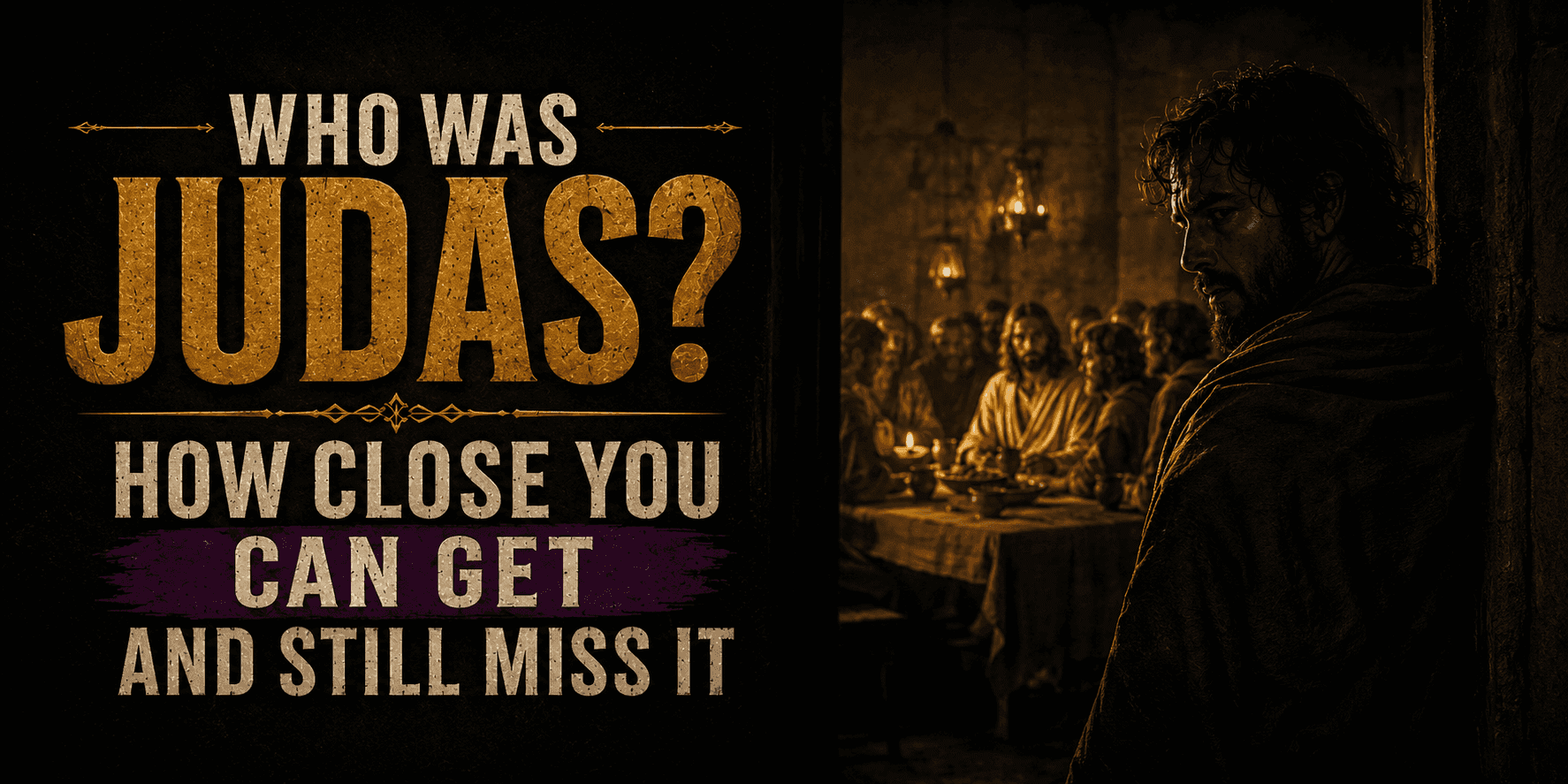
Judas led the arresting party straight to Jesus, in a garden he knew well.
He had a sign ready for the soldiers, so there would be no confusion in the dark.
"Now he that betrayed him gave them a sign, saying, Whomsoever I shall kiss, that same is he: hold him fast."
A kiss on the cheek, from a student to a teacher, was an ordinary sign of respect.
Judas turned it into the signal for an arrest.
"And forthwith he came to Jesus, and said, Hail, master; and kissed him."
Luke records Jesus naming exactly what was happening, by name, out loud.
"But Jesus said unto him, Judas, betrayest thou the Son of man with a kiss?"
And then, astonishingly, this.
"And Jesus said unto him, Friend, wherefore art thou come? Then came they, and laid hands on Jesus, and took him."
📌 Friend. That is the word Jesus used, at the exact second the kiss landed on His face.
Not enemy. Not traitor. Friend. The door was still open, right up to the very last possible second.

6. Remorse, Not Repentance
Once Jesus was condemned, something broke open in Judas. He could not carry what he had done.
"Then Judas, which had betrayed him, when he saw that he was condemned, repented himself, and brought again the thirty pieces of silver to the chief priests and elders, Saying, I have sinned in that I have betrayed the innocent blood."
He said the true words. "I have sinned." He even named Jesus correctly, "innocent blood." That is not nothing.
The priests did not care.
"And they said, What is that to us? see thou to that."
Judas had nowhere left to carry the weight. So he put it down the only way he knew.
"And he cast down the pieces of silver in the temple, and departed, and went and hanged himself."
Acts fills in the grim end of that field.
"Now this man purchased a field with the reward of iniquity; and falling headlong, he burst asunder in the midst, and all his bowels gushed out. And it was known unto all the dwellers at Jerusalem; insomuch as that field is called in their proper tongue, Aceldama, that is to say, The field of blood."
⚠️ Here is the piece of this story people miss most: Judas felt real sorrow, and it still destroyed him.
Sorrow over sin is not the same thing as turning back to Christ. Feeling terrible is not the same as repenting. One leads to a changed life. The other, left alone, can lead to despair. Scripture is honest about exactly what real repentance looks like, and Judas never got there.
Compare him to Peter, in the very same week.
Peter denied Jesus three times, to His face, out of fear.
"And the Lord turned, and looked upon Peter. And Peter remembered the word of the Lord, how he had said unto him, Before the cock crow, thou shalt deny me thrice. And Peter went out, and wept bitterly."
Peter wept bitterly too. Both men broke down. Both men had betrayed Jesus, in their own way.
💡 The difference was not the size of the sin. It was where each man took his sorrow. Peter went back to the other disciples. Judas went to the priests who had paid him, and when they would not absolve him, he had nowhere else to go.
Peter had three more years of denying, weeping, and being restored still ahead of him. He stood on a beach a few weeks later and heard Jesus ask him three times, "lovest thou me?" one question for each denial, and he answered yes every time.
Judas never got that conversation. Not because Jesus refused it. Because Judas never went looking for it. That is the whole difference between the two men, laid out in one week of history.
7. The Place He Left Empty
Jesus had already spoken of him in solemn terms before the end even came.
"While I was with them in the world, I kept them in thy name: those that thou gavest me I have kept, and none of them is lost, but the son of perdition; that the scripture might be fulfilled."
After it was all over, Peter stood before the believers and named what had happened plainly.
"Men and brethren, this scripture must needs have been fulfilled, which the Holy Ghost by the mouth of David spake before concerning Judas, which was guide to them that took Jesus."
Judas is described as a man who fell from his own calling. "From which Judas by transgression fell, that he might go to his own place" (Acts 1:25).
His office did not disappear. The believers prayed, cast lots, and Matthias took his place among the twelve (Acts 1:26).
📌 God's purpose was never dependent on Judas. His failure did not break the plan of God. It just meant he would have no part in finishing it.

Lessons From Judas's Life
1. Proximity is not the same as surrender
Judas heard every sermon. Saw every miracle. Sat at the table.
None of that, by itself, changed his heart.
❓ Being around Jesus and belonging to Jesus are not automatically the same thing.
2. Small compromises prepare the big one
The betrayal did not begin in the garden. It began at the money bag.
Nobody wakes up one morning and decides to sell out Jesus.
⚠️ They get there one small, unseen, unaddressed choice at a time.
3. Jesus loved him until the very last second
The sop at the table. The word friend in the garden.
Jesus never stopped offering Judas a way out.
✅ Whatever you have done, the door is not shut on you while there is still breath in your lungs.
4. Sorrow alone cannot save you
Judas felt genuine guilt. He confessed the truth out loud.
He just took that sorrow to the wrong place.
📌 Real repentance always runs toward Christ, not away from everyone who could help.
5. You are not a puppet in someone else's script
Jesus knew the betrayal was coming. The scripture had spoken of it in advance.
And Jesus still said, "woe unto that man by whom the Son of man is betrayed" (Matthew 26:24).
⚠️ Knowing what you will choose does not make the choice any less yours.
Do not hide behind the idea that you are just doing what you were always going to do anyway. Judas never used that excuse, and Scripture never offers it to him either.
Key Verses From Judas's Story
1. Matthew 26:15
"And said unto them, What will ye give me, and I will deliver him unto you? And they covenanted with him for thirty pieces of silver."
Judas did not get talked into this. He walked up and asked the price.
Thirty pieces, the price Exodus set for a slave, not a king.
📌 Sin always talks you into a bargain that is smaller than what you are actually giving up.
2. John 13:27
"And after the sop Satan entered into him. Then said Jesus unto him, That thou doest, do quickly."
He had already agreed to the deal. This was the moment he handed the wheel over completely.
💡 You do not have to be possessed by evil to start down that road. You just have to keep opening the door.
3. Matthew 26:24
"The Son of man goeth as it is written of him: but woe unto that man by whom the Son of man is betrayed! it had been good for that man if he had not been born."
Jesus said this out loud, at the table, before Judas had even left the room.
He named the weight of it plainly, and He still did not throw Judas out.
⚠️ God's plan moving forward never excuses a man from his own choices.
4. Luke 22:48
"But Jesus said unto him, Judas, betrayest thou the Son of man with a kiss?"
He used his name. Face to face, in the exact moment of the betrayal.
📌 Jesus never stopped treating him as a person who was choosing this, not a stranger.
5. Acts 1:18-19
"Now this man purchased a field with the reward of iniquity; and falling headlong, he burst asunder in the midst, and all his bowels gushed out."
The money he took bought the field where his story ended.
💡 Sin always promises a payout. It never tells you the full cost up front.
Frequently Asked Questions About Judas
Was Judas chosen by Jesus knowing he would betray Him?
Yes. Jesus knew from early on that one of the twelve would betray Him, and He still chose Judas and sent him out to preach and heal like the rest. Scripture never hides this. Jesus' foreknowledge did not force Judas to betray Him, and it did not stop Judas from being fully responsible for the choice he made.
What does Iscariot mean?
Most scholars believe it points to Kerioth, a town in Judah, meaning Judas was "a man of Kerioth." If that is correct, he was likely the only apostle from Judah rather than Galilee, which may have set him apart from the group even before anything went wrong.
Why did Judas betray Jesus for only thirty pieces of silver?
Scripture does not give a single motive. It shows a man already stealing from the money bag and already resentful enough to object to an act of worship toward Jesus. Whether it was greed, disappointment that Jesus would not seize political power, or both, the text leaves the deeper why unanswered and simply shows what he did. What it does tell us plainly is that he was already a thief before the offer ever came, which means greed had a long head start on whatever else was going on in his heart.
Did Judas ever really love Jesus?
He followed Him for three years, preached in His name, and was devastated enough at the end to take his own life. Something in him was real. But following and serving are not the same as surrendering your heart, and his story is the clearest warning in Scripture that the two can look identical from the outside for a long time. You can preach, heal, and travel with Jesus for years and still be unwilling to let Him own the one thing you have quietly decided is yours.
What is the difference between Judas's sorrow and Peter's repentance?
Both men wept. Both men had failed Jesus badly in the same week. Peter took his sorrow back to the other disciples and to Jesus Himself, and was restored. Judas took his sorrow to the men who had paid him, found no comfort there, and had nowhere left to turn. The sorrow was similar. Where each man carried it was not.
What happened to the thirty pieces of silver?
Judas threw the coins down in the temple before his death. The chief priests, unwilling to put blood money in the treasury, used it to buy a burial field for strangers, which became known as the field of blood. Matthew connects this to an old prophecy about thirty pieces of silver given for a potter's field (Matthew 27:9 and 10), the same kind of detail Scripture had already laid out centuries before anyone involved was born.
Is Judas in hell?
Jesus called him "the son of perdition" and said it would have been good for him if he had not been born, which is sober, serious language. Scripture does not spell out a final verdict in those exact words, and this question deserves more than a single line, so read what the Bible actually says about hell for the fuller picture.
Who replaced Judas as the twelfth apostle?
A man named Matthias. After Judas's death, the believers in Jerusalem prayed and cast lots between two candidates who had followed Jesus from the beginning, and Matthias was numbered with the eleven remaining apostles. The gap Judas left behind did not stay open. God simply filled it with someone willing to finish the work.
If Jesus knew Judas would fall, was Judas ever really free to choose otherwise?
This is one of the hardest questions in the whole story, and honest Christians land in different places on how God's knowledge and human choice fit together. What Scripture itself insists on is simpler: Jesus still called Judas responsible for the choice, calling it "woe" to him specifically, which means Judas was never treated as a puppet with no real say in the matter.
Why did Jesus still call Judas "friend" at the arrest?
Because the offer of relationship never closed on Jesus' side. Even as the kiss landed and the soldiers moved in, Jesus spoke to Judas as a person He still loved, not as an enemy He had written off. The door stayed open until Judas himself walked through it the other way.
Final Thoughts
Judas's story is not really about a man two thousand years ago.
❓ It is about how close someone can get to Jesus, and still walk away.
He did not fall in a single moment. He drifted there, one small compromise at a time.
He felt real sorrow when it was over, and the sorrow alone could not save him.
And right up to the very last second, Jesus still called him friend.
That is the part worth sitting with. Not the ending. The door that stayed open the entire time.
📌 Being near Jesus is not the same as belonging to Him. Only you can close that gap.
Read John 13 tonight and watch how patient Jesus was with Judas, right up until Judas chose to leave. Then ask yourself honestly, the same question every disciple asked at that table: Lord, is it I?