📖 Who Was Rachel in the Bible? The Woman Jacob Worked Fourteen Years For
Rachel was the woman everyone wanted.
She was young and beautiful, and a man fell in love with her the moment he saw her at a well. He worked fourteen years just to make her his wife. That is the kind of love most people only read about in a story.
📌 But being wanted that much never gave Rachel peace.
For years she watched her own sister give her husband son after son, while her body gave her nothing. She grew desperate. She grew jealous of the very sister she had grown up beside. She once told her husband, in raw honesty, that she would rather die than stay childless.
Rachel is proof that having the thing everyone else envies does not mean you have the thing you actually need. She got the husband who loved her most. She still spent years feeling empty. And in the end, the ease her beauty seemed to promise never came. She died on a road, in labor, and named her last son with her dying breath.
This is Rachel's full story, walked through in order, straight from Genesis. The well where Jacob first saw her. The wedding night that betrayed her without her ever agreeing to it. Her years of longing. The birth of the son she prayed for. The idols she stole and hid. And the death that met her on the road to Bethlehem.
Who Rachel Was
Rachel was the younger daughter of a man named Laban.
Her older sister was Leah. If you want the same events from Leah's side, read who Leah was in the Bible, because these two sisters lived out one story from two very different places in it.
She lived roughly 1900 years before Christ, in the days of the patriarchs.
📌 Her story runs through Genesis 29 to 35, with the heaviest part of it packed into Genesis 29 and 30.
Rachel became the second wife of a man named Jacob, the grandson of Abraham.
She was the wife Jacob actually chose and loved first. Her sister became his wife because of a trick, not because he asked for her.
Rachel became the mother of two of the twelve tribes of Israel: Joseph and Benjamin.
💡 Hold onto that name Joseph. His own story becomes one of the biggest in the whole Bible, and you can read the full account in who Joseph was in the Bible.
Now here is how her life actually went.
Rachel's Story
1. The Well, the Weeping, and the Flock She Kept Herself
Jacob had fled from his home after cheating his brother out of a blessing. He traveled to Haran, the land where his mother's family lived, looking for safety and for a wife.
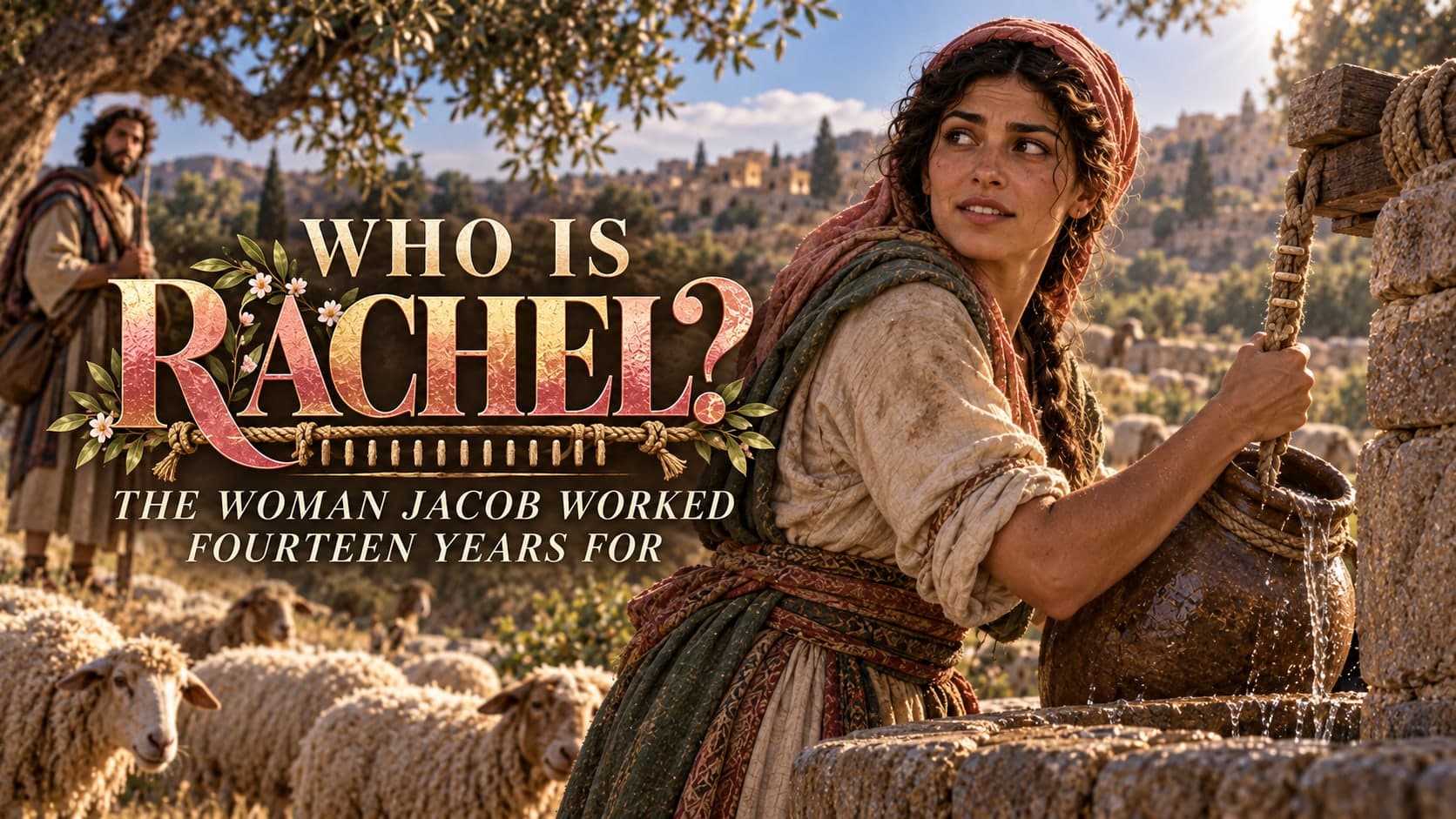
He came to a well where shepherds gathered their flocks, and while he was talking with them, a young woman walked up with her father's sheep. Her name was Rachel, and keeping the flock was her own job, not a servant's.
"And while he yet spake with them, Rachel came with her father’s sheep: for she kept them. And it came to pass, when Jacob saw Rachel the daughter of Laban his mother’s brother, and the sheep of Laban his mother’s brother, that Jacob went near, and rolled the stone from the well’s mouth, and watered the flock of Laban his mother’s brother. And Jacob kissed Rachel, and lifted up his voice, and wept."
The stone over that well was usually heavy enough that it took several shepherds working together to move it. Jacob rolled it away by himself, just to water her flock.
💡 That is Rachel's introduction in Scripture. A man who had never met her worked to serve her before he ever spoke a single word to her.
Then he kissed her and wept out loud. A grown man, a stranger to her a moment earlier, crying at a well because he had found his mother's family and, it turns out, the woman he would love for the rest of his life.
❓ Try to picture what that moment felt like from her side. A total stranger weeping over her before she even knew his name.
2. Seven Years That Felt Like a Few Days
Jacob went to live with Laban, Rachel's father, and worked for him. Rachel had an older sister named Leah. Genesis is blunt about how the two sisters looked. Leah was tender eyed, while Rachel was described as beautiful and well favoured.
Jacob loved Rachel, and he made Laban an offer.
"And Jacob loved Rachel; and said, I will serve thee seven years for Rachel thy younger daughter. And Laban said, It is better that I give her to thee, than that I should give her to another man: abide with me. And Jacob served seven years for Rachel; and they seemed unto him but a few days, for the love he had to her."
📌 Seven years of hard labor felt like a few days to Jacob, because of how much he loved her.
Think about what it must have done to Rachel to know that. To be loved so plainly, so publicly, by a man willing to work seven years just to earn the right to marry her.
She had every reason to believe her life was about to be the easy, wanted kind of life.
3. A Wedding Night That Betrayed Her Without Asking
The seven years ended. The wedding feast happened. And then, in the dark, Laban brought his older daughter Leah into the tent instead of Rachel.
"And it came to pass in the evening, that he took Leah his daughter, and brought her to him; and he went in unto her. And it came to pass, that in the morning, behold, it was Leah: and he said to Laban, What is this thou hast done unto me? did not I serve with thee for Rachel? wherefore then hast thou beguiled me?"
Most retellings only look at this moment through Leah's eyes, and Leah has her own hard story to carry, which you can read in full in Leah's story. But stop and think about Rachel that same night.
⚠️ Rachel did not choose this. Her own father used her wedding as a trick, and used her sister to pull it off.
Somewhere in that camp, on the night that was supposed to be her wedding night, Rachel had to sit and wait while the man who loved her was given to her sister instead. She had no say in it at all. Whatever plan her father had, both daughters were tools inside it, just in different ways.
Scripture does not record a single word Rachel said that night. Only the silence.
4. Seven More Years, and a House Split in Two
Laban gave an excuse. He claimed it was not the custom in that land to give away the younger daughter before the older one. Whatever the truth of that, the result was more work for Jacob and more waiting for Rachel.
"Fulfil her week, and we will give thee this also for the service which thou shalt serve with me yet seven other years. And Jacob did so, and fulfilled her week: and he gave him Rachel his daughter to wife also. And Laban gave to Rachel his daughter Bilhah his handmaid to be her maid. And he went in also unto Rachel, and he loved also Rachel more than Leah, and served with him yet seven other years."
Rachel finally became Jacob's wife too, only a week after her sister.
📌 Fourteen years total. That is how long Jacob worked to have Rachel as his wife.
The text says plainly that Jacob loved Rachel more than Leah. That single sentence set up years of pain in that household. Two sisters, one husband, and a love that was never evenly shared. Rachel got the love. Leah got the children, at first. Neither sister got a peaceful home.
5. Barren Years and a Desperate Cry
While Leah had son after son, Rachel had none. Genesis says the LORD saw that Leah was unloved and opened her womb, while Rachel stayed barren. The most loved wife had the one thing she wanted most withheld from her.
Watch what that did to her over time.
"And when Rachel saw that she bare Jacob no children, Rachel envied her sister; and said unto Jacob, Give me children, or else I die."
⚠️ Envied her sister. That is the Bible's own word for what was happening inside Rachel.
She said give me children, or else I die. That is not a calm request. That is a woman near the breaking point, aiming her pain at the one person nearby who could not actually give her what she wanted.
So Rachel tried to solve it on her own.
"And she said, Behold my maid Bilhah, go in unto her; and she shall bear upon my knees, that I may also have children by her. And she gave him Bilhah her handmaid to wife: and Jacob went in unto her."
Bilhah, Rachel's own servant, had two sons that Rachel counted as her own. Listen to what Rachel named them.
- 📌 Dan — God hath judged me, and hath also heard my voice
- 📌 Naphtali — with great wrestlings have I wrestled with my sister, and I have prevailed
⚠️ Wrestled with my sister, and I have prevailed. That is not the language of a peaceful home. That is the language of a competition Rachel felt like she was finally winning.
Years passed this way. Sons kept coming through both sisters and their servants. Not one of them came through Rachel's own body.
6. God Remembers Her: The Birth of Joseph
Then, after years of nothing, something changed.
"And God remembered Rachel, and God hearkened to her, and opened her womb. And she conceived, and bare a son; and said, God hath taken away my reproach: And she called his name Joseph; and said, The LORD shall add to me another son."
💡 God remembered her. Not because Rachel earned it through her scheming with Bilhah, and not because her envy pushed God's hand. Scripture simply says He remembered her, in His own timing.
She named the boy Joseph and said, the LORD shall add to me another son. That was not just a wish. It turned out to be a request God answered years later, though it would come at the highest possible cost to her.
✅ God hath taken away my reproach. In that culture, being unable to have children was treated as a personal shame. Rachel finally felt that shame lifted.
This son, Joseph, would grow up to be sold into slavery by his own brothers and then rise to save his whole family from famine. If you want to see where the boy Rachel prayed for ends up, his full story is worth reading on its own.
7. Stolen Idols and a Death on the Road to Bethlehem
Years later, Jacob decided to take his whole family and flocks and leave Laban for good. As they packed up to go, Rachel did something Scripture never explains.
"And Laban went to shear his sheep: and Rachel had stolen the images that were her father’s."
These images, sometimes called household idols, were small family gods kept in the home. In that culture they could also carry a claim to a family's inheritance. When Laban realized they were missing, he chased Jacob down and searched every tent.
"Now Rachel had taken the images, and put them in the camel’s furniture, and sat upon them. And Laban searched all the tent, but found them not. And she said to her father, Let it not displease my lord that I cannot rise up before thee; for the custom of women is upon me. And he searched, but found not the images."
⚠️ The Bible never tells us why Rachel took them. It would be easy to invent a tidy reason, but the honest answer is that Scripture just does not say. Maybe it was about family security. Maybe it was old habits from a household that never fully let go of other gods. The text leaves it a mystery, so we should too, rather than repeating a guess as if it were fact.
What is not a mystery is what happened next. Rachel lied to her own father to protect the theft, sitting on the very idols he was searching for.
Some time after that, Jacob's family was traveling again, this time toward Bethlehem. Rachel was pregnant with her second child.
"And they journeyed from Bethel; and there was but a little way to come to Ephrath: and Rachel travailed, and she had hard labour. And it came to pass, when she was in hard labour, that the midwife said unto her, Fear not; thou shalt have this son also. And it came to pass, as her soul was in departing, (for she died) that she called his name Benoni: but his father called him Benjamin. And Rachel died, and was buried in the way to Ephrath, which is Bethlehem."
📌 With her last breath, Rachel named her son Benoni, which means son of my sorrow.
Jacob could not leave that name on his boy. He renamed him Benjamin, a name usually understood to mean son of the right hand. One parent named the child out of grief. The other renamed him out of hope.
💡 Rachel got the husband who loved her most, and still died on the side of a road, never reaching the home she was traveling toward.
If you have ever wondered why a good and loved life can still end in so much pain, that question is worth sitting with, and why God allows suffering takes it further than this one story can.

Lessons From Rachel's Life
1. Being loved is not the same as being at peace
Rachel had the one thing Leah spent her whole life wanting: Jacob's love.
It did not stop her from crying give me children, or else I die.
⚠️ Getting the thing you think will finally make you happy does not automatically bring peace. It just moves the ache somewhere new.
2. Envy can poison even a fortunate life
Rachel was beautiful, chosen, and deeply loved.
She still spent years envying her own sister over the one thing she lacked.
📌 You can have most of what a good life looks like and still let envy over one missing piece steal your joy from all of it.
3. Comparing yourself to someone else hurts everyone involved
Rachel envied Leah's children. Leah envied Rachel's love.
Both women spent years measuring their worth against each other instead of against God.
❓ What would change in your own life if you stopped keeping score against someone else?
4. God's timing does not mean God has forgotten you
Rachel waited years while her sister and even a servant had children before her.
Then Scripture says plainly that God remembered her.
💡 A long wait is not proof that God is not paying attention.
5. What we cling to in secret still matters to God
Rachel left Laban's household outwardly, but she carried his household idols with her, hidden under her own body.
⚠️ Leaving a place is not the same as leaving everything that place put in your heart.
Key Verses From Rachel's Story
1. Genesis 29:20
"And Jacob served seven years for Rachel; and they seemed unto him but a few days, for the love he had to her."
This is one of the most quoted lines about love in the whole Bible.
💡 Real love does not erase hard work. It changes how the work feels while you do it.
2. Genesis 30:1
"And when Rachel saw that she bare Jacob no children, Rachel envied her sister; and said unto Jacob, Give me children, or else I die."
The rawest sentence Rachel ever spoke.
📌 Scripture does not clean her up here. It lets you see the envy plainly, without excusing it.
3. Genesis 30:22 and 23
"And God remembered Rachel, and God hearkened to her, and opened her womb. And she conceived, and bare a son; and said, God hath taken away my reproach:"
Years of waiting end in one short sentence: God remembered her.
✅ The answer did not come from her scheming. It came in God's own time.
4. Genesis 31:19
"And Laban went to shear his sheep: and Rachel had stolen the images that were her father’s."
A strange, unexplained action in an otherwise faithful life.
💡 Even people God is clearly working through can carry things they should have let go of.
5. Genesis 35:18
"And it came to pass, as her soul was in departing, (for she died) that she called his name Benoni: but his father called him Benjamin."
The last words Rachel ever spoke were the name of her own sorrow.
📌 Her husband was the one who chose hope for their son instead. Both responses came from real love.

Frequently Asked Questions About Rachel
Who was Rachel in the Bible?
Rachel was the younger daughter of Laban and the second wife of Jacob. Jacob loved her from the moment he met her at a well and worked fourteen years total to marry her. She became the mother of Joseph and Benjamin, two of the twelve tribes of Israel. Her story is told in Genesis 29 through 35.
Why did Jacob work fourteen years for Rachel?
Jacob first agreed to work seven years for Rachel, but on the wedding night her father Laban gave him her sister Leah instead. Jacob then had to work seven more years to also marry Rachel, bringing the total to fourteen years of labor for the one wife he actually asked for.
Why did Laban trick Jacob into marrying Leah instead of Rachel?
Laban claimed it was not the custom in his land to marry off a younger daughter before an older one. Scripture never confirms whether that custom was real or an excuse. Whatever the reason, it gave Laban seven more years of free labor from Jacob and left both his daughters caught in the middle of it.
Was Rachel jealous of Leah?
Yes, and the Bible says so directly. Genesis 30:1 says Rachel envied her sister when Leah kept having sons and Rachel had none. Rachel had Jacob's love, and Leah had children. Each sister spent years wanting what the other one had.
Why was Rachel barren for so long?
Scripture does not give a medical explanation. It simply says the LORD saw that Leah was unloved and opened her womb, while Rachel stayed barren, and later says God remembered Rachel and opened her womb in His own timing. The text presents it as something in God's hands, not something Rachel failed to earn.
Why did Rachel give Bilhah to Jacob?
Desperate for children of her own, Rachel gave her servant Bilhah to Jacob so that any sons Bilhah had would count as Rachel's own family. This was an accepted practice in that culture, though it added even more strain to an already divided household.
Why did Rachel steal her father's idols?
The Bible never explains her motive. It simply records that she stole the household images when the family left Laban, hid them in her camel's saddle, and sat on them so her father could not find them during his search. Any explanation beyond that is a guess, not something the text actually states.
How did Rachel die?
Rachel died giving birth to her second son on the road to Ephrath, near Bethlehem. Her labor was hard, and with her last breath she named the boy Benoni, meaning son of my sorrow. Jacob renamed him Benjamin. Rachel was buried on that road, not in the family tomb where Jacob, Leah, and the other patriarchs were later buried.
What does Benoni mean, and why did Jacob change the name to Benjamin?
Benoni means son of my sorrow. It was Rachel's dying word over her own child. Jacob changed it to Benjamin, a name usually understood to mean son of the right hand. He chose to send his son into the world carrying hope instead of grief.
Is Rachel a good example in the Bible?
Scripture does not present her as either a hero or a villain. She was deeply loved, deeply desperate, jealous of her sister, dishonest with her father, and eventually the mother God remembered in His own time. Her honesty about her pain, and her costly death, are why her story still lands so hard today.
Final Thoughts
Rachel had almost everything her culture told women to want.
Beauty. A husband who loved her more than anyone else. Eventually, sons.
📌 None of it protected her from years of envy, or from dying on a road before she ever reached home.
📌 God still remembered her, in His own timing, not hers.
📌 Her sorrow and her husband's hope both got spoken over the same child.
Her life says something important to anyone chasing the one thing they think will finally fix everything.
Getting it might not bring the peace you expect. It did not for Rachel.
✅ But the God who remembered her in her own hard waiting is the same God who sees you in yours.
Read Genesis 29 and 30 this week, slowly, and watch how honestly the Bible tells her story.