📖 Who Was Rebekah in the Bible? The Mother Who Tricked Her Own Husband
A stranger showed up at her family's well one evening.
He asked for a drink of water.
By the end of that same conversation, Rebekah agreed to leave her home forever and marry a man she had never met.
She said yes on the spot.
📌 That kind of quick, bold trust is what made Rebekah remarkable. Years later, that same boldness is what made her dangerous.
God had already told her something huge about her future sons before they were even born.
He said the younger one would end up leading the older one.
That should have been enough. God had said it. It was going to happen.
But years passed, her husband got old, and it looked like everything was about to go the other way.
❓ So Rebekah did what a lot of us do when we are afraid God will not come through in time. She decided to help Him along, by lying.
Maybe you know that feeling.
You believe God made you a promise. But time is running out, or the door looks like it is closing, and waiting starts to feel foolish.
So you reach for control instead.
This is the full story of Rebekah in the Bible, walked through in order, straight from Genesis. The stranger at the well. The proposal she said yes to in one word. The husband she grew to love. The twin sons who fought before they were even born. And the lie that got her what God had already promised, at a cost she never saw coming.
Who Rebekah Was
Rebekah was the daughter of a man named Bethuel.
Her brother was Laban, who later becomes a major character in the story of Jacob.
Her family lived far from the land of Canaan, in a region called Mesopotamia, in a city connected to Abraham's own relatives.
📌 Her story runs through Genesis 24, 25, and 27, and it covers most of her adult life.
She became the wife of Isaac, the son that God had promised to Abraham in his old age.
That makes Rebekah the second matriarch of the Bible, right after Sarah.
💡 She is also one of the few women in the Old Testament we get to see as a young woman before her marriage, not just after it. Genesis shows us exactly who she was the moment everything changed for her.
She and Isaac had twin sons, Esau and Jacob, and Jacob later became the father of the twelve tribes of Israel.
Now here is how her story actually unfolds.

Rebekah's Story
1. A Servant's Test at the Well
Abraham was old. He wanted a wife for his son Isaac, but not just anyone.
He refused to let Isaac marry a woman from the local Canaanite tribes.
So he sent his oldest servant, a man named Eliezer, on a long trip back to his own relatives to find a bride.
Eliezer arrived at a well outside a city, tired from the road, with ten camels needing water.
He did not just wait and hope. He asked God for a very specific sign.
"And he said, O LORD God of my master Abraham, I pray thee, send me good speed this day, and shew kindness unto my master Abraham."
He laid out exactly what he was looking for.
"And let it come to pass, that the damsel to whom I shall say, Let down thy pitcher, I pray thee, that I may drink; and she shall say, Drink, and I will give thy camels drink also: let the same be she that thou hast appointed for thy servant Isaac; and thereby shall I know that thou hast shewed kindness unto my master."
💡 Watering ten camels was not a small favor. A thirsty camel can drink a huge amount of water. Eliezer was not asking for a kind girl. He was asking for a girl willing to do a long, tiring job for a total stranger, without being asked twice.
Before he even finished praying, a young woman came out to the well.
"And it came to pass, before he had done speaking, that, behold, Rebekah came out, who was born to Bethuel, son of Milcah, the wife of Nahor, Abraham's brother, with her pitcher upon her shoulder."
The servant ran to meet her and asked for a drink.
"And she said, Drink, my lord: and she hasted, and let down her pitcher upon her hand, and gave him drink."
Then, without being asked, she offered the exact thing Eliezer had prayed for.
"And when she had done giving him drink, she said, I will draw water for thy camels also, until they have done drinking."
📌 Rebekah did the exact thing the servant had asked God for, word for word, before she ever knew a servant was watching or that God was involved at all.
She hurried back and forth to the well, filling the trough again and again, for ten thirsty camels.
⚠️ Do not skip past how much work that was. This was not a polite gesture. It was hours of hard, humble labor for a stranger she owed nothing to.
That single act of generosity is what set the rest of her life in motion.
2. Leaving Everything on One Question
Eliezer followed Rebekah home, met her family, and explained the whole mission.
He told them about Abraham, about Isaac, and about the sign God had given him at the well.
Rebekah's father and brother agreed the whole thing was clearly from the LORD.
But there was one more question left to ask, and it was Rebekah's alone to answer.
"And they said, We will call the damsel, and enquire at her mouth."
"And they called Rebekah, and said unto her, Wilt thou go with this man? And she said, I will go."
📌 Three words. I will go. That is the whole answer.
Think about what she was actually agreeing to.
She had never met Isaac. She would be traveling for weeks, away from her family, to a land she had never seen, to marry a man she knew only by his father's name.
❓ How many of us say yes to God's plan that quickly, with that little information, and that much certainty?
Her family wanted her to wait ten more days before leaving. Rebekah did not want to wait.
💡 Once she believed this was God's doing, she moved. No stalling, no second guessing.
3. A Field, a Veil, and a New Home
After a long journey, Rebekah's caravan finally neared Isaac's camp.
"And Isaac went out to meditate in the field at the eventide: and he lifted up his eyes, and saw, and, behold, the camels were coming."
Rebekah saw a man walking in the field toward them and asked who he was.
"And Rebekah lifted up her eyes, and when she saw Isaac, she lighted off the camel."
"For she had said unto the servant, What man is this that walketh in the field to meet us? And the servant had said, It is my master: therefore she took a vail, and covered herself."
When she learned it was Isaac, she got off her camel and covered her face out of respect, as was the custom.
The servant told Isaac everything that had happened.
"And Isaac brought her into his mother Sarah's tent, and took Rebekah, and she became his wife; and he loved her: and Isaac was comforted after his mother's death."
📌 He loved her. That short phrase is not something the Bible hands out often, and it comes here before we ever see a single conversation between them.
💡 Notice the order in that verse too. He took her as his wife first, and love followed after. Their marriage did not begin with romance. It began with obedience and grew into love.
Isaac had been grieving his mother Sarah. Rebekah's arrival brought him comfort in that grief.
For another young woman whose life changed in one sudden moment of obedience, read the story of Eve, the very first woman God ever gave to a man.
4. Barren Years and a Prayer That Was Answered
Marriage did not bring children right away.
Rebekah was barren, unable to have a baby, for twenty years.
Isaac did not blame her or give up. He prayed for her.
"And Isaac intreated the LORD for his wife, because she was barren: and the LORD was intreated of him, and Rebekah his wife conceived."
📌 God answered that prayer, but the pregnancy itself was hard and confusing.
"And the children struggled together within her; and she said, If it be so, why am I thus? And she went to enquire of the LORD."
The two babies inside her were literally fighting.
Rebekah did not just endure it or guess about it. She took her confusion straight to God and asked Him directly what was happening.
💡 That is worth slowing down on. When life felt unbearable, her first move was to ask the LORD, not to panic and not to guess.
God answered her with a full explanation of what her sons would become.
"And the LORD said unto her, Two nations are in thy womb, and two manner of people shall be separated from thy bowels; and the one people shall be stronger than the other people; and the elder shall serve the younger."
📌 God told Rebekah plainly, before either son was even born, that the younger one would end up above the older one.
Remember that verse. It is the single most important sentence in her whole story, because everything she does later comes from how she handles this promise.
5. Two Very Different Sons
The twins were born, and even their birth showed the struggle continuing.
"And the first came out red, all over like an hairy garment; and they called his name Esau."
"And after that came his brother out, and his hand took hold on Esau's heel; and his name was called Jacob: and Isaac was threescore years old when she bare them."
Esau came out first, red and hairy. Jacob came out second, holding onto his brother's heel.
The name Jacob is connected to that image of grabbing the heel, and it can also carry the meaning of one who takes the place of another.
The boys grew up completely different from each other.
"And the boys grew: and Esau was a cunning hunter, a man of the field; and Jacob was a plain man, dwelling in tents."
Esau loved the outdoors and hunting. Jacob was quieter, more at home near the tents.
Then comes one plain sentence that explains almost everything that happens next in this family.
"And Isaac loved Esau, because he did eat of his venison: but Rebekah loved Jacob."
⚠️ Each parent picked a favorite. Isaac chose Esau, and even the Bible tells us why: because of the food Esau brought him. Rebekah chose Jacob.
That is a divided house, right from the start. And a divided house rarely stays quiet forever.
6. The Plan at Isaac's Bedside
Many years passed. Isaac grew old and his eyes grew too dim to see.
He believed he was near death, so he called Esau in to give him the formal blessing due to the firstborn son.
That blessing was not a small, warm speech. It legally set who would lead the family and inherit the promises God had made to Abraham.
Isaac told Esau to hunt some venison first and make him the savory meal he loved, and then he would give the blessing.
Rebekah overheard the whole conversation.
"And Rebekah heard when Isaac spake to Esau his son. And Esau went to the field to hunt for venison, and to bring it."
She moved fast. She went straight to Jacob and laid out a plan.
"And Rebekah spake unto Jacob her son, saying, Behold, I heard thy father speak unto Esau thy brother, saying, Bring me venison, and make me savoury meat, that I may eat, and bless thee before the LORD before my death."
"Now therefore, my son, obey my voice according to that which I command thee."
She told Jacob to bring her two young goats so she could cook a meal just like Isaac loved, one Jacob could bring in ahead of his brother, pretending to be Esau.
Jacob's objection was not about right and wrong. It was about getting caught.
"And Jacob said to Rebekah his mother, Behold, Esau my brother is a hairy man, and I am a smooth man: My father peradventure will feel me, and I shall seem to him as a deceiver; and I shall bring a curse upon me, and not a blessing."
⚠️ Neither of them stopped to ask whether the plan was right. Jacob only worried that it might not work.
Rebekah's answer is one of the most chilling lines she speaks in the whole story.
"And his mother said unto him, Upon me be thy curse, my son: only obey my voice, and go fetch me them."
She was willing to carry the consequences herself, if it meant Jacob got what she believed God had already promised him.
She cooked the meal exactly the way Isaac liked it, then took the plan even further.
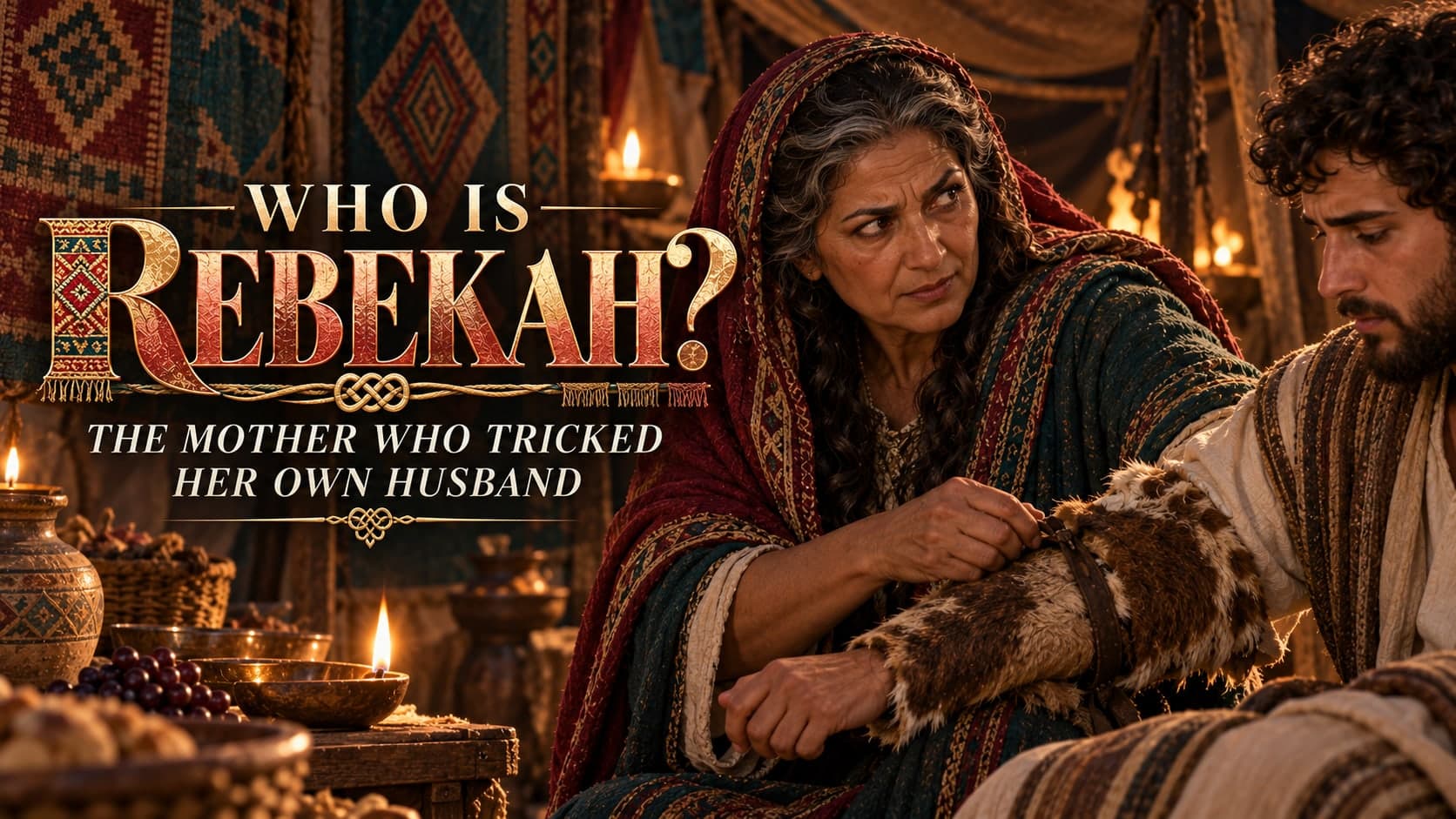
"And Rebekah took goodly raiment of her eldest son Esau, which were with her in the house, and put them upon Jacob her younger son:"
"And she put the skins of the kids of the goats upon his hands, and upon the smooth of his neck:"
She dressed Jacob in his brother's clothes so he would smell like Esau, and wrapped goat skins on his hands and neck so he would even feel hairy to the touch.
📌 This was not a small white lie. It was a planned, detailed, physical deception, aimed at her own blind, dying husband.
7. The Deception Works, and the Family Breaks
Jacob walked in and lied to his father's face.
"And Jacob said unto his father, I am Esau thy first born; I have done according as thou badest me: arise, I pray thee, sit and eat of my venison, that thy soul may bless me."
⚠️ Jacob even brought God's name into the lie, telling his father the LORD had helped him find the meat so quickly.
Isaac had doubts. He asked Jacob to come close so he could feel him.
"And Jacob went near unto Isaac his father; and he felt him, and said, The voice is Jacob's voice, but the hands are the hands of Esau."
"And he discerned him not, because his hands were hairy, as his brother Esau's hands: so he blessed him."
The goat skins did their job. Isaac ate the meal, smelled Jacob's clothes, and gave him the blessing meant for Esau.
"Therefore God give thee of the dew of heaven, and the fatness of the earth, and plenty of corn and wine: Let people serve thee, and nations bow down to thee: be lord over thy brethren, and let thy mother's sons bow down to thee: cursed be every one that curseth thee, and blessed be he that blesseth thee."
The plan worked exactly the way Rebekah designed it.
💡 God had already promised this outcome in Genesis 25. Rebekah got it anyway, but through a lie instead of through waiting.
The cost showed up almost immediately.
"And Esau hated Jacob because of the blessing wherewith his father blessed him: and Esau said in his heart, The days of mourning for my father are at hand; then will I slay my brother Jacob."
Esau planned to kill his own brother the moment their father died.
Rebekah heard about the threat and moved fast one more time, but now to protect the son she had put in danger.
"And these words of Esau her elder son were told to Rebekah: and she sent and called Jacob her younger son, and said unto him, Behold, thy brother Esau, as touching thee, doth comfort himself, purposing to kill thee."
"Now therefore, my son, obey my voice; and arise, flee thou to Laban my brother to Haran; And tarry with him a few days, until thy brother's fury turn away;"
She sent Jacob away to her own brother Laban, far from home, telling him it would only be a few days until Esau calmed down.
⚠️ It was not a few days. Jacob stayed away for twenty years, and Genesis never records Rebekah seeing her favorite son again.
Her last recorded words in this story are about how much she still had to lose.
"Until thy brother's anger turn away from thee, and he forget that which thou hast done to him: then I will send, and fetch thee from thence: why should I be deprived also of you both in one day?"
She feared losing both sons in a single day, one to murder and one to the death penalty that would follow it.
💡 Rebekah got the outcome she wanted, and paid for it with the son she loved most.
The pattern of a woman using deception to control an outcome shows up again later in Scripture with Jezebel, though Jezebel's motives and methods were far darker than Rebekah's.

Lessons From Rebekah's Life
1. Small acts of kindness get noticed by God
Rebekah did not know she was being tested at the well. She just helped a tired traveler.
📌 That one ordinary act of hard work and generosity changed the entire direction of her life.
2. Quick obedience is a strength worth having
Rebekah did not need weeks to decide. Once she believed this was from God, she said I will go and left.
💡 Delay is not always caution. Sometimes it is just fear wearing a patient disguise.
3. Favoritism plants seeds that grow into division
Isaac loved Esau. Rebekah loved Jacob. Neither parent hid it.
⚠️ A house split by favorites rarely stays peaceful. It cracks under pressure, exactly the way this one did.
4. Believing a promise is not the same as trusting God's timing
Rebekah believed God's word in Genesis 25 completely. She never doubted Jacob would come out ahead.
What she did not trust was God's timing and God's method for getting there.
⚠️ She was right about the promise and wrong about how to get it, and the wrong part cost her the most.
5. Forcing God's plan your own way always costs something
Jacob did receive the blessing, exactly as God had said he would.
But Rebekah lost him for twenty years, lost his presence in her final days, and split her family in two.
⚠️ God's promises do not need our lies to come true. When we grab at them early and by force, we usually still get them, but with a bill attached that we did not expect.
If fear of a future you cannot control is what drives you toward shortcuts like this, what the Bible says about fear is worth reading before you act on that fear.
6. God's plans survive our mistakes without needing them
God had already said the younger would serve the elder. That was going to happen whether Rebekah schemed or not.
📌 Her lie did not create God's plan. It only made the road to it much harder for everyone involved.
Key Verses From Rebekah's Story
1. Genesis 24:58
"And they called Rebekah, and said unto her, Wilt thou go with this man? And she said, I will go."
Three words that changed her whole life.
📌 No hesitation, no long list of conditions. Just a decision to trust and move.
2. Genesis 24:67
"And Isaac brought her into his mother Sarah's tent, and took Rebekah, and she became his wife; and he loved her: and Isaac was comforted after his mother's death."
Love that grew after commitment, not before it.
💡 Their marriage began with obedience, and love followed. That order is worth noticing.
3. Genesis 25:23
"And the LORD said unto her, Two nations are in thy womb, and two manner of people shall be separated from thy bowels; and the one people shall be stronger than the other people; and the elder shall serve the younger."
The promise that explains everything else in her story.
📌 God told her plainly what would happen. The tragedy is how she chose to help it along.
4. Genesis 25:28
"And Isaac loved Esau, because he did eat of his venison: but Rebekah loved Jacob."
One short sentence that describes a divided home.
⚠️ Favoritism named this plainly in Scripture is a warning, not just a fact.
5. Genesis 27:13
"And his mother said unto him, Upon me be thy curse, my son: only obey my voice, and go fetch me them."
The moment Rebekah fully owned the plan, consequences and all.
💡 She was willing to pay any price except the one that actually came due, which was losing her son's presence for the rest of her life.
Frequently Asked Questions About Rebekah
Who was Rebekah in the Bible?
Rebekah was the wife of Isaac, the son of Abraham, and the mother of the twins Esau and Jacob. A servant found her at a well while searching for a wife for Isaac, and she agreed to leave her home and marry him. Her story is told in Genesis 24, 25, and 27.
Was Rebekah wrong to help Jacob deceive Isaac?
Yes. Scripture does not excuse the deception. Rebekah planned it, dressed Jacob to fool his own blind father, and coached him through lying to Isaac's face. The plan worked, but it led to Jacob fleeing for his life and Rebekah losing him for twenty years.
Why did Rebekah love Jacob more than Esau?
The Bible does not give a full reason. Genesis simply states that Isaac loved Esau because of his hunting, and Rebekah loved Jacob, without further explanation. It may connect to the promise God gave her about Jacob before the twins were even born.
Did Rebekah know God's plan for her sons before they were born?
Yes. While she was pregnant and the twins struggled inside her, Rebekah asked the LORD what was happening. God told her directly that two nations were in her womb and that the elder would serve the younger. She carried that promise for decades before she took matters into her own hands.
What happened to Rebekah after Jacob left?
Genesis does not describe her final years in detail. She is never shown reuniting with Jacob, who was gone about twenty years. Genesis 49 mentions that she was buried in the same family tomb as Abraham, Sarah, and later Isaac and Leah.
How old was Rebekah when she married Isaac?
The Bible does not give her exact age. She is described as a young, unmarried woman when the servant met her at the well. Isaac was forty years old when they married, according to Genesis 25:20.
Why was Rebekah barren for so long?
Scripture does not explain the reason, only the fact. Rebekah was barren for about twenty years of her marriage until Isaac prayed for her and the LORD answered. Barrenness followed by a prayed for pregnancy is a pattern that also appears with Sarah, Rachel, and later Hannah.
What does the name Rebekah mean?
The name is generally understood to mean something like to tie firmly or a captivating beauty, though scholars are not fully certain of the exact root. Her actions throughout Genesis, holding tightly to God's promise about Jacob, fit the idea of tying firmly to something.
Did Isaac ever find out Rebekah planned the deception?
Genesis does not record his reaction toward Rebekah directly. It does say that after Jacob left and Esau's anger became clear, Isaac himself sent Jacob away to find a wife among Rebekah's relatives, so he was fully aware of what had happened by then.
Is Rebekah considered one of the matriarchs of the Bible?
Yes. She is counted among the four matriarchs of Israel, alongside Sarah, Leah, and Rachel. Her sons and grandsons became the twelve tribes of Israel through Jacob.
What can we learn from Rebekah today?
That kindness to strangers can open doors we never expect, that quick obedience to God is a strength, and that even a true promise from God does not give us permission to lie or manipulate our way toward it. God's word comes true on His timing, not ours.
Final Thoughts
Rebekah's life holds two very different women inside one story.
One said I will go to a stranger's offer, trusting God with almost nothing to go on.
📌 The other looked at God's own promise and decided waiting was too risky, so she lied to make it happen her own way.
Both women got what God had said would happen. Only one of them paid for it with years of separation from the son she loved most.
✅ Here is the hope in her story. God's promise to Rebekah came true anyway. Not because of her scheme, but because God's word does not fail, with or without our help.
If you are holding a promise from God right now and the waiting feels unbearable, read Genesis 27 slowly this week and notice where fear, not faith, took the wheel.
Then ask God to help you trust His timing instead of your own plan.