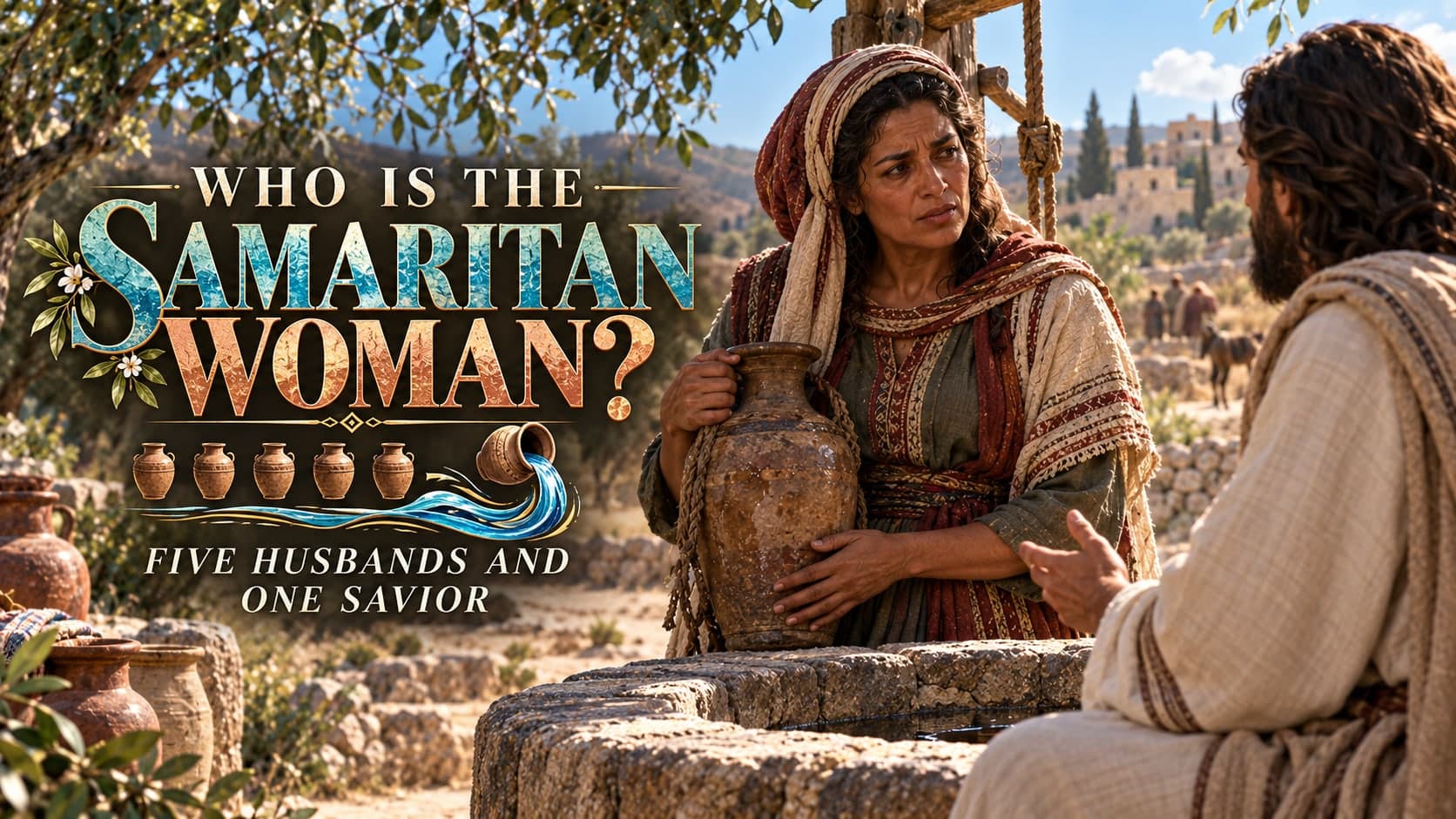
📖 Who Was the Samaritan Woman? Five Husbands and One Savior
She timed her whole day around not seeing anyone.
Women in her town drew water together in the cool of the morning.
She went alone, at noon, in the worst heat of the day.
📌 She was not avoiding the walk to the well. She was avoiding the people at it.
Something about her past had made her a topic. A joke. A warning to other women.
So she planned her whole life around empty hours.
Then a Jewish man sat down at that same well, at that same hour, and spoke to her.
❓ In her culture, a Jewish man was not even supposed to be in the same conversation as a Samaritan woman. So why did He start one?
Maybe you know a version of her noon.
A group chat you avoid. A church you stopped attending. A room you time your exit around.
You have a past, or a rumor, or a mistake, and it feels safer alone than seen.
This is the full story of the Samaritan woman at the well, told in order, straight from John chapter 4. Who she was. What Jesus actually said to her, word for word. Why five husbands and a man who was not her husband mattered so much. And why the woman with the worst reputation in town became the first missionary in the whole Gospel of John.
Who the Samaritan Woman Was
The Bible never gives this woman a name.
📌 That is worth saying plainly up front. Some traditions have given her a name over the centuries, but Scripture itself simply calls her a woman of Samaria. So this post will do the same and call her the Samaritan woman, exactly as John does.
She lived in a city called Sychar, in the region of Samaria.
To understand her story, you need to understand one thing first. Jews and Samaritans did not associate with each other.
Centuries earlier, the northern kingdom of Israel had been conquered, and many of its people intermarried with foreigners the conquerors brought in. Over time, Samaritans built their own place of worship on a mountain called Gerizim instead of the temple in Jerusalem, and they only accepted the first five books of the Bible.
⚠️ To a Jew in Jesus' day, Samaritans were half breeds and heretics. Most Jews traveling between Judea and Galilee walked around Samaria entirely rather than pass through it.
Her whole story is told in one chapter, John 4.
💡 So before she ever opens her mouth, this woman is already carrying two strikes against her in that culture. She is a Samaritan, and she is a woman with a reputation. Keep both in mind as you read what Jesus does next.

Her Story
1. A Tired Savior at a Well at Noon
Jesus was leaving Judea to go back to Galilee.
Most Jewish travelers went the long way around Samaria to avoid it.
Jesus did not.
"He left Judaea, and departed again into Galilee. And he must needs go through Samaria."
📌 Must needs go. That phrase is doing a lot of work. It was not the shortest route by necessity. It reads like a divine appointment He was walking toward on purpose.
He came to a city called Sychar, near a piece of land Jacob had given his son Joseph long before.
"Now Jacob's well was there. Jesus therefore, being wearied with his journey, sat thus on the well: and it was about the sixth hour."
Wearied. Sat down. The sixth hour, which was noon.
💡 Jesus was fully God, and here He is fully tired, dusty, and thirsty from walking. He did not skip the exhaustion that comes with being human.
And noon was not a normal time to draw water.
Most women came early in the morning, before the heat, and they came together.
One woman, alone, at the hottest hour of the day, is not a coincidence. It is a pattern of hiding.
2. "Give Me to Drink"
She arrived to draw water and found a Jewish man sitting there.
He spoke first.
"There cometh a woman of Samaria to draw water: Jesus saith unto her, Give me to drink."
Four small words, and they broke at least two social rules at once.
A Jewish rabbi did not speak to a strange woman in public. And a Jew did not ask a Samaritan for anything, let alone to drink from her bucket.
She said exactly what anyone in her position would have thought.
"Then saith the woman of Samaria unto him, How is it that thou, being a Jew, askest drink of me, which am a woman of Samaria? for the Jews have no dealings with the Samaritans."
⚠️ The Jews have no dealings with the Samaritans. That was simply how things were. She was not being rude. She was stating a fact everyone around her already knew.
❓ So why would He cross that line, for her, of all people?
That question sits underneath the entire conversation that follows.
3. Living Water That Never Runs Dry
Instead of explaining Himself, Jesus turned the conversation somewhere she did not expect.
"Jesus answered and said unto her, If thou knewest the gift of God, and who it is that saith to thee, Give me to drink; thou wouldest have asked of him, and he would have given thee living water."
She heard living water and thought of running water, like a spring, as opposed to still water sitting in a well.
So she pointed out the obvious problem.
"The woman saith unto him, Sir, thou hast nothing to draw with, and the well is deep: from whence then hast thou that living water? Art thou greater than our father Jacob, which gave us the well, and drank thereof himself, and his children, and his cattle?"
Fair question. Jacob's well was a landmark. Both Jews and Samaritans respected it.
Jesus answered with something no well could ever hold.
"Jesus answered and said unto her, Whosoever drinketh of this water shall thirst again: But whosoever drinketh of the water that I shall give him shall never thirst; but the water that I shall give him shall be in him a well of water springing up into everlasting life."
💡 He was not talking about her thirst for water. He was talking about the thirst inside every person that keeps sending them back to the same well over and over, whatever their well happens to be.
✅ A well inside a person that never runs dry, springing up into everlasting life. That is the promise. Not a one time drink, but a permanent source.
She wanted it, but she still thought in physical terms.
"The woman saith unto him, Sir, give me this water, that I thirst not, neither come hither to draw."
Notice what she actually wants. Not just the water. An end to the noon trips. An end to the hiding.
4. Five Husbands and a Man Who Already Knew
Then Jesus said something that shifted the whole conversation.
"Jesus saith unto her, Go, call thy husband, and come hither."
She gave Him a short, true, incomplete answer.
"The woman answered and said, I have no husband. Jesus said unto her, Thou hast well said, I have no husband: For thou hast had five husbands; and he whom thou now hast is not thy husband: in that saidst thou truly."
Five husbands. And the man she was living with now was not even her husband.
⚠️ Scripture never tells us why she had five husbands. It does not say she was married and widowed five times, or divorced five times, or some mix of both. It simply does not say. Anyone who tells you exactly why is guessing.
What it does say is how Jesus handled it.
📌 He named the truth exactly, and He did not shame her for it. No lecture. No walking away. He stayed at the well and kept talking with her.
💡 He knew everything about her life before she ever confessed a word of it. That is not a small detail. A stranger just told her the one thing everyone in Sychar already whispered about behind her back, and He said it without cruelty.
That kind of full knowledge paired with full patience is rare even among people who love us. It is worth thinking about the same way Eve's story shows God speaking hard truth to someone while still moving toward her, not away from her.
5. The Right Mountain and the Real Answer
She changed the subject, fast, the way people often do when a conversation gets too close.
"The woman saith unto him, Sir, I perceive that thou art a prophet. Our fathers worshipped in this mountain; and ye say, that in Jerusalem is the place where men ought to worship."
She raised the oldest argument between Jews and Samaritans. Was the true place of worship Mount Gerizim, where her ancestors worshipped, or Jerusalem, where the Jews worshipped?
Jesus did not pick a side in the argument the way she expected.
"Jesus saith unto her, Woman, believe me, the hour cometh, when ye shall neither in this mountain, nor yet at Jerusalem, worship the Father."
"But the hour cometh, and now is, when the true worshippers shall worship the Father in spirit and in truth: for the Father seeketh such to worship him. God is a Spirit: and they that worship him must worship him in spirit and in truth."
📌 True worship was never about the right mountain. It was always about the right heart.
💡 Notice how patient Jesus is being. She tried to redirect a personal conversation into a centuries old religious debate, and He still gave her a full, serious answer, one that reshaped the whole argument instead of just picking a winner.
6. "I That Speak Unto Thee Am He"
She said one more thing, almost like she was putting the whole conversation on hold for later.
"The woman saith unto him, I know that Messias cometh, which is called Christ: when he is come, he will tell us all things."
Then Jesus answered her with four words that He said to almost no one else this plainly, this early.
"Jesus saith unto her, I that speak unto thee am he."
📌 That is one of the clearest, most direct statements Jesus ever made about who He was. And He said it to a Samaritan woman with a reputation, alone, at a well, not to the religious leaders in Jerusalem.
❓ Of everyone Jesus met, why hand that truth to her first, before He said it so plainly almost anywhere else?
Scripture does not answer that question directly. It just lets the fact sit there.
7. She Left Her Water Pot Running
Right then, Jesus' disciples came back and found Him talking with her.
They were surprised, but none of them questioned it out loud.
And the woman did something that tells you everything about what had just happened inside her.
"The woman then left her waterpot, and went her way into the city, and saith to the men, Come, see a man, which told me all things that ever I did: is not this the Christ?"
She left her water pot at the well.
💡 That water pot was the whole reason she had walked out there in the heat of noon. She forgot it, because she had just found something the water pot could never hold.
And think about who she ran to tell. The very people she had been avoiding for years by coming at noon.
✅ The woman who hid from the town became the woman who ran straight into it. Her shame did not disappear from her memory. She even says it out loud, told me all things that ever I did. But it stopped controlling her feet.
8. A Whole City Believes
Her testimony was not polished theology. It was one honest sentence about what had just happened to her.
It was enough.
"And many of the Samaritans of that city believed on him for the saying of the woman, which testified, He told me all that ever I did."
The Samaritans came out to see Jesus for themselves, and He stayed with them two more days.
"And many more believed because of his own word; And said unto the woman, Now we believe, not because of thy saying: for we have heard him ourselves, and know that this is indeed the Christ, the Saviour of the world."
📌 Her one sentence got a whole town to the well. His words are what kept them there.
She did not need a title, a clean record, or years of training to point people to Jesus. She only needed to say what He had done for her.
That pattern shows up again and again in Scripture, the same way Leah's story shows God building something enormous through a woman nobody expected much from.

Lessons From Her Story
1. Jesus crosses lines other people will not cross for you
She was a Samaritan and a woman with a reputation. Both, in that culture, were reasons for a Jewish rabbi to walk right past her.
📌 He sat down at her well instead. Whoever you think is too far outside the circle, He is already willing to sit with them.
2. He can know your whole story and still stay at the table
Jesus named her five husbands and the man she was living with, plainly and accurately.
He did not soften it, and He did not leave because of it.
⚠️ Being fully known by God is not the same thing as being rejected by Him.
3. Real worship is not about the right building
She wanted to argue about mountains. Jesus redirected her to spirit and truth.
💡 You can attend the right church, sit in the right pew, and still miss the point Jesus made at that well.
4. You do not need a clean past to point someone to Christ
She told the town the one thing she was most ashamed of, and used it as the proof.
📌 Told me all things that ever I did was not a confession she buried. It became her testimony.
5. One honest conversation can change a whole community
She did not preach a sermon. She said one true sentence to people she used to avoid.
✅ Many believed because of her words, and then believed even more once they met Jesus themselves.
Key Verses From Her Story
1. John 4:14
"But whosoever drinketh of the water that I shall give him shall never thirst; but the water that I shall give him shall be in him a well of water springing up into everlasting life."
This is the heart of the whole conversation.
Jesus is not offering a fix for one thirsty afternoon. He is offering a permanent source, living inside a person, that never runs empty.
2. John 4:18
"For thou hast had five husbands; and he whom thou now hast is not thy husband: in that saidst thou truly."
The plainest, hardest fact in her whole story.
📌 Notice what does not follow it. No condemnation. Jesus states the truth and keeps talking with her.
3. John 4:24
"God is a Spirit: and they that worship him must worship him in spirit and in truth."
One of the clearest statements in the Bible about what worship actually is.
💡 Not a location. Not a tradition. A posture of heart before a God who is Spirit.
4. John 4:26
"Jesus saith unto her, I that speak unto thee am he."
Jesus tells her directly who He is, in words as plain as they come.
He gave this clarity to a Samaritan woman at a well before He gave it so openly almost anywhere else.
5. John 4:29
"Come, see a man, which told me all things that ever I did: is not this the Christ?"
Her own words, running back into the town she used to avoid.
✅ It is the simplest kind of testimony there is. He knows me, and He is still here.

Frequently Asked Questions About the Samaritan Woman
Who was the Samaritan woman in the Bible?
She was an unnamed woman from Sychar, a city in Samaria, who met Jesus at Jacob's well around noon. Her conversation with Him is recorded in John chapter 4. She had been married five times and was living with a man who was not her husband, and after speaking with Jesus she went and told her whole town about Him.
Why did Jews and Samaritans not get along?
After the northern kingdom of Israel fell centuries earlier, many of its people intermarried with foreign settlers. Samaritans built their own worship site on Mount Gerizim instead of the temple in Jerusalem and only accepted the first five books of the Bible. Jews generally viewed Samaritans as religiously compromised, and the two groups avoided each other.
Why did the Samaritan woman have five husbands?
Scripture does not say. It never explains whether she was widowed, divorced, or some combination of both across five marriages. What it does record is that Jesus knew the exact truth of her situation and stated it plainly, without shaming her for it or ending the conversation because of it.
What is living water in John 4?
Living water is the phrase Jesus used to describe a spiritual gift that satisfies a person permanently, becoming in them a well of water springing up into everlasting life. She first heard it as a promise of running water instead of well water. Jesus meant something a physical well could never provide.
Why did the Samaritan woman come to the well at noon?
The text does not state her reason directly, but it does note the detail on purpose. Most women drew water in the cooler morning hours, together. Coming alone in the heat of noon is widely understood as a way of avoiding the other women in town, likely because of her reputation.
Did the Samaritan woman become a believer?
Yes. After Jesus told her plainly that He was the Messiah, she left her water pot and ran to tell the men of her city about Him. Her testimony led many Samaritans to believe, and many more believed afterward when they heard Jesus themselves.
What does Jacob's well have to do with this story?
Jacob's well was a real, known landmark near Sychar, associated with the patriarch Jacob and respected by both Jews and Samaritans. Jesus sat there, wearied from His journey, when the woman arrived. It set the stage for the conversation, since she pointed to Jacob as the well's source when Jesus offered her something greater.
Why does Jesus talk to her about worship and mountains?
She raised the old dispute between Jews and Samaritans over the correct place to worship, Mount Gerizim or Jerusalem. Jesus answered by teaching that true worship is not about a location at all, but about worshipping the Father in spirit and in truth.
Is the Samaritan woman named in the Bible?
No. John 4 never gives her a name. Some traditions outside Scripture have assigned her one over the centuries, but the biblical text itself simply calls her a woman of Samaria, so this article uses the same description Scripture does.
What can we learn from the Samaritan woman?
That Jesus crosses social and religious lines to reach people others overlook. That being fully known by Him is not the same as being rejected by Him. And that an honest testimony, even from someone with a difficult past, can lead a whole community toward Christ.
Final Thoughts
She planned her whole day around avoiding people.
Then Jesus sat down at her well anyway, on purpose, at the exact hour she thought was safe.
📌 He named the truth of her life without shaming her for it.
📌 He gave her one of the clearest statements of who He was in the whole Gospels.
📌 And He sent her, with her whole story still attached, to be the reason a town believed.
You do not have to have a clean record to be used by God.
You do not have to hide at noon anymore.
Read John 4 for yourself tonight, slowly, and picture yourself sitting at that well instead of her. If you are still asking what it actually means to trust Him with your own story, how do you know you are saved is a good next place to look.