📖 1 Samuel 4 Explained: The Ark Captured and Eli's Death
Israel loses a battle, so they send for the one object they think cannot lose.
They are wrong, and the cost is almost beyond counting.
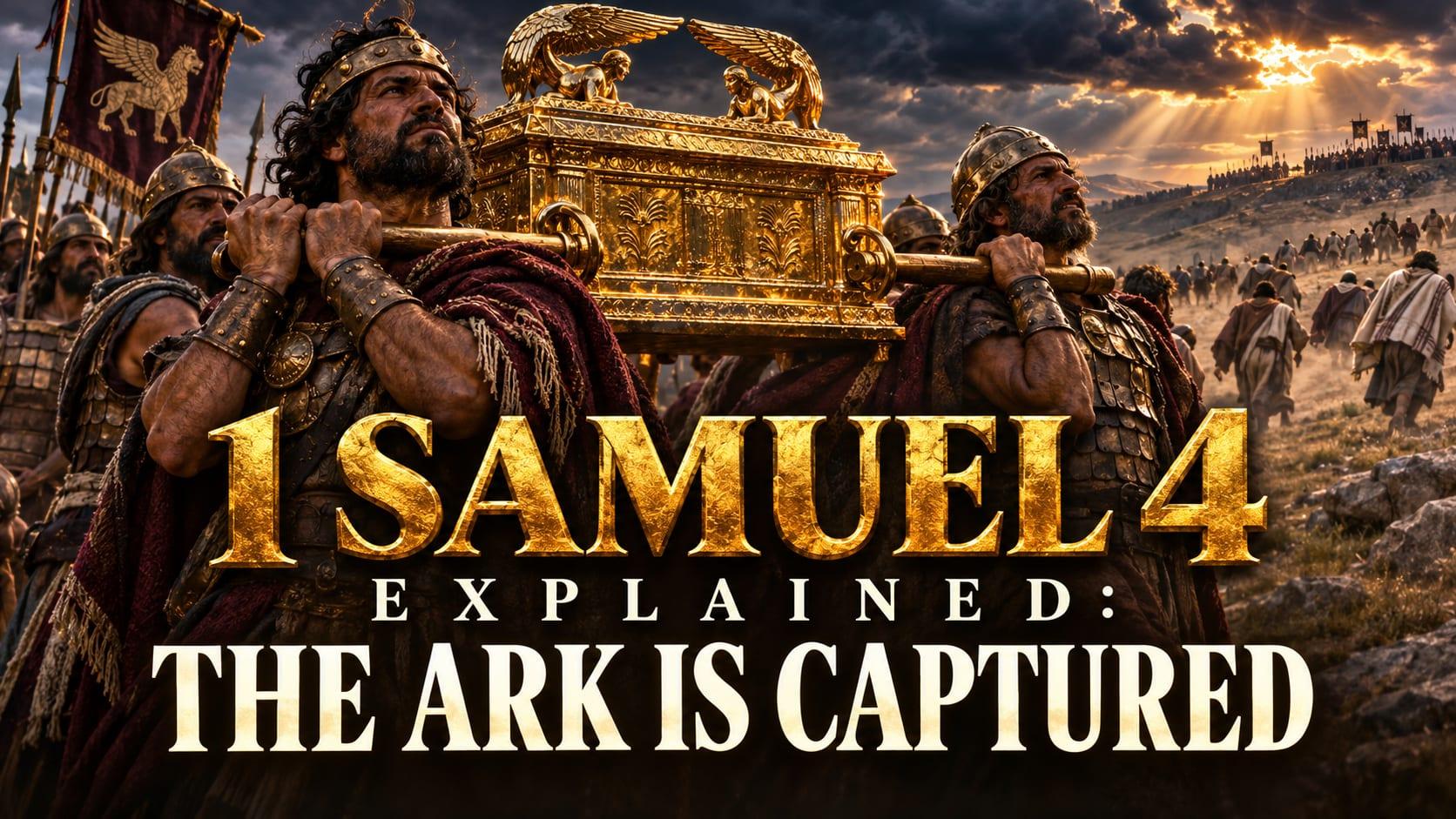
1 Samuel 4 explained is the chapter where the ark of the covenant, the single most sacred object in Israel, gets carried onto a battlefield like a weapon and ends up in enemy hands by nightfall. Thirty thousand soldiers die. Two corrupt priests die exactly when they were told they would. An old man falls backward off his seat and never gets up.
Maybe you have reached for a familiar ritual or a trusted routine, hoping it would fix a problem you never actually brought to God.
- ❓ Why did the elders think fetching the ark would guarantee a win?
- ❓ Why did God let His own ark fall into pagan hands?
- ❓ Was Eli's death just an accident, or part of the judgment already announced?
- ❓ What does the name Ichabod actually mean, and why name a baby that?
📌 Nobody in this chapter asks God anything until it is far too late to matter. That one missing step explains almost everything that goes wrong in it.
Here is the whole chapter, in order: the first defeat, the elders' plan, the ark brought in, the second and far worse defeat, the messenger who runs to Shiloh, and the baby named for a loss nobody in that house will recover from.
What Happened Just Before This Chapter
1 Samuel 3 ended with Samuel established as a prophet from Dan to Beersheba, and with God speaking again at Shiloh after years of near silence. The judgment against Eli's house had now been announced twice, once by an unnamed man of God and once directly to Samuel: Hophni and Phinehas would die on the same day, and the priesthood would be stripped from Eli's line for good.
1 Samuel 4 explained is where that announced judgment stops being a prophecy and starts being a news report. Nothing in this chapter is new information to Eli. He has heard this exact ending twice already. What changes here is that it finally arrives, in a single terrible day, and it arrives alongside a national disaster nobody saw coming on that scale.

1 Samuel 4 Explained Verse by Verse
1. Israel Goes to War Without Asking Anyone (verses 1 and 2)
The chapter opens with a battle line, not a prayer.
"And the word of Samuel came to all Israel. Now Israel went out against the Philistines to battle, and pitched beside Ebenezer: and the Philistines pitched in Aphek."
💡 Samuel was just established as a true prophet in the previous chapter, but this verse never says Israel asked him anything before marching out. The text simply moves from Samuel's word reaching the nation to armies already camped opposite each other. Whatever decision sent Israel into this fight, it was not one anyone consulted God about first.
"And the Philistines put themselves in array against Israel: and when they joined battle, Israel was smitten before the Philistines: and they slew of the army in the field about four thousand men."
📌 Four thousand men are already dead before the ark ever enters the story. Whatever happens next with the ark, it is not the cause of this first defeat. Israel lost this fight on its own.
2. The Elders Ask the Wrong Question (verses 3 and 4)
Back in camp, grieving soldiers and their elders finally stop to think about why they lost.
"And when the people were come into the camp, the elders of Israel said, Wherefore hath the LORD smitten us to day before the Philistines? Let us fetch the ark of the covenant of the LORD out of Shiloh unto us, that, when it cometh among us, it may save us out of the hand of our enemies."
📌 The elders ask the right question and then skip straight past the real answer. "Wherefore hath the LORD smitten us" is a fair thing to ask. But instead of searching their own unfaithfulness, or sending for Samuel, or offering a sacrifice, they reach for an object. Bring the box, and the box will save us. That is the entire plan.
Compare this to how Joshua responded to Israel's defeat at Ai. Joshua tore his clothes and fell on his face before the ark asking God directly what had gone wrong, and the answer turned out to be hidden sin in the camp that needed to be dealt with before anything else. Here, nobody falls on their face. Nobody asks what is wrong with the camp itself, even though two of the men carrying the ark into battle are the same priests already named as corrupt.
"So the people sent to Shiloh, that they might bring from thence the ark of the covenant of the LORD of hosts, which dwelleth between the cherubims: and the two sons of Eli, Hophni and Phinehas, were there with the ark of the covenant of God."
⚠️ Whoever sent for the ark also got Hophni and Phinehas as part of the package. The two priests who stole from sacrifices and treated the tabernacle like their own property now walk onto a battlefield carrying the holiest object Israel has.
3. A Shout Loud Enough to Shake the Ground (verses 5 to 9)
When the ark reaches the camp, the reaction is immediate and loud.
"And when the ark of the covenant of the LORD came into the camp, all Israel shouted with a great shout, so that the earth rang again."
The Philistines hear it from their own camp and immediately understand what it means, without anyone telling them.
"And when the Philistines heard the noise of the shout, they said, What meaneth the noise of this great shout in the camp of the Hebrews? And they understood that the ark of the LORD was come into the camp."
"And the Philistines were afraid, for they said, God is come into the camp. And they said, Woe unto us! for there hath not been such a thing heretofore."
"Woe unto us! who shall deliver us out of the hand of these mighty Gods? these are the Gods that smote the Egyptians with all the plagues in the wilderness."
💡 The Philistines remember what God did to Egypt long before the Israelites in this chapter ever bring it up. Pagan soldiers who worship other gods entirely still know exactly what this God once did to the strongest army in the ancient world. That reputation terrifies them far more than it moves the Israelite elders to any real fear of the LORD.
📌 The Philistines treat God's reputation more seriously than Israel treats God Himself in this chapter. Their fear is real and specific. Israel's confidence is based on nothing but a box.
Terrified or not, the Philistine commanders talk themselves into fighting anyway.
"Be strong, and quit yourselves like men, O ye Philistines, that ye be not servants unto the Hebrews, as they have been to you: quit yourselves like men, and fight."

4. The Ark Is Taken, Two Prophecies Land on the Same Day (verses 10 and 11)
Whatever Israel expected the ark to guarantee, it does not happen.
"And the Philistines fought, and Israel was smitten, and they fled every man into his tent: and there was a very great slaughter; for there fell of Israel thirty thousand footmen."
"And the ark of God was taken; and the two sons of Eli, Hophni and Phinehas, were slain."
⚠️ Thirty thousand footmen fall in this second defeat, almost eight times the losses from the first battle, and it happens with the ark physically present in the camp. Whatever power the elders expected the ark to activate automatically, carrying it into battle guaranteed nothing. The ark was never a weapon. It was a sign of a covenant, and the men carrying it that day had spent years breaking that covenant in plain sight.
This is also the exact moment 1 Samuel 2's prophecy comes true, word for word.
"And this shall be a sign unto thee, that shall come upon thy two sons, on Hophni and Phinehas; in one day they shall die both of them."
📌 Two separate prophets, speaking years apart, both named this exact detail. One day. Both sons. Nothing vague about it, and nothing about it failed to happen.
5. Eli Falls (verses 12 to 18)
News of a disaster this size does not stay on the battlefield long.
"And there ran a man of Benjamin out of the army, and came to Shiloh the same day with his clothes rent, and with earth upon his head."
"And when he came, lo, Eli sat upon a seat by the wayside watching: for his heart trembled for the ark of God. And when the man came into the city, and told it, all the city cried out."
💡 Torn clothes and dust on the head were the standard signs of mourning and disaster in that culture, so the runner announces bad news with his whole appearance before he says a single word. Eli is already sitting and watching the road, his heart trembling for the ark specifically. He knows enough to be afraid before anyone tells him anything.
"And when Eli heard the noise of the crying, he said, What meaneth the noise of this tumult? And the man came in hastily, and told Eli."
"Now Eli was ninety and eight years old; and his eyes were dim, that he could not see."
⚠️ Eli cannot see the messenger coming. He can only hear the crying in the city before the actual report ever reaches him, which means he has to sit with dread for a stretch of time before he has any facts at all.
"And the man said unto Eli, I am he that came out of the army, and I fled to day out of the army. And he said, What is there done, my son?"
"And the messenger answered and said, Israel is fled before the Philistines, and there hath been also a great slaughter among the people, and thy two sons also, Hophni and Phinehas, are dead, and the ark of God is taken."
📌 The messenger lists four pieces of news in one breath, and he saves the ark for last. The army has fled. There has been great slaughter. Both sons are dead. And the ark is gone. Scripture itself seems to be telling you what breaks Eli first.
"And it came to pass, when he made mention of the ark of God, that he fell from off the seat backward by the side of the gate, and his neck brake, and he died: for he was an old man, and heavy. And he had judged Israel forty years."
📌 It is the ark, not the news of his own sons' deaths, that finally kills Eli. He survives hearing that Hophni and Phinehas are dead. The moment the messenger says the ark is taken, Eli falls backward and his neck breaks. Whatever else Eli failed to do as a father, that detail says plainly what he cared about most at the very end.
The chapter closes his life with one flat sentence: forty years as Israel's judge, ended on a seat by a gate, the same day both the sign he was given and the son of that sign's fulfillment ran out at once.

6. Ichabod: A Birth Named for a Loss (verses 19 to 22)
The chapter has one more death still owed, and one more birth to set beside it.
"And his daughter in law, Phinehas' wife, was with child, near to be delivered: and when she heard the tidings that the ark of God was taken, and that her father in law and her husband were dead, she bowed herself and travailed; for her pains came upon her."
⚠️ The same news that kills Eli sends his daughter in law into premature labor on the spot. Three generations of this family are struck in the space of a few verses: Eli, his son Phinehas, and now the grandson about to be born into a house that has lost almost everything in a single afternoon.
"And about the time of her death the women that stood by her said unto her, Fear not; for thou hast born a son. But she answered not, neither did she regard it."
💡 Hannah named her son Samuel while rejoicing, calling him a direct gift she had asked of the LORD. This unnamed woman dies giving birth to a son and cannot even bring herself to acknowledge the good news the women around her are trying to offer. Two births in the same book, two completely different households.
"And she named the child Ichabod, saying, The glory is departed from Israel: because the ark of God was taken, and because of her father in law and her husband."
"And she said, The glory is departed from Israel: for the ark of God is taken."
📌 She says the same sentence twice in two verses, as if it is the only thought left in her. The glory is departed. Not grief over her husband by name. Not fear for her newborn. The loss of the ark is what she names her own son after, with her last recorded words in Scripture.
Hebrew scholars generally read Ichabod as meaning something close to "no glory" or "where is the glory," though the exact sense of the name is debated. What every reading agrees on is the point the mother makes explicit twice over: whatever this family and this nation had, it is gone.
Hard Questions 1 Samuel 4 Raises
Did bringing the ark into battle count as real trust in God, or as treating a holy object like a lucky charm? What the text says: verse 3 records the elders' own stated reasoning, that the ark coming among them would save them, with no mention anywhere in the chapter of confession, sacrifice, or asking God anything before or after the decision. How this is read: nothing in the Old Testament treats the ark as a device that works automatically regardless of the nation's faithfulness. Joshua's response to defeat at Ai looked completely different: real inquiry of God, real searching for what had gone wrong. The elders here skip every one of those steps and go straight to logistics.
Why did God let His own ark, the sign of His presence, be captured by a pagan nation that worshipped Dagon? What the text says: this chapter simply reports the capture without commentary on why God allowed it. How this is read: Scripture elsewhere names this exact event directly, and not as a victory for Philistine gods.
"So that he forsook the tabernacle of Shiloh, the tent which he placed among men; And delivered his strength into captivity, and his glory into the enemy's hand. He gave his people over also unto the sword; and was wroth with his inheritance."
Centuries later, Jeremiah points back to this same moment as a direct warning to a temple that was starting to repeat Shiloh's mistake of trusting a sacred building instead of actual obedience.
"But go ye now unto my place which was in Shiloh, where I set my name at the first, and see what I did to it for the wickedness of my people Israel."
Both passages place the cause squarely on Israel's own unfaithfulness, not on any real contest between the LORD and Dagon. God was not defeated here. He withdrew.
Is it fair that thirty thousand soldiers died for sins that belonged mainly to two priests? What the text says: the judgment announced in 1 Samuel 2 and 1 Samuel 3 was specific to Eli's house, yet this chapter's worst casualties fall on the whole army. How this is read: the chapter itself shows a second failure that belongs to the whole nation, not just Eli's family. Nobody in Israel, from the elders down, sought God before this battle either time. The prophecy against Eli explains why Hophni and Phinehas died that day. It does not claim to explain every soldier's death, which the text ties instead to Israel marching into a second battle on the same broken assumption that cost them the first one.
Was Eli's death simply an old man's fall, or part of the judgment? What the text says: verse 18 describes a physical cause plainly, a heavy old man falling backward and breaking his neck, with no supernatural language attached to the fall itself. How this is read: the timing is what carries the weight, not the mechanism. Eli dies the same day his sons die exactly as foretold, closing out his forty years as judge at the precise moment the sign he was given years earlier comes to pass. An ordinary fall, on the one day it was always going to matter most.

Top Verses From 1 Samuel 4
1. 1 Samuel 4:3
"And when the people were come into the camp, the elders of Israel said, Wherefore hath the LORD smitten us to day before the Philistines? Let us fetch the ark of the covenant of the LORD out of Shiloh unto us, that, when it cometh among us, it may save us out of the hand of our enemies."
The right question followed by the wrong answer. Israel asks why they lost and reaches for an object instead of searching their own unfaithfulness.
2. 1 Samuel 4:10 and 11
"And the Philistines fought, and Israel was smitten, and they fled every man into his tent: and there was a very great slaughter; for there fell of Israel thirty thousand footmen. And the ark of God was taken; and the two sons of Eli, Hophni and Phinehas, were slain."
The ark guaranteed nothing. Thirty thousand soldiers fall with it physically present in the camp, and the exact prophecy from 1 Samuel 2 lands word for word.
3. 1 Samuel 4:18
"And it came to pass, when he made mention of the ark of God, that he fell from off the seat backward by the side of the gate, and his neck brake, and he died: for he was an old man, and heavy. And he had judged Israel forty years."
Not the report of his sons' deaths, but the report of the ark's loss, is what finally breaks Eli. Forty years of leadership end on a seat by a gate.
4. 1 Samuel 4:21 and 22
"And she named the child Ichabod, saying, The glory is departed from Israel: because the ark of God was taken, and because of her father in law and her husband. And she said, The glory is departed from Israel: for the ark of God is taken."
A mother says the same sentence twice while naming her newborn son. A whole chapter's grief compressed into one repeated line.
Frequently Asked Questions About 1 Samuel 4
What happened in 1 Samuel 4?
Israel lost a battle against the Philistines, then sent for the ark of the covenant believing it would guarantee victory. The ark was carried into a second battle, Israel lost again far worse, the ark was captured, and Hophni and Phinehas died exactly as prophesied. Eli died the same day on hearing the news, and his daughter in law died giving birth to a son she named Ichabod.
Why did Israel bring the ark of the covenant into battle?
After losing an initial battle, the elders decided the ark's presence would save them, as stated plainly in verse 3. Nothing in the chapter shows them consulting Samuel, offering a sacrifice, or asking God anything before making that decision.
Was it wrong for Israel to bring the ark into battle?
The ark itself was not forbidden from accompanying Israel in war elsewhere in Scripture. What this chapter shows going wrong is the assumption behind it, treating the ark as a guarantee of victory rather than as a sign of a covenant the nation was actively breaking through its corrupt priesthood.
Why did God allow the ark to be captured by the Philistines?
Psalm 78:60 to 62 describes this moment as God forsaking the tabernacle of Shiloh and giving His people over to the sword because of their unfaithfulness. The capture reflects God withdrawing His protection, not the Philistine god Dagon defeating Him.
What does Ichabod mean?
The name is generally understood to mean something like "no glory" or "where is the glory," fitting the explanation his mother gives twice in verses 21 and 22: the glory is departed from Israel because the ark was taken.
How did Eli die, and was it part of the prophecy against his house?
Eli fell backward off his seat and broke his neck upon hearing that the ark had been taken, as described in verse 18. The text gives a plain physical cause, but the timing places his death on the exact day the judgment against his family, first announced in 1 Samuel 2, was fulfilled in full.
Did Hophni and Phinehas's deaths fulfill the prophecy from 1 Samuel 2?
Yes, precisely. 1 Samuel 2:34 promised both sons would die in one day as a sign, and 1 Samuel 4:11 reports exactly that, with no gap between the prophecy and its fulfillment.
Why were the Philistines afraid when they heard Israel's shout?
They understood immediately that the ark meant God's presence had entered the camp, and they remembered what that same God had once done to Egypt through the plagues. Their fear, named specifically in verses 7 and 8, shows they took God's reputation more seriously in that moment than Israel's own elders did.
Does this chapter mean God lost to the Philistine gods?
No. Scripture never frames the outcome as a contest between the LORD and Dagon. Psalm 78 and Jeremiah 7 both describe this event as God withdrawing because of Israel's own unfaithfulness, and the very next chapter shows Dagon itself unable to remain standing in the ark's presence.
How does 1 Samuel 4 connect to 1 Samuel 2 and 3?
This chapter is where the judgment announced twice before, first by an unnamed man of God and then directly to Samuel, actually comes to pass. Nothing in the outcome is new information. What changes is that the warning finally becomes history.
Final Thoughts
1 Samuel 4 is a hard chapter because almost nothing in it is reversible by the end.
📌 A sacred object is never a substitute for an honest relationship with God. Israel treated the ark like a guaranteed outcome and lost worse than before. The ark was always a sign, never a weapon.
📌 Judgment that is announced in advance still lands exactly on schedule. Two separate warnings about Hophni and Phinehas, given years apart, both came true on the very same day, down to the detail.
Eli spent a lifetime around the ark and still could not bring himself to discipline the sons who were disgracing it. His last moment on earth was not grief for his sons. It was the ark.
So here is your one next step.
Ask yourself honestly this week whether you have been reaching for a familiar routine or ritual to fix something that actually needs real repentance and real obedience first.