📖 1 Samuel 5 Explained: Dagon Falls Before the Ark
The Philistines just won the greatest trophy of their lives.
They carry it straight into the house of their own god, to show him off.
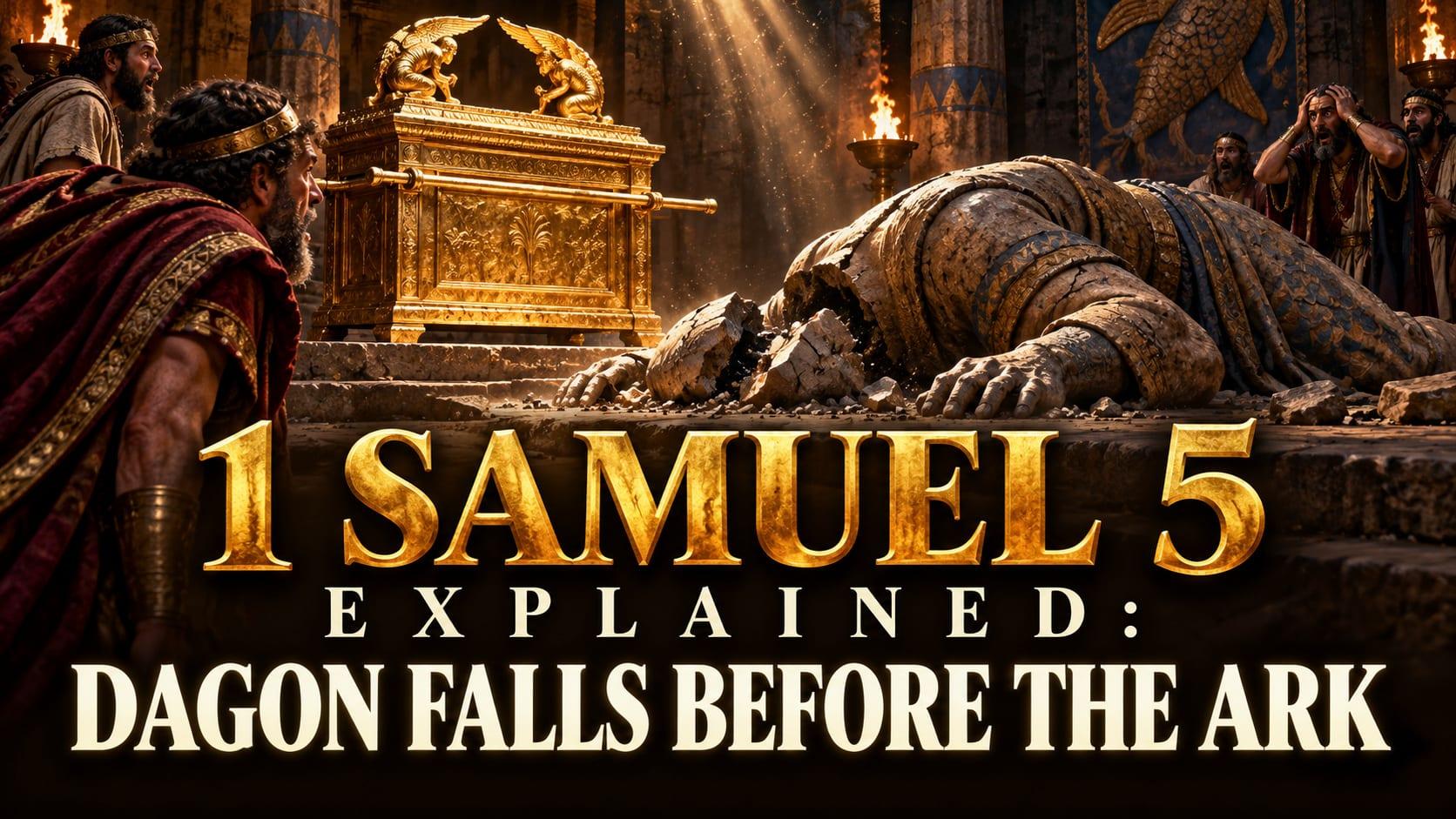
1 Samuel 5 explained is the chapter where that trophy stops behaving like one. The statue it is set beside starts falling down in front of it. Within weeks, the men who fought a battle to capture this object are begging each other to get rid of it before it kills anyone else.
Maybe you have assumed that once something good falls into the wrong hands, it stops mattering what God thinks about it.
- ❓ Why did the Philistines set the ark right next to their own god, Dagon?
- ❓ What does it mean that Dagon fell on his face, twice?
- ❓ What were the emerods that struck Ashdod, Gath, and Ekron?
- ❓ Why did the Philistines keep moving the ark instead of just sending it home?
📌 Israel loses this ark without putting up a fight for it. God does not need Israel in the room to defend His own name.
Here is the whole chapter, in order: the ark set beside Dagon, Dagon falling twice, a disease that spreads with the ark, and three cities in a row begging to pass the problem somewhere else.
What Happened Just Before This Chapter
1 Samuel 4 ended about as badly as a chapter can end. Israel lost thirty thousand soldiers in a single battle, Hophni and Phinehas died exactly as two separate prophecies said they would, Eli fell backward off his seat and broke his neck the moment he heard the ark was gone, and his daughter in law died giving birth to a son she named Ichabod, saying the glory had left Israel.
1 Samuel 5 explained picks up with the ark no longer in Israel's story at all. It is sitting in enemy territory, in the hands of people who worship a god named Dagon, and the chapter never once checks back in on Israel to see how they are handling the loss. For twelve verses, Israel is not even in the room. The chapter only follows the ark, and what starts happening to the people who think they won it.

1 Samuel 5 Explained Verse by Verse
1. A Trophy Set Beside a Rival God (verses 1 and 2)
The chapter opens with the ark on the move, carried deep into Philistine country.
"And the Philistines took the ark of God, and brought it from Ebenezer unto Ashdod. When the Philistines took the ark of God, they brought it into the house of Dagon, and set it by Dagon."
Ashdod was one of five major Philistine cities, along with Gath and Ekron, both of which show up later in this same chapter. Dagon was the chief god of the Philistines, usually connected to grain and the harvest. Setting a captured people's sacred object beside your own god's statue was a normal victory move in that world. It said, plainly, our god beat your god.
📌 Nobody in Ashdod asked whether that claim was actually true. They just assumed it, and arranged the furniture to match. The rest of the chapter is Dagon disagreeing with his own worshippers.
2. Dagon Falls Once (verse 3)
The victory display does not survive its first night.
"And when they of Ashdod arose early on the morrow, behold, Dagon was fallen upon his face to the earth before the ark of the LORD. And they took Dagon, and set him in his place again."
💡 "Fallen upon his face" is the exact posture of a worshipper bowing down. Dagon is not knocked sideways or toppled by an earthquake. He is found in the one position a god is never supposed to take in front of anything, flat on the ground, face down, in front of the ark.
The men of Ashdod do not take the hint. They pick Dagon back up and put him exactly where he was, as if the statue simply slipped. Pharaoh's magicians reacted a similar way centuries earlier, matching the first plagues with their own tricks right up until they could not anymore. Aaron's rod swallowed theirs and still did not end the contest on the spot. One bent knee from a statue was never going to convince Ashdod either, at least not the first time.
3. Dagon Falls Again, and Loses What a God Should Never Lose (verses 4 and 5)
The next morning removes any room for explaining it away as an accident.
"And when they arose early on the morrow morning, behold, Dagon was fallen upon his face to the ground before the ark of the LORD; and the head of Dagon and both the palms of his hands were cut off upon the threshold; only the stump of Dagon was left to him."
⚠️ This is not a second fall. It is a dismantling. Dagon is found face down again, and this time his head and both hands have broken off, left lying right on the threshold he supposedly guards. Only a stump remains where the statue used to stand whole. Whatever put him on the ground the first night, nobody could call a coincidence twice.
Centuries later, a song in the Psalms describes idols in general with language that fits this exact scene almost too well.
"Their idols are silver and gold, the work of men's hands. They have mouths, but they speak not: eyes have they, but they see not: They have ears, but they hear not: noses have they, but they smell not: They have hands, but they handle not: feet have they, but they walk not: neither speak they through their throat."
📌 Dagon's own hands end up cut off and useless on the floor of his temple, the exact detail that song mocks about every idol everywhere. A god with no working hands cannot even hold himself up, let alone defend the people who carried an ark into his house to prove he was the stronger one.
"Therefore neither the priests of Dagon, nor any that come into Dagon's house, tread on the threshold of Dagon in Ashdod unto this day."
💡 This verse tells you the custom was still being kept at the time it was written down, long after the event itself. A small superstition, stepping carefully around a broken god's doorway, outlived the explanation for why anyone started doing it.

4. The Hand of the LORD Turns Heavy on Ashdod (verses 6 and 7)
A broken statue was not the end of what Ashdod had to deal with.
"But the hand of the LORD was heavy upon them of Ashdod, and he destroyed them, and smote them with emerods, even Ashdod and the coasts thereof."
💡 Emerods were a painful swelling or tumor. Exactly what medical condition the Hebrew word describes is genuinely debated, since it only shows up a handful of times in the Old Testament. Some older translations read it as hemorrhoids. What every reading agrees on is that it was physically painful, it spread beyond the city itself into the surrounding territory, and it arrived right alongside the ark.
The people of Ashdod reach the obvious conclusion fast.
"And when the men of Ashdod saw that it was so, they said, The ark of the God of Israel shall not abide with us: for his hand is sore upon us, and upon Dagon our god."
📌 Notice what they do not say. They never claim Dagon fought back or lost a close contest. They say the LORD's hand is heavy on them and on Dagon alike, as if their own god were just one more casualty standing next to them. Their solution is not repentance. It is distance. Get the object out of our city.
5. Gath Learns the Same Lesson (verses 8 and 9)
Ashdod cannot solve this alone, so it becomes a problem for the whole region.
"They sent therefore and gathered all the lords of the Philistines unto them, and said, What shall we do with the ark of the God of Israel? And they answered, Let the ark of the God of Israel be carried about unto Gath. And they carried the ark of the God of Israel about thither."
⚠️ The plan is to relocate the ark, not to return it. Nobody in this meeting suggests sending it back to Israel. The five lords of the Philistines treat this like a problem that can be handed to a neighboring city instead of a sign that needs to be obeyed. Gath inherits the ark with no warning about what came with it in Ashdod.
"And it was so, that, after they had carried it about, the hand of the LORD was against the city with a very great destruction: and he smote the men of the city, both small and great, and they had emerods in their secret parts."
📌 Moving the ark did not move the problem away from it. It moved the problem to wherever the ark went next. "Both small and great" means this was not limited to leaders or soldiers. The whole city, regardless of rank, is struck the same way Ashdod was.
6. Ekron Begs Before the Ark Even Arrives (verses 10 to 12)
By the third city, nobody needs to wait and see what happens.
"Therefore they sent the ark of God to Ekron. And it came to pass, as the ark of God came to Ekron, that the Ekronites cried out, saying, They have brought about the ark of the God of Israel to us, to slay us and our people."
📌 Ekron reacts before a single person there has been struck with anything. Word of Ashdod and Gath has traveled fast enough that the whole city cries out on arrival. Two cities were enough evidence. Nobody in Ekron is willing to wait for a third data point.
"So they sent and gathered together all the lords of the Philistines, and said, Send away the ark of the God of Israel, and let it go again to his own place, that it slay us not, and our people: for there was a deadly destruction throughout all the city; the hand of God was very heavy there."
"And the men that died not were smitten with the emerods: and the cry of the city went up to heaven."
💡 For the first time in the chapter, somebody uses the right words. "Let it go again to his own place" finally names the actual solution, three cities and an unknown number of deaths after the ark first entered Dagon's temple. "The cry of the city went up to heaven" closes the chapter on a note that sounds almost like a prayer, even though nobody here worships the God they are crying out to.

Hard Questions 1 Samuel 5 Raises
Why did the Philistines set the ark right next to Dagon in the first place? What the text says: verse 2 reports the act without explaining the reasoning behind it. How this is read: placing a defeated nation's sacred object beside the victor's own god was a normal way ancient peoples announced a conquest, treating the outcome of a battle as proof that one god had beaten another. The chapter spends the rest of its length showing that assumption was wrong.
Does Dagon falling down mean he was a real, lesser god that the LORD defeated? What the text says: the narrative only describes a statue falling and breaking, with no commentary on what, if anything, stood behind it. How this is read: Scripture elsewhere describes idols as lifeless objects, not weaker rival powers.
"Thou shalt have no other gods before me. Thou shalt not make unto thee any graven image, or any likeness of any thing that is in heaven above, or that is in the earth beneath, or that is in the water under the earth: Thou shalt not bow down thyself to them, nor serve them: for I the LORD thy God am a jealous God"
A statue with no working hands or head, lying on the ground it was supposed to guard, reads less like one god losing a fight to another and more like the point Exodus 20 already makes plainly. There was never a contest between equals here.
What were the emerods, exactly? What the text says: verses 6, 9, and 12 all name the same affliction without describing its symptoms beyond painful swelling. How this is read: the precise medical condition behind the Hebrew word is genuinely uncertain, and honest readers should hold that loosely rather than naming it with more confidence than the text supports. What is certain is that it struck in proportion to how long each city kept the ark, and it stopped being a mystery to anyone after the second outbreak.
Why did the Philistines move the ark to Gath and Ekron instead of sending it back to Israel right after Ashdod? What the text says: verse 8 records the lords choosing to carry the ark to Gath, with no mention of returning it considered at that meeting. How this is read: relocating a problem is often easier than admitting what caused it. Ashdod could tell itself the trouble was local. Only after two more cities suffered the identical pattern did "send it back" finally become the plan, in the very last verses of the chapter.
Top Verses From 1 Samuel 5
1. 1 Samuel 5:3
"And when they of Ashdod arose early on the morrow, behold, Dagon was fallen upon his face to the earth before the ark of the LORD. And they took Dagon, and set him in his place again."
A rival god found bowing, and his own worshippers stand him back up rather than ask what it means. The whole chapter grows out of that first refusal to take the hint.
2. 1 Samuel 5:4
"And when they arose early on the morrow morning, behold, Dagon was fallen upon his face to the ground before the ark of the LORD; and the head of Dagon and both the palms of his hands were cut off upon the threshold; only the stump of Dagon was left to him."
A statue that supposedly represents strength loses its head and both hands in one night, leaving nothing standing but a stump on its own doorstep.

3. 1 Samuel 5:7
"And when the men of Ashdod saw that it was so, they said, The ark of the God of Israel shall not abide with us: for his hand is sore upon us, and upon Dagon our god."
The men of Ashdod never claim Dagon fought and lost. They lump their own god in with themselves as another casualty, which says more than they probably meant it to.
4. 1 Samuel 5:11
"So they sent and gathered together all the lords of the Philistines, and said, Send away the ark of the God of Israel, and let it go again to his own place, that it slay us not, and our people: for there was a deadly destruction throughout all the city; the hand of God was very heavy there."
The right answer, finally spoken, after two cities already learned it the hard way. Sending the ark home was always the only real solution on offer.
Frequently Asked Questions About 1 Samuel 5
What happened in 1 Samuel 5?
The Philistines placed the captured ark of the covenant in the temple of their god Dagon at Ashdod. Dagon's statue fell down twice, the second time losing its head and hands, and the city was then struck with a painful affliction called emerods. The ark was moved to Gath and then Ekron, and the same destruction followed it to both cities until the Philistine leaders finally agreed to send it back to Israel.
Who was Dagon in the Bible?
Dagon was the chief god of the Philistines, most closely associated with grain and the harvest. His temple in Ashdod was prominent enough to house a national trophy like the captured ark, and his statue appears again later in Samson's story, where the Philistines credit Dagon with handing Samson over to them.
Why did Dagon fall down before the ark?
The text does not explain the mechanism, only that it happened twice in two consecutive mornings. The posture, fallen on his face, is the exact position of someone bowing down, which reads as a plain reversal of what the Philistines intended when they set him beside their trophy in the first place.
What does it mean that Dagon lost his head and hands?
A head and hands cut off and left on the threshold leave the statue unable to see, speak, or act in any of the ways a god was supposed to. It is a vivid picture of the same point Psalm 115 makes about every idol: hands that cannot handle anything are no real defense for anyone who trusts them.
What were emerods?
Emerods were a painful swelling or tumor, though the exact medical condition behind the Hebrew word is uncertain since it appears only a handful of times in the Old Testament. Whatever it was, it struck Ashdod, Gath, and Ekron in the same pattern, each time soon after the ark arrived.
Why did the Philistines keep moving the ark instead of sending it home right away?
Ashdod's leaders chose to send the ark to Gath rather than consider returning it, treating the trouble as something that could be handed off instead of a sign that needed to be obeyed. Only after Gath and then Ekron suffered the identical affliction did the Philistine lords finally agree, in the chapter's last verses, that sending it back to Israel was the only real option left.
Does 1 Samuel 5 mean Dagon was a real but weaker god?
Scripture consistently describes idols as lifeless objects made by human hands rather than lesser rival powers, which fits what happens to Dagon here. A statue with no working head or hands, lying broken on its own doorstep, reads as exposure rather than a contest between two real gods.
Why is the custom about the threshold mentioned in verse 5?
The verse notes that priests still avoided stepping on Dagon's threshold at the time the book was written, long after the original event. It shows the memory of Dagon's humiliation outlasted the generation that witnessed it, turning into a lasting superstition in Ashdod itself.
How does 1 Samuel 5 connect to 1 Samuel 4?
1 Samuel 4 ended with Israel defeated and the ark captured, seemingly a total loss. 1 Samuel 5 shows that losing the ark to an enemy never put it, or the God it represented, under anyone's control. The disaster that looked final in one chapter becomes a humiliation for the other side in the very next one.
Final Thoughts
1 Samuel 5 never mentions Israel once, and that is exactly the point.
📌 God did not need Israel's army, or even Israel's attention, to defend His own name. He did it alone, inside the enemy's own temple, while the nation that lost the ark was still mourning Eli and naming a baby Ichabod.
📌 An idol propped back up is still an idol. Ashdod picked Dagon off the floor once and tried to pretend nothing had happened. The second morning removed that option for good.
📌 Relocating a problem is not the same as solving it. Three cities suffered the same affliction because the first two tried to pass it along instead of asking what it actually required.
So here is your one next step.
If there is a problem in your life that you have been moving from place to place instead of actually sending back where it belongs, name it honestly this week instead of handing it off one more time.