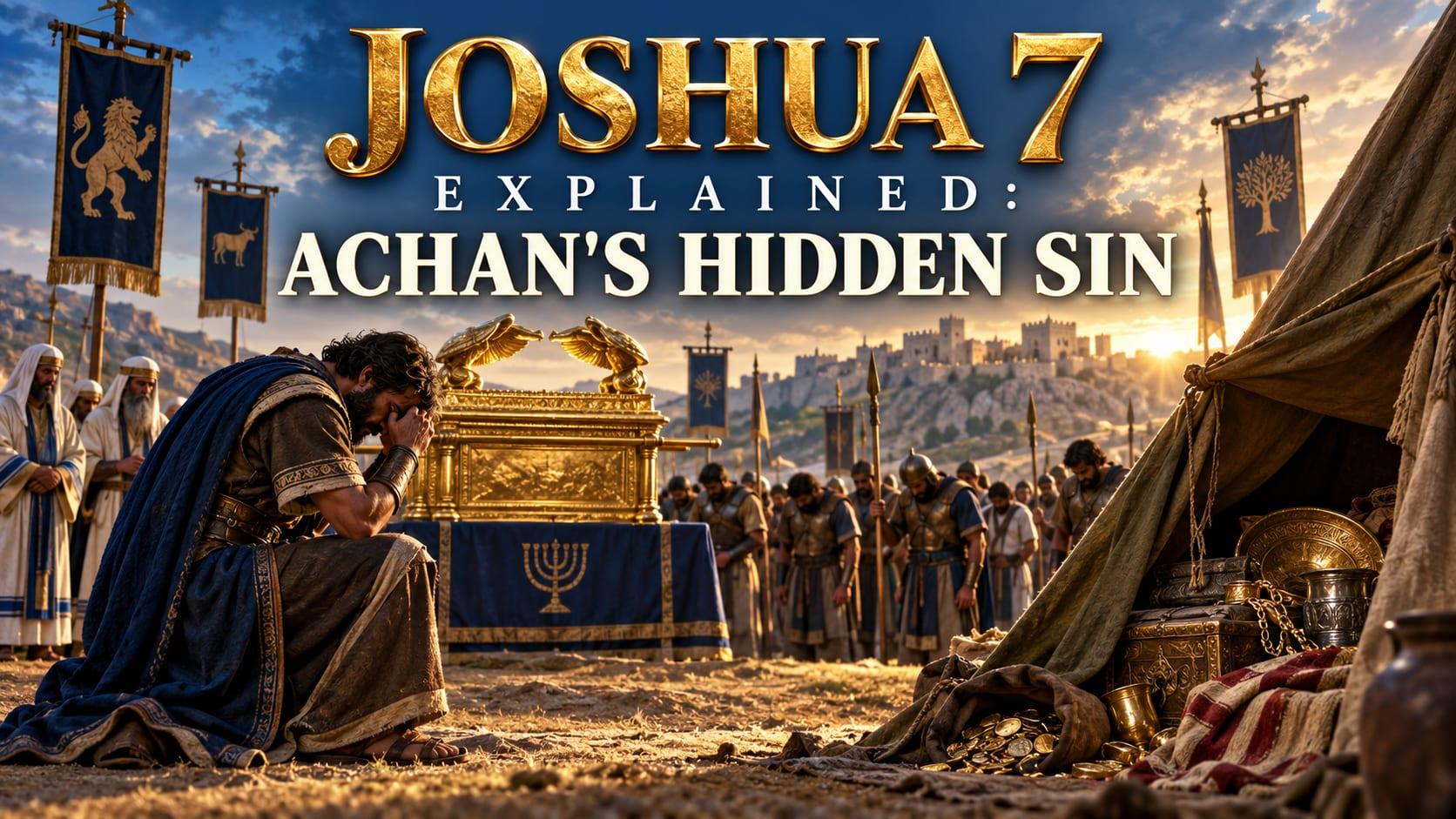
📖 Joshua 7 Explained: Achan's Hidden Sin and the Defeat at Ai
Jericho fell without Israel striking a single blow. Then a city a fraction of its size sends Israelite soldiers running for their lives.
Joshua 7 explained is the chapter where the winning streak breaks, and the reason has nothing to do with Ai's walls or Ai's army. One man made a quiet decision inside his own tent back at Jericho, and because of it, the whole camp cannot stand in front of an enemy that should never have been a real threat at all.
Maybe the setback you are facing right now does not add up either. You did what seemed right, or thought you did, and the ground still gave way under you.
- ❓ Why did a small city like Ai defeat an army that had just leveled Jericho?
- ❓ What exactly did Achan take, and why did it matter enough to cost thirty six lives?
- ❓ Why did God narrow the search with lots, tribe to family to household to one man, instead of simply naming Achan?
- ❓ Did Achan's whole household really pay for a sin only he committed?
📌 Achan's sin was hidden from every person in the camp. It was never hidden from God, and it cost Israel exactly as much as if the whole nation had done it.
This walkthrough goes through the whole chapter in order: the sin the narrator tells you about before anyone inside the story knows it, the failed attack on Ai, Joshua tearing his own clothes before the ark, the lots closing in one step at a time, Achan's confession, and the judgment carried out in the valley that still carries the name of what happened there.
Read slowly. Hidden sin feels private right up until the moment it stops being hidden.
What Happened Just Before This Chapter
Joshua 6 ended with Jericho burned to the ground, Rahab's household rescued exactly as promised, and a curse spoken over anyone who ever rebuilt the city. In the middle of that chapter sat a command easy to read past in the excitement of the wall falling.
"And ye, in any wise keep yourselves from the accursed thing, lest ye make yourselves accursed, when ye take of the accursed thing, and make the camp of Israel a curse, and trouble it. But all the silver, and gold, and vessels of brass and iron, are consecrated unto the LORD: they shall come into the treasury of the LORD."
That warning was not a suggestion. The gold and silver of Jericho belonged to the LORD alone, and touching it for yourself was described as making yourself accursed, the exact word used for the devoted things themselves. Joshua 7 opens on the far side of that warning, and it answers a question the previous chapter never had to ask out loud. Did everyone actually listen?

Joshua 7 Explained Verse by Verse
1. A Sin the Reader Knows Before Joshua Does (verse 1)
The chapter opens by telling you something nobody inside the story knows yet.
"But the children of Israel committed a trespass in the accursed thing: for Achan, the son of Carmi, the son of Zabdi, the son of Zerah, of the tribe of Judah, took of the accursed thing: and the anger of the LORD was kindled against the children of Israel."
📌 Notice the order of information. The narrator names the man, his father, his grandfather, and his great grandfather, and states exactly what he did, before Joshua or a single soldier has any idea anything is wrong. The rest of the chapter will spend twenty five more verses making Israel search for information you were already handed in the first sentence.
Trespass here means a violation of something set apart, not a small slip. Achan is identified by a full line of ancestry, tribe of Judah included, which matters later when the search for him narrows tribe by tribe. The LORD's anger is stated as fact in the same verse, against the whole nation, even though only one man had sinned.
2. A City Small Enough to Beat Without Really Trying (verses 2 to 5)
With Jericho behind them, Joshua turns his attention to a much smaller target.
"And Joshua sent men from Jericho to Ai, which is beside Bethaven, on the east side of Bethel, and spake unto them, saying, Go up and view the country. And the men went up and viewed Ai."
"And they returned to Joshua, and said unto him, Let not all the people go up; but let about two or three thousand men go up and smite Ai; and make not all the people to labour thither; for they are but few."
The spies are confident, almost casual. After a fortified city as large as Jericho, Ai looks like nothing worth tiring the whole army over. Three thousand men go up instead.
"So there went up thither of the people about three thousand men: and they fled before the men of Ai. And the men of Ai smote of them about thirty and six men: for they chased them from before the gate even unto Shebarim, and smote them in the going down: wherefore the hearts of the people melted, and became as water."
⚠️ Read that last phrase again. "Hearts melted" is the same language Joshua 5:1 used for every king in Canaan when they heard what God had done at the Jordan. Now the same words describe Israel. The nation that terrified every king in the land a chapter ago is now the one running.
It gets worse set against what God had already told Joshua before any of this began: be strong and of a good courage, be not afraid, neither be dismayed. Thirty six men are dead, and the whole camp is suddenly living out the opposite of that promise, for a reason nobody on the battlefield understands yet.
3. Joshua Falls on His Face (verses 6 to 9)
Joshua's response to the news is not strategy. It is grief.
"And Joshua rent his clothes, and fell to the earth upon his face before the ark of the LORD until the eventide, he and the elders of Israel, and put dust upon their heads."
Torn clothes, dust, lying face down until evening. Every elder in Israel joins him. Then Joshua speaks, and the prayer that comes out sounds almost like doubt.
"And Joshua said, Alas, O LORD God, wherefore hast thou at all brought this people over Jordan, to deliver us into the hand of the Amorites, to destroy us? would to God we had been content, and dwelt on the other side Jordan!"
"O LORD, what shall I say, when Israel turneth their backs before their enemies! For the Canaanites and all the inhabitants of the land shall hear of it, and shall environ us round, and cut off our name from the earth: and what wilt thou do unto thy great name?"
📌 Joshua does not know about Achan yet, so his questions go straight at God instead. Why bring us here just to let us be destroyed. He even echoes the wilderness generation's old complaint, wishing they had stayed on the other side of the Jordan, the very unbelief that cost an entire generation the land in the first place.
💡 The closing line of the prayer is the real weight of it. Joshua is not only worried about Israel. He is worried about God's own reputation among the nations watching, "thy great name," the same concern Moses raised for Israel more than once in the wilderness.

4. God's Answer Is a Diagnosis, Not Comfort (verses 10 to 15)
The LORD does not sympathize with the lament. He cuts it off.
"And the LORD said unto Joshua, Get thee up; wherefore liest thou thus upon thy face?"
"Israel hath sinned, and they have also transgressed my covenant which I commanded them: for they have even taken of the accursed thing, and have also stolen, and dissembled also, and they have put it even among their own stuff."
⚠️ Six separate actions stack up in a single breath: sinned, transgressed, taken, stolen, dissembled, and put it among their own stuff. God names what Achan did with no softening at all, and he names it as Israel's sin, singular man and whole nation treated as one unit. The defeat at Ai was never about Ai's strength. It was already decided the moment the accursed thing went into that tent.
"Therefore the children of Israel could not stand before their enemies, but turned their backs before their enemies, because they were accursed: neither will I be with you any more, except ye destroy the accursed from among you."
That is the real stakes of the chapter, stated plainly. God's own presence, the thing that had carried Israel across the Jordan and flattened Jericho, is now on hold until this one hidden theft is found and removed. Then come the instructions for how to find it.
"Up, sanctify the people, and say, Sanctify yourselves against to morrow: for thus saith the LORD God of Israel, There is an accursed thing in the midst of thee, O Israel: thou canst not stand before thine enemies, until ye take away the accursed thing from among you."
This is also exactly what Deuteronomy 7 had already warned Israel about before they ever crossed the Jordan: do not desire the silver or the gold on a devoted thing and take it for yourself, because it is a cursed thing, and bringing it into your own house makes you a cursed thing right along with it. Achan did not break an unfamiliar rule. He broke one Israel had already been told, twice now, in plain words.
5. The Lots Close In, One Step at a Time (verses 16 to 18)
The LORD gives Joshua a method, and the chapter slows down to narrate every single step of it.
"So Joshua rose up early in the morning, and brought Israel by their tribes; and the tribe of Judah was taken: And he brought the family of Judah; and he took the family of the Zarhites: and he brought the family of the Zarhites man by man; and Zabdi was taken: And he brought his household man by man; and Achan, the son of Carmi, the son of Zabdi, the son of Zerah, of the tribe of Judah, was taken."
💡 Tribe, then family, then household, then one man. Twelve tribes narrow to one. One family inside that tribe narrows further. One household inside that family narrows again, until a single name is left standing. The text repeats Achan's full genealogy a second time, word for word from verse 1, closing the loop the reader was already let in on.
📌 Nobody in the camp learns anything the reader did not already know in the first verse. The suspense in this section belongs entirely to Israel. God already knew exactly who it was. The whole point of the search was never information for God. It was Israel coming face to face, slowly and publicly, with what one of their own had done.

6. "Indeed I Have Sinned": Achan's Confession (verses 19 to 21)
Joshua speaks to Achan with unexpected gentleness for a man about to face judgment.
"And Joshua said unto Achan, My son, give, I pray thee, glory to the LORD God of Israel, and make confession unto him; and tell me now what thou hast done; hide it not from me."
"My son" is not a small detail. Even here, Joshua invites honesty rather than demanding it with threats. Achan answers without a single excuse.
"And Achan answered Joshua, and said, Indeed I have sinned against the LORD God of Israel, and thus and thus have I done: When I saw among the spoils a goodly Babylonish garment, and two hundred shekels of silver, and a wedge of gold of fifty shekels weight, then I coveted them, and took them; and, behold, they are hid in the earth in the midst of my tent, and the silver under it."
📌 Saw, coveted, took, hid. Four steps, in that order, and Achan names every one of them himself. Nothing in his confession tries to shift blame the way Adam and Eve once did in the garden. He simply states what happened. A fine garment, a stack of silver, one wedge of gold, worth noticing but nowhere near enough to explain the cost that followed.
💡 "Hid in the earth in the midst of my tent" is the detail that ties the whole chapter together. The sin stayed buried, literally, under the ground of his own home, invisible to every person in the camp except the one who buried it and the God who saw it anyway.
7. Judgment in the Valley Named for Trouble (verses 22 to 26)
Messengers confirm every word of the confession before anything else happens.
"So Joshua sent messengers, and they ran unto the tent; and, behold, it was hid in his tent, and the silver under it. And they took them out of the midst of the tent, and brought them unto Joshua, and unto all the children of Israel, and laid them out before the LORD."
The stolen things are laid out in front of everyone, before the LORD, exactly where they should have gone in the first place, straight into His treasury rather than under a tent floor.
"And Joshua, and all Israel with him, took Achan the son of Zerah, and the silver, and the garment, and the wedge of gold, and his sons, and his daughters, and his oxen, and his asses, and his sheep, and his tent, and all that he had: and they brought them unto the valley of Achor."
"And Joshua said, Why hast thou troubled us? the LORD shall trouble thee this day. And all Israel stoned him with stones, and burned them with fire, after they had stoned them with stones."
⚠️ Joshua's own words become the name of the place. "Why hast thou troubled us, the LORD shall trouble thee" is not a figure of speech. The valley is named directly after that sentence in the very next verse.
"And they raised over him a great heap of stones unto this day. So the LORD turned from the fierceness of his anger. Wherefore the name of that place was called, The valley of Achor, unto this day."
💡 Achor means trouble, and the chapter makes sure you cannot miss the connection. Achan's own name and the valley's name sound almost identical in Hebrew, a wordplay that ties the man to the trouble he caused permanently. Only after this is finished does the chapter say the LORD's anger actually turned. The defeat at Ai never had anything to do with Ai. It ends the moment the hidden thing is no longer hidden.

Hard Questions Joshua 7 Raises
Did Achan's sons and daughters die along with him? What the text says: verse 24 lists Achan's sons, daughters, animals, and tent all being brought to the valley together with him, but verse 25 shifts to singular language, "stoned him," before switching back to plural, "burned them," "stoned them," which leaves real ambiguity about exactly who the stones fell on. How Christians read it: some take the plain, surface reading that the household was executed together with Achan, consistent with how an entire family or household could be treated as one unit under covenant law in this period. Others point to Deuteronomy 24:16, which states that fathers are not put to death for their children, nor children for their fathers, and argue the family was brought along only as witnesses to the judgment and to the removal of a household now tied to something accursed, not as people being executed themselves. The chapter does not settle this cleanly either way.
Why did thirty six men who had nothing to do with Achan's theft die in the attack on Ai? What the text says: verse 11 and verse 12 describe the sin as Israel's sin, not only Achan's, and tie the entire army's defeat directly to it, with no separate explanation offered for why those particular men fell. What this reflects: Israel is treated throughout Joshua as one body under one covenant, the same framework that let the whole nation share in the blessing of Jericho falling. A covenant community that shares completely in victory, in this chapter, shares completely in the consequence of hidden sin inside it as well. The text does not say this makes the thirty six deaths easy to accept. It only states that this is how the chapter presents what happened.
Was this harsh punishment for taking a garment and some metal? What the text says: Achan's theft directly violated a specific, recent, repeated command about things devoted entirely to God from the first city taken in the conquest, not an ordinary case of stealing from another person. How this fits the larger pattern: nothing in Joshua 7 suggests this penalty applies to everyday theft under Israel's law generally. The severity is tied to what was taken, items set apart for God alone at the start of a conquest meant to prove whether Israel would obey completely, and to the cost that one hidden act had already produced before anyone even knew Achan's name.
Top Verses From Joshua 7
1. Joshua 7:11
"Israel hath sinned, and they have also transgressed my covenant which I commanded them: for they have even taken of the accursed thing, and have also stolen, and dissembled also, and they have put it even among their own stuff."
God names the exact sin before Joshua ever finds out who committed it, and names it as belonging to all of Israel, not only to the one man responsible.
2. Joshua 7:12
"Therefore the children of Israel could not stand before their enemies, but turned their backs before their enemies, because they were accursed: neither will I be with you any more, except ye destroy the accursed from among you."
The real stakes of the whole chapter in one sentence. Not the loss of a battle, but the loss of God's own presence, which nothing else in Israel's arsenal could replace.
3. Joshua 7:20 and 21
"And Achan answered Joshua, and said, Indeed I have sinned against the LORD God of Israel, and thus and thus have I done: When I saw among the spoils a goodly Babylonish garment, and two hundred shekels of silver, and a wedge of gold of fifty shekels weight, then I coveted them, and took them; and, behold, they are hid in the earth in the midst of my tent, and the silver under it."
The anatomy of hidden sin, told plainly by the man who committed it. He saw, he wanted, he took, he buried it, with no excuse offered for any step.
4. Joshua 7:25
"And Joshua said, Why hast thou troubled us? the LORD shall trouble thee this day. And all Israel stoned him with stones, and burned them with fire, after they had stoned them with stones."
A sentence that becomes the permanent name of the place where it was spoken, in the very next verse.
5. Joshua 7:5
"And the men of Ai smote of them about thirty and six men: for they chased them from before the gate even unto Shebarim, and smote them in the going down: wherefore the hearts of the people melted, and became as water."
The exact fear that every Canaanite king felt toward Israel now belongs to Israel itself, over a city far smaller than the one they had just destroyed.
Frequently Asked Questions About Joshua 7
What does Joshua 7 mean?
Joshua 7 records Israel's defeat at Ai right after the victory at Jericho, caused by one man, Achan, secretly keeping gold, silver, and a garment that had been devoted entirely to God. Once Achan is found out through lots and confesses, he is judged in a valley later named for the trouble his hidden sin caused.
Why did Israel lose the battle of Ai?
Joshua 7:11 and 12 explain it directly. Israel lost because Achan had taken something devoted to God, and the LORD withdrew His presence from the whole camp until that hidden sin was removed, not because Ai had a stronger army.
Who was Achan in the Bible?
Achan was an Israelite from the tribe of Judah who secretly kept a garment, silver, and gold from the devoted things of Jericho, hiding them under his tent. Joshua 7:1 names his sin before the rest of the chapter even begins.
What was the accursed thing Achan took?
Joshua 6:18 and 19 had already set apart everything valuable in Jericho for the LORD's own treasury. Joshua 7:21 names what Achan kept instead: a fine garment, two hundred shekels of silver, and a wedge of gold weighing fifty shekels.
Why did God use lots to find Achan instead of just naming him?
The text does not explain the reasoning directly, but the slow narrowing from tribe to family to household to one man made the whole nation watch the search happen in front of them, rather than simply being told the answer.
Did Achan's family die because of his sin?
Joshua 7:24 and 25 describe his household being brought to the valley with him, but the verses leave real ambiguity about whether they were executed or only present. Christians read this differently, and the chapter itself does not fully resolve it.
Why did thirty six soldiers die at Ai for Achan's sin?
Joshua 7:11 treats Achan's theft as the whole nation's sin, not only his own, under the same covenant framework that let all of Israel share in the earlier victory at Jericho.
What does the valley of Achor mean?
Achor means trouble. Joshua 7:26 names the valley directly after Joshua's own words to Achan, "why hast thou troubled us." Centuries later, Hosea 2:15 promises that the same valley of Achor would one day become "a door of hope," turning the place of judgment into a place of restoration.
How does Joshua 7 connect to the rest of the Bible?
It directly fulfills the warning given in Joshua 6:18 and 19 and echoes the exact command against coveting devoted silver and gold already laid out in Deuteronomy 7:25. Generations later, Hosea 2:15 reaches back to the same valley and turns its name into a promise instead of only a memory of judgment.
Final Thoughts
Joshua 7 is the chapter where one hidden decision undoes what an entire army had just won.
📌 A victory does not make you immune to the next failure. Israel had just watched a fortified city fall flat without a fight, then lost thirty six men to a city barely worth mentioning, because something was wrong underneath the surface the whole time.
📌 What is buried does not stay buried from God, even while it stays buried from everyone else. Achan's tent floor hid the evidence from every person in the camp. It never hid anything from the one who already named him in the chapter's very first verse.
📌 Confession, once it finally comes, does not undo the consequence, but it is still worth telling the truth. Achan named exactly what he did, in order, with no excuse attached, and Joshua still called him "my son" before any judgment was carried out.
You will not bury silver under a tent. But you likely have something smaller tucked away right now that you have told no one about, trusting that nobody will ever dig there.
Here is the one thing this chapter actually asks of you.
Bring that one hidden thing into the open yourself, today, instead of waiting for a search to find it for you. The valley of Achor ends in judgment in this chapter, but Hosea 2:15 promises it does not have to stay that way.