📖 1 Samuel 6 Explained: The Ark Goes Home on a Cart of Cows
Seven months of plagues finally buys the Philistines one honest question.
Not how do we fight back. How do we send it home.
1 Samuel 6 explained is the chapter where the men who captured Israel's ark try to return it without ever admitting out loud that the God of Israel beat them. They build a test designed to clear their own god of blame. Two cows decide the outcome anyway, and a town in Judah pays a terrible price for treating the answer carelessly once it arrives.
Maybe you have tried to fix a problem while still avoiding the one admission that would actually solve it.
- ❓ Why did the Philistines send gold mice and gold tumors with the ark?
- ❓ What was the point of two cows pulling a cart they had never pulled before?
- ❓ Why does this chapter mention Pharaoh and Egypt?
- ❓ Why were the men of Bethshemesh struck down for looking at the ark?
📌 The Philistines design a test meant to let them off the hook, and it convicts them anyway.
Here is the whole chapter, in order: the priests called in, the strange trespass offering, the cart built as an experiment, the cows that will not disobey, the harvest interrupted at Bethshemesh, and the staggering cost of treating the ark carelessly once it finally comes home.
What Happened Just Before This Chapter
1 Samuel 5 followed the captured ark into the temple of Dagon at Ashdod, where the statue was found fallen on its face twice, the second time with its head and both hands broken off on the threshold. A painful affliction called emerods followed the ark everywhere it went next, first to Gath and then to Ekron, striking both cities the same way it had struck Ashdod. By the end of that chapter, the Philistine lords finally agreed the ark needed to go back to Israel. They just had not yet worked out how.
1 Samuel 6 explained picks up exactly there, with the ark still sitting in Philistine territory and a region full of people terrified of touching it wrong a second time.

1 Samuel 6 Explained Verse by Verse
1. Seven Months, and the Priests Are Finally Called In (verses 1 to 3)
The chapter opens with a detail easy to skip past too fast.
"And the ark of the LORD was in the country of the Philistines seven months."
📌 Seven months of broken idols and painful sores, and nobody sent the ark back the first week. Three cities had to suffer the identical pattern before anyone treated it as more than bad luck.
Only after that long do the Philistines turn to the people they trust for answers:
"And the Philistines called for the priests and the diviners, saying, What shall we do to the ark of the LORD? tell us wherewith we shall send it to his place."
Diviners practiced magic and fortune telling, a trade the law of Moses flatly forbids for Israel. The irony sits right there in the question: men who worship a broken statue, using a method God's own people were told never to use, are the ones consulted on how to satisfy God's own ark.
Their answer is more theologically careful than anyone expected from pagan priests:
"And they said, If ye send away the ark of the God of Israel, send it not empty; but in any wise return him a trespass offering: then ye shall be healed, and it shall be known to you why his hand is not removed from you."
💡 A trespass offering, in the law given to Israel, was restitution for a specific wrong done, not a generic gift to smooth things over. By calling for one here, the priests are admitting something significant without quite saying it outright: the Philistines owe a debt, not just a tribute.
2. Five Golden Mice, Five Golden Tumors (verses 4 to 6)
Pressed for specifics, the priests name the strangest offering in the whole Old Testament.
"Then said they, What shall be the trespass offering which we shall return to him? They answered, Five golden emerods, and five golden mice, according to the number of the lords of the Philistines: for one plague was on you all, and on your lords."
Five lords, one for each of the major Philistine cities, so five of each image. The golden emerods are a model of the exact affliction that struck them, and the mice likely represent whatever was ruining crops and stores alongside it. Making a small image of the thing that is hurting you, to formally hand it back to the God you believe sent it, was a known way ancient peoples admitted a wrong without using the word sorry.
"Wherefore ye shall make images of your emerods, and images of your mice that mar the land; and ye shall give glory unto the God of Israel: peradventure he will lighten his hand from off you, and from off your gods, and from off your land."
📌 "Give glory unto the God of Israel" is the closest this whole book gets to a Philistine confession of faith, and it still comes from men hedging their bets, not men converted. They are not worshipping the LORD. They are trying to appease Him enough to be left alone.
Then the priests reach for the one example everybody in that world would recognize:
"Wherefore then do ye harden your hearts, as the Egyptians and Pharaoh hardened their hearts? when he had wrought wonderfully among them, did they not let the people go, and they departed?"
💡 Centuries after the exodus, Pharaoh's stubbornness was still the textbook warning story across the region, even among people who never worshipped Israel's God. The priests are telling their own lords, in effect, do not repeat the one mistake everyone already knows the ending to.

3. A Test Built to Clear Their Own God (verses 7 to 9)
The priests do not just send the ark back. They design an experiment around it.
"Now therefore make a new cart, and take two milch kine, on which there hath come no yoke, and tie the kine to the cart, and bring their calves home from them:"
"And take the ark of the LORD, and lay it upon the cart; and put the jewels of gold, which ye return him for a trespass offering, in a coffer by the side thereof; and send it away, that it may go."
Milch kine are nursing cows, animals with calves still depending on them, and these particular two had never once worn a yoke. Every natural instinct in a nursing, unbroken cow pulls toward home and toward her calf, not toward an unfamiliar road and a cart she has never been trained to drag. The priests are stacking every odd they can find against the one outcome that would actually prove their point.
Then comes the test itself, stated as plainly as any experiment in Scripture:
"And see, if it goeth up by the way of his own coast to Bethshemesh, then he hath done us this great evil: but if not, then we shall know that it is not his hand that smote us: it was a chance that happened to us."
⚠️ Read what the priests are actually hoping for. They are not hoping the cows go to Bethshemesh. They are hoping the cows wander anywhere else, back toward their calves, so the whole disaster can be filed under coincidence instead of judgment. The test was built to let them keep their god and their pride. It was never built expecting the LORD to win it this cleanly.
4. The Cows Will Not Disobey (verses 10 to 12)
The Philistines run the experiment exactly as designed, calves and all.
"And the men did so; and took two milch kine, and tied them to the cart, and shut up their calves at home:"
"And they laid the ark of the LORD upon the cart, and the coffer with the mice of gold and the images of their emerods."
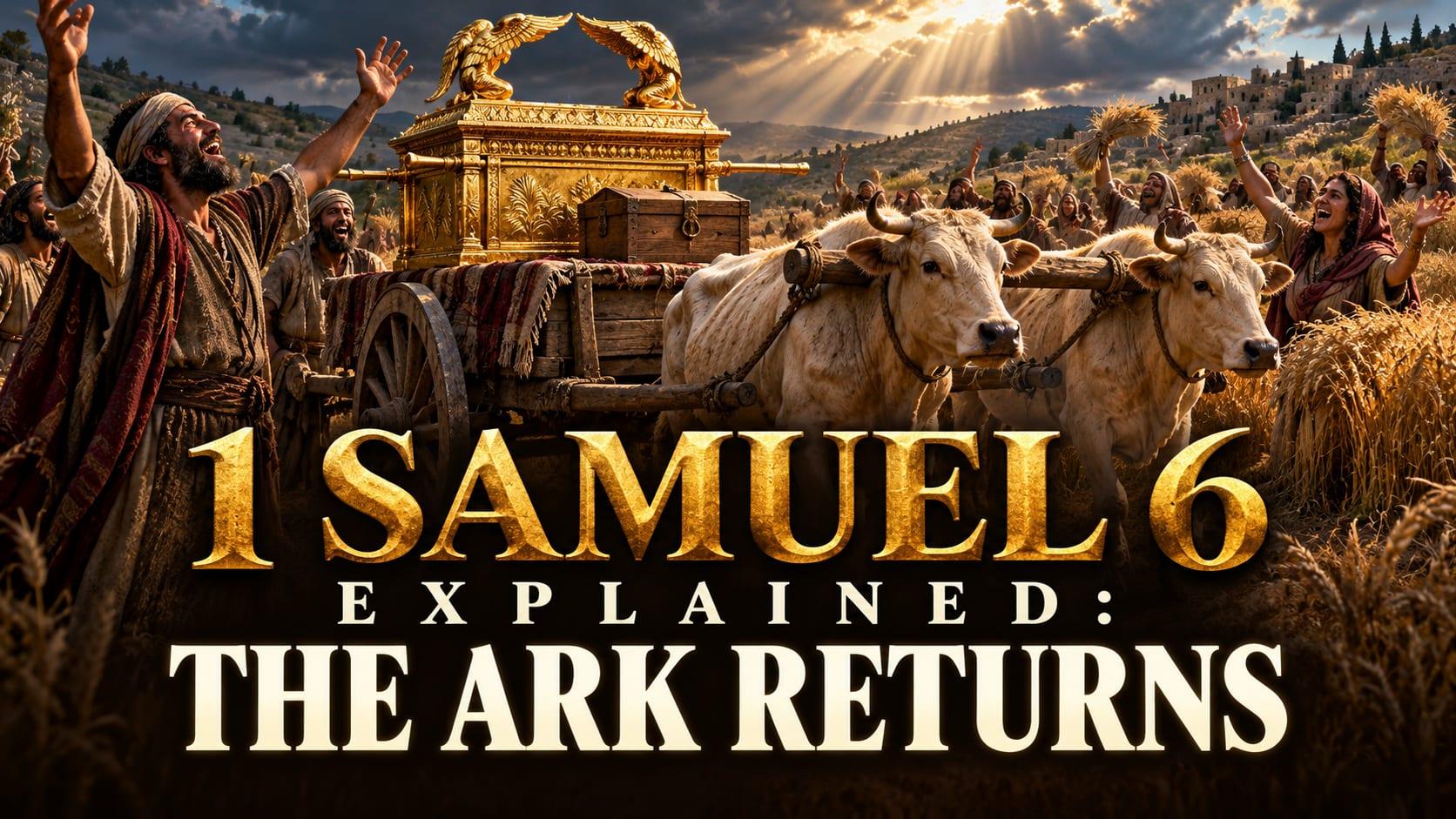
"And the kine took the straight way to the way of Bethshemesh, and went along the highway, lowing as they went, and turned not aside to the right hand or to the left; and the lords of the Philistines went after them unto the border of Bethshemesh."
📌 "Turned not aside to the right hand or to the left" describes animals acting against everything in their own nature. Lowing, the sound a cow makes crying for her calf, they still kept walking the wrong direction the whole way. The five lords themselves follow close enough to watch it happen with their own eyes, which means the very men who built the test become its witnesses.
This is the same category of problem Israel would later face with the ark firsthand. A cart was never the way the law of Moses told Israel to move it; the ark was meant to be carried on poles by Levites, never hauled on a vehicle like ordinary cargo. The Philistines, who did not know that law, were never under it, so the cart cost them nothing here. The rule still mattered, and it would matter again later, for people who did know it.

5. A Harvest Interrupted, and an Altar Built From a Cart (verses 13 to 15)
On the Israelite side of the border, an ordinary workday stops in its tracks.
"And they of Bethshemesh were reaping their wheat harvest in the valley: and they lifted up their eyes, and saw the ark, and rejoiced to see it."
Bethshemesh had been set apart generations earlier as one of the cities given to the sons of Aaron, so Levites were already living there when the ark arrived. That is why trained hands are on hand within verses to handle what comes next correctly, instead of ordinary farmers improvising with something sacred.
"And the cart came into the field of Joshua, a Bethshemite, and stood there, where there was a great stone: and they clave the wood of the cart, and offered the kine a burnt offering unto the LORD."
"And the Levites took down the ark of the LORD, and the coffer that was with it, wherein the jewels of gold were, and put them on the great stone: and the men of Bethshemesh offered burnt offerings and sacrificed sacrifices the same day unto the LORD."
💡 The very cart and cows that carried the trespass offering become the material for worship. Nothing about this moment is staged or imported. A farmer's field, a stone already sitting there, and wood from a cart built by pagan priests, all pressed into service the same afternoon the ark comes home.
6. The Full Account Closes, City by City (verses 16 to 18)
The Philistine lords wait only long enough to see the test settle.
"And when the five lords of the Philistines had seen it, they returned to Ekron the same day."
"And these are the golden emerods which the Philistines returned for a trespass offering unto the LORD; for Ashdod one, for Gaza one, for Askelon one, for Gath one, for Ekron one;"
This verse is the only place in the whole ark narrative that names all five major Philistine cities together: Ashdod, Gath, and Ekron had already been named as places the ark struck directly in 1 Samuel 5, and Gaza and Askelon now turn out to have suffered right alongside them, even though the ark itself never physically traveled to either one.
📌 One golden emerod for each lord confirms what verse 4 already said: one plague covered the whole Philistine confederation, not just the three cities the ark happened to visit.
"And the golden mice, according to the number of all the cities of the Philistines belonging to the five lords, both of fenced cities, and of country villages, even unto the great stone of Abel, whereon they set down the ark of the LORD: which stone remaineth unto this day in the field of Joshua, the Bethshemite."
Fenced cities and country villages together, so the gold mice covered every settlement under Philistine control, not only the five named capitals. The stone itself is called a plain "great stone" in verses 14 and 15, then named "the stone of Abel" here. Scripture does not explain the name change, so any confident explanation of it is guesswork past what the text actually gives.

7. Fifty Thousand and Seventy, and the Ark Moves On (verses 19 to 21)
The chapter ends on the hardest verse in it, not a Philistine city this time, but Israel's own town.
"And he smote the men of Bethshemesh, because they had looked into the ark of the LORD, even he smote of the people fifty thousand and threescore and ten men: and the people lamented, because the LORD had smitten many of the people with a great slaughter."
📌 Rejoicing at the ark's return did not stop some of the men of Bethshemesh from treating it carelessly once it arrived. Looking into the ark violated the handling instructions God had already given Israel, instructions the Philistines were never bound by in the first place. Familiarity with holy things is never the same as the right to handle them however curiosity wants.
"And the men of Bethshemesh said, Who is able to stand before this holy LORD God? and to whom shall he go up from us?"
"And they sent messengers to the inhabitants of Kirjathjearim, saying, The Philistines have brought again the ark of the LORD; come ye down, and fetch it up to you."
💡 Bethshemesh's question echoes what the men of Ashdod asked themselves back in 1 Samuel 5, almost word for word in tone. Holiness that was too much for Philistines to live near turns out to be too much for careless Israelites to live near as well. The ark moves one more time, to Kirjathjearim, where it will stay for twenty years before anyone brings it out again.
Hard Questions 1 Samuel 6 Raises
Was the cart test the priests designed actually a fair way to test God? What the text says: verse 9 states the test plainly, with the Philistines hoping chance would explain away everything that had happened. How this is read: the test was never neutral. Every detail, unbroken cows, calves left behind, no human driver, was chosen to make the outcome the priests secretly hoped for as easy as possible. God answering a rigged test anyway, decisively, says more about His willingness to be known than about the Philistines' fairness.
Why did pagan priests know a word as specific as trespass offering? What the text says: verse 3 uses the same category of sacrifice the law of Moses gives Israel for a specific wrong requiring restitution. How this is read: the concept of paying a god back for an offense was common across the ancient Near East, so the priests may simply be using language familiar from their own religious system, which the Hebrew narrator then records using Israel's own vocabulary for it.
Did fifty thousand and seventy men really die at Bethshemesh, a small town? What the text says: the KJV, following the traditional Hebrew wording, reads "fifty thousand and threescore and ten men," fifty thousand and seventy. How this is read: many modern translations and commentators have long noted that this number is unusually large for a single rural town and have pointed to the unusual Hebrew grammar in the verse itself, some reading it instead as seventy men only. Both readings keep the same point: a serious, deadly judgment fell on people who should have known better than to look.
Why were the men of Bethshemesh punished when they were Israelites who received the ark gladly? What the text says: verse 19 blames the judgment specifically on looking into the ark, not on receiving it. How this is read: rejoicing at the right thing does not excuse mishandling it afterward. Numbers 4:20 had already warned that even the Levites assigned to the ark's own transport were never to look at it uncovered, on pain of death, so this was a known boundary, not a surprise rule invented on the spot.
Top Verses From 1 Samuel 6
1. 1 Samuel 6:9
"And see, if it goeth up by the way of his own coast to Bethshemesh, then he hath done us this great evil: but if not, then we shall know that it is not his hand that smote us: it was a chance that happened to us."
A test designed to find an escape hatch, phrased so plainly that there was no room left to argue with whatever happened next.
2. 1 Samuel 6:12
"And the kine took the straight way to the way of Bethshemesh, and went along the highway, lowing as they went, and turned not aside to the right hand or to the left; and the lords of the Philistines went after them unto the border of Bethshemesh."
Two nursing cows crying for their calves still walk the one direction every instinct in them should have refused. The lords who built the test end up watching it fail them in person.
3. 1 Samuel 6:19
"And he smote the men of Bethshemesh, because they had looked into the ark of the LORD, even he smote of the people fifty thousand and threescore and ten men: and the people lamented, because the LORD had smitten many of the people with a great slaughter."
A reminder that reverence for God was never optional for the people who already knew Him, even in the same chapter where strangers to Him were shown such patience.
4. 1 Samuel 6:20
"And the men of Bethshemesh said, Who is able to stand before this holy LORD God? and to whom shall he go up from us?"
The exact question a Philistine city already asked in the previous chapter, now coming from Israel's own mouths. Holiness never grades on which side of the border asks about it.
Frequently Asked Questions About 1 Samuel 6
What does 1 Samuel 6 mean?
It means God does not need anyone's cooperation to prove who He is, not even the cooperation of a pagan priesthood trying to rig a test in their own favor. The chapter also warns that knowing God is not a safeguard against mishandling what belongs to Him.
Why did the Philistines send gold mice and gold tumors with the ark?
Their priests called for a trespass offering, a sacrifice that admitted a specific wrong rather than a generic gift. Making small gold images of the plague itself, the emerods and whatever the mice represented, was their way of formally returning what had hurt them without directly confessing guilt in words.
What was the point of the two cows pulling the cart?
The priests built a controlled test. Nursing cows that had never worn a yoke, with their calves shut up at home, should have turned back toward their young on an unfamiliar road. Instead they walked straight to Bethshemesh, removing any way to call the ark's whole ordeal a coincidence.
Why does 1 Samuel 6 mention Pharaoh and the Egyptians?
The priests use Pharaoh's hardened heart from the exodus as a cautionary example their own lords would recognize, warning them not to repeat a well known mistake of resisting God's hand after being shown clear evidence of it.
Why were the men of Bethshemesh struck down for looking into the ark?
Looking directly into the ark broke a handling boundary God had already set for Israel, one even the Levites responsible for transporting it were never allowed to cross. Joy at the ark's return did not cancel that requirement once it arrived.
How many men died at Bethshemesh in 1 Samuel 6?
The KJV text reads fifty thousand and seventy men. Many modern translations and commentators have questioned whether the original number was meant to be read as seventy alone, pointing to unusual phrasing in the underlying Hebrew, but every reading agrees the judgment was real, severe, and limited to those who looked into the ark.
What is Kirjathjearim, and why did the ark go there?
Kirjathjearim was an Israelite town that the frightened men of Bethshemesh invited to take the ark off their hands after the judgment they had just witnessed. It would remain there for twenty years before being brought out again later in Israel's story.
Why were five golden emerods and five golden mice sent instead of some other number?
The number matched the five lords of the Philistines, representing their five major cities. Verse 17 later confirms all five, Ashdod, Gaza, Askelon, Gath, and Ekron, suffered under the same plague even though the ark itself only ever physically visited three of them.
Were the Philistines punished more than the Israelites in this story?
Not in the way the chapter frames it. The Philistines, who did not know God's law, were corrected through plagues and a humiliating test until they finally obeyed. The men of Bethshemesh, who did know the law, were held to a stricter standard the moment they crossed a line they had no excuse for crossing.
Final Thoughts
1 Samuel 6 is a chapter about two very different kinds of carelessness, and only one of them gets excused.
📌 A test built to avoid an answer can still deliver one. The priests stacked the odds toward chance, hoping to clear their own god of blame, and watched two nursing cows prove them wrong anyway.
📌 Ignorance and familiarity are not treated the same way. Philistines who never knew God's law were corrected with patience over seven long months. Israelites who already knew the rules paid for breaking one of them the very day the ark came home.
The ark leaves this chapter headed for Kirjathjearim, where it will sit quietly for twenty years while Israel figures out what to do with everything this chapter just showed them.
So here is your one next step.
Ask honestly whether there is something sacred in your own life you have grown too familiar with to still treat carefully, and treat it carefully again this week.