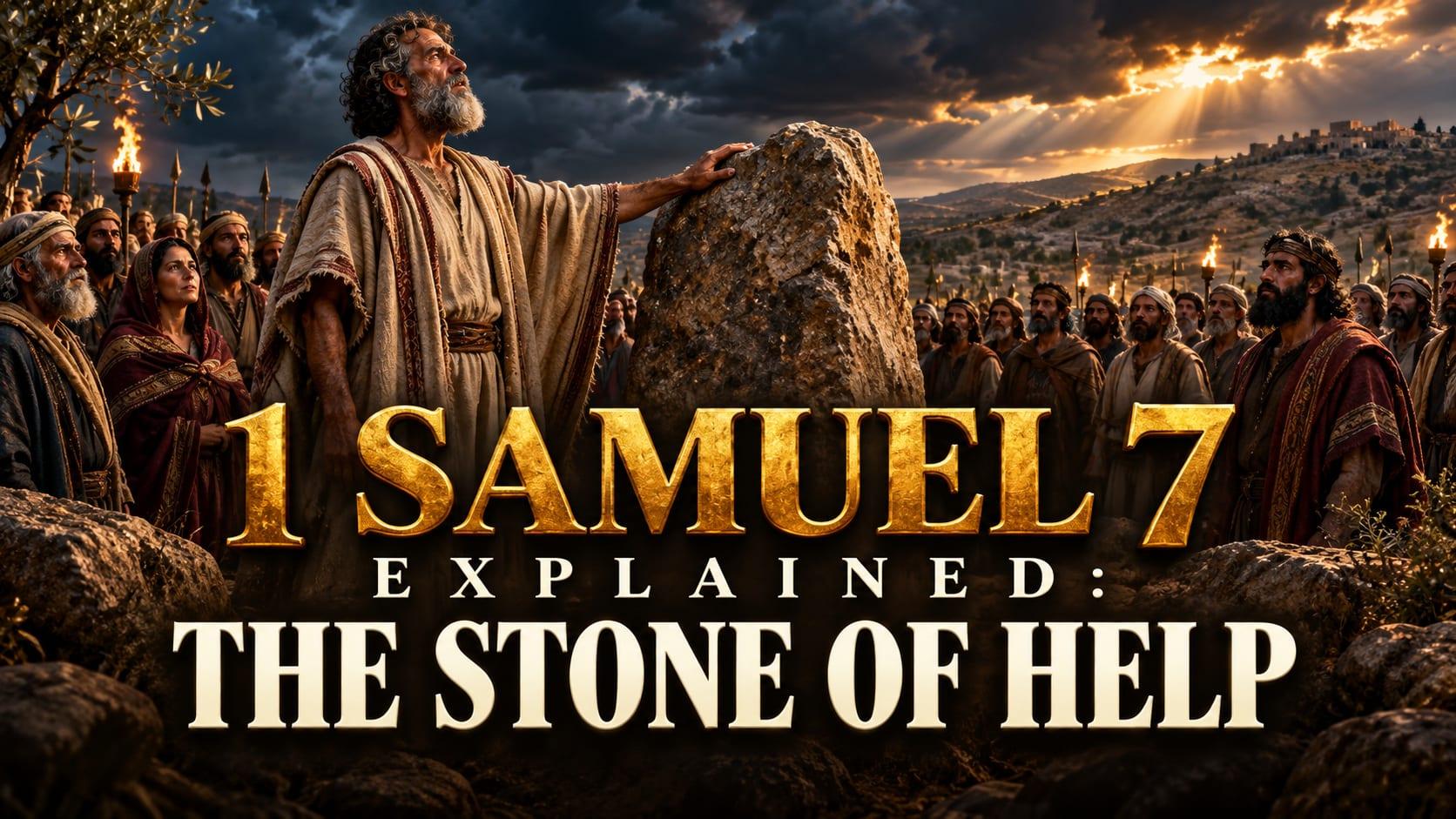
📖 1 Samuel 7 Explained: Repentance at Mizpeh and the Stone Called Ebenezer
Twenty years pass in a single verse, and then everything changes in a single day.
No ark leading the charge this time. No cart, no cows, no Philistine priests guessing at a cure.
1 Samuel 7 explained is the chapter where Israel finally does the one thing nobody tried in the three chapters before it: turn back to the LORD honestly, before asking Him for anything. Samuel calls the nation to put away its foreign gods, gathers everyone to Mizpeh for a day of confession, and watches God win a battle Israel never has to fight with its own strength.
Maybe you have waited years for a breakthrough that only came after you stopped bargaining and actually changed.
- ❓ Why does the chapter jump twenty years ahead in one sentence?
- ❓ What were Baalim and Ashtaroth, and why did Israel have to put them away first?
- ❓ What was the point of drawing water and pouring it out at Mizpeh?
- ❓ What does Ebenezer mean, and why does Samuel set up a stone to remember this day?
📌 1 Samuel 7 is the hinge of the whole book. Everything before it is about what Israel lost. Everything in this chapter is about what it costs to actually get it back.
Here is the whole chapter, in order: two decades of quiet longing, Samuel's condition for deliverance, the national confession at Mizpeh, a battle fought with thunder instead of swords, a stone named for help already received, and a long, settled peace under Samuel's leadership.
What Happened Just Before This Chapter
1 Samuel 6 ended with the ark leaving Philistine territory on a cart pulled by two cows that would not turn aside, then landing hard on the men of Bethshemesh who looked into it carelessly. Terrified by what they had just witnessed, the men of Bethshemesh sent word to the town of Kirjathjearim, asking its people to come and take the ark off their hands.
1 Samuel 7 explained picks up with that request answered, and then keeps going for decades. The ark finally stops moving. Israel, for the first time in this whole story, gets time to think about what it actually lost.

1 Samuel 7 Explained Verse by Verse
1. Twenty Years of Silence at Kirjathjearim (verses 1 and 2)
The chapter opens with the ark finally arriving somewhere it will stay.
"And the men of Kirjathjearim came, and fetched up the ark of the LORD, and brought it into the house of Abinadab in the hill, and sanctified Eleazar his son to keep the ark of the LORD."
Kirjathjearim sat on a hill a short distance from Bethshemesh, and Abinadab's house there becomes the ark's resting place. His son Eleazar is set apart specifically to guard it, a quiet, careful handling that stands in sharp contrast to the men who had just lost their lives for looking into it the wrong way.
Then the narrator does something this book has not done yet. It lets years pass with almost no detail at all.
"And it came to pass, while the ark abode in Kirjathjearim, that the time was long; for it was twenty years: and all the house of Israel lamented after the LORD."
📌 Every chapter so far has moved in days or weeks. This one opens by skipping twenty years in a single sentence. That pacing is the point. Real repentance rarely arrives the week after a disaster. Israel needed two decades of living without the ark, without a king, without a clear word from God, before it was ready to lament after Him instead of just lamenting its losses.
"Lamented after the LORD" is a deeper phrase than ordinary grief. It describes longing that is actually aimed at God Himself, not just at the comfort He used to provide. That distinction matters for what happens next.
2. Samuel's Condition for Deliverance (verses 3 and 4)
Twenty years of lament finally get an answer, and it is not a ritual. It is a demand.
"And Samuel spake unto all the house of Israel, saying, If ye do return unto the LORD with all your hearts, then put away the strange gods and Ashtaroth from among you, and prepare your hearts unto the LORD, and serve him only: and he will deliver you out of the hand of the Philistines."
Baalim was the plural of Baal, a Canaanite storm and fertility god worshipped under many local titles across the region. Ashtaroth was the plural of Ashtoreth, a fertility goddess often paired with Baal in Israel's worship. Judges 10 shows the same two names at the center of the exact same cycle: Israel drifts toward these gods, loses ground to its enemies, and then has to actually repent instead of just regretting the consequences.
📌 Notice the order Samuel lays out. Return with all your hearts, then put away the idols, then God delivers. Deliverance is not the first move. It is the last one, and it depends on everything that comes before it being real.
Israel does not argue with the terms.
"Then the children of Israel did put away Baalim and Ashtaroth, and served the LORD only."
One verse holds a whole nation's reform. No battle has happened yet. No enemy has been defeated yet. The change in worship comes first, entirely on its own, before Israel has any evidence it will lead anywhere.

3. The Assembly at Mizpeh (verses 5 and 6)
With the idols gone, Samuel calls the whole nation to one place for one purpose.
"And Samuel said, Gather all Israel to Mizpeh, and I will pray for you unto the LORD."
"And they gathered together to Mizpeh, and drew water, and poured it out before the LORD, and fasted on that day, and said there, We have sinned against the LORD. And Samuel judged the children of Israel in Mizpeh."
Scripture does not explain exactly what drawing water and pouring it out was meant to picture, so any confident answer here goes past what the text actually gives. The fasting and the spoken confession are plain enough on their own: a nation admitting, out loud and together, "we have sinned against the LORD," the same words the men of Judges 10 reach for when they finally stop making excuses.
📌 Compare this confession to Bethshemesh in the chapter before it. The men of Bethshemesh reacted to the ark with fear after they had already mishandled it. Israel at Mizpeh confesses before any judgment falls on them at all. One nation repents under pressure. The other repents first.
4. Fear Returns, the Response Does Not (verses 7 to 9)
The gathering itself becomes the trigger for exactly the danger Israel feared most.
"And when the Philistines heard that the children of Israel were gathered together to Mizpeh, the lords of the Philistines went up against Israel. And when the children of Israel heard it, they were afraid of the Philistines."
A crowd of unarmed worshippers gathered in one place was an obvious target, and the Philistines move on it immediately. Israel is afraid, exactly as it has every reason to be. What changes is what fear leads them to do next.
"And the children of Israel said to Samuel, Cease not to cry unto the LORD our God for us, that he will save us out of the hand of the Philistines."
"And Samuel took a sucking lamb, and offered it for a burnt offering wholly unto the LORD: and Samuel cried unto the LORD for Israel; and the LORD heard him."
📌 No one grabs a weapon first. They ask Samuel to keep praying. 1 Samuel 4 showed what happens when Israel marches into battle carrying a sacred object and no real relationship with the God behind it. This time there is no ark on the field at all, only an intercessor crying out and a God who hears him.
5. Thunder, Not a Sword (verses 10 and 11)
The LORD answers while the sacrifice is still burning, not after it.
"And as Samuel was offering up the burnt offering, the Philistines drew near to battle against Israel: but the LORD thundered with a great thunder on that day upon the Philistines, and discomfited them; and they were smitten before Israel."
"And the men of Israel went out of Mizpeh, and pursued the Philistines, and smote them, until they came under Bethcar."
The thunder does the breaking. Israel's part is the pursuit that follows it, chasing a confused and already defeated enemy rather than winning the fight through its own strength. The timing in verse 10 is exact: the Philistines advance while the offering is still on the altar, so the victory and the sacrifice are the same event, not two separate steps.

6. The Stone Called Ebenezer (verse 12)
Samuel marks the moment before the nation has a chance to forget it.
"Then Samuel took a stone, and set it between Mizpeh and Shen, and called the name of it Ebenezer, saying, Hitherto hath the LORD helped us."
Ebenezer means stone of help. The name is not a prayer for future help. It is a plain statement about help already given, set in stone so it cannot be quietly forgotten the next time things get hard.
💡 "Hitherto hath the LORD helped us" looks backward on purpose. Samuel does not name the stone for what he hopes God will do next. He names it for what God had just finished doing, a fixed marker for a nation that is going to need the reminder.
7. Peace, Judges, and a Life at Ramah (verses 13 to 17)
The chapter closes by zooming out from one battle to a whole season of settled peace.
"So the Philistines were subdued, and they came no more into the coast of Israel: and the hand of the LORD was against the Philistines all the days of Samuel."
"And the cities which the Philistines had taken from Israel were restored to Israel, from Ekron even unto Gath; and the coasts thereof did Israel deliver out of the hands of the Philistines. And there was peace between Israel and the Amorites."
Territory lost over years comes back in a single summary verse. Ekron and Gath were two of the five major Philistine cities named back in 1 Samuel 6, so the land that is restored here runs right up to the doorstep of the same cities that had just finished sending the ark home.
"And Samuel judged Israel all the days of his life. And he went from year to year in circuit to Bethel, and Gilgal, and Mizpeh, and judged Israel in all those places. And his return was to Ramah; for there was his house; and there he judged Israel; and there he built an altar unto the LORD."
Bethel, Gilgal, and Mizpeh were established worship and gathering sites stretching across Israel's territory, so Samuel is not waiting for people to travel to him. He makes the circuit himself, year after year, before always returning home to Ramah, where he builds his own altar. The chapter that opened on an ark with no home of its own closes on a judge with a settled one.
Hard Questions 1 Samuel 7 Raises
Doesn't 1 Samuel 4 already call this place Ebenezer, before Samuel names it here? What the text says: 1 Samuel 4:1 describes Israel camping "beside Ebenezer" years before this chapter, while 7:12 has Samuel naming a stone Ebenezer for the first time after this victory. How this is read: Hebrew narrators regularly use a place's later, more familiar name when describing earlier events, the same way a modern account might call a town by its current name before that name existed. The simplest reading is that 4:1 borrows the name this chapter is about to explain, written for readers who would already know it.
What did drawing water and pouring it out at Mizpeh actually mean? What the text says: verse 6 records the act without any explanation attached to it. How this is read: readers have proposed it as a picture of emptying out before God, or as an act of mourning paired with the fasting that follows in the same verse, but Scripture never says which, so any confident claim beyond that is guessing past what is written.
If verse 13 says the Philistines never came into Israel's territory again, why do they fight Israel later in 1 Samuel? What the text says: the statement is bounded by its own phrase, "all the days of Samuel," not forever. How this is read: this describes the Philistines being subdued for this particular season of Samuel's leadership. Later chapters set during Saul's reign, while Samuel was still alive, show renewed Philistine conflict, which fits a defined period of peace rather than a permanent end to the two nations' history.
Why does Samuel, not a priest, offer the burnt offering in verse 9? What the text says: Samuel personally offers the lamb and cries out to the LORD, with no objection recorded anywhere in the chapter. How this is read: Samuel had been dedicated to the LORD's service from early childhood and already functions here as judge, prophet, and intercessor for the whole nation, and the text treats his role at the altar as simply part of that calling rather than something unusual needing defense.

Top Verses From 1 Samuel 7
1. 1 Samuel 7:3
"And Samuel spake unto all the house of Israel, saying, If ye do return unto the LORD with all your hearts, then put away the strange gods and Ashtaroth from among you, and prepare your hearts unto the LORD, and serve him only: and he will deliver you out of the hand of the Philistines."
The clearest statement in the chapter of what real repentance requires before deliverance ever arrives: a whole heart, not a convenient one.
2. 1 Samuel 7:6
"And they gathered together to Mizpeh, and drew water, and poured it out before the LORD, and fasted on that day, and said there, We have sinned against the LORD. And Samuel judged the children of Israel in Mizpeh."
A whole nation saying the same honest sentence together, with no disaster currently falling on them to force the words out.
3. 1 Samuel 7:10
"And as Samuel was offering up the burnt offering, the Philistines drew near to battle against Israel: but the LORD thundered with a great thunder on that day upon the Philistines, and discomfited them; and they were smitten before Israel."
A battle Israel does not have to win on its own strength, decided while the smoke of a sacrifice was still rising.
4. 1 Samuel 7:12
"Then Samuel took a stone, and set it between Mizpeh and Shen, and called the name of it Ebenezer, saying, Hitherto hath the LORD helped us."
A monument built to remember help already given, not help still being asked for, so a forgetful nation would have something harder to walk past than a memory.
Frequently Asked Questions About 1 Samuel 7
What does 1 Samuel 7 mean?
It means deliverance follows repentance, not the other way around. Israel puts away its idols and confesses its sin before any battle is fought, and the victory that follows is credited entirely to the LORD, not to Israel's own strength.
Why did Israel lament after the LORD for twenty years?
The text does not explain the full twenty years, only that it was long and that the house of Israel spent it longing specifically for the LORD, not just for relief from the Philistines. That span of quiet longing sets up the real repentance that follows in the same chapter.
What are Baalim and Ashtaroth?
Baalim is the plural of Baal, a Canaanite god tied to storms and fertility worshipped under many local names. Ashtaroth is the plural of Ashtoreth, a fertility goddess frequently worshipped alongside Baal. Both names appear repeatedly across the Old Testament as symbols of Israel drifting from the LORD toward its neighbors' gods.
What does Ebenezer mean, and why is it still well known today?
Ebenezer means stone of help, set up by Samuel to mark the LORD's help at Mizpeh. The name has stayed familiar well beyond this chapter because the hymn "Come Thou Fount of Every Blessing" borrows the line directly, asking to raise an Ebenezer of its own.
Why did Samuel have the people draw water and pour it out?
Scripture records the act in verse 6 without explaining its meaning, so the honest answer is that no one can say for certain. It is paired with fasting and a spoken confession of sin, so whatever it pictured, it belonged to the same act of national repentance.
Was the ark present at the battle in 1 Samuel 7?
No. The ark stays at Kirjathjearim throughout this chapter. The battle is won through Samuel's sacrifice and prayer alone, a direct contrast to 1 Samuel 4, where Israel carried the ark into battle and still lost badly.
How long did the ark stay at Kirjathjearim?
Verse 2 gives twenty years as the length of time covered in this chapter while the ark remained there, lamented after but untouched, before the events at Mizpeh take place.
Why does this chapter mention Bethel, Gilgal, and Mizpeh?
These were established gathering sites spread across Israel's territory. Verse 16 shows Samuel riding a yearly circuit between them to judge the people in person, rather than requiring the whole nation to travel to him every time a dispute needed settling.
Did the Philistines ever attack Israel again after this chapter?
Verse 13 describes them subdued specifically during Samuel's leadership, not forever. Later chapters of 1 Samuel, set during Saul's reign while Samuel was still alive, record renewed conflict with the Philistines once Israel's situation changed again.
Final Thoughts
1 Samuel 7 is the quietest chapter in this story so far, and it changes more than any of the loud ones before it.
📌 Deliverance has an order to it, and Israel finally follows it. Return with the whole heart, put away what competes with God, and then watch Him act. Every step out of order in the earlier chapters had cost Israel dearly.
📌 A stone can hold a memory longer than a feeling can. Samuel names Ebenezer for help already received, not help he hoped for, because he knew exactly how fast a rescued nation forgets.
The ark stays quietly at Kirjathjearim as this chapter ends, and Samuel settles into a long season of leading Israel well. That peace will not last forever. The very next chapter is where Israel starts asking for something it was never promised.
So here is your one next step.
Find your own Ebenezer this week. Name one specific way God has already helped you, and write it down somewhere you will actually see it again.