📖 Deuteronomy 15 Explained: Debt Release, Open Hands, Free Servants
A debt wiped clean. A hand forced open. A servant sent off with a flock of his own.
Deuteronomy 15 explained is Moses moving from the dinner table in the last chapter to the ledger. Deuteronomy 14 asked whether holiness reached what Israel ate. This chapter asks whether it reached what Israel owned, and whether a household let go of money, grain, and people the moment God said the time was up.
Maybe you have only ever heard this chapter as an ancient rule about loans, with nothing left to say to you.
- ❓ Why would God command every debt forgiven on a fixed schedule?
- ❓ Does verse 4 promising no poor contradict verse 11 saying the poor will never cease?
- ❓ Why does a servant get paid to leave after serving for free?
- ❓ What does an awl through the ear have to do with loving your master?
📌 Deuteronomy 15 is three different kinds of release, all running on the same clock, all testing the same thing: does your hand stay open once the bill comes due.
Twenty three verses, and they cover a debt released every seven years, a hand commanded to stay open to the poor in between, a servant freed and sent off loaded with provisions, and a firstborn animal that belonged to God before it belonged to anyone's herd.
Read slowly. This chapter will not let generosity stay a feeling. It makes generosity a law with a due date.
What Happened Just Before This Chapter
Deuteronomy 14 closed with a tithe that stayed home every third year specifically to feed the Levite, the stranger, the fatherless, and the widow within the gates. Holiness had already reached the dinner table and the storeroom.
Deuteronomy 15 takes that same concern for the forgotten and moves it into the household's money and labor. It stops asking what gets stored in the barn for the poor once every three years and starts asking what gets released to them, on a fixed seven year rhythm, long before anyone has to ask for it.

Deuteronomy 15 Explained Verse by Verse
1. Every Seven Years, the Debt Is Gone (verses 1 to 6)
Moses opens the chapter with a date already circled on the calendar.
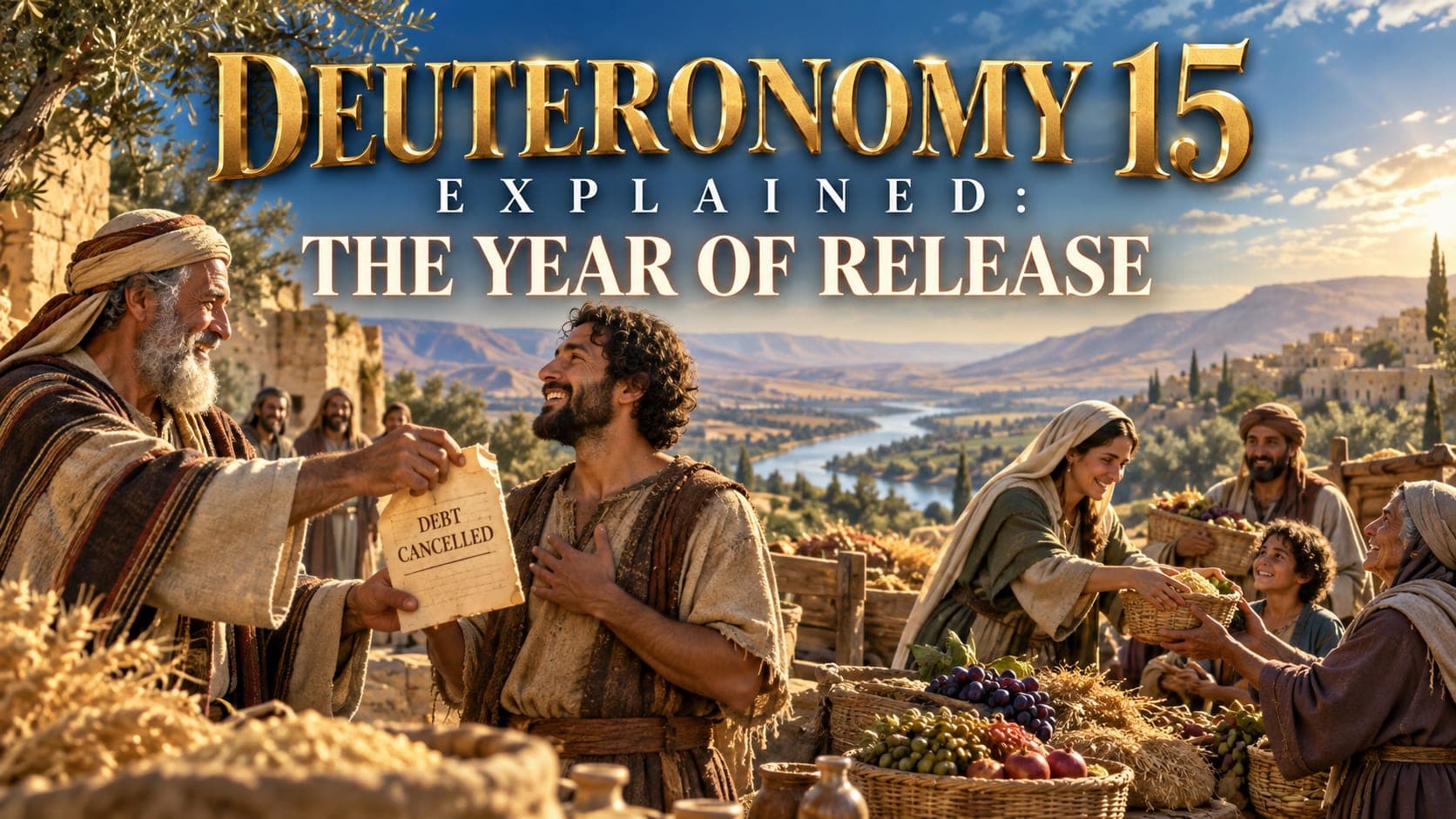
"At the end of every seven years thou shalt make a release."
"And this is the manner of the release: Every creditor that lendeth ought unto his neighbour shall release it; he shall not exact it of his neighbour, or of his brother; because it is called the LORD's release."
📌 This release has a name, and the name is not Israel's. It is the LORD's release. A creditor who cancels a debt in this chapter is not being extra generous out of his own goodness. He is simply doing what the actual owner of the arrangement already decided. The debt was always going to end on this clock, whether the creditor liked the schedule or not.
Verse 3 then draws a line most modern readers do not expect.
"Of a foreigner thou mayest exact it again: but that which is thine with thy brother thine hand shall release;"
💡 The release runs along covenant lines, not a universal rule for every loan everywhere. A foreign trader doing business with Israel operated outside this cycle and could still be held to the original terms. Inside the covenant family, between brother and brother, the clock could not be negotiated away.
Then comes a promise that sounds almost too clean.
"Save when there shall be no poor among you; for the LORD shall greatly bless thee in the land which the LORD thy God giveth thee for an inheritance to possess it: Only if thou carefully hearken unto the voice of the LORD thy God, to observe to do all these commandments which I command thee this day."
📌 The promise of no poor is not unconditional. It is tied directly to obedience. Verse 5 attaches the blessing of verse 4 to one word: only. Only if Israel carefully listens and does what is commanded. The abundance was real, but it was never separate from the obedience that made room for it.
"For the LORD thy God blesseth thee, as he promised thee: and thou shalt lend unto many nations, but thou shalt not borrow; and thou shalt reign over many nations, but they shall not reign over thee."
A nation that obeyed would lend, not borrow. It would lead, not be led. Verse 6 paints the picture of what full obedience could have produced, before the chapter turns and describes the land as it would actually be lived in.
2. The Hand That Has to Stay Open (verses 7 to 11)
Moses turns from the schedule itself to the heart that has to carry it out.
"If there be among you a poor man of one of thy brethren within any of thy gates in thy land which the LORD thy God giveth thee, thou shalt not harden thine heart, nor shut thine hand from thy poor brother:"
"But thou shalt open thine hand wide unto him, and shalt surely lend him sufficient for his need, in that which he wanteth."
📌 Two body parts get named in one breath: the heart and the hand. A hardened heart comes first in verse 7, and a shut hand follows right behind it. Moses treats the two as one problem. What a person refuses inwardly, their hand eventually refuses outwardly too.
Then he names the exact thought that would make the whole system fail.
"Beware that there be not a thought in thy wicked heart, saying, The seventh year, the year of release, is at hand; and thine eye be evil against thy poor brother, and thou givest him nought; and he cry unto the LORD against thee, and it be sin unto thee."
⚠️ The law Moses just gave to protect the poor could become the exact reason a lender refused to help them. Someone doing the math in year six, watching the release clock tick closer, could decide a loan was too risky to make at all. Moses calls that calculation out by name before it ever gets the chance to feel reasonable.
"Thou shalt surely give him, and thine heart shall not be grieved when thou givest unto him: because that for this thing the LORD thy God shall bless thee in all thy works, and in all that thou puttest thine hand unto."
Verse 11 then says plainly what verse 4 only hinted at.
"For the poor shall never cease out of the land: therefore I command thee, saying, Thou shalt open thine hand wide unto thy brother, to thy poor, and to thy needy, in thy land."
💡 Verse 4 described what full obedience could produce. Verse 11 describes the land as Moses actually expects it to run, with poverty never fully gone. The two verses are not fighting each other. One names the ideal God offers; the other names the reality Moses knows Israel will actually live in, and commands generosity either way.
3. A Servant Set Free, and Sent Off Loaded (verses 12 to 18)
From debts, Moses turns to a different kind of release: a person.
"And if thy brother, an Hebrew man, or an Hebrew woman, be sold unto thee, and serve thee six years; then in the seventh year thou shalt let him go free from thee."
A Hebrew servant in this world was usually someone who had sold their own labor to pay off debt, not property seized by force. Exodus 21 had already set the same six year limit at Sinai. Moses is not introducing a new law here. He is making sure a generation that never heard it the first time does not let the limit quietly disappear.
What comes next is new, and it is the heart of this whole section.
"And when thou sendest him out free from thee, thou shalt not let him go away empty: Thou shalt furnish him liberally out of thy flock, and out of thy floor, and out of thy winepress: of that wherewith the LORD thy God hath blessed thee thou shalt give unto him."
📌 Freedom with empty hands was not freedom Moses was willing to call enough. A servant released with nothing would be free in name only, likely back in debt within a season. Moses commands flock, grain, and wine to leave with him, enough to actually start again, not just enough to walk out the door.
Then Moses gives the reason, and it is the same reason Israel hears again and again.
"And thou shalt remember that thou wast a bondman in the land of Egypt, and the LORD thy God redeemed thee: therefore I command thee this thing to day."
💡 Israel did not walk out of Egypt with empty hands either. Exodus describes them leaving with silver, gold, and livestock from the very nation that had enslaved them. A master sending a servant off loaded is simply repeating, on a small scale, what God already did for every person reading this law.
Moses then allows for the servant who genuinely wants to stay.
"And it shall be, if he say unto thee, I will not go away from thee; because he loveth thee and thine house, because he is well with thee; Then thou shalt take an aul, and thrust it through his ear unto the door, and he shall be thy servant for ever. And also unto thy maidservant thou shalt do likewise."
⚠️ This permanent arrangement is offered, never forced. The whole scenario depends on the servant's own words: because he loves his master, and is well with him. The piercing marked a choice already made freely, not a master overriding a servant who wanted to leave.
Verse 18 closes the section by reframing the entire six years that came before.
"It shall not seem hard unto thee, when thou sendest him away free from thee; for he hath been worth a double hired servant to thee, in serving thee six years: and the LORD thy God shall bless thee in all that thou doest."
📌 Moses anticipates the master's resentment before it has a chance to form. Losing free labor could feel like a loss. Moses answers that feeling directly: six years of service already outweighed what a hired servant would have cost, so the release owed to the servant was never really a net loss to begin with.
4. The Firstborn Animal Already Belongs to God (verses 19 to 23)
The chapter closes on a release that happens before an animal is ever old enough to work.
"All the firstling males that come of thy herd and of thy flock thou shalt sanctify unto the LORD thy God: thou shalt do no work with the firstling of thy bullock, nor shear the firstling of thy sheep."
📌 A firstborn male calf or lamb was claimed by God before a household ever got to use it. No plowing with it, no shearing it for wool first. It belonged to the LORD from birth, the same claim already placed on Israel's own firstborn sons back in Exodus 13, the night the LORD passed over Egypt's firstborn and spared Israel's.
Eaten, not kept, and eaten in one specific place.
"Thou shalt eat it before the LORD thy God year by year in the place which the LORD shall choose, thou and thy household."
That one chosen place is the same place Deuteronomy 14 already sent the yearly tithe. A firstling sacrifice and an annual tithe both run through the same single location, keeping Israel's worship from scattering the way Canaanite worship did.
Not every firstling qualifies, though.
"And if there be any blemish therein, as if it be lame, or blind, or have any ill blemish, thou shalt not sacrifice it unto the LORD thy God."
💡 A lame or blind animal could not be offered to God, though it was never simply discarded.
"Thou shalt eat it within thy gates: the unclean and the clean person shall eat it alike, as the roebuck, and as the hart."
📌 A blemished firstling simply becomes ordinary food, eaten at home like any other meat. The sacrifice rule only ever applied to what was fit to offer. A flawed animal lost its place at the altar, not its place at the table.
The chapter ends on the one rule that has followed every meat law so far in Deuteronomy.
"Only thou shalt not eat the blood thereof; thou shalt pour it upon the ground as water."
✅ A chapter that opened by releasing debts closes by releasing blood back to the ground. Every kind of release in this chapter, money, people, and now life itself, ends up handed back to the one it actually belonged to all along.

Hard Questions Deuteronomy 15 Raises
Does verse 4 promising no poor contradict verse 11 saying the poor will never cease? The two verses describe different things, not a contradiction. Verse 4 states what full, careful obedience could produce, explicitly conditioned in verse 5 on Israel actually keeping every command. Verse 11 states the realistic situation Moses expects, since Israel's obedience would never be perfect, and commands open handed generosity regardless of which situation is true.
Why did the release apply to a brother but not to a foreigner, in verse 3? The release ran along covenant lines rather than functioning as a universal debt law. A foreign trader operated by the ordinary terms of the loan, while a fellow Israelite fell under the LORD's release because both lender and borrower belonged to the same covenant people under the same God.
Was Hebrew servitude in this chapter the same as slavery as commonly understood today? The text describes a time limited arrangement, usually entered to pay off debt, with a mandatory release after six years and a command to send the servant away provided for, not empty handed. The chapter also allows, but never forces, a servant to choose permanent service out of love for the household, marked by the piercing in verse 17. Both of these features mark it as different from chattel slavery, though the text does not pretend the arrangement carried no real hardship for the person inside it.
Why pierce a servant's ear specifically, rather than use some other mark? Scripture does not explain the choice of the ear beyond describing the practice itself. What the text makes plain is that the mark followed a stated choice, not a master's decision made for the servant. The servant's own words, because he loveth thee, come first in verse 16, before the piercing in verse 17.
Top Verses From Deuteronomy 15
1. Deuteronomy 15:1
"At the end of every seven years thou shalt make a release."
The verse the whole chapter is built around. Debt in Israel was never meant to run forever. It had a release date written into the law itself.
2. Deuteronomy 15:7 and 8
"If there be among you a poor man of one of thy brethren within any of thy gates in thy land which the LORD thy God giveth thee, thou shalt not harden thine heart, nor shut thine hand from thy poor brother: But thou shalt open thine hand wide unto him."
The heart and the hand named together. Moses treats a closed hand as a symptom of a hardened heart, not a separate problem on its own.
3. Deuteronomy 15:11
"For the poor shall never cease out of the land: therefore I command thee, saying, Thou shalt open thine hand wide unto thy brother, to thy poor, and to thy needy, in thy land."
A realistic verse, not a defeated one. The command to give generously does not wait for poverty to disappear first.
4. Deuteronomy 15:14
"Thou shalt furnish him liberally out of thy flock, and out of thy floor, and out of thy winepress: of that wherewith the LORD thy God hath blessed thee thou shalt give unto him."
Freedom with nothing to start on was not freedom Moses called finished. A released servant had to leave with something real in his hands.
5. Deuteronomy 15:15
"And thou shalt remember that thou wast a bondman in the land of Egypt, and the LORD thy God redeemed thee: therefore I command thee this thing to day."
The reason behind every release in this chapter, in one sentence. Israel gives because Israel first received, from a God who redeemed them while they owned nothing.

Frequently Asked Questions About Deuteronomy 15
What is Deuteronomy 15 about?
Deuteronomy 15 commands a release of debts between Israelites every seven years, an open handed response to the poor regardless of the release schedule, a freed and provisioned Hebrew servant after six years of service, and the dedication of firstborn male animals to the LORD.
What was the Sabbath year debt release in the Bible?
Deuteronomy 15:1 and 2 command every seven years that a creditor cancel what a fellow Israelite owes him, called the LORD's release. It applied between covenant brothers and did not cancel what a foreigner owed, as verse 3 states directly.
Does Deuteronomy 15 contradict itself about poverty?
No. Verse 4 describes what full obedience could produce, conditioned in verse 5 on Israel actually keeping every command. Verse 11 names the more realistic future and commands generosity to the poor either way, so the two verses work together rather than against each other.
How long did a Hebrew servant serve before being freed?
Six years, with release required in the seventh, the same limit Exodus 21 already set at Sinai. Deuteronomy 15:13 and 14 add a new requirement on top of that limit: the servant had to leave provisioned with flock, grain, and wine, not empty handed.
Why did a servant's ear get pierced in Deuteronomy 15?
Verses 16 and 17 describe a servant who chooses to stay permanently because he loves his master and is well with him. The piercing marked that freely stated choice to remain, not a master forcing the servant to stay against his will.
Was Hebrew servitude in the Bible the same as slavery?
It differed in key ways from chattel slavery: it was usually entered to pay off debt, it carried a mandatory six year limit, and a servant leaving was required to be provided for rather than released empty handed. The text does not pretend the arrangement carried no hardship, but it is not described or regulated the way later slave systems were.
Why did firstborn animals belong to God in Deuteronomy 15?
Deuteronomy 15:19 claims every firstling male for the LORD before it could be put to work or sheared. This mirrors the claim God placed on Israel's own firstborn sons in Exodus 13, the night the LORD spared Israel's firstborn in Egypt.
What happened to a firstling animal with a blemish?
Deuteronomy 15:21 and 22 forbid sacrificing a lame or blind firstling, but it was not thrown away. It became ordinary food, eaten at home like any other meat, available to the clean and unclean person alike.
Does Deuteronomy 15 still apply to Christians today?
The specific debt and servant release laws belonged to Israel's covenant and economy. The principle behind them still stands: God's people are called to open handed generosity toward the poor and the indebted, rooted in remembering that they were themselves once redeemed while owning nothing.
Final Thoughts
Deuteronomy 15 never asks Israel to feel generous. It asks them to release on schedule, whether they feel like it or not.
📌 Generosity in this chapter is a law with a due date, not a mood. A debt released, a hand opened, a servant provisioned for, all commanded on a fixed clock rather than left to whatever a lender happened to feel in the moment.
📌 Every release traces back to one memory. Verse 15 roots the whole chapter in Egypt. Israel gives because Israel first received, redeemed while owning nothing at all.
📌 What belongs to God gets handed back to Him, even down to the blood poured on the ground. Money, people, and life itself all move through this chapter toward the one they actually belonged to from the start.
You do not run a seven year debt cycle. But you still decide, on your own private schedule, whether your hand stays open once giving stops feeling convenient.
So here is your one next step.
Name one debt, favor, or grudge you are quietly still holding over someone, and release it this week the way this chapter commands, before anyone has to ask.