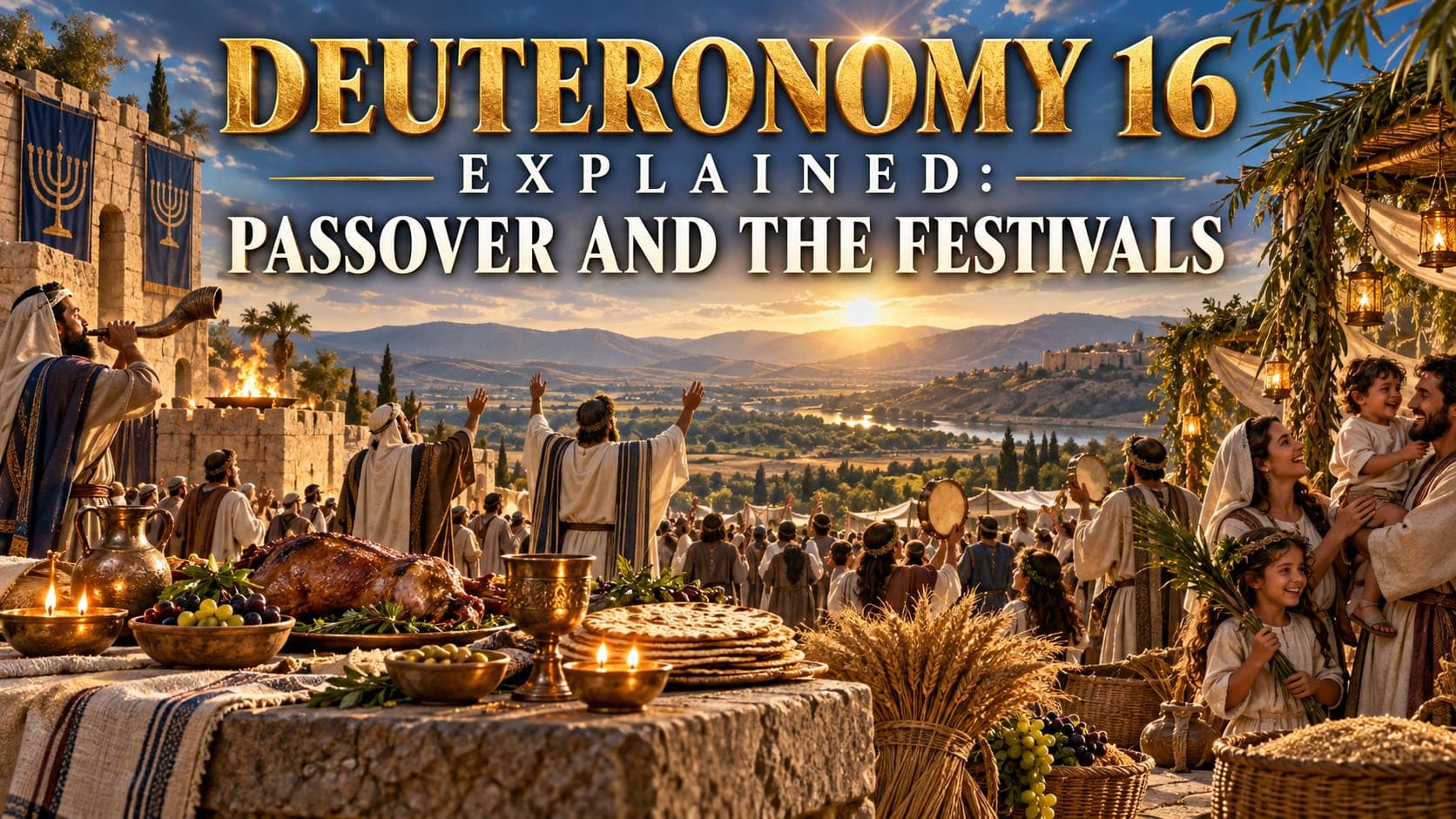
📖 Deuteronomy 16 Explained: Three Feasts and Honest Judges
Three trips a year. One place to show up. Nobody arrives with empty hands.
Deuteronomy 16 explained is Moses moving from what a household released every seven years to what every household owed three times in a single year: a trip to the place God chose, and a courtroom at the gate that could not be bought.
Maybe you have only ever read this chapter as a list of holidays with nothing left to say to you.
- ❓ Why did Israel have to travel three separate times a year just to worship?
- ❓ Why does verse 2 suddenly mention the herd when Exodus only named a lamb?
- ❓ What does a grove of trees have to do with idolatry?
- ❓ Why does a chapter about feasts end on judges and bribes?
📌 Deuteronomy 16 is worship with its feet on the road and justice with its hands kept empty of bribes, three feasts and one courtroom guarding the same loyalty.
Twenty two verses, and they hold two subjects under one roof: the calendar every Israelite's feet had to follow, and the gate every Israelite's case had to stand before.
Read slowly. This chapter will not let you separate how you worship from how you treat your neighbor.
What Happened Just Before This Chapter
Deuteronomy 15 closed a household's ledger: debts released every seven years, a hand commanded to stay open to the poor, a servant freed and loaded with flock, grain, and wine, and a firstborn animal that belonged to God before anyone got to use it. Every release in that chapter ran on a fixed clock Israel did not get to negotiate.
Deuteronomy 16 widens the lens from one household's calendar to the whole nation's. The clock that mattered in chapter 15 was private and financial. The clock in chapter 16 is public and national: three set dates every Israelite's feet had to keep, whether the harvest was good that year or not.

Deuteronomy 16 Explained Verse by Verse
1. Passover, Kept on God's Calendar (verses 1 to 4)
Moses opens with a month, not a date on some other nation's calendar.
"Observe the month of Abib, and keep the passover unto the LORD thy God: for in the month of Abib the LORD thy God brought thee forth out of Egypt by night."
Abib means green ears, the stage barley reaches right before harvest. Israel's first month was named after a crop, not a king or a god borrowed from Egypt. Centuries later this same month would be called Nisan, but the memory attached to it never changed: the night the LORD brought Israel out of Egypt, in the dark, on His own timing.
"Thou shalt therefore sacrifice the passover unto the LORD thy God, of the flock and the herd, in the place which the LORD shall choose to place his name there."
💡 Exodus 12 named a lamb or young goat from the flock as the Passover sacrifice itself, with no mention of cattle. Most readers take the herd mentioned here as the fuller set of offerings eaten across the week of unleavened bread, not a change to the Passover lamb, which stayed tied to the flock exactly as it was at Sinai.
Notice too that the sacrifice has an address: the place which the LORD shall choose. Passover was never a holiday Israel could keep wherever felt convenient.
"Thou shalt eat no leavened bread with it; seven days shalt thou eat unleavened bread therewith, even the bread of affliction; for thou camest forth out of the land of Egypt in haste: that thou mayest remember the day when thou camest forth out of the land of Egypt all the days of thy life."
📌 The memory of Egypt got baked into bread, not just repeated in a sentence. Flat, unleavened bread recalls a departure too urgent to let dough rise. Israel did not merely hear the Exodus story once a year. They tasted the haste of it, every single meal, for seven straight days.
"And there shall be no leavened bread seen with thee in all thy coast seven days; neither shall there any thing of the flesh, which thou sacrificedst the first day at even, remain all night until the morning."
The same rule against leftovers Exodus gave at the very first Passover still stood here, generations later. Nothing about this meal was meant to become routine leftovers picked at the next morning.
2. One Place to Sacrifice, One Way Home (verses 5 to 8)
Moses rules out the easy option first.
"Thou mayest not sacrifice the passover within any of thy gates, which the LORD thy God giveth thee:"
"But at the place which the LORD thy God shall choose to place his name in, there thou shalt sacrifice the passover at even, at the going down of the sun, at the season that thou camest forth out of Egypt."
⚠️ No local gate, no backyard altar, no exception for the family that lived far away. Every household converged on one location, at the same hour the first Passover happened, at the going down of the sun. Convenience was never going to be the deciding factor in how Israel kept this night.
"And thou shalt roast and eat it in the place which the LORD thy God shall choose: and thou shalt turn in the morning, and go unto thy tents."
"Six days thou shalt eat unleavened bread: and on the seventh day shall be a solemn assembly to the LORD thy God: thou shalt do no work therein."
💡 The meal itself had to happen at the chosen place, but a household did not have to camp there the whole week. Once the Passover night was kept, they could turn for home the next morning and finish the remaining days of unleavened bread in their own tents, closing the week with one more day set apart for rest, not labor.
3. Counting Fifty Days to the Feast of Weeks (verses 9 to 12)
From a fixed date, Moses moves to a count that starts in the field.
"Seven weeks shalt thou number unto thee: begin to number the seven weeks from such time as thou beginnest to put the sickle to the corn."
📌 This feast could not be scheduled in advance on a fixed calendar date. The count began the moment the sickle first touched standing grain, a day that shifted with the harvest itself. Seven weeks later, on the fiftieth day, the feast arrived. Greek speakers would later call that fiftieth day Pentecost, and the name stuck all the way into the New Testament.
"And thou shalt keep the feast of weeks unto the LORD thy God with a tribute of a freewill offering of thine hand, which thou shalt give unto the LORD thy God, according as the LORD thy God hath blessed thee:"
💡 Unlike a fixed tithe, this offering scaled to the harvest. A thin year gave less. A full year gave more. The amount was never dictated; the proportion was.
"And thou shalt rejoice before the LORD thy God, thou, and thy son, and thy daughter, and thy manservant, and thy maidservant, and the Levite that is within thy gates, and the stranger, and the fatherless, and the widow, that are among you, in the place which the LORD thy God hath chosen to place his name there."
"And thou shalt remember that thou wast a bondman in Egypt: and thou shalt observe and do these statutes."
📌 Nobody in the house or the town got left outside the joy. Sons, daughters, servants, the Levite with no land, the foreigner, the fatherless, the widow. The harvest feast was never a private celebration for the landowner alone. And the reason given, one more time, is Egypt: Israel gives and includes others because Israel was once the one with nothing.
4. Tabernacles, and a Joy Moses Commands (verses 13 to 15)
The third feast closes the farming year itself.
"Thou shalt observe the feast of tabernacles seven days, after that thou hast gathered in thy corn and thy wine:"
"And thou shalt rejoice in thy feast, thou, and thy son, and thy daughter, and thy manservant, and thy maidservant, and the Levite, the stranger, and the fatherless, and the widow, that are within thy gates."
This feast arrived last on the calendar, after grain and grapes were both already in. Whatever the year had produced, good or lean, was finished being gathered by the time this one began. The same guest list from the Feast of Weeks shows up again, because the point was never only the grain. It was who got to enjoy it.
"Seven days shalt thou keep a solemn feast unto the LORD thy God in the place which the LORD shall choose: because the LORD thy God shall bless thee in all thine increase, and in all the works of thine hands, therefore thou shalt surely rejoice."
📌 "Thou shalt surely rejoice" is a command, not a suggestion for whoever happened to feel like it. Joy gets ordered here the same way rest and sacrifice get ordered elsewhere in this book. This chapter never spells out the detail of living in booths during this feast; that instruction waits in Leviticus 23, which also lays out the fuller calendar this chapter only rehearses in summary.
5. Three Trips a Year, Nobody Shows Up Empty (verses 16 and 17)
Moses gathers all three feasts into one requirement.
"Three times in a year shall all thy males appear before the LORD thy God in the place which he shall choose; in the feast of unleavened bread, and in the feast of weeks, and in the feast of tabernacles: and they shall not appear before the LORD empty:"
"Every man shall give as he is able, according to the blessing of the LORD thy God which he hath given thee."
📌 Three journeys a year, and an empty gift was never an option. This is nearly the same requirement Exodus 23 already gave Israel at Sinai. The giving itself still flexed to what a man actually had; a poor year did not cancel the trip, it only changed the size of what he carried.
6. Judges Who Cannot Be Bought (verses 18 to 20)
Without any transition, Moses turns from the festival calendar to the courtroom.
"Judges and officers shalt thou make thee in all thy gates, which the LORD thy God giveth thee, throughout thy tribes: and they shall judge the people with just judgment."
💡 The city gate was where legal business actually happened in this world, the same public spot where elders settled disputes and witnesses were gathered. Justice was not tucked away behind closed doors. It happened where everyone walked past.
"Thou shalt not wrest judgment; thou shalt not respect persons, neither take a gift: for a gift doth blind the eyes of the wise, and pervert the words of the righteous."
📌 Three separate ways a judge could fail, named one after another. Twisting a verdict, favoring a face, and pocketing a bribe are not three unrelated sins. They are the same corruption showing up at different points in the process. Even a wise judge is not immune; the text says a gift blinds the wise specifically, not just the foolish or the inexperienced.
"That which is altogether just shalt thou follow, that thou mayest live, and inherit the land which the LORD thy God giveth thee."
Justice and the land are tied together again here, the same way obedience and the land are tied together throughout this book. A corrupt court was never a minor side issue next to keeping the feasts. It threatened the very thing the feasts were celebrating.
7. No Grove, No Pillar, Beside God's Altar (verses 21 and 22)
The chapter closes on two short, blunt commands.
"Thou shalt not plant thee a grove of any trees near unto the altar of the LORD thy God, which thou shalt make thee."
"Neither shalt thou set thee up any image; which the LORD thy God hateth."
⚠️ A planted grove and a standing pillar were recognized features of Canaanite worship, not neutral decoration. A sacred tree or wooden pole beside an altar was tied to the fertility goddess worshipped alongside Baal, and a carved pillar carried the same borrowed religion. Israel's altar had to stay visibly, physically clear of both, the same insistence on one undivided place of worship that Deuteronomy 12 already laid down.

Hard Questions Deuteronomy 16 Raises
Why does verse 2 mention the herd when Exodus 12 only named a lamb or goat? Exodus 12:3 to 5 required a lamb or young goat specifically for the Passover sacrifice itself. The broader language in Deuteronomy 16:2 most likely covers the fuller set of offerings eaten across the whole week of unleavened bread, not a change to the Passover lamb, which stayed tied to the flock exactly as it was first given.
Why does a chapter about three feasts end on judges and bribes? Both halves protect the same loyalty from two different directions. Showing up faithfully at the place God chose and dealing honestly with a neighbor at the gate were never two separate categories in this law. A nation could not call itself faithful at the feast while its courts quietly sold justice to whoever paid.
Did the feasts only require men to attend? Verse 16 specifically commands all the males to appear three times a year. The earlier verses about rejoicing, verses 11 and 14, already include sons, daughters, servants, the Levite, the stranger, the fatherless, and the widow in the celebration itself. The household was not excluded from the joy; the three mandatory journeys were required specifically of the men.
What exactly was wrong with planting trees near an altar? The text does not explain the practice in detail, only forbids it. A planted grove or standing pillar beside an altar was a recognized feature of Canaanite worship sites, tied to gods Israel was repeatedly warned away from. Keeping the LORD's altar clear of them was part of keeping Israel's worship from quietly blending into the religion around it.
Top 5 Bible Verses From Deuteronomy 16
1. Deuteronomy 16:12
"And thou shalt remember that thou wast a bondman in Egypt: and thou shalt observe and do these statutes."
The memory behind every feast in this chapter. Israel kept these laws because Israel first remembered what it was like to have nothing, in a land that owned them.
2. Deuteronomy 16:15
"Seven days shalt thou keep a solemn feast unto the LORD thy God in the place which the LORD shall choose: because the LORD thy God shall bless thee in all thine increase, and in all the works of thine hands, therefore thou shalt surely rejoice."
Joy commanded outright, not left to whatever mood the harvest happened to produce. Rejoicing was as much a duty here as showing up.
3. Deuteronomy 16:17
"Every man shall give as he is able, according to the blessing of the LORD thy God which he hath given thee."
Giving tied to blessing already received, not to a flat demand everyone owed regardless of their situation. A lean year still required a gift; it simply required a smaller one.
4. Deuteronomy 16:19
"Thou shalt not wrest judgment; thou shalt not respect persons, neither take a gift: for a gift doth blind the eyes of the wise, and pervert the words of the righteous."
Three separate failures named by name, so a judge could never claim the line was unclear. Even a wise man's judgment was not safe from a well placed bribe.
5. Deuteronomy 16:20
"That which is altogether just shalt thou follow, that thou mayest live, and inherit the land which the LORD thy God giveth thee."
Justice tied directly to the land Israel was about to inherit. Keeping the courts honest was never a side issue next to keeping the feasts.

Frequently Asked Questions About Deuteronomy 16
What is Deuteronomy 16 about?
Deuteronomy 16 commands Israel to keep three pilgrim feasts each year, Passover and Unleavened Bread, the Feast of Weeks, and the Feast of Tabernacles, all at the place God would choose. It then commands honest judges and officers in every town, and forbids planting a grove or setting up an image near the LORD's altar.
What were the three pilgrim feasts in the Bible?
Passover and Unleavened Bread in the first month, the Feast of Weeks fifty days after the grain harvest began, and the Feast of Tabernacles after the full harvest of grain and wine was gathered. Deuteronomy 16:16 required every Israelite man to appear before the LORD at all three.
Why is Passover connected to the month of Abib?
Abib means green ears, the stage barley reaches just before harvest, and it was the first month of Israel's calendar. Deuteronomy 16:1 ties the month directly to the night the LORD brought Israel out of Egypt, later called the month of Nisan.
What is the Feast of Weeks in the Bible?
A harvest feast counted seven weeks, or fifty days, from the moment the sickle first touched the standing grain, described in Deuteronomy 16:9 and 10. Its name in Greek, Pentecost, carries into the New Testament, where it marks the day the Holy Spirit came in Acts 2.
What is the Feast of Tabernacles?
The final harvest feast of the year, kept seven days after the grain and wine were gathered in, described in Deuteronomy 16:13 to 15. The command to live in temporary shelters during the feast comes from Leviticus 23, not from this chapter directly.
Why couldn't judges in Deuteronomy 16 take gifts?
Deuteronomy 16:19 states plainly that a gift blinds the eyes of the wise and perverts the words of the righteous. A bribe did not just risk one unfair verdict; it corrupted the judge's ability to see any case clearly afterward.
What does "wrest judgment" mean in Deuteronomy 16:19?
It means to twist or bend a legal decision away from what is actually true, whether out of favoritism, pressure, or a bribe. Deuteronomy 16:19 names it as the first of three ways a judge could fail the people trusting that court.
Why did God forbid planting a grove near His altar?
A planted grove or standing pillar beside an altar was a recognized feature of Canaanite worship sites, tied to gods Israel was repeatedly warned away from. Deuteronomy 16:21 and 22 keep the LORD's altar visibly clear of that borrowed religion.
Does Deuteronomy 16 still apply to Christians today?
The specific pilgrim feasts belonged to Israel's calendar and covenant. The principles behind them still stand: worship with real cost attached, generosity scaled to what you actually have, and a refusal to let money or favoritism bend what is right.
Final Thoughts
Deuteronomy 16 refuses to let worship and justice live in separate rooms.
📌 Faithfulness here kept a calendar, not just a feeling. Three fixed trips a year, whether the harvest was generous or thin, held Israel to a rhythm no single mood could cancel.
📌 Joy was commanded, not merely allowed. "Thou shalt surely rejoice" stands next to every other command in this chapter with the same weight.
📌 A faithful feast and an honest gate were never two different loyalties. Moses moves from Passover straight into bribery without a single transition, because in his eyes they were never really separate subjects.
You do not keep a pilgrim calendar. But you still decide, this year, whether worship costs you anything real, and whether what you say is right stays right even when a gift is sitting on the table.
So here is your one next step.
Look at one decision in front of you right now where honesty would cost you something, and choose the honest answer before anyone offers you a reason not to.