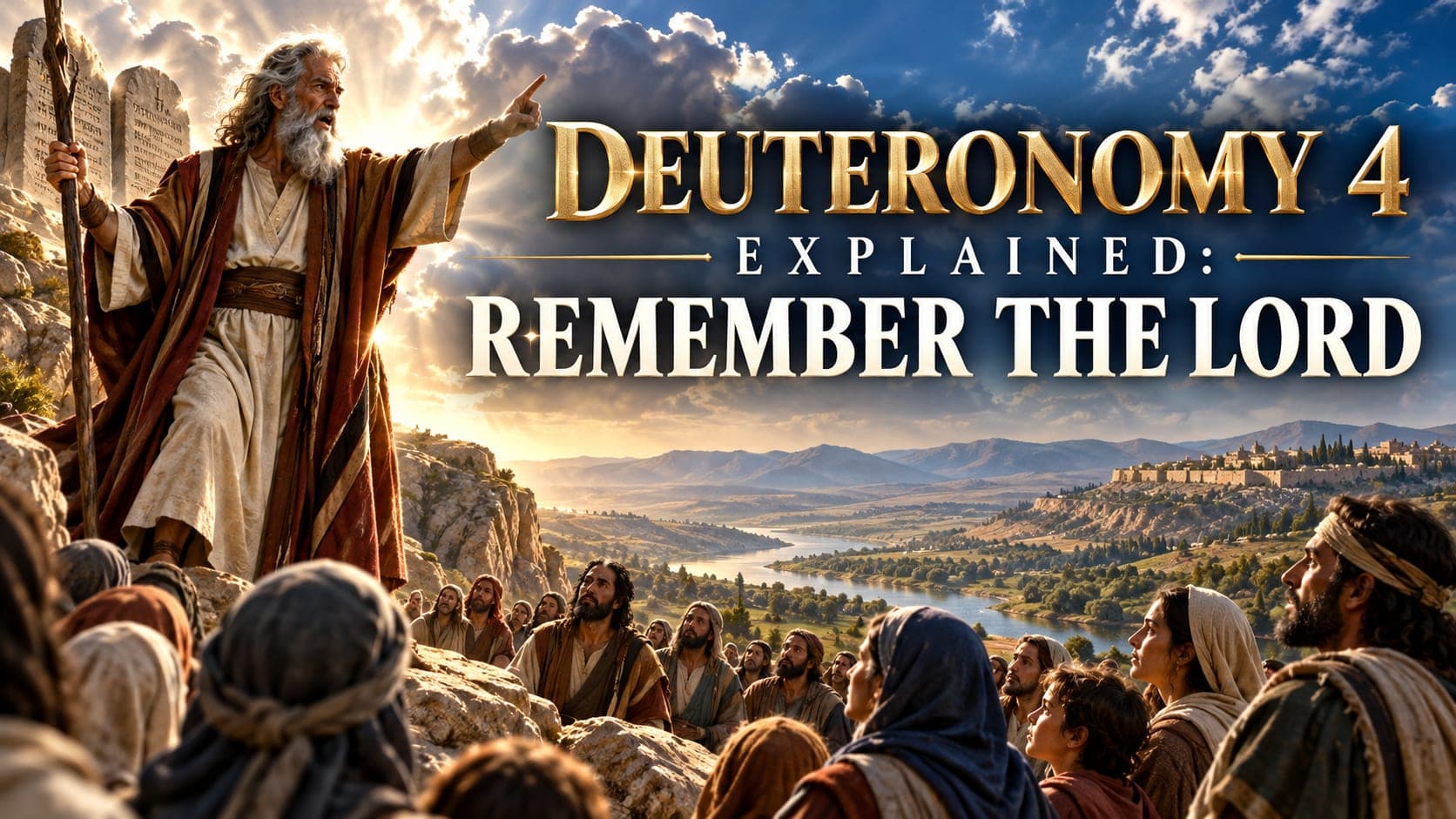
📖 Deuteronomy 4 Explained: No Graven Image and a Future Foretold
No shape. No picture. No image of any kind, of anything, for any reason.
That is the one rule Moses defends longer and harder than anything else in this chapter.
Deuteronomy 4 explained is the hinge of the whole book. The history is finished. Sihon and Og are dead. The land east of the Jordan is already divided. Moses stops retelling the journey here and starts preaching straight at the people in front of him, and the sermon goes somewhere most readers do not expect: a forecast of exile, centuries before it happens, followed by a promise that the exile will not be the end of the story.
Maybe you have wondered why the Bible takes a whole chapter to forbid pictures of God.
- ❓ Why does Moses say Israel saw no shape at Horeb, when the mountain was on fire right in front of them?
- ❓ What does it mean to call God "a consuming fire" and still call Him merciful two verses later?
- ❓ Did Moses really predict the exile and the return from it, hundreds of years ahead of time?
- ❓ Why does a sermon about idols suddenly stop to name three cities?
📌 Deuteronomy 4 is Moses telling a generation that never saw Egypt, and will never fail the way their parents failed, exactly how they are going to fail anyway, and exactly how God will still take them back.
This walkthrough goes through the whole chapter in order: the command not to touch God's word, the day at Horeb nobody in this crowd remembers firsthand, the ban on every kind of image, the prophecy of scattering and return, the appeal to Israel's own unmatched experience, and the three cities Moses sets apart before the sermon even ends.
Forty nine verses, and the whole book of Deuteronomy turns on what this one says first.
What Happened Just Before This Chapter
Deuteronomy 3 ended on a refusal. Moses had just watched two kings fall, Sihon and Og, and used that proof of God's power to beg for one more thing: a chance to cross the Jordan himself. God said no, offered him a view from Pisgah instead, and told him to spend his remaining strength building up Joshua rather than arguing for a different outcome.
Deuteronomy 4 picks up right where that conversation left off, at the camp near Bethpeor, with Moses still facing the river he will never cross. But the tone of the sermon changes here. The history lesson is over. What follows is not another battle report. It is Moses, with whatever time he has left, telling Israel plainly what obedience actually requires of them once he is gone, and what will happen if they drop it.

Deuteronomy 4 Explained Verse by Verse
1. Do Not Add, Do Not Take Away (verses 1 to 8)
Moses opens the sermon proper with a word that will not let go of him for the rest of the book.
"Now therefore hearken, O Israel, unto the statutes and unto the judgments, which I teach you, for to do them, that ye may live, and go in and possess the land which the LORD God of your fathers giveth you. Ye shall not add unto the word which I command you, neither shall ye diminish ought from it, that ye may keep the commandments of the LORD your God which I command you."
📌 "Hearken" is not a suggestion to consider. It is a command to actually listen, the way you listen when your own life rides on the answer. Moses ties obedience directly to staying alive in the land God is about to give them, not metaphorically.
Moses backs the warning with an example everyone in the crowd watched happen.
"Your eyes have seen what the LORD did because of Baalpeor: for all the men that followed Baalpeor, the LORD thy God hath destroyed them from among you. But ye that did cleave unto the LORD your God are alive every one of you this day."
💡 Numbers 25 records the event: Israelite men joining Moabite worship at Baalpeor, and a plague that only stopped once Phinehas acted. Moses does not retell the story. He simply points at the plain fact in front of him, the men who clung to the LORD are still alive, as proof this is not an abstract threat.
Keeping the law is not framed here as a burden. Moses calls it Israel's advantage before a watching world.
"Keep therefore and do them; for this is your wisdom and your understanding in the sight of the nations, which shall hear all these statutes, and say, Surely this great nation is a wise and understanding people. For what nation is there so great, who hath God so nigh unto them, as the LORD our God is in all things that we call upon him for?"
📌 Other nations were meant to look at Israel's law and see wisdom, and look at Israel's God and see nearness. A nation that lived out the law visibly enough would make the surrounding nations curious about the God behind it.
2. Remember the Day at Horeb (verses 9 to 14)
Most of the people standing in front of Moses right now were children, or not yet born, when Israel stood at the mountain. Moses makes them own the memory anyway.
"Only take heed to thyself, and keep thy soul diligently, lest thou forget the things which thine eyes have seen, and lest they depart from thy heart all the days of thy life: but teach them thy sons, and thy sons' sons;"
💡 The command is not simply to remember. It is to pass the memory down two generations deep, before it ever fades out of the family. A memory that stops with you dies with you.
Then Moses describes the day itself.
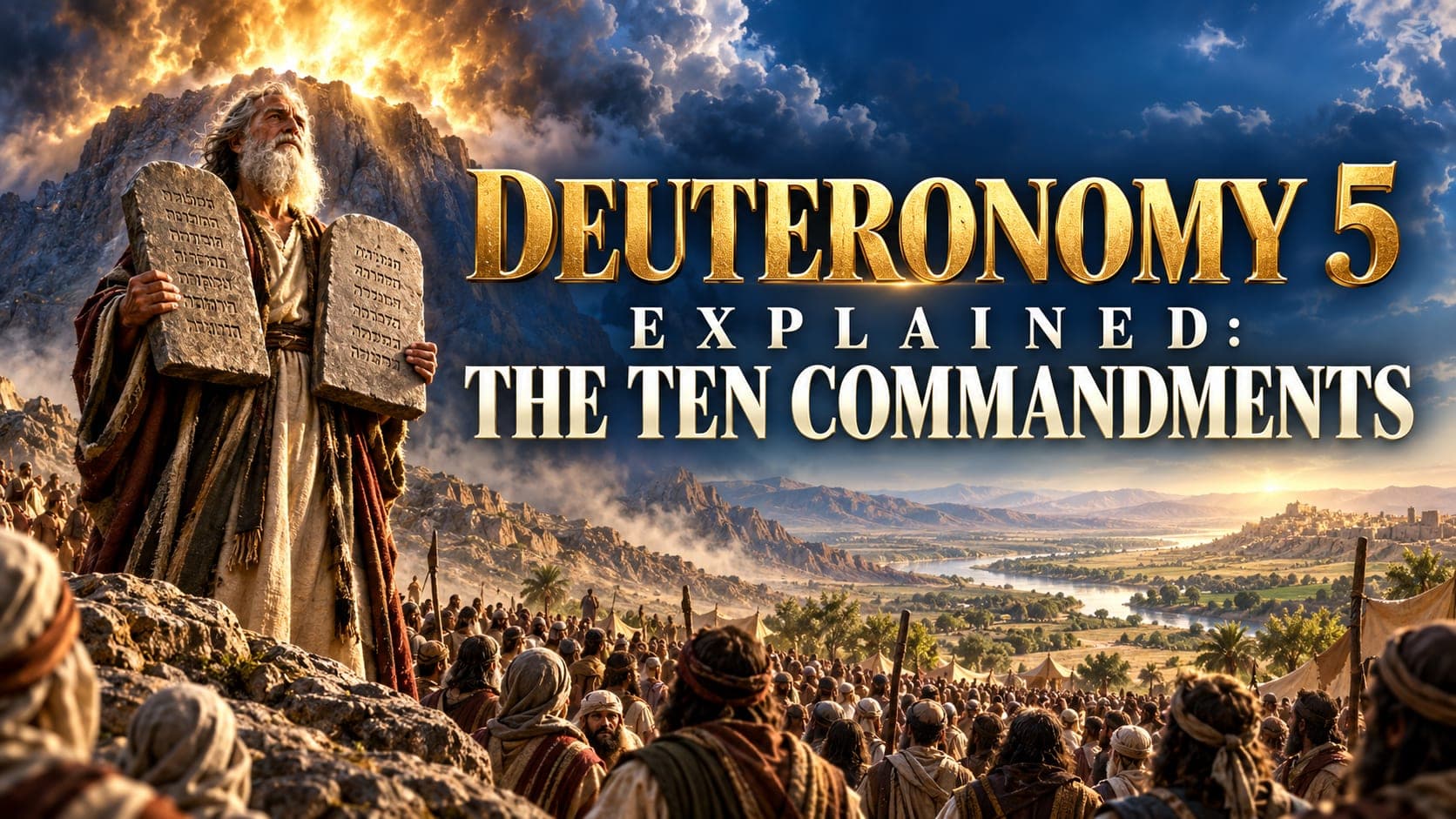
"And ye came near and stood under the mountain; and the mountain burned with fire unto the midst of heaven, with darkness, clouds, and thick darkness. And the LORD spake unto you out of the midst of the fire: ye heard the voice of the words, but saw no similitude; only ye heard a voice."
⚠️ "Similitude" means a shape, a form, a likeness, something you could picture or draw. Israel heard a real voice out of real fire at a real mountain, exactly what Exodus 19 already described. What they never got, on purpose, was anything that looked like anything. That gap is the hinge the rest of this chapter swings on.
Out of that fire came ten specific words, written down the same day.
"And he declared unto you his covenant, which he commanded you to perform, even ten commandments; and he wrote them upon two tables of stone."
Exodus 20 records those ten commandments word for word, and Moses will repeat them himself in the very next chapter. Here he only needs the fact of them: God spoke, God wrote, and stone does not forget what a memory eventually will.
3. No Likeness of Anything (verses 15 to 24)
Moses now draws the direct conclusion from what he just spent six verses establishing.
"Take ye therefore good heed unto yourselves; for ye saw no manner of similitude on the day that the LORD spake unto you in Horeb out of the midst of the fire: Lest ye corrupt yourselves, and make you a graven image, the similitude of any figure, the likeness of male or female,"
📌 No shape was shown so that no shape could ever honestly claim to represent Him. Any image made afterward, however careful or well meant, would have to come from imagination, not from what Israel actually saw, because there was nothing to see.
The ban is not limited to human shapes. Moses runs through the whole created order, closing every door before Israel can find one left open.
- 🦁 The likeness of any beast on the earth.
- 🦅 The likeness of any winged fowl that flies in the air.
- 🐍 The likeness of anything that creeps on the ground.
- 🐟 The likeness of any fish in the waters beneath the earth.
- ☀️ The sun, the moon, the stars, and all the host of heaven.
💡 That last category matters. Verse 19 does not just forbid idols of animals. It forbids worshiping the sky itself, the sun and moon and stars that every surrounding culture treated as gods, before Israel ever crosses into a land full of people who already bowed to them.
Right in the middle of the warning, Moses pauses to remind them where they came from.
"But the LORD hath taken you, and brought you forth out of the iron furnace, even out of Egypt, to be unto him a people of inheritance, as ye are this day."
"Iron furnace" is the harshest image Moses has for the forced labor Israel just escaped. He names the misery on purpose, right before asking them to trade a visible substitute for the invisible God who actually rescued them.
Moses adds his own loss into the same breath, already explained twice before in this book, without letting it distract from the main warning.
"Furthermore the LORD was angry with me for your sakes, and sware that I should not go over Jordan, and that I should not go in unto that good land, which the LORD thy God giveth thee for an inheritance: But I must die in this land, I must not go over Jordan: but ye shall go over, and possess that good land."
Then comes the verse that explains why an image of God could never be a small matter.
"For the LORD thy God is a consuming fire, even a jealous God."
⚠️ "Jealous" here is not pettiness. It is the same word used for a husband who will not share his wife. God had just bound Himself to Israel at Horeb in covenant terms. An idol was never simply bad art. It was giving to a carved thing what belonged only to the God who rescued them. Centuries later Hebrews reaches back for the same picture.
"For our God is a consuming fire."
💡 The same description that warned Israel against idols still describes the God Christians worship, in any century.
4. The Exile Foretold, and the Way Back (verses 25 to 31)
Moses stops warning about the present moment and starts describing the distant future, in plain detail.
"When thou shalt beget children, and children's children, and ye shall have remained long in the land, and shall corrupt yourselves, and make a graven image, or the likeness of any thing, and shall do evil in the sight of the LORD thy God, to provoke him to anger: I call heaven and earth to witness against you this day, that ye shall soon utterly perish from off the land whereunto ye go over Jordan to possess it; ye shall not prolong your days upon it, but shall utterly be destroyed."
📌 Moses does not say this might happen. He says it will happen, "when," not "if," generations before it did. The books of Kings record exactly this outcome: Israel and then Judah carried off, because the nation kept making the very images this chapter forbids.
"And the LORD shall scatter you among the nations, and ye shall be left few in number among the heathen, whither the LORD shall lead you. And there ye shall serve gods, the work of men's hands, wood and stone, which neither see, nor hear, nor eat, nor smell."
⚠️ A bitter irony sits here on purpose. A nation that abandons the God who sees, hears, and acts will end up serving gods that cannot do any of those things.
But the warning does not end on judgment. It turns, in the very next verse, toward hope.
"But if from thence thou shalt seek the LORD thy God, thou shalt find him, if thou seek him with all thy heart and with all thy soul. When thou art in tribulation, and all these things are come upon thee, even in the latter days, if thou turn to the LORD thy God, and shalt be obedient unto his voice;"
"(For the LORD thy God is a merciful God;) he will not forsake thee, neither destroy thee, nor forget the covenant of thy fathers which he sware unto them."
📌 The same God called a consuming fire seven verses earlier is called merciful here. Exile was never going to be the final word. Even scattered among the nations, the door back to God stays open to whoever actually seeks Him.
5. A Nation That Had Never Happened Before (verses 32 to 40)
Moses pivots from the future back to the past, making his case with questions nobody listening can honestly answer differently than he wants.
"For ask now of the days that are past, which were before thee, since the day that God created man upon the earth, and ask from the one side of heaven unto the other, whether there hath been any such thing as this great thing is, or hath been heard like it? Did ever people hear the voice of God speaking out of the midst of the fire, as thou hast heard, and live?"
💡 Moses is not exaggerating for effect. No other nation in the ancient world claimed its entire population heard their god's voice and survived it. He is asking Israel to notice how unusual their own story is, because familiarity can quietly flatten a miracle into something ordinary.
The next question widens from the voice itself to everything God did to bring Israel out.
"Or hath God assayed to go and take him a nation from the midst of another nation, by temptations, by signs, and by wonders, and by war, and by a mighty hand, and by a stretched out arm, and by great terrors, according to all that the LORD your God did for you in Egypt before your eyes?"
Then Moses states the single conclusion all of it was always meant to prove.
"Unto thee it was shewed, that thou mightest know that the LORD he is God; there is none else."
"Know therefore this day, and consider it in thine heart, that the LORD he is God in heaven above, and upon the earth beneath: there is none else."
📌 Every plague, every pillar of fire, every word out of the mountain had the same single goal. Not just to rescue Israel from Egypt, but to settle, beyond argument, that there is exactly one true God.
And the whole appeal ends the same way it started, tying belief directly back to obedience.
"Thou shalt keep therefore his statutes, and his commandments, which I command thee this day, that it may go well with thee, and with thy children after thee, and that thou mayest prolong thy days upon the earth, which the LORD thy God giveth thee, for ever."
6. Three Cities, Set Apart Before the Sermon Ends (verses 41 to 43)
Right after the most sweeping theological statement in the chapter, Moses turns to something narrow and practical: protecting someone who kills another person by accident.
"Then Moses severed three cities on this side Jordan toward the sunrising; That the slayer might flee thither, which should kill his neighbour unawares, and hated him not in times past; and that fleeing unto one of these cities he might live:"
"Namely, Bezer in the wilderness, in the plain country, of the Reubenites; and Ramoth in Gilead, of the Gadites; and Golan in Bashan, of the Manassites."
📌 Bezer, Ramoth, and Golan sit on the same land Reuben, Gad, and half of Manasseh had just received east of the Jordan. Numbers 35 had already commanded six cities of refuge total, three on each side of the Jordan, so a person who killed someone by accident would have somewhere to flee before anyone could take revenge without a trial. Moses sets apart the eastern three now, before Israel has even crossed the river.
It reads like an interruption in a chapter about idols and exile. It fits better as proof of what the whole chapter argues. A people who know God's character build mercy into their justice system before they even finish settling the land.
7. Closing the Sermon: Where and to Whom (verses 44 to 49)
Moses ends with a short note that functions almost like a label on the sermon he just finished.
"And this is the law which Moses set before the children of Israel: These are the testimonies, and the statutes, and the judgments, which Moses spake unto the children of Israel, after they came forth out of Egypt,"
"On this side Jordan, in the valley over against Bethpeor, in the land of Sihon king of the Amorites, who dwelt at Heshbon, whom Moses and the children of Israel smote, after they were come forth out of Egypt: And they possessed his land, and the land of Og king of Bashan, two kings of the Amorites, which were on this side Jordan toward the sunrising,"
💡 The closing verses tie the sermon back to the exact place Moses is standing, the same land won from Sihon and Og. Every warning about idols and every promise of mercy was spoken by a specific man, to a specific camp, on a specific stretch of ground.

Hard Questions Deuteronomy 4 Raises
If Israel "saw no similitude" at Horeb, does that rule out all religious art, or only images meant for worship? The text's target is narrower than "all art." Verses 16 to 18 forbid making an image to represent or worship as God, not every drawing or carving for any purpose. The tabernacle itself included carved cherubim. The line this chapter draws is between representing the Creator with a created image, forbidden absolutely, and using images in general, which the rest of the law treats differently.
Was the prophecy in verses 25 to 31 a real, specific prediction, or a general warning that could apply to any nation? It reads as specific. Moses names the exact sin, the images, and the exact consequence, being scattered and left few in number among the nations, generations before the fall of the northern kingdom to Assyria or Judah's exile to Babylon.
Does "the LORD he is God; there is none else" conflict with the New Testament's teaching that Jesus is God? No. Deuteronomy 4:35 and 39 make a point about the uniqueness of the one true God against the many gods of the nations around Israel, not a statement about how many persons exist within that one God. Christians read this as the strict monotheism Jesus and the apostles later affirmed, while also teaching that the Father, the Son, and the Holy Spirit are that one God.
Why does Moses set apart only three cities of refuge here, when Numbers 35 commanded six? Because only half the land was conquered yet. Numbers 35 set the rule for the whole future territory, three cities west of the Jordan and three east of it. Israel had only taken the eastern side so far, so Moses secures justice for the land already in hand rather than waiting for the rest of the conquest.
Top Verses From Deuteronomy 4
1. Deuteronomy 4:2
"Ye shall not add unto the word which I command you, neither shall ye diminish ought from it, that ye may keep the commandments of the LORD your God which I command you."
The rule that opens Moses' sermon and never loosens through the rest of the book. God's word was given complete, with nothing to improve by adding to it or quietly trimming it down.
2. Deuteronomy 4:9
"Only take heed to thyself, and keep thy soul diligently, lest thou forget the things which thine eyes have seen, and lest they depart from thy heart all the days of thy life: but teach them thy sons, and thy sons' sons;"
A command to remember on purpose, and to pass that memory two generations deep before it has any chance to quietly disappear from a family that stops talking about it.
3. Deuteronomy 4:24
"For the LORD thy God is a consuming fire, even a jealous God."
The reason an idol was never a small sin. It handed to a carved object the devotion that belonged only to the God who had just bound Himself to Israel in covenant.
4. Deuteronomy 4:29
"But if from thence thou shalt seek the LORD thy God, thou shalt find him, if thou seek him with all thy heart and with all thy soul."
A promise spoken before the exile it describes ever happened, and still true for anyone reading it long after that exile ended.
5. Deuteronomy 4:39
"Know therefore this day, and consider it in thine heart, that the LORD he is God in heaven above, and upon the earth beneath: there is none else."
The flat conclusion of the longest argument in the chapter, meant to be settled in the heart, not just agreed with in the head.

Frequently Asked Questions About Deuteronomy 4
What is Deuteronomy 4 about?
Deuteronomy 4 is Moses' call to obedience after finishing the history of Israel's journey. It covers the command not to add to or take away from God's word, the memory of Horeb, the ban on every kind of image, a prophecy of future exile and restoration, Israel's unique experience of God, and three cities of refuge set apart east of the Jordan.
Why does God forbid graven images in Deuteronomy 4?
Moses grounds the ban in what Israel actually experienced at Horeb. They heard God's voice out of fire but saw no shape of any kind, so any image made afterward could only come from imagination rather than from what was shown. Verse 24 adds that God is a jealous God, meaning an image would hand to a created object devotion that belonged only to Him.
What happened at Baalpeor?
Numbers 25 records Israelite men joining Moabite worship at Baalpeor, which brought a plague on the nation until Phinehas acted. Deuteronomy 4:3 and 4 point back to that event as recent, living proof that following other gods carries a real cost.
Does Deuteronomy 4:2 mean nothing can ever be added to the Bible?
In its own setting, the verse protects the law Moses had just delivered from being edited by Israel itself, adding new rules or dropping inconvenient ones. It is not a statement about the later books of Scripture, which God Himself continued adding through other prophets and apostles. The command is about human tampering, not about whether God could speak again.
What does "the LORD thy God is a consuming fire" mean?
It describes God's holiness as something that cannot simply coexist with idolatry or casual disregard, the way fire cannot simply coexist with what it burns. Hebrews 12:29 uses the identical phrase centuries later, describing the same God Christians worship.
Is Deuteronomy 4:25 to 31 really a prophecy of the Babylonian exile?
It reads as a specific forecast rather than a vague warning. Moses names the exact sin, making images, and the exact outcome, being scattered and left few in number among the nations, which the books of Kings later describe happening to both Israel and Judah for this very reason.
Does Deuteronomy 4:35 and 39 deny that Jesus is God?
No. Those verses answer the question of how many true gods exist, one, against the many idols of the nations around Israel. They do not address how many persons exist within that one God, which the New Testament addresses separately in its teaching about the Father, the Son, and the Holy Spirit.
What were the cities of refuge in Deuteronomy 4?
Bezer, Ramoth, and Golan, three cities Moses set apart east of the Jordan where someone who killed a person by accident could flee for safety before facing trial. Numbers 35 had already commanded six such cities total, three on each side of the Jordan.
Why wasn't Moses allowed to cross the Jordan?
Deuteronomy 4:21 repeats what Moses had already explained in Deuteronomy 1 and 3: God was angry with him for the sake of the people's unbelief. Numbers 20 records the specific act, Moses striking the rock rather than speaking to it as commanded, as the direct cause.
How does Deuteronomy 4 relate to the Ten Commandments in Exodus 20?
Deuteronomy 4:13 refers back to the ten commandments God spoke and wrote on two tables of stone, the same event Exodus 20 records in full. Moses will repeat the commandments themselves word for word in the very next chapter.
Final Thoughts
Deuteronomy 4 covers more ground than almost any chapter before it, and it still holds together as one argument.
📌 No shape was ever shown, so no shape should ever be made. The ban on images was never about art. It was about refusing to let anything created stand in for the God who actually rescued Israel from Egypt.
📌 God named the failure before it happened, and the mercy before it was needed. Exile was never going to catch God by surprise, and neither was Israel's eventual return to Him once they actually sought Him with their whole heart.
📌 Knowing who God is was always meant to produce how you live. Every question Moses asks about Israel's unmatched experience of God ends in the same place: keep His statutes, because of who He has already proven Himself to be.
You have probably never stood at a burning mountain or heard a voice out of fire. But you have almost certainly swapped something real for something you could see and control more easily.
So here is your one next step.
Name the one thing in your life that is quietly playing the role only God was ever meant to play, and seek Him instead of it, with your whole heart, the way verse 29 promises will not come back empty.