📖 Deuteronomy 5 Explained: The Ten Commandments Retold
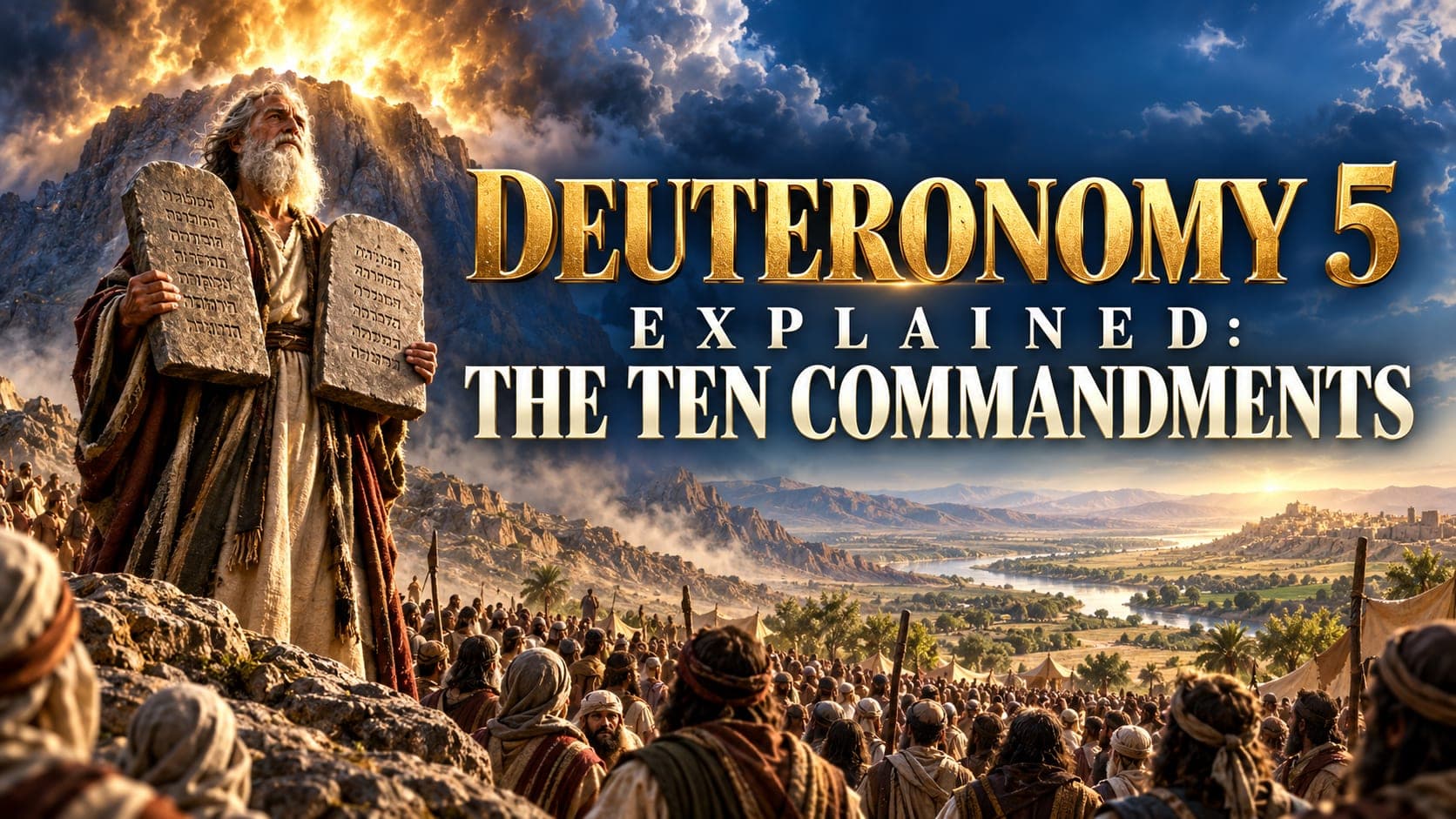
Forty years after Horeb, Moses stands up and says the Ten Commandments out loud again, almost word for word.
Deuteronomy 5 explained is Moses handing the covenant itself to a generation that was too young, or not even born yet, when God first spoke it at the mountain, and making sure not one of them can later claim nobody told them the terms.
Maybe you have heard the Ten Commandments read so many times they stopped sounding like anything.
- ❓ Why does Moses repeat commandments the people already received once, forty years earlier?
- ❓ Why does the reason for keeping the Sabbath change between Exodus and this chapter?
- ❓ Did Israel really ask Moses to stand between them and God, out of plain fear?
- ❓ What does it mean that God wished Israel had a different heart, if He already knew what they would do with the one they had?
📌 Deuteronomy 5 is Moses proving that a covenant made once, at a mountain most of this crowd never personally stood at, still binds the generation standing in front of him right now.
This walkthrough goes through the whole chapter in order: the covenant renewed for "us, even us," the Ten Commandments repeated with one striking change, the people's fear at the mountain and the mediator they asked for, and the longing God voices for a heart that actually follows through on what the mouth just promised.
Thirty three verses, and the hardest one might be the one where God wishes for something He already knows will not hold.
What Happened Just Before This Chapter
Deuteronomy 4 closed Moses' first sermon with an appeal to something no other nation could claim: Israel alone had heard God's own voice out of fire and lived. Moses used that unmatched memory to argue for obedience, forecast a future exile, promise a future return, and quietly set apart three cities of refuge east of the Jordan before Israel had even crossed it.
Deuteronomy 5 opens a new sermon, and the tone shifts again. Moses stops arguing from Israel's experience of God and starts restating the actual terms of what God said at that mountain. He calls the whole nation together and puts the covenant itself back in front of them, the same ten words first spoken at Horeb nearly forty years earlier, before this book moves on to the fuller law that fills the rest of Deuteronomy.

Deuteronomy 5 Explained Verse by Verse
1. "This Day, Not Your Fathers" (verses 1 to 5)
Moses opens by gathering everyone, not just the elders or the heads of tribes.
"And Moses called all Israel, and said unto them, Hear, O Israel, the statutes and judgments which I speak in your ears this day, that ye may learn them, and keep, and do them. The LORD our God made a covenant with us in Horeb. The LORD made not this covenant with our fathers, but with us, even us, who are all of us here alive this day."
📌 Read that claim carefully, because it is not simply true by the calendar. Most of the adults standing in front of Moses right now were children, or not yet born, when Israel actually stood at Horeb. The men old enough to fight that day are the generation God swore would die in the wilderness after the rebellion Deuteronomy 1 already described, and they did, over the thirty eight years it took for the oath to run its course. Moses is not stretching the facts. He is collapsing the distance between generations on purpose, treating the nation as one continuous people who do not get to say the covenant belonged to someone else.
Moses then recalls exactly how the covenant was delivered.
"The LORD talked with you face to face in the mount out of the midst of the fire, (I stood between the LORD and you at that time, to shew you the word of the LORD: for ye were afraid by reason of the fire, and went not up into the mount;) saying,"
💡 "Face to face" and "I stood between" sit in the same two verses without canceling each other out. God spoke the ten words directly to the whole nation at once, the way Exodus 19 describes the fire and trumpet at Horeb. Moses still functioned as the one who kept explaining and carrying God's word before and after that moment, a role the people themselves will ask him to make permanent later in this same chapter.
2. The Ten Commandments Repeated, With One Key Difference (verses 6 to 22)
Moses now says the covenant out loud, in the same ten words Exodus 20 already recorded, almost unchanged.
"I am the LORD thy God, which brought thee out of the land of Egypt, from the house of bondage. Thou shalt have none other gods before me."
"Thou shalt not make thee any graven image, or any likeness of any thing that is in heaven above, or that is in the earth beneath, or that is in the waters beneath the earth: Thou shalt not bow down thyself unto them, nor serve them: for I the LORD thy God am a jealous God, visiting the iniquity of the fathers upon the children unto the third and fourth generation of them that hate me, And shewing mercy unto thousands of them that love me and keep my commandments."
📌 Nothing here surprises anyone who just read Deuteronomy 4. The ban on images and the warning about jealousy are the same ground Moses already covered at length one chapter earlier. Here they simply take their place as the first two of the ten words, not a separate argument.
The fourth commandment is where the wording quietly changes.
"Keep the sabbath day to sanctify it, as the LORD thy God hath commanded thee. Six days thou shalt labour, and do all thy work: But the seventh day is the sabbath of the LORD thy God: in it thou shalt not do any work, thou, nor thy son, nor thy daughter, nor thy manservant, nor thy maidservant, nor thine ox, nor thine ass, nor any of thy cattle, nor thy stranger that is within thy gates; that thy manservant and thy maidservant may rest as well as thou. And remember that thou wast a servant in the land of Egypt, and that the LORD thy God brought thee out thence through a mighty hand and by a stretched out arm: therefore the LORD thy God commanded thee to keep the sabbath day."
⚠️ Exodus 20 grounds the exact same command in a completely different memory.
"For in six days the LORD made heaven and earth, the sea, and all that in them is, and rested the seventh day: wherefore the LORD blessed the sabbath day, and hallowed it."
Exodus points back to creation. Deuteronomy points back to slavery and rescue. Neither verse corrects the other. Rest is owed to creation itself, because God rested first, and rest is owed to a people who once had no right to rest at all, because a slave in Egypt did not get a seventh day off. Moses gives Israel two reasons to keep one command, and either reason alone would be enough.
The fifth commandment gets a small addition Exodus does not carry.
"Honour thy father and thy mother, as the LORD thy God hath commanded thee; that thy days may be prolonged, and that it may go well with thee, in the land which the LORD thy God giveth thee."
💡 Exodus 20:12 promises only that your days will be long. Deuteronomy adds "that it may go well with thee," a phrase this whole book repeats constantly for keeping any command at all. Honoring parents is not singled out as harder or stranger than the rest. It gets folded into the same promise every other command in this book carries.
The last five commandments move quickly, each one a single short line.
"Thou shalt not kill. Neither shalt thou commit adultery. Neither shalt thou steal. Neither shalt thou bear false witness against thy neighbour."
"Neither shalt thou desire thy neighbour's wife, neither shalt thou covet thy neighbour's house, his field, or his manservant, or his maidservant, his ox, or his ass, or any thing that is thy neighbour's."
📌 Compare that last line to Exodus 20:17, and the order flips. Exodus names the neighbor's house first and his wife second, inside one single verb. Deuteronomy names the wife first, uses a different verb for her than it uses for the property, and adds a field to the list, a detail Exodus never mentions. A people about to settle down and farm land they do not own yet needed "field" said out loud. Both records carry the same command. Neither contradicts the other on anything that actually changes what is forbidden.
Moses closes the list the same way Exodus 20 does, stating what happened the moment God finished speaking.
"These words the LORD spake unto all your assembly in the mount out of the midst of the fire, of the cloud, and of the thick darkness, with a great voice: and he added no more. And he wrote them in two tables of stone, and delivered them unto me."
"He added no more" matters as much as anything said before it. Ten words, spoken once, in front of the whole nation, with nothing extra thrown in and nothing left out.
3. "We Will Hear It, and Do It" (verses 23 to 27)
Once the voice stops, the leaders of Israel come to Moses with something close to panic.
"And it came to pass, when ye heard the voice out of the midst of the darkness, (for the mountain did burn with fire,) that ye came near unto me, even all the heads of your tribes, and your elders; And ye said, Behold, the LORD our God hath shewed us his glory and his greatness, and we have heard his voice out of the midst of the fire: we have seen this day that God doth talk with man, and he liveth."
💡 That last line is not a small observation. Nobody in the ancient world expected to hear a god speak and survive it. Israel is stating, almost in disbelief, that they just did exactly that.
Relief does not stop them from asking for something to change going forward.
"Now therefore why should we die? for this great fire will consume us: if we hear the voice of the LORD our God any more, then we shall die. For who is there of all flesh, that hath heard the voice of the living God speaking out of the midst of the fire, as we have, and lived? Go thou near, and hear all that the LORD our God shall say: and speak thou unto us all that the LORD our God shall speak unto thee; and we will hear it, and do it."
📌 "We will hear it, and do it" is a complete promise, said out loud by the whole nation's leaders, in the exact moment conviction was strongest. The request itself is not framed as unbelief. It reads as a people who finally understand what they just survived, and who would rather receive God's words secondhand through a man than risk that fire a second time.
4. God's Longing, and the Charge to Moses (verses 28 to 31)
God hears the request before Moses even has a chance to repeat it, and answers immediately.
"And the LORD heard the voice of your words, when ye spake unto me; and the LORD said unto me, I have heard the voice of the words of this people, which they have spoken unto thee: they have well said all that they have spoken."
God approves the request outright. Then, in the very next breath, He says something far heavier than approval.
"O that there were such an heart in them, that they would fear me, and keep all my commandments always, that it might be well with them, and with their children for ever!"
⚠️ Good words were just spoken. God still wishes for something the words alone do not guarantee: an actual heart that follows through. "They have well said" and "O that there were such an heart in them" sit in back to back verses on purpose. Speaking the right promise and living inside that promise are not automatically the same thing, and Moses lets both statements stand without softening either one.
God then answers the request itself, sending the people home and keeping Moses on the mountain.
"Go say to them, Get you into your tents again. But as for thee, stand thou here by me, and I will speak unto thee all the commandments, and the statutes, and the judgments, which thou shalt teach them, that they may do them in the land which I give them to possess it."
💡 This is the moment the rest of Deuteronomy gets its reason for existing. Everything from chapter six onward, the whole body of statutes and judgments Moses is about to teach, traces back to Israel asking for a mediator and God granting it on the spot.
5. Walking in All His Ways (verses 32 and 33)
Moses closes the chapter with a short command that sums up everything just said.
"Ye shall observe to do therefore as the LORD your God hath commanded you: ye shall not turn aside to the right hand or to the left. Ye shall walk in all the ways which the LORD your God hath commanded you, that ye may live, and that it may be well with you, and that ye may prolong your days in the land which ye shall possess."
📌 "Not turn aside to the right hand or to the left" is not a vague closing line. It is the same insistence on a complete, unedited law that opened the previous sermon's command not to add to or take away from it. Obedience here is not pictured as a single dramatic choice made once at a mountain. It is pictured as a road, walked one step at a time, with a straight line on either side a person could still wander off of years after the fire has gone quiet.
Hard Questions Deuteronomy 5 Raises
Why repeat the Ten Commandments at all, instead of just pointing back to Exodus 20? The whole point of this sermon is that the covenant belongs to the generation hearing it now, not only to the generation that first heard it. Restating the words in full, in front of everyone, closes off any excuse that the commandments were someone else's agreement and not theirs.
Does the different Sabbath reason mean one account got it wrong? No. Exodus roots the command in creation's rhythm, something true for every human being regardless of history. Deuteronomy roots the same command in Israel's own rescue from slavery, something true only for this specific people. The text presents both as real reasons for the same rest, not competing explanations where only one can survive.
Was Israel's request for a mediator faith or fear? The text does not force a choice between the two. Verse 28 has God calling their words well said, and nothing in the passage rebukes the request itself. Fear of the fire and genuine respect for what they had just witnessed sit together in the same breath, and Scripture lets them.
Does "O that there were such an heart in them" mean God did not already know how Israel would fail? Reading it that way misses how this kind of language works throughout Scripture. The same book that records this longing also records Moses predicting Israel's future failure in exact detail one chapter earlier. The wish is relational, not informational. A God who already knows the outcome can still genuinely long for a different one, the same way a parent can want obedience from a child whose next choice they can already predict.
Top Verses From Deuteronomy 5
1. Deuteronomy 5:3
"The LORD made not this covenant with our fathers, but with us, even us, who are all of us here alive this day."
The verse that collapses forty years of distance into one word. The covenant was never just for the generation who first stood at the mountain.
2. Deuteronomy 5:15
"And remember that thou wast a servant in the land of Egypt, and that the LORD thy God brought thee out thence through a mighty hand and by a stretched out arm: therefore the LORD thy God commanded thee to keep the sabbath day."
A second, equally real reason to rest, grounded in rescue rather than creation. Both reasons point at the same command.
3. Deuteronomy 5:27
"Go thou near, and hear all that the LORD our God shall say: and speak thou unto us all that the LORD our God shall speak unto thee; and we will hear it, and do it."
Israel's own promise, spoken at the height of their fear and their awe, before the rest of this book tests whether the promise held.
4. Deuteronomy 5:29
"O that there were such an heart in them, that they would fear me, and keep all my commandments always, that it might be well with them, and with their children for ever!"
God's answer to a well spoken promise. Right words and a right heart are named here as two different things, not one.
5. Deuteronomy 5:33
"Ye shall walk in all the ways which the LORD your God hath commanded you, that ye may live, and that it may be well with you, and that ye may prolong your days in the land which ye shall possess."
The chapter's closing picture of obedience: not one dramatic moment at a mountain, but a road walked one step at a time.

Frequently Asked Questions About Deuteronomy 5
What is Deuteronomy 5 about?
Deuteronomy 5 is Moses restating the Ten Commandments to a new generation of Israel almost forty years after they were first given at Horeb. It also recounts the people's fear at hearing God's voice directly, their request for Moses to act as a mediator, and God's response granting that request while still longing for a heart in Israel that would obey out of more than fear.
Why does Moses repeat the Ten Commandments in Deuteronomy 5?
The generation Moses is speaking to was mostly too young, or not yet born, when the commandments were first given. Deuteronomy 5:3 states the point directly: the covenant was made with "us, even us," the generation alive and listening right now, not only with the parents who stood at the mountain decades earlier.
What is the difference between the Ten Commandments in Exodus 20 and Deuteronomy 5?
The commandments themselves match. The two small differences are the reason given for the Sabbath, creation in Exodus 20:11 and rescue from slavery in Deuteronomy 5:15, and the wording of the final command, which adds "field" and lists the neighbor's wife before his house in Deuteronomy 5:21.
Why does Deuteronomy give a different reason for the Sabbath than Exodus?
Exodus 20:11 ties the Sabbath to God resting after creating the world, a reason true for everyone. Deuteronomy 5:15 ties the same command to Israel's own rescue from slavery in Egypt, a reason true only for Israel. Both are given as real grounds for the same command, not competing explanations.
Why did Israel ask Moses to be a mediator between them and God?
After hearing God's voice directly out of the fire, Israel's elders feared they would die if they heard it again. Deuteronomy 5:27 records them asking Moses to hear God's words on their behalf and bring the message back to them, a request God calls well said in verse 28.
What does "the LORD made not this covenant with our fathers, but with us" mean?
It means the covenant given at Horeb was not a one time agreement that expired with the generation that first heard it. Moses applies it directly to the generation standing in front of him, most of whom were children or not yet born when it was first spoken.
Does "O that there were such an heart in them" mean God does not know the future?
No. The same book that records this longing also records Moses predicting Israel's future failure and exile in specific detail. The wish in Deuteronomy 5:29 expresses real relational longing for Israel's obedience, not uncertainty about what Israel would actually do.
Why do some churches number the Ten Commandments differently?
Deuteronomy 5 and Exodus 20 list the same ten statements, but different traditions divide them into ten differently. Jewish tradition treats "I am the LORD thy God" as its own first word. Catholic and Lutheran tradition combine the command against other gods with the command against graven images, then split the final command on coveting into two to keep the total at ten. Most other Protestant traditions count no other gods and no graven images as two separate commandments from the start.
How does Deuteronomy 5 connect to the rest of the book?
Israel's request for a mediator in verses 23 to 27, and God's decision to keep Moses on the mountain to receive the fuller law in verses 30 and 31, set up everything from Deuteronomy 6 onward. The statutes and judgments Moses teaches for the rest of the book exist because of the arrangement made in this one chapter.
Final Thoughts
Deuteronomy 5 is a chapter about words said once that still have to be said again.
📌 The covenant was never only for the generation who first heard it. Moses makes a whole new generation own words they never personally heard at the mountain, because the agreement never expired with the people who first signed onto it.
📌 Two different reasons can both be true for the same command. Rest was owed to creation's own rhythm and to a people once denied any rest at all. God did not need to pick one reason over the other.
📌 Being heard and being obeyed are not the same thing. Israel spoke well. God still longed for a heart that would carry those words past the moment they were spoken.
You probably are not standing at a burning mountain this week, repeating promises you are not sure you can keep. But you have almost certainly said "we will hear it, and do it" about something, in a moment the feeling was real and strong.
So here is your one next step.
Ask whether the heart behind your own last good promise to God has actually kept walking since you made it, or whether it quietly went back to its tent the moment the fire died down.