📖 Deuteronomy 6 Explained: The Shema and Total Love for God
Six words, said twice a day for thousands of years, by people who never met each other.
Deuteronomy 6 explained is the chapter that gave Israel, and later Jesus Himself, the most repeated sentence in Scripture: the LORD is one, and you are to love Him with everything you have. No fine print. No partial version.
Maybe you have said you love God without ever asking what loving Him with your whole heart would actually look like this week.
- ❓ What does it mean that the LORD is one, and does that verse say anything about the Trinity?
- ❓ Were Israelites supposed to literally tie words to their hands and foreheads?
- ❓ Why does Moses warn Israel about having too much, right after promising them a land flowing with milk and honey?
- ❓ Why did Jesus quote this exact chapter twice, once as the greatest command and once while being tempted?
📌 Deuteronomy 6 is Moses handing Israel a command to love God, then building an entire way of life designed to make that love impossible to forget.
This walkthrough goes through the whole chapter in order: the reason for the statutes, the Shema itself, the plan to teach it at every hour of an ordinary day, the warning buried inside prosperity, the command not to test God, and the answer Israel was told to give their own children one day.
Twenty five verses, and almost every line of the New Testament's greatest commandment traces straight back to this one chapter.
What Happened Just Before This Chapter
Deuteronomy 5 ended with Israel asking Moses to stand between them and God, too afraid of the fire at Horeb to hear His voice directly ever again. God granted the request, sent the people back to their tents, and kept Moses alone on the mountain to receive "all the commandments, and the statutes, and the judgments" that Moses would then teach the nation.
Deuteronomy 6 is the first of those statutes and judgments, delivered now that the Ten Commandments have already been repeated in full. Where Deuteronomy 5 restated the law itself, Deuteronomy 6 explains the heart the law was always meant to come from, and the ordinary daily habits meant to keep that heart from going cold once Israel actually settles into the land they have not yet reached.
Deuteronomy 6 Explained Verse by Verse
1. Why These Commands Exist at All (verses 1 to 3)
Moses opens with the purpose of everything he is about to say, before he says any of it.
"Now these are the commandments, the statutes, and the judgments, which the LORD your God commanded to teach you, that ye might do them in the land whither ye go to possess it: That thou mightest fear the LORD thy God, to keep all his statutes and his commandments, which I command thee, thou, and thy son, and thy son's son, all the days of thy life; and that thy days may be prolonged."
📌 The law was never handed down for its own sake. It was given so that Israel could actually live well, generation after generation, in a land they had not yet set foot in. Moses names three generations in one breath: you, your son, your son's son. This command was never built to last one lifetime.
The promise attached to obedience is stated just as plainly.
"Hear therefore, O Israel, and observe to do it; that it may be well with thee, and that ye may increase mightily, as the LORD God of thy fathers hath promised thee, in the land that floweth with milk and honey."
💡 "Hear therefore" opens this verse, and the exact same Hebrew word for hear, shema, opens the next two verses as well. Moses is not reaching for a new word. He is about to use the most important word in the chapter three times in a row.
2. The Shema: One LORD, Loved With Everything (verses 4 and 5)
Here is the verse Jewish people have recited morning and evening for thousands of years.
"Hear, O Israel: The LORD our God is one LORD: And thou shalt love the LORD thy God with all thine heart, and with all thy soul, and with all thy might."
📌 This is called the Shema, after its opening word, and it is the closest thing Israel ever had to a single sentence that summed up the whole faith.
"The LORD our God is one LORD" is first of all a claim about who this God is not. Every nation around Israel served many gods, each one covering a different piece of life. This verse insists there is no divided territory. One LORD rules every part of it.
And then the command that follows refuses to divide a person the same way the first half refuses to divide God. Heart, soul, and might cover intention, identity, and strength. Nothing is left outside the command.
⚠️ Love here is commanded, not merely felt. That can sound strange, since feelings are not usually something you can order someone to have. But the Hebrew word used throughout this chapter for love describes committed loyalty and action at least as much as emotion. You are told to love God the way a covenant partner loves, with your choices, not only your feelings.
3. Teaching It Diligently, Everywhere (verses 6 to 9)
A command this central cannot survive on its own. Moses immediately builds a plan to keep it in front of the nation.
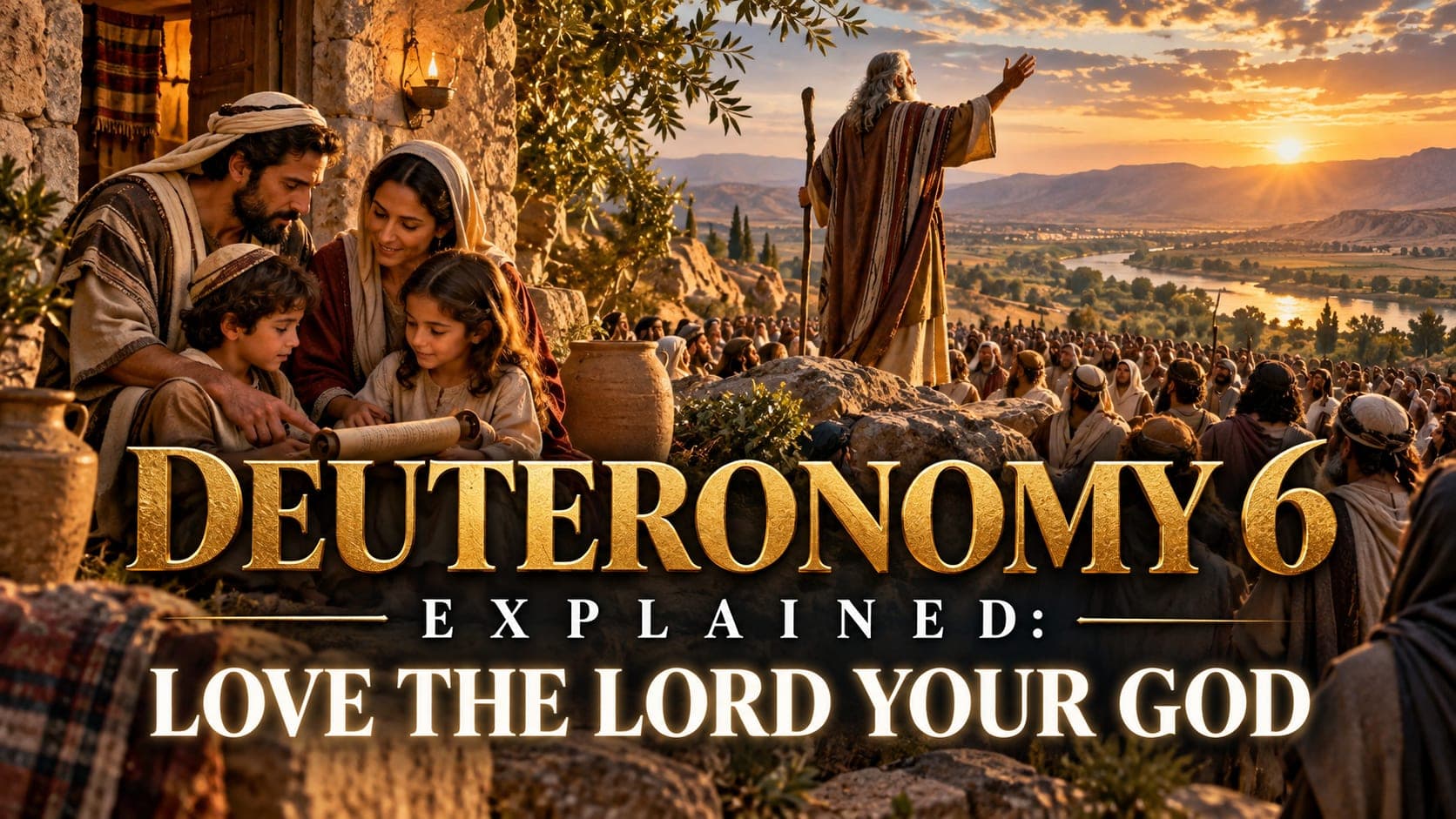
"And these words, which I command thee this day, shall be in thine heart: And thou shalt teach them diligently unto thy children, and shalt talk of them when thou sittest in thine house, and when thou walkest by the way, and when thou liest down, and when thou risest up."
📌 Notice there is no slot in the day this misses. Sitting at home, walking somewhere, lying down, waking up. Moses is not asking for one formal lesson a week. He is asking for a conversation that never fully stops.
Then the command gets physical.
"And thou shalt bind them for a sign upon thine hand, and they shall be as frontlets between thine eyes. And thou shalt write them upon the posts of thy house, and on thy gates."
💡 Tying words to a hand, wearing them on the forehead, and writing them on a doorframe are not small details. Observant Jewish practice took this literally, which is where tefillin, the small boxes containing these words worn on the arm and forehead during prayer, and the mezuzah, a scroll fixed to the doorpost, both come from. Many Christian readers take the same verses as a vivid picture rather than a literal uniform, a way of saying this command should touch what your hands do, what your mind fixes on, and what greets you every time you leave or enter your home. Both readings take the verse seriously. They simply land it in different places.
4. The Danger Hiding Inside a Full Table (verses 10 to 15)
Moses now looks past the wilderness, to a future Israel has not reached yet, and warns them about exactly what that future will feel like.
"And it shall be, when the LORD thy God shall have brought thee into the land which he sware unto thy fathers, to Abraham, to Isaac, and to Jacob, to give thee great and goodly cities, which thou buildedst not, And houses full of all good things, which thou filledst not, and wells digged, which thou diggedst not, vineyards and olive trees, which thou plantedst not; when thou shalt have eaten and be full;"
📌 Every item on this list is something Israel will receive, not build. Cities they did not construct, houses they did not fill, wells they did not dig, vineyards they did not plant. Moses lists four things Israel inherits before naming the one danger that comes with all of it.
"Then beware lest thou forget the LORD, which brought thee forth out of the land of Egypt, from the house of bondage. Thou shalt fear the LORD thy God, and serve him, and shalt swear by his name. Ye shall not go after other gods, of the gods of the people which are round about you; (For the LORD thy God is a jealous God among you) lest the anger of the LORD thy God be kindled against thee, and destroy thee from off the face of the earth."
⚠️ Notice what Moses warns against here. Not a famine. A full table. Hunger in the wilderness kept Israel looking to God for the next meal. Moses already knows that a house you did not build has a way of making the God who gave it to you fade quietly into the background. The jealousy named in verse 15 is the same ground Deuteronomy 4 and Deuteronomy 5 already covered, now applied to a very specific moment: the day comfort arrives.
5. Do Not Put God to the Test (verse 16)
One short verse, pointing straight back at an incident Israel had already lived through.
"Ye shall not tempt the LORD your God, as ye tempted him in Massah."
Massah is the place Exodus 17 describes, where a thirsty Israel demanded water and effectively challenged God to prove Himself present.
"And he called the name of the place Massah, and Meribah, because of the chiding of the children of Israel, and because they tempted the LORD, saying, Is the LORD among us, or not?"
📌 Testing God means demanding proof on your own terms instead of trusting what He has already shown you. Israel had already seen the Red Sea split and manna fall from the sky. Massah was not a lack of evidence. It was a refusal to rest on evidence already given.
This single verse becomes important again centuries later. When the devil tempts Jesus in the wilderness to force God's hand by jumping from the temple, Jesus answers with this exact command.
"Jesus said unto him, It is written again, Thou shalt not tempt the Lord thy God."
💡 Where Israel failed this exact test at Massah, Jesus passes it in the wilderness, quoting the very verse Israel broke.
6. Do What Is Right and Good in His Sight (verses 17 to 19)
Moses widens the command from one incident at Massah to a whole posture toward obedience.
"Ye shall diligently keep the commandments of the LORD your God, and his testimonies, and his statutes, which he hath commanded thee. And thou shalt do that which is right and good in the sight of the LORD: that it may be well with thee, and that thou mayest go in and possess the good land which the LORD sware unto thy fathers, To cast out all thine enemies from before thee, as the LORD hath spoken."
📌 "Right and good in the sight of the LORD" sets the real standard. Not merely legal, not merely what gets Israel by. Moses asks for obedience measured against God's own eyes, not the lowest bar the law happens to allow.
7. Answering the Question Your Child Will Ask (verses 20 to 25)
Moses closes the chapter by scripting an actual conversation, years in the future, between a parent and a child who was not alive for any of this.
"And when thy son asketh thee in time to come, saying, What mean the testimonies, and the statutes, and the judgments, which the LORD our God hath commanded you? Then thou shalt say unto thy son, We were Pharaoh's bondmen in Egypt; and the LORD brought us out of Egypt with a mighty hand:"
📌 The answer Moses scripts is not a list of rules. It is a story. When a child asks why the family keeps these statutes, the first word out of the parent's mouth is not a command. It is a memory: we were slaves, and the LORD brought us out.
The chapter ends on the connection between that rescue and the obedience it produces.
"And the LORD commanded us to do all these statutes, to fear the LORD our God, for our good always, that he might preserve us alive, as it is at this day. And it shall be our righteousness, if we observe to do all these commandments before the LORD our God, as he hath commanded us."
💡 "For our good always" closes the loop that opened the chapter. The commandments were never arbitrary. They were given, Moses insists one more time, for Israel's own good, by the same God who had already proven He could be trusted with their rescue.
Hard Questions Deuteronomy 6 Raises
Does "the LORD our God is one LORD" say anything about the Trinity? The verse's plain function in its own setting is to rule out every other god Israel's neighbors served. It is a claim about exclusive, undivided loyalty to one God, not a statement about God's internal nature. Some Christians have pointed to the same Hebrew word for one being used elsewhere for a composite unity, the way Genesis 2:24 calls a husband and wife one flesh, to argue the verse leaves room for later New Testament teaching about the Trinity. Most Hebrew scholars treat that as reading more into the word than the verse itself claims. The text's own point is Israel's complete loyalty to one God, not a description of how that one God is three persons, a doctrine the New Testament establishes on its own, later ground.
Were the frontlets and doorpost words meant literally or figuratively? Scripture does not settle the question inside this chapter. Observant Jewish practice has read it literally for over two thousand years, producing tefillin and the mezuzah. Other readers, ancient and modern, read the same command as a memorable image for keeping God's word central to everything your hands do and everywhere you live, without requiring a physical object. Both readings have a long, serious history behind them.
Is tempting God in verse 16 the same thing as the testing James 1:13 says God never does to people? No, the two are different directions of the same word. James 1:13 says God never tempts a person toward sin. Deuteronomy 6:16 and Exodus 17 describe people testing God, demanding He prove Himself on their terms instead of trusting what He had already shown. The command here runs upward, from Israel toward God, not the other way around.
Can love really be commanded? Not if love only means a feeling that arrives on its own. The love commanded in verse 5 is covenant love, the kind a nation promises the way a spouse promises faithfulness on a wedding day, before every future feeling has even happened yet. Scripture elsewhere expects feeling to follow faithfulness more often than faithfulness waits on feeling.
Top Verses From Deuteronomy 6
1. Deuteronomy 6:4 and 5
"Hear, O Israel: The LORD our God is one LORD: And thou shalt love the LORD thy God with all thine heart, and with all thy soul, and with all thy might."
The Shema. Centuries later Jesus names this verse, almost word for word, as the first and greatest commandment in all of Scripture.
2. Deuteronomy 6:16
"Ye shall not tempt the LORD your God, as ye tempted him in Massah."
The verse Jesus quotes word for word to refuse the devil in the wilderness, succeeding exactly where Israel had failed at the same test generations earlier.
3. Deuteronomy 6:6 and 7
"And these words, which I command thee this day, shall be in thine heart: And thou shalt teach them diligently unto thy children, and shalt talk of them when thou sittest in thine house, and when thou walkest by the way, and when thou liest down, and when thou risest up."
A command for every hour of an ordinary day, not one weekly lesson. Faith was meant to live in conversation, not only in ceremony.
4. Deuteronomy 6:12
"Then beware lest thou forget the LORD, which brought thee forth out of the land of Egypt, from the house of bondage."
A warning placed right beside a promise of houses, wells, and vineyards Israel did not build. Comfort, not hardship, is named as the real danger to remembering God.
5. Deuteronomy 6:24
"And the LORD commanded us to do all these statutes, to fear the LORD our God, for our good always, that he might preserve us alive, as it is at this day."
The answer a parent gives a child who asks why any of this matters. The law was never arbitrary. It was for Israel's own good, from the very God who had already rescued them once.
Frequently Asked Questions About Deuteronomy 6
What is Deuteronomy 6 about?
Deuteronomy 6 contains the Shema, Israel's call to love the one LORD with all of their heart, soul, and might, along with instructions to teach it constantly, a warning not to forget God once they are prosperous in the promised land, a command not to test God the way Israel did at Massah, and a script for answering a child's question about why the law matters at all.
What is the Shema?
The Shema is Deuteronomy 6:4 and 5, named after its opening Hebrew word for "hear." It declares that the LORD is one God and commands total, undivided love for Him. Jewish people have recited it daily for thousands of years, and Jesus later names it the greatest commandment in the law.
Why did Jesus quote Deuteronomy 6:5 as the greatest commandment?
When asked which commandment mattered most, Jesus answered with the Shema in Mark 12:29 and 30, calling total love for God the first commandment, then pairing it with loving your neighbor from Leviticus 19:18. He was not introducing a new teaching. He was naming the verse Israel had already been reciting for centuries as the center of the whole law.
What are frontlets, and were Israelites supposed to wear them?
Frontlets are the bands Deuteronomy 6:8 describes being worn between the eyes. Observant Jewish tradition took this literally, producing tefillin, small boxes containing these words strapped to the arm and forehead during prayer. Other readers take the same verse as a vivid picture for keeping God's word at the center of your thinking, not a requirement for a physical object.
What is a mezuzah, and does this chapter command it?
A mezuzah is a small case containing these words, fixed to a doorframe, following the literal reading of Deuteronomy 6:9. Many Jewish homes still keep one on the doorpost today. Christians are not bound to the practice, though the verse's underlying point, that God's word should greet you at the door of your own life, still applies.
What does it mean to tempt the LORD, and why does Jesus quote this verse?
Tempting the LORD means demanding proof of His presence or power on your own terms, instead of trusting what He has already shown. Israel did this at Massah in Exodus 17, doubting God's presence despite having already seen the Red Sea part. Jesus quotes Deuteronomy 6:16 word for word in Matthew 4:7 to refuse the devil's dare to force God's hand, succeeding at the exact test an earlier generation of Israel failed.
Why does Deuteronomy 6 warn about prosperity instead of poverty?
Because Moses already knows human nature. Hunger in the wilderness kept Israel looking to God daily for food. Houses, wells, and vineyards they did not have to build for themselves carry a quieter danger: the temptation to credit comfort to circumstance and quietly forget the God who actually provided it.
Does "the LORD our God is one LORD" rule out the Trinity?
No. The verse's plain purpose is affirming exclusive loyalty to one God against the many gods Israel's neighbors served, not describing God's internal nature one way or the other. Christians read the doctrine of the Trinity from the fuller witness of the New Testament, not from this verse denying or confirming it either way.
What does it mean that obedience would be Israel's righteousness?
Deuteronomy 6:25 ties righteousness to observing the commandments God had already given a rescued people, not to earning rescue in the first place. Israel was already brought out of Egypt before this chapter was ever spoken. The obedience described here responds to a salvation already received, the same order the New Testament keeps for grace and good works.
Why does Moses script an exact answer for a child's question?
Because Moses assumes the next generation will not have lived through Egypt themselves and will eventually ask why any of this matters. The scripted answer in verses 21 to 23 roots the law in a true story of rescue rather than a bare list of rules, making sure the reason for obedience gets passed down along with the obedience itself.
Final Thoughts
Deuteronomy 6 is a chapter built around one sentence, with everything else designed to protect it.
📌 Loving God was never meant to be partial. Heart, soul, and might cover every part of a person Moses could name, because the Shema refuses to let devotion stay divided the way the surrounding nations divided their gods.
📌 Comfort tests you differently than hardship does. Israel's real danger was never going to be the wilderness. It was the full table waiting for them in a land they did not have to build.
📌 The reason for obedience always comes before the command itself. Moses hands the next generation a rescue story first, then the statutes that rescue produced, in that order, every time.
You are probably not reciting the Shema morning and evening this week. But you almost certainly have some part of your life quietly left out of "all your heart, and all your soul, and all your might."
So here is your one next step.
Name the one area you have been loving God with less than everything, and bring that one area back into the sentence today.