📖 Exodus 16 Explained: Manna, Quail, and the First Sabbath Test
A month and a half out of Egypt, and the whole camp is already talking about going back.
Exodus 16 explained is the chapter where Israel runs out of food in the wilderness of Sin, and instead of a plague or a punishment, God answers hunger with bread that falls from the sky every single morning for forty years. But the real story in this chapter is not the bread. It is what God hides inside the instructions for gathering it.
Maybe you have wondered why a miracle this generous came wrapped in so many rules.
- ❓ Why does Israel wish for death over hunger, only six weeks after the Red Sea?
- ❓ What actually was manna, and does science have an explanation for it?
- ❓ Why does gathering too much manna never leave anyone with extra?
- ❓ And why does the sabbath show up here, before the Ten Commandments are ever given?
📌 God does not just feed Israel in this chapter. He uses daily bread to teach a whole nation how to trust Him one morning at a time.
This walkthrough goes through the whole chapter in order: the complaint that blames Moses for a famine that has not actually happened yet, the quail and the dew that covers the camp, the strange math of the omer, the test buried inside a day of rest, and the jar of manna kept as a witness long after the wilderness ended.
Read slowly. This chapter has more to say about your own impatience than you might expect.
What Happened Just Before This Chapter
Exodus 15 ended at Elim, a camp with twelve wells of water and seventy palm trees, right after Israel had sung the first song in the Bible on the shore of the sea and then complained about bitter water at Marah only three days later. God sweetened that water and gave Israel a small taste of what obedience and testing would look like going forward.
Exodus 16 opens a month after leaving Egypt, with Israel moving on from Elim's water and shade into the wilderness of Sin, a dry stretch of ground between Elim and Sinai. Water had been the crisis last chapter. This chapter, it is food, and the complaint arrives faster and angrier than it did at Marah.
Exodus 16 Explained Verse by Verse
1. A Camp Wishing It Had Died in Egypt (verses 1 to 3)
The chapter opens with a date and a complaint, in that order.
"And they took their journey from Elim, and all the congregation of the children of Israel came unto the wilderness of Sin, which is between Elim and Sinai, on the fifteenth day of the second month after their departing out of the land of Egypt."
Scripture is careful to date this moment exactly: one month to the day since Israel walked out of Egypt. Whatever food they carried with them has run out right on schedule.
"And the children of Israel said unto them, Would to God we had died by the hand of the LORD in the land of Egypt, when we sat by the flesh pots, and when we did eat bread to the full; for ye have brought us forth into this wilderness, to kill this whole assembly with hunger."
📌 Notice the word they reach for first: death. Not "we are hungry." They wish God had simply killed them back in Egypt, next to full pots of meat, rather than let them face an empty stomach free. Slavery is remembered here as comfortable, which it never actually was.
Nobody in the camp has starved yet. The complaint arrives before the crisis does, exactly the same pattern already seen at the Red Sea and again at Marah: fear of a hardship speaks louder than the hardship itself.
2. God's Answer: Bread From Heaven, and a Test Hidden Inside It (verses 4 and 5)
God does not scold the complaint. He goes straight to provision, and tells Moses exactly why.
"Then said the LORD unto Moses, Behold, I will rain bread from heaven for you; and the people shall go out and gather a certain rate every day, that I may prove them, whether they will walk in my law, or no."
💡 Prove them is the whole chapter in one phrase. The bread is real provision, but the way it is given, a day at a time, never stockpiled, is designed to test whether Israel will trust God daily or try to manage tomorrow on their own terms.
Verse 5 adds a second detail that will not make sense yet: a double portion comes on the sixth day. Israel will not understand why until the end of the chapter, but God has already built the sabbath into the plan before announcing it.
3. Moses and Aaron Turn the Complaint Back to God (verses 6 to 12)
Before any bread falls, Moses and Aaron correct who the complaint was really aimed at.
"And Moses said, This shall be, when the LORD shall give you in the evening flesh to eat, and in the morning bread to the full; for that the LORD heareth your murmurings which ye murmur against him: and what are we? your murmurings are not against us, but against the LORD."
📌 Israel thought they were complaining about Moses's leadership. Moses tells them plainly they were really complaining about God. Grumbling about the people in charge of your circumstances is very often grumbling about the God who put them there.
Aaron speaks to the whole congregation, and the LORD answers with something visible.
"And it came to pass, as Aaron spake unto the whole congregation of the children of Israel, that they looked toward the wilderness, and, behold, the glory of the LORD appeared in the cloud."
The same cloud that has led Israel since the pillar of cloud and fire now carries God's glory into view at the exact moment the people turn to look, before a single quail or flake of manna has fallen.
4. Quail at Evening, and a Bread Nobody Had Seen Before (verses 13 to 15)
The promise in verse 8 arrives in the exact order it was spoken: flesh at evening, bread in the morning.
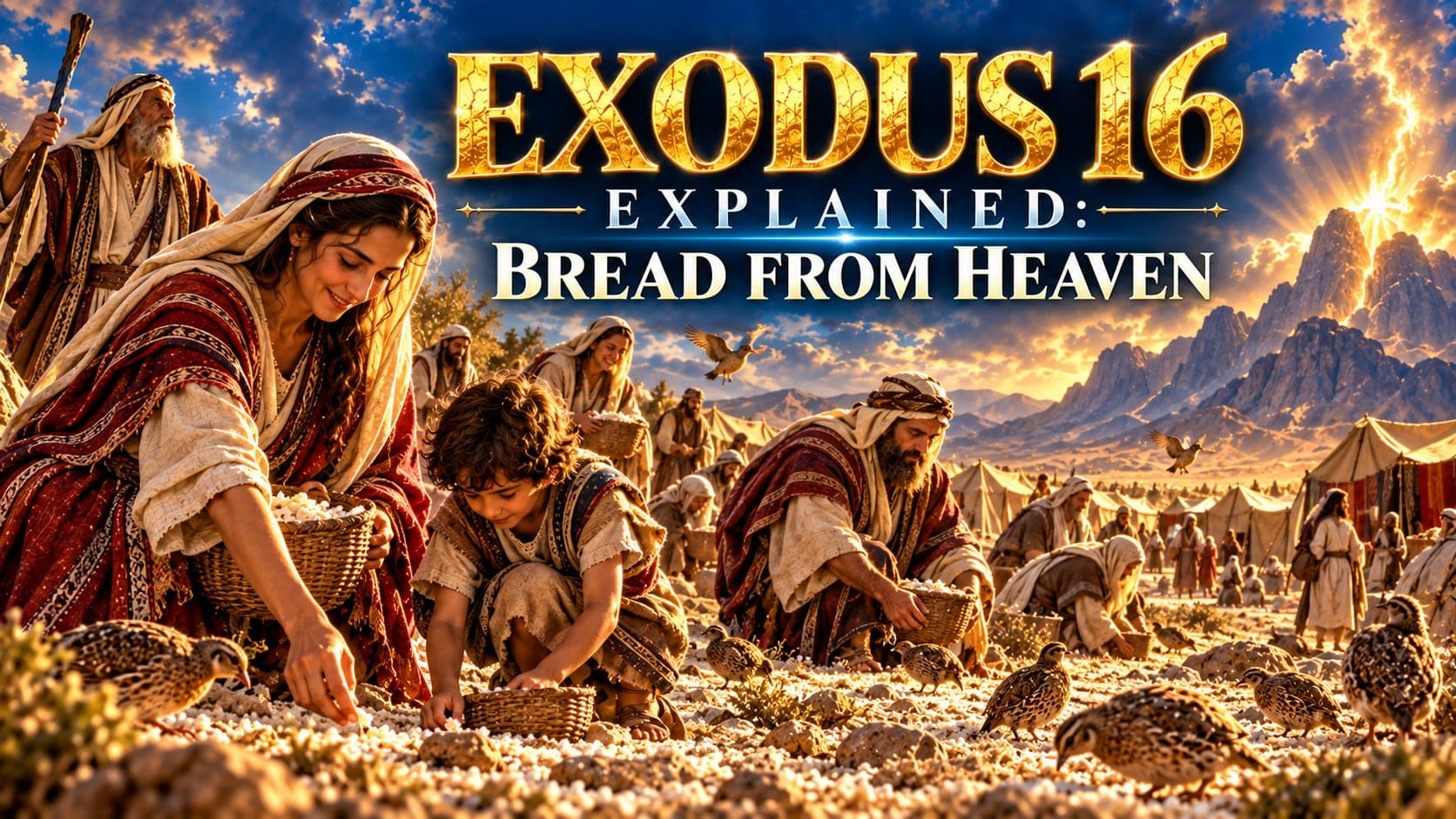
"And it came to pass, that at even the quails came up, and covered the camp: and in the morning the dew lay round about the host."
"And when the dew that lay was gone up, behold, upon the face of the wilderness there lay a small round thing, as small as the hoar frost on the ground."
Israel has no word for what they are looking at. Their own confusion gives the substance its name.
"And when the children of Israel saw it, they said one to another, It is manna: for they wist not what it was. And Moses said unto them, This is the bread which the LORD hath given you to eat."
💡 Manna comes from the Hebrew question "man hu," roughly "what is this." The name of the single most famous food in the Old Testament is literally a question nobody could answer the first morning they ate it.
5. An Omer a Day: the Math That Always Comes Out Even (verses 16 to 21)
God gives a specific, measured instruction for how much manna each household should gather.
"This is the thing which the LORD hath commanded, Gather of it every man according to his eating, an omer for every man, according to the number of your persons; take ye every man for them which are in his tents."
An omer is a dry measure, defined later in the chapter as a tenth of an ephah. What happens next with that measure is the strange part.
"And when they did mete it with an omer, he that gathered much had nothing over, and he that gathered little had no lack; they gathered every man according to his eating."
📌 However much a household actually gathered, it measured out to exactly enough, no more and no less. Paul later quotes this verse directly when asking the Corinthian church to give generously toward believers in need, pointing to this exact moment as the pattern for equality among God's people.
Moses then gives one more instruction, and it does not go well.
"Notwithstanding they hearkened not unto Moses; but some of them left of it until the morning, and it bred worms, and stank: and Moses was wroth with them."
⚠️ Hoarding manna did not preserve it. It ruined it. The bread was built to be trusted one day at a time, and the people who tried to stockpile it against tomorrow found tomorrow's portion already spoiled before they ever reached for it.
6. The First Sabbath Test, Weeks Before Sinai (verses 22 to 30)
On the sixth day, the pattern God hinted at back in verse 5 finally gets explained.
"And he said unto them, This is that which the LORD hath said, To morrow is the rest of the holy sabbath unto the LORD: bake that which ye will bake to day, and seethe that ye will seethe; and that which remaineth over lay up for you to be kept until the morning."
"And they laid it up till the morning, as Moses bade: and it did not stink, neither was there any worm therein."
📌 The exact same leftover manna that rotted overnight in verse 20 stays perfectly fresh overnight in verse 24. Nothing about the bread changed. What changed was whether keeping it was disobedience or obedience. The sabbath did not just rearrange when Israel worked. It made the manna itself behave differently depending on whether trust or hoarding was behind the gathering.
Some in the camp test the rule anyway.
"Six days ye shall gather it; but on the seventh day, which is the sabbath, in it there shall be none."
"And it came to pass, that there went out some of the people on the seventh day for to gather, and they found none."
God's response to that is not a new punishment. It is a pointed question about a pattern He already thought He had made plain.
"And the LORD said unto Moses, How long refuse ye to keep my commandments and my laws?"
This is worth sitting with: Israel has not yet reached Sinai, and the Ten Commandments, including the fourth one about keeping the sabbath, have not been formally given. The weekly rhythm of rest is already a settled expectation here, taught through bread before it is ever carved into stone.
7. A Jar of Bread Kept for Generations Not Yet Born (verses 31 to 36)
The chapter closes by describing the manna itself, and then preserving a sample of it.
"And the house of Israel called the name thereof Manna: and it was like coriander seed, white; and the taste of it was like wafers made with honey."
"And Moses said unto Aaron, Take a pot, and put an omer full of manna therein, and lay it up before the LORD, to be kept for your generations."
A jar of bread that should have rotted in a day instead gets stored on purpose, as physical proof for people not even born yet that this food once fell from the sky. The chapter then jumps forward to summarize the whole forty years in a single verse.
"And the children of Israel did eat manna forty years, until they came to a land inhabited; they did eat manna, until they came unto the borders of the land of Canaan."
📌 What starts as an emergency response to one camp's hunger becomes the daily routine of an entire generation. The miracle in this chapter was never a single event. It repeated every single morning, for forty years, until a whole wilderness generation had grown up never knowing a day without it.
Hard Questions Exodus 16 Raises
Was manna a natural substance, or a pure miracle? Some readers point to a sticky, sweet secretion produced by certain insects on tamarisk trees in the Sinai region, still gathered by local people today, as a possible natural counterpart to what fell on Israel. Other readers note that nothing in the Sinai desert naturally falls daily for forty years, feeds over a million people, stops precisely on the sabbath, and spoils or does not spoil depending on obedience, and treat the whole event as a direct miracle that may have used a familiar substance as its form. Either way, the timing, the volume, and the sabbath pattern go well beyond anything a natural process alone explains.
Why does gathering more or less manna always even out to exactly an omer per person? The text states the result plainly in verse 18 without explaining the mechanism. What it does make clear is the purpose: nobody's hard work earned them extra, and nobody's weakness left them short. The portion was tied to what a person actually needed, not to how much effort they put into gathering it.
How can Israel be tested on sabbath keeping before the Ten Commandments were given at Sinai? Genesis 2:2 and 3 already describes God resting on the seventh day of creation long before Exodus 16 or Exodus 20. The sabbath did not begin as a new law invented at Sinai. Exodus 16 shows God training Israel into a rhythm that was already built into creation itself, well before it became one of the Ten Commandments in writing.
Why does God let some people fail the sabbath test instead of simply preventing it? The text records the failure plainly, both the hoarding in verse 20 and the gathering attempt in verse 27, without softening either one. A test that could not actually be failed would not have revealed anything real about whether Israel trusted God's word. The rebuke in verse 28 treats the failure as a real, correctable choice, not an unavoidable outcome.
Top Verses From Exodus 16
1. Exodus 16:4
"Then said the LORD unto Moses, Behold, I will rain bread from heaven for you; and the people shall go out and gather a certain rate every day, that I may prove them, whether they will walk in my law, or no."
The purpose of the whole chapter in one sentence. The bread was real provision, and also a daily test of whether Israel would trust God one morning at a time.
2. Exodus 16:18
"And when they did mete it with an omer, he that gathered much had nothing over, and he that gathered little had no lack; they gathered every man according to his eating."
A portion that always came out to exactly enough, regardless of how much anyone actually gathered. Paul later builds an entire appeal for generosity on this single verse.
3. Exodus 16:20
"Notwithstanding they hearkened not unto Moses; but some of them left of it until the morning, and it bred worms, and stank: and Moses was wroth with them."
The clearest picture in the chapter of what hoarding tomorrow's trust does to today's provision. It did not keep. It only spoiled.
4. John 6:32
"Then Jesus said unto them, Verily, verily, I say unto you, Moses gave you not that bread from heaven; but my Father giveth you the true bread from heaven."
Centuries later, a crowd brings up manna to test Jesus, and He points past the bread their ancestors ate to a bread that would never run out or spoil overnight.
5. 1 Corinthians 10:3 and 4
"And did all eat the same spiritual meat; And did all drink the same spiritual drink: for they drank of that spiritual Rock that followed them: and that Rock was Christ."
Paul looks back at this same wilderness generation and reads their daily bread as more than physical food, a picture written for a church that would read about it long after the wilderness ended.

Frequently Asked Questions About Exodus 16
What happens in Exodus 16?
A month after leaving Egypt, Israel runs out of food in the wilderness of Sin and complains to Moses and Aaron. God sends quail in the evening and a bread called manna every morning, with instructions to gather only one day's portion at a time and a double portion on the sixth day. Some who hoard extra manna find it spoiled, and some who go looking for it on the sabbath find none, and the chapter closes with a jar of manna preserved as a reminder for future generations.
What was manna in the Bible?
Exodus 16:14 and 31 describe manna as a small, round substance that appeared on the ground each morning after the dew lifted, tasting like wafers made with honey. The name comes from Israel's own confused question, "man hu," roughly "what is this," asked the first morning they saw it.
Why did people live so long in Genesis, but Israel starved in weeks in the wilderness?
Exodus 16 does not describe people starving from a lack of food in general. It describes Israel running out of the supplies they had carried out of Egypt only a month earlier, in a dry wilderness with no crops or herds of their own yet established. The hunger was real, but it was a travel problem, not a famine across the land.
Why did Israel complain about dying of hunger so soon after the Red Sea?
Exodus 16:3 shows the complaint arriving before any actual starvation, the same pattern already seen at the Red Sea and at Marah. A real physical need, running low on food in the wilderness, triggered a complaint that reached further back, wishing for the comfort of slavery over the discomfort of freedom.
Why did some manna spoil overnight while other manna did not?
Exodus 16:20 and 24 record both outcomes side by side. Manna kept in disobedience, against Moses's instruction on an ordinary day, bred worms and stank. The same substance, kept in obedience ahead of the sabbath, stayed fresh overnight. The difference was not the bread. It was whether keeping it that day was obedience or hoarding.
Why does the sabbath appear in Exodus 16 before the Ten Commandments?
Genesis 2:2 and 3 already describes God resting on the seventh day of creation, long before Exodus 16 or Sinai. Exodus 16 trains Israel into a rhythm rooted in creation itself through their daily bread, ahead of the sabbath later being written into the Ten Commandments.
What is an omer, and how much food was it?
Exodus 16:36 defines an omer as a tenth of an ephah, a specific dry measure used for grain. Scripture gives the ratio rather than a modern volume, and the measure mattered less for its exact size than for the fact that it was fixed, the same portion commanded for every single person regardless of how much they actually gathered.
Did the jar of manna Moses kept survive, and where did it go?
Exodus 16:33 and 34 say Aaron laid an omer of manna before the Testimony to be kept for future generations. Hebrews 9:4 later places a golden pot of manna inside the ark of the covenant itself, suggesting the sample described here became part of what Israel carried as physical proof of this chapter for generations after.
How does Exodus 16 connect to Jesus?
John 6:32 to 35 and 49 to 51 show Jesus directly contrasting Himself with the manna this chapter describes. Manna fed the body for one day and still allowed death to follow. Jesus calls Himself the true bread from heaven that gives life that does not end, using the exact event of Exodus 16 as the comparison His listeners already knew by heart.
Final Thoughts
Exodus 16 is not really a chapter about bread. It is a chapter about whether a whole nation could learn to ask for today and mean it.
📌 A real need does not excuse wishing for the comfort of the old chains. Israel's hunger was genuine. Their memory of slavery as comfortable was not. Both things can be true about your own hardest complaints too.
📌 Provision measured daily, not stockpiled, builds trust that a warehouse full of supply never would. The manna that rotted when hoarded and stayed fresh when kept in obedience was the same bread both times. Only the trust behind the keeping changed.
📌 Rest was built into the plan before it was ever written into law. The sabbath test in this chapter came through a loaf of bread, weeks before it came carved into stone.
So here is one thing to actually do with this chapter.
Name the one provision you are most tempted to hoard against tomorrow instead of trusting God with today, and bring exactly that one to Him this week.
The manna never ran out for forty years. It also never once let anyone keep more than they needed.