📖 Exodus 25 Explained: The Ark of the Covenant and the Tabernacle
Moses is still in the cloud. Forty days of it. And the very first thing God tells him is not a rule.
Exodus 25 explained is the chapter where God asks for an offering, then hands Moses the blueprint for a room where heaven and earth can meet: a gold covered box, two golden angels, a table that never runs empty, and a lamp with seven flames shaped like a budding almond tree.
Maybe tabernacle chapters are the ones you skim past on your way to a story.
- ❓ Why does God forbid images of Himself, then order two gold statues for His own ark?
- ❓ Where did a people who had just escaped slavery get enough gold to build any of this?
- ❓ What is a "mercy seat," and why does the whole chapter bend around it?
- ❓ Why does a candlestick get almond blossoms carved into it?
📌 Every measurement in this chapter answers one line buried in the middle of it: God wants to dwell among His people, and He is willing to be specific about how.
Here is every verse explained in sequence: the offering God asks for, the ark that will carry His presence, the mercy seat and the cherubim above it, the table of shewbread, and the gold lampstand that lit the whole room.
None of this furniture was decoration. Every piece was a sentence in a language God was teaching Israel to read.
What Happened Just Before This Chapter
Exodus 24 ended with Moses climbing past everyone else, Aaron and the elders included, into a cloud that swallowed the whole mountain for forty days and forty nights. The covenant had just been sealed in blood. The people had said yes twice. Now Moses is alone with God, inside the cloud, and chapter 25 opens with the first words God speaks to him there.
It would be easy to expect more commandments, more case law like the long list that filled Exodus 23. Instead God asks for gifts, and starts describing a building that does not exist yet, in Hebrew units no engineer in the camp had ever been asked to work with before.
Exodus 25 Explained Verse by Verse
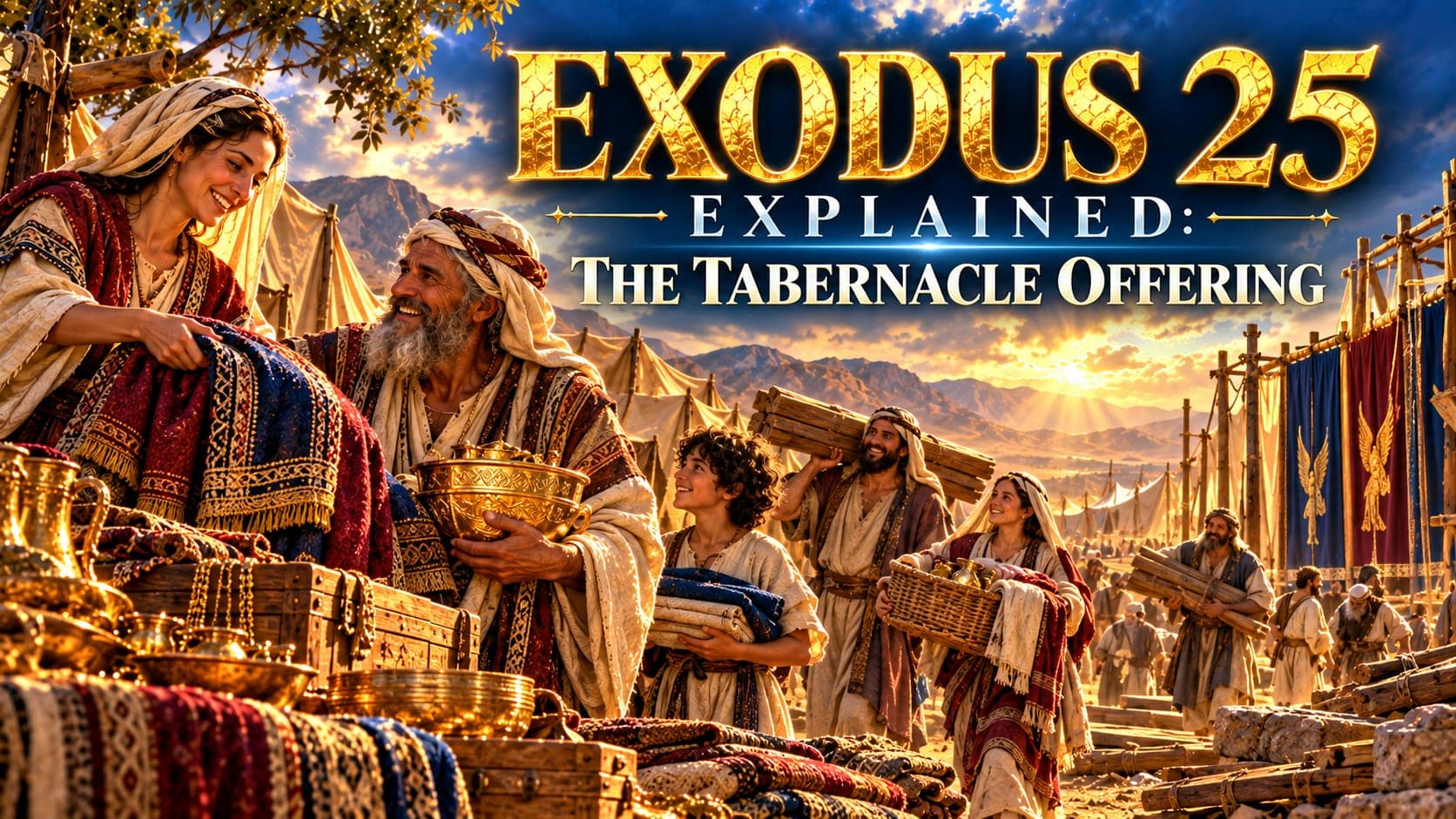
1. An Offering Nobody Is Forced to Give (verses 1 to 7)
God does not open with a tax. He opens with an invitation.
"And the LORD spake unto Moses, saying, Speak unto the children of Israel, that they bring me an offering: of every man that giveth it willingly with his heart ye shall take my offering."
📌 The word "willingly" is doing all the work in this verse. There is no quota here, no tribe assigned a number of shekels. Only Moses relaying what people are moved to bring, and God calling that gift His own the moment it leaves someone's hand.
"And this is the offering which ye shall take of them; gold, and silver, and brass, And blue, and purple, and scarlet, and fine linen, and goats' hair, And rams' skins dyed red, and badgers' skins, and shittim wood, Oil for the light, spices for anointing oil, and for sweet incense, Onyx stones, and stones to be set in the ephod, and in the breastplate."
💡 Shittim wood is acacia, a hard, rot resistant tree that actually grows in the deserts around Sinai, so this was not an imported luxury material. The "badgers' skins" are harder to pin down. Badgers never lived anywhere near this wilderness, and translators have long argued over what animal the Hebrew word actually names, with sea cow or porpoise hide suggested almost as often as badger. Scripture does not settle the question, so neither will this article.
What is not debated is where this gold and these dyed skins came from. Israel left Egypt with the jewelry of the very nation that had enslaved them.
"And the children of Israel did according to the word of Moses; and they borrowed of the Egyptians jewels of silver, and jewels of gold, and raiment: And the LORD gave the people favour in the sight of the Egyptians, so that they lent unto them such things as they required. And they spoiled the Egyptians."
📌 The gold in the tabernacle was Egyptian gold first. What Exodus 12 recorded as a strange, almost throwaway detail about borrowed jewelry turns out to be the raw material for the holiest object Israel will ever carry. Nothing in Exodus was wasted, including what looked like a minor negotiating footnote at the time.
2. The Reason for Everything That Follows (verses 8 and 9)
Before a single measurement is given, God states His purpose in one short line.
"And let them make me a sanctuary; that I may dwell among them."
📌 Nine words carry the whole reason the rest of Exodus looks the way it does. God does not ask for a sanctuary because He is confined to it, or because He needs a house the way people do. He asks for it so that He can dwell among the very people He just rescued, close enough that distance stops being the main fact of their relationship with Him.
"According to all that I shew thee, after the pattern of the tabernacle, and the pattern of all the instruments thereof, even so shall ye make it."
⚠️ Moses is not designing anything here. He is copying something he has been shown. The word "pattern" will come back at the very end of this chapter, framing everything in between as a replica, not an invention.
3. The Ark of the Covenant (verses 10 to 16)
The first object described is also the most important one in the whole tabernacle.
"And they shall make an ark of shittim wood: two cubits and a half shall be the length thereof, and a cubit and a half the breadth thereof, and a cubit and a half the height thereof."
💡 A cubit was roughly the length of a forearm, about eighteen inches. That puts this box at around four and a half feet long and about two and a half feet wide and tall. Small enough for a few men to carry. Important enough to be overlaid in pure gold, inside and out, with a crown of gold running around the top edge.
"And thou shalt cast four rings of gold for it, and put them in the four corners thereof; and two rings shall be in the one side of it, and two rings in the other side of it."
"And thou shalt make staves of shittim wood, and overlay them with gold. And thou shalt put the staves into the rings by the sides of the ark, that the ark may be borne with them."
📌 The ark was built to be carried, never to sit still. Four rings, two matching poles, gold plated like the box itself. Whatever this object was going to hold, God designed it from the start to travel with His people rather than wait for them somewhere fixed.
"And thou shalt put into the ark the testimony which I shall give thee."
"The testimony" here is the covenant God is about to write, the same tables of stone promised back in Exodus 24. This small gold box was built to hold the written terms of the relationship God had just sealed in blood.
4. The Mercy Seat and the Cherubim (verses 17 to 22)
The ark needed a lid. What God describes is far more than a lid.
"And thou shalt make a mercy seat of pure gold: two cubits and a half shall be the length thereof, and a cubit and a half the breadth thereof."
💡 The Hebrew word behind "mercy seat" shares its root with the word for atonement, the same root behind the Day of Atonement later called Yom Kippur. The name itself is already pointing forward to what this gold cover will be used for: the place where judgment and mercy meet over the exact spot where the broken covenant is kept.
"And thou shalt make two cherubims of gold, of beaten work shalt thou make them, in the two ends of the mercy seat."
"And the cherubims shall stretch forth their wings on high, covering the mercy seat with their wings, and their faces shall look one to another; toward the mercy seat shall the faces of the cherubims be."
⚠️ This is not the first time cherubim guard something holy in Scripture. After Adam and Eve were driven from Eden, Cherubim were stationed at the entrance so no one could casually walk back in.
"So he drove out the man; and he placed at the east of the garden of Eden Cherubims, and a flaming sword which turned every way, to keep the way of the tree of life."
Genesis 3 used cherubim to keep people out. Exodus 25 puts two of them, facing each other, over the exact place where God says He will meet with Moses. The same figures that once sealed off access to God's presence now frame the one spot where that access is being reopened.
"And there I will meet with thee, and I will commune with thee from above the mercy seat, from between the two cherubims which are upon the ark of the testimony, of all things which I will give thee in commandment unto the children of Israel."
📌 This single verse names the exact spot where God promises to speak. Not the whole tabernacle in general. One particular space, between two particular golden figures, above one particular gold lid. God is not vague about where He can be found.
5. The Table of Shewbread (verses 23 to 30)
From the ark, the instructions move to a much more ordinary piece of furniture: a table.
"Thou shalt also make a table of shittim wood: two cubits shall be the length thereof, and a cubit the breadth thereof, and a cubit and a half the height thereof."
"And thou shalt make the dishes thereof, and spoons thereof, and covers thereof, and bowls thereof, to cover withal: of pure gold shalt thou make them."
"And thou shalt set upon the table shewbread before me alway."
💡 "Shewbread" means bread of the presence, bread set out continually before God rather than offered once and gone. Later chapters fill in the details of how many loaves sat here and how often they were replaced. What Exodus 25 establishes first is simpler: there would always be bread on this table, every single day, with no gap where the table sat empty.
📌 God wanted a gold covered box for His covenant and a gold covered table for His bread, in the same room. Presence and provision, kept a few feet apart from each other, both described before anything else in the tabernacle gets built.
6. The Golden Candlestick (verses 31 to 40)
The chapter ends with the most detailed single object in it: a lampstand made of one solid piece of gold.
"And thou shalt make a candlestick of pure gold: of beaten work shall the candlestick be made: his shaft, and his branches, his bowls, his knops, and his flowers, shall be of the same."
"And six branches shall come out of the sides of it; three branches of the candlestick out of the one side, and three branches of the candlestick out of the other side:"
💡 Six branches, three on each side of a central shaft, every one of them hammered out of the same single block of gold rather than welded together from separate parts. "Beaten work" means a craftsman shaped this entire object by striking one piece of metal, branches and all, until it took its final form.
"Three bowls made like unto almonds, with a knop and a flower in one branch; and three bowls made like almonds in the other branch, with a knop and a flower: so in the six branches that come out of the candlestick."
⚠️ The decoration is not random. Every branch is shaped like a flowering almond tree, buds and blossoms worked into solid gold. Almond trees were known in that region for blooming earliest in the year, ahead of every other tree. Scripture does not explain why that specific tree was chosen here, so this is where the text stops and speculation would begin.
"And thou shalt make the seven lamps thereof: and they shall light the lamps thereof, that they may give light over against it."
One shaft and six branches add up to seven separate lamps, all lit at once, all cut from the same piece of gold they stand on.
"Of a talent of pure gold shall he make it, with all these vessels."
"And look that thou make them after their pattern, which was shewed thee in the mount."
📌 The chapter opens and closes on the same word. Verse 9 told Moses to build after the pattern he was shown. Verse 40 repeats the command almost exactly, closing the whole chapter the same way it opened. Nothing described here came from Moses' own imagination.

Hard Questions Exodus 25 Raises
Why does God command two gold cherubim here when the second commandment forbids graven images? The commandment given back in Exodus 20 forbids making an image of God Himself, or an image meant to be worshipped as a god. The cherubim are neither. They are not images of the LORD, and nothing in Exodus 25 treats them as objects of worship. They mark and frame the place where God meets with Moses, the same role cherubim already held guarding Eden in Genesis 3.
Where did people who had just escaped slavery get this much gold, silver, and dyed fabric in the middle of a wilderness? Exodus 12:35 and 36 already answered this before this chapter was even written. Israel left Egypt carrying jewelry borrowed from the Egyptians themselves, with God making the Egyptians willing to hand it over. The offering in Exodus 25 draws on wealth that had already left Egypt months earlier.
Is the mercy seat just a lid, or something more? It is shaped and sized to cover the ark exactly, so in one sense it functions as a lid. But its Hebrew name, its place between the two cherubim, and the promise in verse 22 that God will speak from above it, all point to something with its own identity and purpose, not a plain cover that happens to sit on top of a box.
Why give exact measurements for furniture almost no one outside the priesthood would ever see? The chapter never explains this directly, but the pattern language in verses 9 and 40 suggests the answer is not about human eyes at all. Moses is told to copy something he was shown, not to design something impressive for a crowd. The precision serves the pattern, not an audience.
Top Verses From Exodus 25
1. Exodus 25:8
"And let them make me a sanctuary; that I may dwell among them."
The purpose statement for the entire tabernacle, and for every chapter that follows this one through the rest of Exodus. God wants to be near His people, not just over them.
2. Exodus 25:22
"And there I will meet with thee, and I will commune with thee from above the mercy seat, from between the two cherubims which are upon the ark of the testimony, of all things which I will give thee in commandment unto the children of Israel."
A specific promise about a specific place. God names exactly where Moses can expect to hear from Him, rather than leaving that location vague.
3. Exodus 25:40
"And look that thou make them after their pattern, which was shewed thee in the mount."
The verse Hebrews 8:5 later quotes almost word for word, treating the whole tabernacle as a shadow of something greater that Moses was only shown a glimpse of.
4. Hebrews 9:4 and 5
"Which had the golden censer, and the ark of the covenant overlaid round about with gold, wherein was the golden pot that had manna, and Aaron's rod that budded, and the tables of the covenant; And over it the cherubims of glory shadowing the mercyseat; of which we cannot now speak particularly."
Centuries later, the ark Exodus 25 describes is still being discussed in detail, now holding more than just the tables of the covenant, and still too significant for the writer of Hebrews to fully unpack in one letter.
5. John 1:14
"And the Word was made flesh, and dwelt among us, (and we beheld his glory, the glory as of the only begotten of the Father,) full of grace and truth."
The same desire Exodus 25:8 states plainly, to dwell among His people, shows up again centuries later in a way no gold box could ever fully carry.

Frequently Asked Questions About Exodus 25
What is Exodus 25 about?
God asks Israel for a willing offering of gold, silver, fabric, and wood, then gives Moses the design for the ark of the covenant, the mercy seat with its two cherubim, the table of shewbread, and the golden candlestick, all to be built exactly after a pattern Moses was shown on the mountain.
What was the ark of the covenant used for?
Exodus 25:16 says it held "the testimony," the tables of the covenant God was about to give Moses. It also became the place where God promised to meet and speak with Moses, from above the mercy seat and between the two cherubim.
What does "mercy seat" mean?
It is the gold cover for the ark of the covenant. Its Hebrew name shares the same root as the word for atonement, the same root behind the Day of Atonement, pointing to its role as the place where God's presence and Israel's covenant met.
Why did the ark have cherubim if God forbids images?
The second commandment forbids images made to represent or worship God Himself. The cherubim on the ark are not images of God and were never treated as objects of worship. Cherubim already appear in Genesis 3:24 guarding the way to Eden, a role of marking and framing sacred space rather than depicting God.
What was inside the ark of the covenant?
Exodus 25:16 names only the testimony, the tables of the covenant. Hebrews 9:4 later describes the ark also holding a golden pot of manna and Aaron's rod that budded, items added to it at later points in Israel's history.
Where did the Israelites get gold for the tabernacle in the wilderness?
Exodus 12:35 and 36 records Israel borrowing jewels of gold and silver from the Egyptians before they left, with God making the Egyptians willing to give it. That wealth became the raw material for the offering described in Exodus 25.
What is shittim wood?
Acacia wood, a hard and rot resistant tree that grows naturally in the desert regions around Sinai. It was used for the ark, the table, and the staves that carried them, then covered in gold.
What was the shewbread?
Bread kept continually on the gold table described in Exodus 25:23 to 30, set "before me alway" according to verse 30, so that God's presence in the tabernacle was always paired with bread, not just law and sacrifice.
Why did the golden candlestick have almond blossoms on it?
Exodus 25:33 and 34 describe bowls shaped like almonds with knops and flowers worked into the branches. Scripture does not explain the specific choice of almond blossoms, so the detail is best read as part of the pattern Moses was shown rather than something the text itself interprets.
What does "according to the pattern" mean in Exodus 25?
Verses 9 and 40 both tell Moses to build everything exactly as he was shown on the mountain. Hebrews 8:5 later quotes this directly, describing the whole tabernacle as a copy of something greater, not a design Moses invented himself.
Why does Exodus spend so many chapters on tabernacle furniture?
Exodus 25:8 gives the reason in one line: so that God could dwell among His people. The detail is not about architecture for its own sake. It is about how seriously God takes the practical question of where and how He will be present with the people He just rescued.
Final Thoughts
Exodus 25 can read like a materials list. Read slowly, it is closer to a love letter in blueprint form.
📌 God wanted a willing gift, not a required one. Every gold ring and dyed curtain in this chapter started as something someone chose to let go of, not something they were taxed into surrendering.
📌 Every object answers verse 8. The ark, the mercy seat, the table, the candlestick, all of it exists so that God can dwell among His people, close enough that distance is no longer the main fact between them.
📌 None of it was Moses' own design. Twice in one chapter he is told to build after the pattern he was shown, a detail Hebrews later uses to call the whole tabernacle a shadow of something still to come.
You will probably never build a gold covered box or hammer a lampstand out of a single piece of metal.
But you can ask the same question this chapter asks of Israel: what are you willing to give, right now, not because you were told to, but because you want God close.