📖 Exodus 24 Explained: Sealing the Covenant in Blood
The law has been given. Now it has to be signed.
Exodus 24 explained is the chapter where Israel stops only hearing God's word and starts under it, sealed by blood thrown on an altar and sprinkled on a whole nation. Seventy elders climb partway up a mountain and see something no crowd had ever been allowed to see. Then Moses keeps climbing, alone, into a cloud that swallows him for forty days.
Maybe you have read past this chapter on your way to the tabernacle instructions that follow it.
- ❓ Why does a covenant need blood thrown on it at all?
- ❓ How did the elders see God and not die on the spot?
- ❓ Why does Moses write the law down in verse 4 and then go get stone tables in verse 12?
- ❓ And why forty days, exactly?
📌 Exodus 24 is the hinge between hearing God's law and belonging to God's covenant, and the hinge turns on blood, a meal, and a mountain nobody is allowed to climb all the way.
This walkthrough goes through the whole chapter in order: the tiered invitation up the mountain, the people's second yes, the blood that ratifies the covenant, the vision of God the elders are given, and the forty days Moses spends in the cloud above them.
Short chapter. Eighteen verses. More packed into them than almost anything else in Exodus.
What Happened Just Before This Chapter
Exodus 23 closed out the case law that began back in Exodus 21, ending on a long promise about the Angel who would lead Israel into Canaan and a warning not to make any covenant with the nations already living there.
Exodus 24 picks up with that same body of law, the Ten Commandments plus the case law of chapters 21 through 23, now needing a response. God has spoken. Moses has relayed it. What happens next is the moment Israel either walks into this covenant or walks away from it, and the chapter answers that question with blood, a meal, and a mountain.

Exodus 24 Explained Verse by Verse
1. Called Up the Mountain, But Not All the Way (verses 1 and 2)
The chapter opens with an invitation that is really a set of boundaries.
"And he said unto Moses, Come up unto the LORD, thou, and Aaron, Nadab, and Abihu, and seventy of the elders of Israel; and worship ye afar off."
"And Moses alone shall come near the LORD: but they shall not come nigh; neither shall the people go up with him."
⚠️ Three different distances are set in two verses. The people stay at the foot of the mountain. Aaron, his two sons Nadab and Abihu, and seventy elders go partway up and worship from there, afar off. Moses alone comes near. Nobody gets to choose their own distance here, and the chapter does not explain why these names were picked over others. It simply states the order and moves on.
📌 Nadab and Abihu are named here for the first time in Scripture, and it will not be the last. These same two men show up again in Leviticus 10, where their own careless approach to God's presence costs them their lives. Nothing in Exodus 24 faults them. The text simply lists who was invited. What they do with access later is a different story entirely.
2. The People Say Yes a Second Time (verse 3)
Before any blood is involved, Moses comes back down and reports in full.
"And Moses came and told the people all the words of the LORD, and all the judgments: and all the people answered with one voice, and said, All the words which the LORD hath said will we do."
💡 This is the second time Israel says yes to the same covenant. Exodus 19 already recorded the people answering with one voice before the Ten Commandments were even spoken. Now, with the commandments and the case law both delivered, they say it again, "the words" being the Ten Commandments and "the judgments" being the rulings that filled chapters 21 through 23. A single yes at the start would have been easy to say without fully understanding what it cost. Saying it again, after hearing the specifics, carries more weight.
3. An Altar, Twelve Pillars, and the Blood of the Covenant (verses 4 to 8)
Agreement in words is not where this covenant gets sealed. That happens next, in blood.
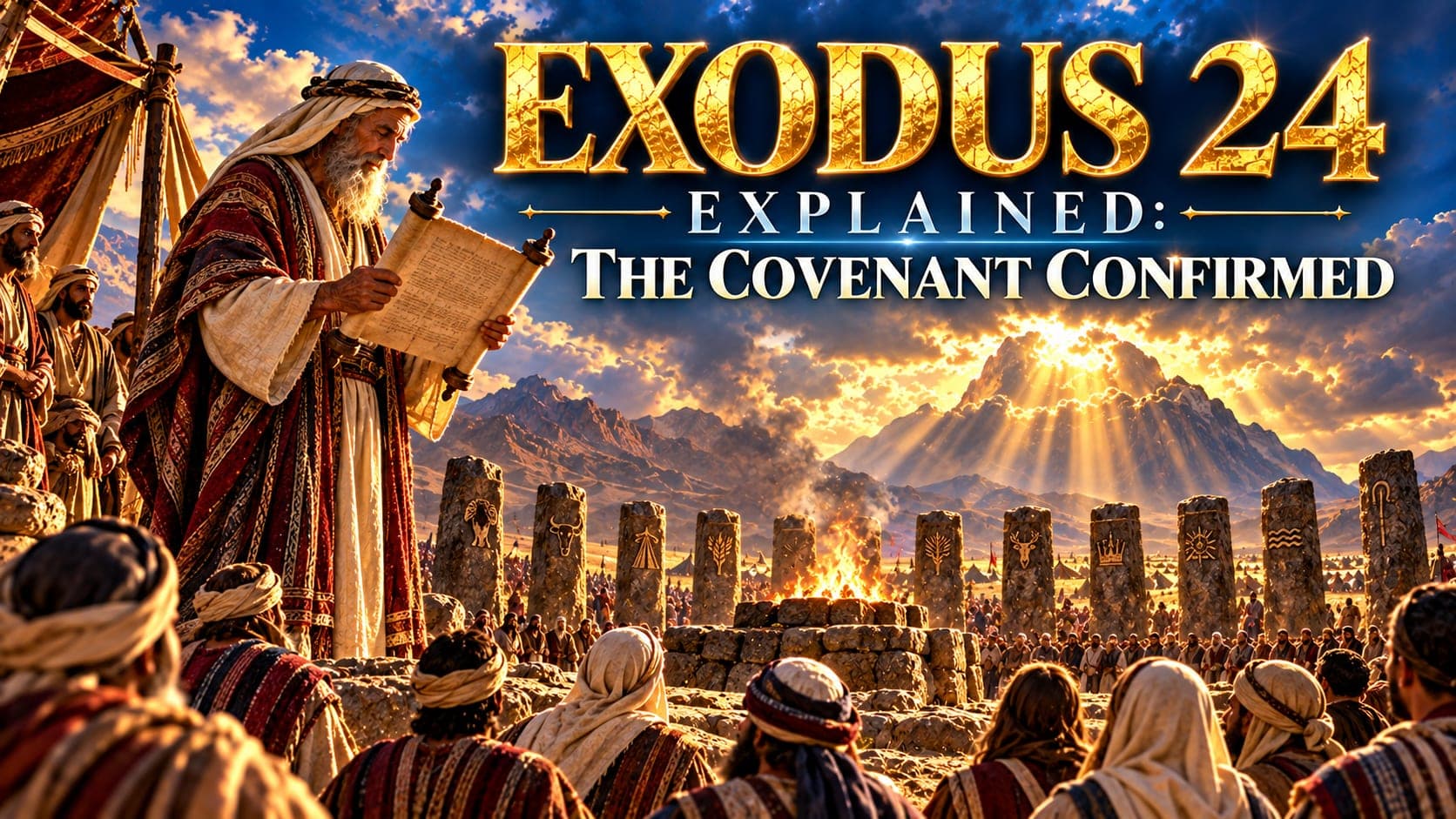
"And Moses wrote all the words of the LORD, and rose up early in the morning, and builded an altar under the hill, and twelve pillars, according to the twelve tribes of Israel."
💡 Moses writes something down here, and it matters what. This is not yet the tables of stone. It is Moses' own record of the Ten Commandments and the case law just given, the same body of instruction the next verse calls the book of the covenant. The twelve pillars standing beside the altar put each of Israel's twelve tribes physically present at their own covenant, whether every individual Israelite could see the mountain or not.
"And he sent young men of the children of Israel, which offered burnt offerings, and sacrificed peace offerings of oxen unto the LORD."
"And Moses took half of the blood, and put it in basons; and half of the blood he sprinkled on the altar."
📌 Splitting the blood in half is the whole point. Half goes on the altar, representing God's side of the agreement. The other half waits in basins for what comes next. Ancient covenants between two parties were often sealed this way, the same blood touching both sides to bind them together. This was not Israel inventing a ritual. It was Israel entering a covenant the way covenants were actually made.
"And he took the book of the covenant, and read in the audience of the people: and they said, All that the LORD hath said will we do, and be obedient."
💡 This is the first time Scripture uses the exact phrase "the book of the covenant," naming out loud the written record of everything from the Ten Commandments through the case law on servants, restitution, and the stranger. The people's answer grows too. The first yes in verse 3 said they would do it. This yes adds a second word: obedient.
"And Moses took the blood, and sprinkled it on the people, and said, Behold the blood of the covenant, which the LORD hath made with you concerning all these words."
📌 The second half of the blood lands on the people themselves. Centuries later, at the Last Supper, Jesus takes the cup and calls it "my blood of the new testament" in Matthew 26:28, the same Greek word behind both "testament" and "covenant" that Moses uses here. He is not choosing random language. He is pointing straight back to this moment at Sinai, where a covenant was first sealed this same way, and announcing that His own blood now does for a new covenant what this blood did for the old one.
4. They Saw the God of Israel (verses 9 to 11)
With the covenant sealed, the seventy elders finally go up to the distance they were given.
"Then went up Moses, and Aaron, Nadab, and Abihu, and seventy of the elders of Israel:"
"And they saw the God of Israel: and there was under his feet as it were a paved work of a sapphire stone, and as it were the body of heaven in his clearness."
⚠️ Notice how carefully this verse is worded. It does not describe God's face or form. It describes what was under His feet, a pavement like clear sapphire, as blue and open as the sky itself. Scripture is reaching for a way to describe something it will not fully describe, giving the elders, and the reader, an edge of the vision rather than the whole of it.
"And upon the nobles of the children of Israel he laid not his hand: also they saw God, and did eat and drink."
📌 They saw God, and instead of dying, they ate a meal. Sharing food after sealing a covenant was the ordinary way ancient treaties were confirmed, both sides eating together as proof the agreement was real. Here it carries even more weight. The God who had just been sealed to Israel by blood now sits, in effect, at the same table with the people He bound Himself to.
5. Moses Called Higher Still (verses 12 to 14)
The covenant meal ends, and Moses alone is called even further up than before.
"And the LORD said unto Moses, Come up to me into the mount, and be there: and I will give thee tables of stone, and a law, and commandments which I have written; that thou mayest teach them."
💡 This is a different document than the one Moses wrote in verse 4. That was Moses recording what God had already spoken. These tables of stone are something God Himself writes, carried down the mountain later for Israel to keep. The book of the covenant and the tables of stone are not the same object told twice. They are two separate steps in how the covenant gets permanently recorded.
"And Moses rose up, and his minister Joshua: and Moses went up into the mount of God."
"And he said unto the elders, Tarry ye here for us, until we come again unto you: and, behold, Aaron and Hur are with you: if any man have any matters to do, let him come unto them."
📌 Moses does not leave the camp without leadership. Joshua goes with him part of the way, the same Joshua who will eventually lead Israel into the promised land. Aaron and Hur stay behind in charge, the same pair who once held up Moses' own hands during the battle with Amalek. Whatever disputes come up while Moses is gone, the elders know exactly who to bring them to.
6. The Cloud, the Fire, and Forty Days (verses 15 to 18)
The chapter ends with Moses disappearing into something no one below can follow him into.
"And Moses went up into the mount, and a cloud covered the mount."
"And the glory of the LORD abode upon mount Sinai, and the cloud covered it six days: and the seventh day he called unto Moses out of the midst of the cloud."
💡 Moses waits six full days before God even calls him in. The cloud alone, without a voice yet, covers the mountain for nearly a week. Only on the seventh day does God call him into it. Even the man who had just eaten in God's presence does not get to rush his own access.
"And the sight of the glory of the LORD was like devouring fire on the top of the mount in the eyes of the children of Israel."
⚠️ From below, the people watching see something closer to a wildfire than a cloud, fire that devours whatever it touches, sitting on top of the mountain for nearly six weeks straight. There is nothing gentle about the image Scripture chooses here.
"And Moses went into the midst of the cloud, and gat him up into the mount: and Moses was in the mount forty days and forty nights."
📌 Forty days and nights shows up again and again in Scripture, and never by accident. The flood lasted forty days. Israel's unbelief over the promised land cost them forty years in the wilderness. Jesus fasts forty days before His own temptation in Matthew 4. Scripture keeps reaching for the same number whenever something has to be tested, prepared, or set apart before it is ready. Moses on this mountain is the pattern many of those later moments are measured against.

Hard Questions Exodus 24 Raises
How did the elders see God and live, when Exodus 33:20 says no one can see God's face and live? The two passages are not describing the same thing. Exodus 24:10 carefully describes what was under God's feet, not His face or full glory, and later Scripture consistently treats seeing God's unveiled glory as fatal while treating a limited, granted vision of His presence as survivable. The elders were given exactly as much as they could bear, no more.
Why does Moses write the words of the Lord down in verse 4, and then go get tables of stone from God in verse 12? These are two different records. Verse 4 is Moses writing down what God had already spoken through him, the Ten Commandments and the case law of chapters 21 through 23, later called the book of the covenant. Verses 12 onward describe tables of stone that God Himself writes, a separate, permanent copy Moses receives directly rather than transcribes.
Why does a covenant need blood at all? In the ancient world, a covenant between two parties was not considered binding on words alone. Blood, from a sacrificed animal, marked the agreement as a matter of life and death rather than a casual promise. Hebrews 9:18 to 20 points directly back to this chapter to make the same point: without blood, this covenant, like the one that follows it, was never ratified.
Were Nadab and Abihu already unfit to be invited up the mountain in verse 1? The text gives no hint of that here. They are named simply as Aaron's sons, included among the leaders summoned up. Their failure in Leviticus 10, offering fire God had not commanded, happens later and is judged on its own terms. Exodus 24 does not read backward from that event to question their presence here.
Why does God make Moses wait six days before calling him into the cloud? The chapter does not explain the delay directly, but the pattern fits everything else in it. Access to God here is consistently graduated: the people at the base, the elders partway up, Moses near, and even Moses himself waiting on God's timing rather than his own before going further in.
Top Verses From Exodus 24
1. Exodus 24:8
"And Moses took the blood, and sprinkled it on the people, and said, Behold the blood of the covenant, which the LORD hath made with you concerning all these words."
The same covenant sealing language Jesus reaches for over the cup at the Last Supper, pointing straight back to this moment while announcing that His own blood now ratifies a new covenant.
2. Exodus 24:7
"And he took the book of the covenant, and read in the audience of the people: and they said, All that the LORD hath said will we do, and be obedient."
The first time Scripture names "the book of the covenant" outright, and the moment Israel's yes grows from doing to doing and obeying.
3. Exodus 24:10
"And they saw the God of Israel: and there was under his feet as it were a paved work of a sapphire stone, and as it were the body of heaven in his clearness."
One of the most restrained descriptions of a vision of God anywhere in Scripture, giving an edge of glory without claiming to capture the whole of it.
4. Exodus 24:12
"And the LORD said unto Moses, Come up to me into the mount, and be there: and I will give thee tables of stone, and a law, and commandments which I have written; that thou mayest teach them."
The call up to a second, higher level of the mountain, and the first mention of the stone tables Moses will carry down later in Exodus.
5. Exodus 24:18
"And Moses went into the midst of the cloud, and gat him up into the mount: and Moses was in the mount forty days and forty nights."
The same forty days Scripture keeps returning to, from the flood to Israel's wilderness years to Jesus' own fast, each one a season of testing before something is ready.
Frequently Asked Questions About Exodus 24
What happens in Exodus 24?
Moses, Aaron, Nadab, Abihu, and seventy elders are called partway up Mount Sinai while the people stay below. Moses builds an altar, offers sacrifices, and seals the covenant by splitting the blood between the altar and the people. The elders then see a vision of God and eat a covenant meal, after which Moses alone goes further up the mountain and stays in a cloud for forty days and forty nights.
What is the book of the covenant in Exodus 24?
It is Moses' written record of the Ten Commandments and the case law given in Exodus 21 through 23, read aloud to the people in verse 7 right before the blood of the covenant is sprinkled on them.
What does the blood of the covenant mean?
It refers to the blood from the peace offerings in Exodus 24:5 and 6, split in half and used to seal the agreement between God and Israel, half on the altar and half sprinkled on the people themselves.
How does Exodus 24 connect to the Lord's Supper?
Jesus calls the cup "my blood of the new testament" in Matthew 26:28, the same word Moses uses for "covenant" in Exodus 24:8, directly linking His own sacrifice to the covenant sealed at Sinai.
Did Israel's elders really see God?
Exodus 24:10 and 11 say plainly that they did, describing what was under His feet rather than His full glory or face, and the nobles were not harmed. The text treats this as a real, granted vision rather than a figure of speech.
Who were Nadab and Abihu?
Aaron's two oldest sons, named here among the leaders called up the mountain. They later die in Leviticus 10 after offering fire God had not commanded, a separate event this chapter does not foreshadow or explain.
Why did Moses stay on the mountain for forty days?
Exodus 24:18 states the length without fully explaining it, but the number forty recurs throughout Scripture at moments of testing or preparation, including the flood, Israel's years in the wilderness, and Jesus' own forty day fast.
Who was Hur, mentioned in Exodus 24:14?
The same man who helped Aaron hold up Moses' hands during the battle with Amalek in Exodus 17. Here he is left in charge of the camp alongside Aaron while Moses is on the mountain.
What is the difference between the book of the covenant and the tables of stone?
The book of the covenant in verse 7 is Moses' own written record of what God had already spoken. The tables of stone in verse 12 are a separate document, written by God Himself and given to Moses later in the chapters that follow.
How does Exodus 24 connect to the rest of the Bible?
Hebrews 9:18 to 20 points back to this chapter to explain why a covenant required blood, and Matthew 26:28 echoes Moses' own words over the cup at the Last Supper, tying the blood of Sinai directly to the blood of the cross.
Final Thoughts
Exodus 24 is short, but almost every verse in it is doing real work.
📌 Access to God here is never flat. The people stay at the base, the elders go partway, Moses goes near, and Moses alone goes further still, waiting even then for God's own timing before the cloud opens to him.
📌 A covenant said with words still had to be sealed with blood. Israel said yes twice before any blood touched them, and neither yes alone was treated as enough to bind the agreement. The sprinkled blood is what made it final, the same covenant language Jesus later reaches for over the cup to describe what His own blood would do.
📌 The vision and the waiting both matter. The elders are given a real, limited glimpse of God and a shared meal in His presence. Moses is given far more access and far more waiting, six days of silence before God even calls him by name into the cloud.
You probably will not see a paved sapphire floor this week, and you will not wait forty days on a mountain either.
But you have made promises to God before, the way Israel did twice in this chapter. Go back to one of them today, and ask whether your life has actually been sealed to it, or only spoken.